Shelves at Recycled Books Denton – photo by the author
If I could travel back in time, I’d tell my childhood self that one day I would have enough disposable income to purchase any book I desired. When I was in elementary school, I loved thumbing through the book fair flyers, circling the books I couldn’t live without. And the day the orders arrived I couldn’t wait to bring them home.
I had a library card, but those books were only visitors to my shelves. The loaned books I had to handle with care so I could return them in the same state as they were when borrowed. I couldn’t read them again and again, until the spines cracked and pages fell from the bindings.
Now I love collecting books. Recently I went with my friend Cathy to Denton, a nearby city with three lovely bookstores on the town square. All within walking distance of each other, providing you stop by your car and unload the heavy purchases before venturing to the next stop. First on our agenda was Recycled Books – a three story treasure house of used books.
Recycled Books Records CD’s in Denton, Texas – photo by the authorThe horror section at Recycled Books – photo by the author
Our second stop was at Denton’s newest bookstore – The Plot Twist. This shop is a cozy stop just off the square. They are a combination book store and bar, so you can unwind with a glass of wine while you browse the books. The Plot Twist is a romance bookstore so I was skeptical about whether I, a horror writer and reader, would find something. But I am also a fan of anything paranormal or witchy so I left with three books. I don’t think I’ve ever left any bookstore without buying a book or two or three or four.
The Plot Twist in Denton, Texas – photo by the author
Around the corner we found Patchouli Joe’s Books and Indulgences. Not only did I find a book or two, but because I signed up for their free newsletter during my birthday month, I received a free bar of their scented soap. (Part of the indulgences for sale in the shop.) I would have subscribed without the soap, but it was a nice reward.
Patchouli Joe’s bookstore in Denton, Texas – photo by the authorBooks at Patchouli Joe’s – photo by the author
No matter the size of the store, I can spend hours searching for the perfect books. It’s not so much the hunt as it is the desire to linger in the safe space. Libraries and book stores serve as doors to different worlds. There, I can travel safely no matter what horrors the outside world contains. I can exchange battling dragons, evading zombies, and conspiring with witches for worrying over whether National Parks, Social Security, and basic human decency will continue to exist.
The books I purchased – photo by the author
I own what some might describe as a book hoard but I have named the ever-growing piles of unread tomes “my library.” Never mind that said library has spilled out of my office, into the living room, onto the floor of my bedroom, and occasionally can be found on the dining room table. The simple solution would be to stop buying books until I’ve read them all, but there is something so comforting about the stacks. The world outside is dangerous, but inside my home I have a fortress of books.
Not the life she imagined but the life made for her
Mannequin in a Wichita Falls antique store – Photo by the author
Andrew and I have recently taken on the task of clearing out his mother’s storage unit. Roby no longer has need or use for the cartons of fine china, boxes of shoes and purses, racks of designer clothing, or bags of vintage dresses. Over the past four years we’ve managed to sell off or donate most of the bulkier items – the dressers and chairs, the dining room table. There’s still a lot left. Enough to fill a small U-Haul. Our goal is to move enough of it out that we can set up a lower priced, smaller unit close to our house and save her the expense of renting the space.
Until then, we’ve turned our living room into a sort of staging area, bringing over car loads of clothing and sorting through it for anything that might be worth selling. We discovered that Roby’s collection of vintage 1970s to 1980s Diane Freis dresses have become popular again. Imagine the sort of outfits worn by the actresses on the set of Dynasty, Designing Women, or Dallas. Think shoulder pads, wild colors, and lots and lots of polyester. To better display these dresses, I ordered a mannequin on Amazon. Andrew named her Molly Mannequin, but I call her Dolly.
Molly Dolly wearing a Diane Freis 100% Silk dress – Photo by the author
Dolly is easy to dress – pop off her head, slip her arms out of their sockets, and drape the dress over her torso. The first set of photos we put up on Ebay featured her smooth, bald head. Andrew suggested she wear a hat, but I didn’t have one that matched the outfits. Except for this one.
Dolly – Photo by the author
The hat, in my opinion, gave her a confused, wistful look. As though she couldn’t believe she had landed here.
Dolly – Photo by the author
In the second box of clothing we discovered an acrylic wig. This was better, it gave Dolly a more life-like appearance. The wig had seen better days. It also looked like it had seen some really bad days. Frizzled strands stuck up across the surface of the artificial hair, giving Dolly an urchin look. It fit, however, with the bohemian vibe of many of the dresses. I remembered a trick recommended to smooth out the fake tresses on dolls and I soaked Dolly’s hairpiece in fabric softener. It worked, but she still didn’t seem happy, despite having smooth locks.
Dolly in a sequined Diane Freis dress – Photo by the author
Something about the racks of frilly clothing and the dressing and undressing of Dolly felt familiar. The clothes were unlike anything I would choose to wear. My wardrobe is made of t-shirts with catchy slogans and sweatpants with elastic waistbands. In another life, however, I could imagine strolling through a garden party or dancing under disco lights. Maybe plotting my revenge on J.R. Ewing or Blake Carrington.
Dolly – Photo by the author
Flipping through the rack, the soft ruffled skirts brushing against my hands – I couldn’t help but smile at some of the whimsical patterns. How fun it would be to dress in one of these. I understood the attraction, the desire to own them all. At last I realized why this felt so familiar. Hadn’t I done the same thing as a young girl?
The cat arrived courtesy of Fedex delivery. This newest addition to our household was meant as a companion for my mother-in-law, Roby. She has dementia, and the robotic cat was designed to bring comfort to folks who would benefit from having a pet but who also no longer have the ability to care for one.
Kitty – Photo by the author
My husband Andrew and I had seen the description and photos of the cat, but nothing came close to preparing me for the unboxing. When I pulled back the last flap of cardboard, it revealed a creature not quite life-like, but also not quite resembling the toy we thought we had ordered. I lifted him from the box and set him on our dining room table. Not exactly the best place for a cat to perch, but this one wouldn’t shed or leave bits of litter scattered across the placemats.
Roby gathered him up, christened him “Kitty” and placed him on the dresser beside her bed.
Kitty – Photo by the author
The term “Uncanny Valley” was coined to describe the eerie feeling we get when something appears too close to human. Kitty in no way resembled a person, but he did share that characteristic of being too close to a living thing. In a dim light, from across the room, he reminded me of Church, the reanimated cat from the Stephen King novel, Pet Sematary. I know Kitty isn’t real, but I wonder if he might attempt to murder me in my sleep some night.
Kitty on his pillow
When Roby brushes his fur or pets his little mechanical head, Kitty unleashes a loud purr that sounds like gravel rolling in a tin can. If you rub him long enough, this noise is followed by his turning over for belly rubs. You can hear the gears grinding as he lifts a paw and rotates. His meow doesn’t sound exactly feline. Instead, the noise Kitty produces resembles the cry of a serial killer trying to lure us with an unsuccessful cat imitation.
Life with someone suffering from dementia has its challenges, but up until several months ago we had dodged one of the most difficult. Roby had never tried to wander from our home. Then, one evening while I was in a book club Zoom meeting, I heard the distinct click of someone unlocking our front door. I glanced out the window beside my desk in time to view my mother-in-law striding from our porch and toward the street. She didn’t seem confused about the journey – she moved like someone with an agenda.
“I’ve got to go,” I told the book club.
Outside, I rushed to get in front of Roby. “Hey, where are you headed?”
She gave me a suspicious squint and replied, “Anyplace but here.”
At that moment I couldn’t have agreed with her more. I imagined the neighbors watching and wondering why we had tossed our elderly parent out the door.
“You need to go back inside. It’s not safe out here.” If I thought a reasonable request would do the trick I was soon proven wrong. Roby tried to dodge around me. I threw up my arms and waved as I swayed back and forth like someone trying to divert a bear attack. This wouldn’t work for long. Although I outweighed her by at least seventy pounds, I couldn’t imagine picking up my five foot two mother-in-law and toting her back inside. Almost certainly there would be kicking and screaming, possibly from both of us. It was still daylight, the better to give everyone a good view of the tussle.
“I’m leaving and I’m not coming back,” she said.
By this time we had made it halfway down the drive. I considered letting her go. I could follow along behind her and pretend we were out for a nice stroll. My husband, her son Andrew, would be home soon. Perhaps he could pick us up if we made it to the interstate. Then I remembered the cat. “If you leave, Kitty will miss you.”
Roby frowned, but she stopped trying to get past me. She seemed to be trying to work out the connection between me, Kitty, and the awful place she had abandoned. We stood there, at an impasse. I decided to try going back inside. Maybe Roby would follow me, to make sure I didn’t bother the cat.
I made it to the front door. Roby didn’t move from her position at the end of the drive. She glanced back and forth between the sidewalk to freedom and the house. More encouragement was needed to lure her back inside. I went to her room and brought out Kitty.
“Here he is.” I held the cat by the scruff of its neck – no easy feat considering the creature was not soft and pliable but was instead polyester fur over a metal frame. Opening the lid to our plastic garbage bin, I said, “If you leave, Kitty goes in the trash!” This was an empty threat. At worst we’d sell him on Ebay. I shook the cat, and Kitty, interpreting this as a petting, began to meow and purr. Before he could twist in an attempt to roll over for belly rubs, I backed into the house. Roby, all thoughts of freedom now vanished, advanced on us like General Sherman marching on Atlanta. I dumped the cat on the dining room table and hid behind my office door until I was sure Roby was safe inside.
While Roby picked up Kitty and consoled him on his near brush with extinction, I locked and deadbolted the front door. My mother-in-law carried the cat back to his perch, and she settled on her bed beside him.
Roby hasn’t tried to leave since that day. Maybe her concern for Kitty keeps her grounded, or maybe she doesn’t remember what stirred her to escape. Thankfully, she forgot my part in the encounter. However, every time I see the cat I feel like I must apologize to him for my rough treatment. I know Kitty’s reactions are not governed by emotion – instead they are limited to his battery power. He isn’t a living animal, but in the dim light of the uncanny valley all it takes to make something real is our belief that it is.
I’m sharing a little story that I originally posted on Medium a couple of years ago. It’s a cautionary tale about having too much curiosity about the presents under the tree. Merry Christmas and Happy Holidays!
Do not Open Until
They were the ugliest ornaments he’d ever seen. “Are these supposed to be nutcrackers?” Adam held up one of the little carved wooden soldiers. Instead of the bright red of the traditional nutcracker, this one had a coat painted a dull maroon, the shade of an old scab. A scraggly beard adorned his face, as though the fellow had been on the run, without time to shave.
“They’re Santa’s soldiers.” Luanne, Adam’s girlfriend, grabbed hold of his wrist and scooped the figurine from his grasp. “This one’s Tom Toss. See, he has a little spear.
The soldier carried a long stick with a sharpened metal point. The glow from the living room fireplace glinted off the tip of the weapon. Too sharp, Adam thought, for something that children might handle.
“Santa’s soldiers?”
“Yes,” Luanne answered, “they guard the tree on Christmas Eve, to make sure no one snoops at the presents.” She gave him a pointed look, as though she suspected he’d be down here in the deep night, shaking boxes and disrupting the wrapping paper.
“A Christmas tradition, then.” Adam chuckled, hoping his laughter would cover up the disgust he felt looking at the ornaments. There were three more in the gold-foiled box. The remaining figures rested on a cushion of cotton, white like snow. Like the one with the spear, they all wore tall black hats and held their wooden arms stiffly at their sides. Luanne hung Tom Toss on the tree, then handed the box to Adam.
“I’ve had this one since I was a child. My grandmother gave him to me.” She lifted a chunky, round-bellied soldier to the Christmas tree. He carried a sledge hammer tucked under his arm. His coat was colored a mottled green, like camouflage. “Adam, meet Knockabout,” Luanne said.
“And this one?” Adam leaned over the box and brushed his finger across the face of a figure dressed in yellow. Unlike its square-jawed companions, this one had a pointed chin. The mouth gaped open, displaying rows of sharp teeth. “Ow!” Adam drew back his hand. A drop of blood welled up on his fingertip.
“Careful, that one’s Biter.” Luanne laughed. “And this one’s my favorite. He’s Pow Pow Boy.” This toy soldier was shorter than the others. His face, with its pug-nose and dots of paint to resemble freckles, resembled Luanne’s. A pair of boxing gloves covered his fists.
Adam, squeezing his injured finger, studied the tree as Luanne finished decorating. The four soldiers, posted at different points among the branches, glared from amongst the twinkling lights and silver garland.
“Remember, no peeking!” Luanne shook her finger at him. She wore a smile, but the past year of experience with the woman had taught Adam this was only the appearance of joviality. His girlfriend was dead serious about the snooping.
“Scouts honor, I’ll be nowhere near the tree tonight.” He wondered what she’d gotten him. Nothing too fancy, he hoped. Adam’s present to his girlfriend was a bottle of her favorite perfume and a gift card to the neighborhood coffee shop.
Luanne had carefully organized their Christmas celebration. Ice skating, caroling, shopping, viewing holiday lights—the whole parade of holiday events. She kept a calendar, with specific dates blocked out for each activity. The whole thing felt more like a ritual than the spontaneous enjoyment of the season.
At last they settled here, presents wrapped and fireplace blazing, in her family’s cabin. Tomorrow, Christmas Day, the rest of the clan would arrive. Luanne insisted they wait until Christmas Eve to set up the tree. On the way here, they’d driven to four different lots until they found a specimen Luanne deemed acceptable. “It has to be a Douglas Fir,” she said. “That’s what we always have.”
The sap that oozed from the cut trunk reminded Adam of bodily fluids. He considered it gruesome that this tree had only recently been a living thing, and now it was stuck here, festooned with gaudy tinsel and baubles. Like hanging ornaments on a corpse.
“Here’s to our first Christmas together.” Luanne lifted her glass of mulled wine in a toast.
Adam clinked his glass against hers. “Cheers,” he said. The first and the last, he thought. Adam planned to break up with her after Christmas, once a suitable amount of time had passed. Only an asshole would dump someone during the holidays. There was Valentine’s Day coming up in February, so he’d better make a clean split in early January.
An unfamiliar noise woke Adam in the middle of the night. Luanne dozed beside him, her arm flung out on top of the covers, her lips puffing out with each soft breath. He eased from the bed and listened for the sound. He heard it again, from the living room, a rustle and tap as though someone were knocking on the window.
Easing from the bed, he crept out of the room. They’d left the lights on the tree plugged in, and the living room lit up in flashes of red, blue, green. Outside, the wind buffeted the shrubbery lined across the front of the cabin. Adam peered out the window, his breath misting the cold glass. A branch skittered against the window, and Adam muttered, “That must have been it,” as he rubbed his palm to clear his view of the front porch.
A dark form lifted from the pines at the edge of the clearing. It floated over the cabin, the moonlight casting an ink-stain shadow on the snow. Adam started, before deciding the dark thing was an owl, hunting for dinner. He stepped back, forgetting the tree and the presents behind him.
One foot knocked over a stack of gifts wrapped in red and white striped paper, and as he bent to grab the pile, he elbowed the tree. The ornaments jingled and one of the nutcracker soldiers fell to the hardwood floor with a clack. This would have been bad enough, but Adam, unbalanced, stepped on the little figure.
“Oh! Crap!” He picked up the soldier and hung it back on the tree. The figure’s arm, the one securing the hammer, lay broken next to a package wrapped in green paper dotted with penguins. Had he been wearing shoes, the damage would have been worse. In the morning he’d confess to Luanne and offer to glue the arm back in place.
“I’m sorry, Knockabout,” Adam whispered. “We’ll have you right as rain soon.”
As he rearranged the gifts under the tree, he tried to remember the exact placement of each box. Maybe if he put them all back like they were before, Luanne wouldn’t notice the broken arm until later. He could blame her little brother, or maybe they’d bring the family dog, always a convenient scapegoat.
The last box was covered in white paper with glitter stars. The tag read “To Adam, From Luanne.” After he listened to make sure his girlfriend still slept, he picked up the box and shook it. Something shifted lightly inside. It was slightly larger than a paperback book, long and thin. Maybe it held the Patek Philippe watch he’d been lusting after. Adam felt a brief pang of guilt. If it was the watch, he’d have to stick around through Valentine’s Day at least. He tucked the package back under the tree.
Thirsty, he stopped in the kitchen for a quick drink before climbing back into bed. He was standing at the sink, a tumbler of water lifted to his mouth, when he felt a sharp stab on his ankle.
“Hey!” Adam shook his foot. A tiny mark, like a pinprick, leaked a bit of red down the side of his foot. Something small and dark scurried behind the kitchen door. A rat? He grabbed the door and flung it closed. Tom Toss, the toy soldier with the spear, stood there, only this time he wasn’t carrying the weapon.
“What the…!” Adam jumped. The soldier dashed past him, back to the living room. Adam turned to follow – certain he hallucinated the image. It had to be a rat, one that ran around on two legs. He’d check the tree, make sure all the ornaments were still there.
Adam made it halfway across the living room floor when Biter latched onto his calf. With a scream, Adam beat at the nutcracker until it fell away, tearing off a chunk of flesh as it went. Panting, Adam limped toward the bedroom. He’d lock himself inside, away from these monsters.
When he started down the hallway, a tall shadow rose to block the path. It was the one-armed Knockabout, a seriously pissed Knockabout, who had grown somehow, until the top of his black hat brushed the ceiling. He raised his hammer and Adam turned to race back down the hall.
He bounced against the walls, Knockabout’s thundering steps at his heels. The kitchen! He’d run into the kitchen where there were knives and things he might use as weapons. Adam spun around the corner and ran smack into Pow Pow Boy.
“No!” He collided with the toy soldier, now the size of a small boy. They fell in a tangle of arms and legs. Adam struggled to his feet as the boxer landed a glancing blow to his side. “Oof!” Adam lost his breath with a gasp. He crawled into the kitchen. Where were the knives? Frantic, Adam yanked open drawers, sending the contents clashing and crashing to the floor. At last, his hand closed around the hilt of a sturdy butcher knife.
“All right, you bastards,” he called, waving the knife. Pow Pow Boy appeared in the doorway and stood there, gloved fists lowered. Biter and Tom Toss, grown to the size of cocker spaniels, tip-tapped up behind the boxer. Where was Knockabout? And where was Luanne? Surely the racket would have awakened her. Unless this was all a dream, a side effect of too much mulled wine.
“Come on then, let’s have it,” Adam said. He’d taken a step toward them when he heard the patter of bare feet approach from the hall.
“What’s all this?” Luanne clutched her robe and stood in the doorway, beside Pow Pow Boy. “What happened to poor Knockabout?”
“Those things…” Adam said, pointing with the knife. He couldn’t explain, couldn’t find the words. If he pinched himself, would he wake up at last?
“You were snooping!”
“It’s not like that.” Adam had a moment, where he wondered why Luanne was not frightened or even curious why her toy soldiers had come to life. The moment passed, Luanne nodded to the gang, and then they were upon him.
******
He woke to light streaming in through the living room window, his field of vision partly blocked by evergreen needles. Had he fallen asleep underneath the tree? Then Luanne’s face loomed into view, impossibly large.
“There now, good morning,” she said. He tried to reply, but his mouth didn’t work. His jaws clacked together uselessly. Something was wrong with his arms – they were frozen at his sides. He clutched the knife from the night before, and suddenly it all came back to him.
“I think I’ll call you Slash Dash, my new special ornament.” Luanne smiled. Adam tried to scream, his wooden jaws stretched wide as she said, “We’ll have a lovely Christmas together forever.”
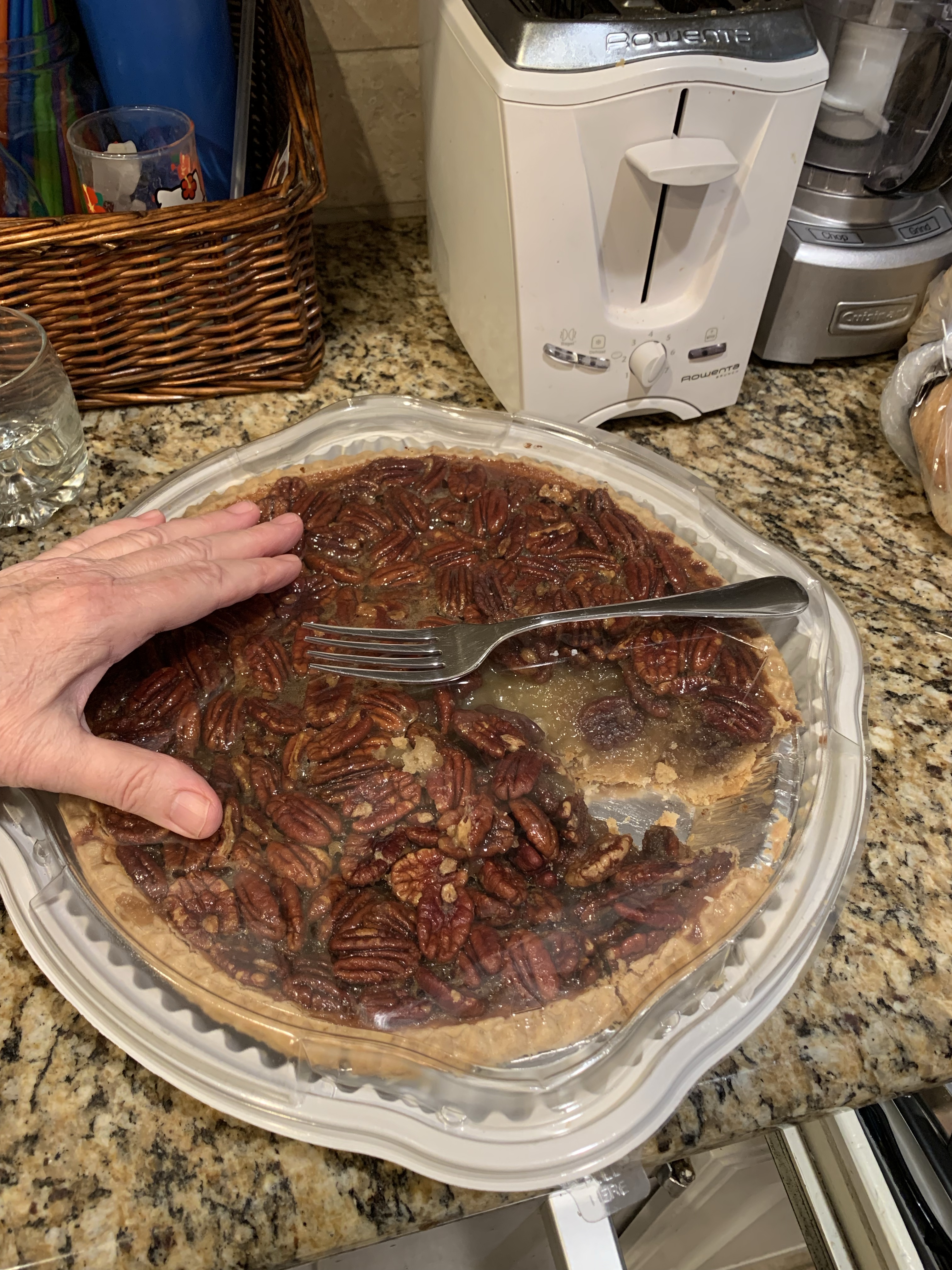
I love pecan pie. Yesterday, our realtor gifted his clients with Thanksgiving pies. We bought our house two years ago, in the middle of a crazy market, when investors were slinging cash like the Monopoly banker. Without his expertise, we wouldn’t have been able to find a place to call home. For that, we are grateful to Kreg Hall. The pie is a bonus. A large bonus, as I am the only one in our household who likes or can eat pecan pie. To make it last, I’ll freeze portions and enjoy it during the winter months. Each time I sit down with coffee and a slice of pecan pie, warm from the microwave, I’ll lift a fork in gratitude for the blessings we have and the good people in our life.
Below is a post from 2017. I wanted to share it again, I hope you enjoy reading it.
Join Hands, Give Thanks
I lived through two decades before I discovered that there were people in the world who made dressing with stale bread cubes instead of fresh cornbread. My oldest sister’s second husband, the nice one, was from somewhere up North. New York, I think. He had dark, pomaded hair swept up and back and he smiled and spoke with an accent I had only ever heard on television. He made a bread stuffing with oysters. I forgave him because it was delicious, each mouthful a feast of earthy black pepper mixed with the salty ocean taste of oysters. Home from college, my mother volunteered me to drive the two of us up to Malakoff, Texas, where my sister and her new husband had retired to life by the lake. In those days before GPS, I got lost following my sister’s handwritten directions. We arrived late, but to a feast still warm and laid out on their Formica topped kitchen island. I wish I had asked him for the recipe for that oyster dressing.
My mother made her dish the Southern way, with cornbread. She used white corn meal, soft as sand, with a bit of flour, scooped up and sprinkled in like snow. Baking soda and baking powder for leavening, for we all need incentive to rise. Buttermilk to mix, salt and bacon drippings for flavor, then all poured into her largest cast iron skillet, warmed on the stove so the crust will brown first. It came out like a pale yellow moon and filled the kitchen with the warm, sweet scent of corn. For the dressing she mixed in celery, onions, broth, and enough sage to repel evil spirits.
When I was young, we traveled to my grandmother’s house for Thanksgiving. Not over the river or through the woods, but past the lake and along Highway 380 the 15 miles to the town of Farmersville. My mother brought her cornbread dressing and a pie or two as her contribution to the meal. I held the warm pan of dressing on my lap where I sat in the slick vinyl backseat of our 1970 Oldsmobile and tried not to drool on the foil covering the pan. My grandmother’s wood frame house had a tiny living room decorated with an autographed photograph of a famous televangelist, before the fall. She sent him money and prayed for healing by laying her hands on her Chroma color television while he preached. The children, including anyone under the age of 18, were banished to the back porch. We fought over metal folding chairs and balanced our plates of food on our knees while we fended off the horde of feral cats living in my grandmother’s yard. The cats were only slightly outnumbered by my cousins.
Some years we visited my father’s family, where my aunts made their dressing and gravy seasoned with the chunks of turkey heart, liver, and gizzard that came packaged and concealed inside a store bought turkey. The first time I cooked a turkey I didn’t realize there was this hidden prize inside. I found them after, steamed and tucked under the skin at the front of the turkey, where his neck would have been if it weren’t shoved up into the body cavity. The neck was roasted too, because I didn’t know there was a second, secret scrap part buried inside my turkey.
My first husband was from Missouri, and the bread stuffing his mother made was moist, but thick, and had to be scooped out in chunks. My father-in-law, an honest, hard-working mechanic and assistant Boy Scout leader, led the prayer each year, insisting that we all stand before the table and join hands. You haven’t really experienced Thanksgiving gratitude until you’ve had to convince a squirming toddler to stay still during a ten minute blessing while the aroma of roasted meat and cinnamon spiced pumpkin wafts over you in a moist cloud of steam you can taste.
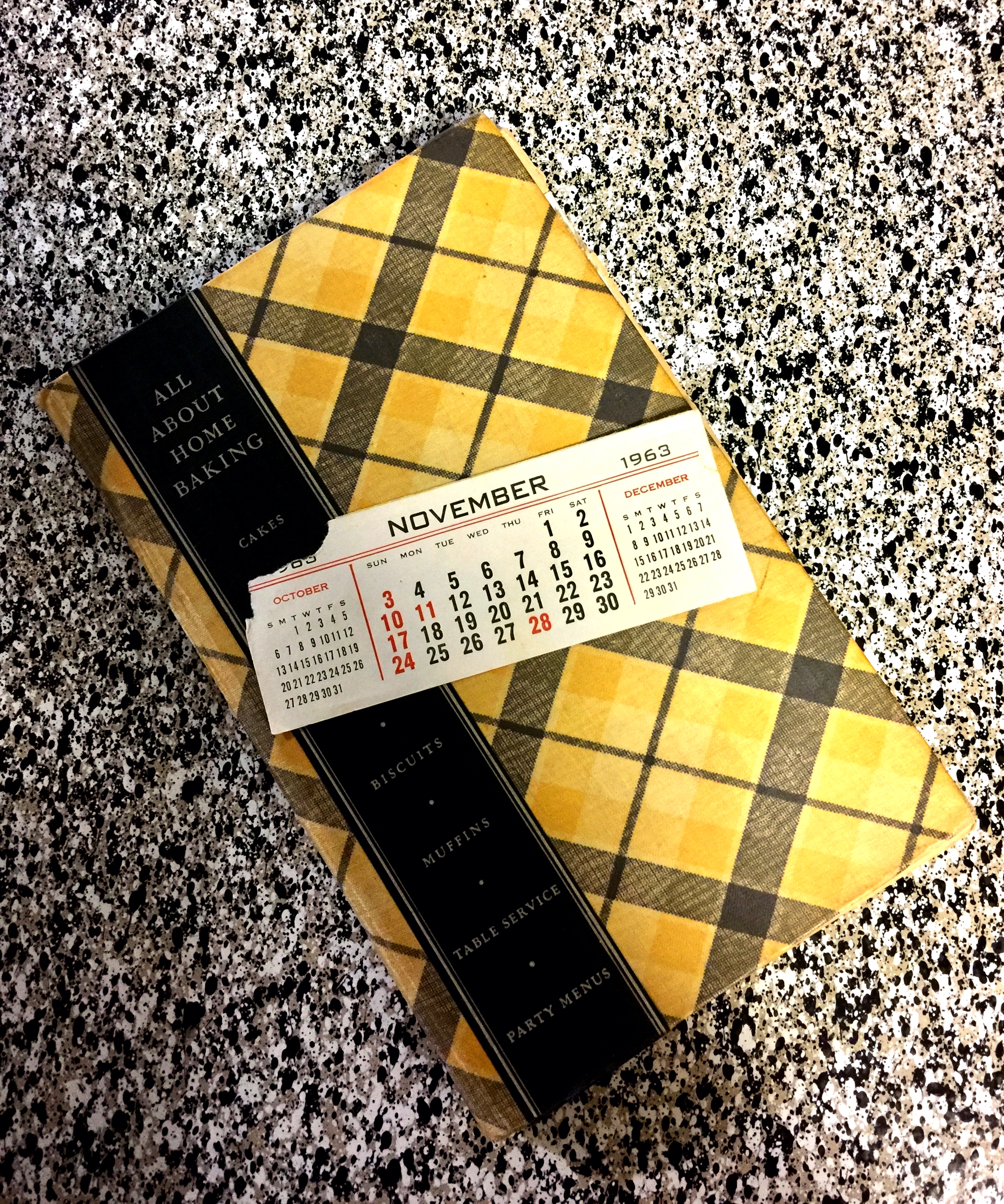
My mother stopped cooking a turkey for Thanksgiving after my parents divorced, when it was just the two of us left at home. She would roast a chicken instead, and make her cornbread dressing. I never saw her consult a cookbook. She cooked from memory, measuring out ingredients to taste except when she was making a pie or a cake. After she moved into a nursing home, I found a cookbook tucked away in a box she had stored in her laundry room. The book, All About Home Baking, had penciled notes in the margins and tucked inside the front cover, scraps of lined paper with recipes written in her delicate, looping cursive. Brittle, yellowed pages from a 1963 calendar fluttered out like falling leaves when I turned the pages of the book.
I roast a turkey every year, even when there are just one or two guests and my vegetarian husband at the table. This year I’m cooking both turkey and a ham. I’ll make cranberry relish from fresh cranberries and oranges and add so much sugar that it passes for jam. We’ll have pumpkin pie and a minced meat pie like my mother used to make, even though no one but me will eat it. It is a deliberate luxury on my part to have a whole pie to myself. My husband, Andrew, will mash potatoes so they come out just the way he likes them, a little bit creamy and with a few tiny lumps. When he leaves the kitchen I will sneak in more butter and salt to the dish.
I don’t cook my mother’s cornbread dressing. I’ve fallen from grace and into the boxed, instant variety but at least it’s the cornbread version. I’ll make traditional green bean casserole with crispy fried onions on top and a spinach rice casserole from a recipe my aunt gave to me. I don’t put marshmallows on the yams, instead I’ll serve them with a pecan streusel topping like my ex-husband’s mother, my first mother-in-law, made.
The guests at the table, the cooks in the kitchen, and the fellowship changes, just as the feast stays the same. I touch my past as my hand stirs the pot, preps the bird, and kneads the bread. I bow my head in silent thanks and join hands with all, even those who are absent from the table. Join hands, bow heads and give thanks. Give thanks for the love we are all about to receive.
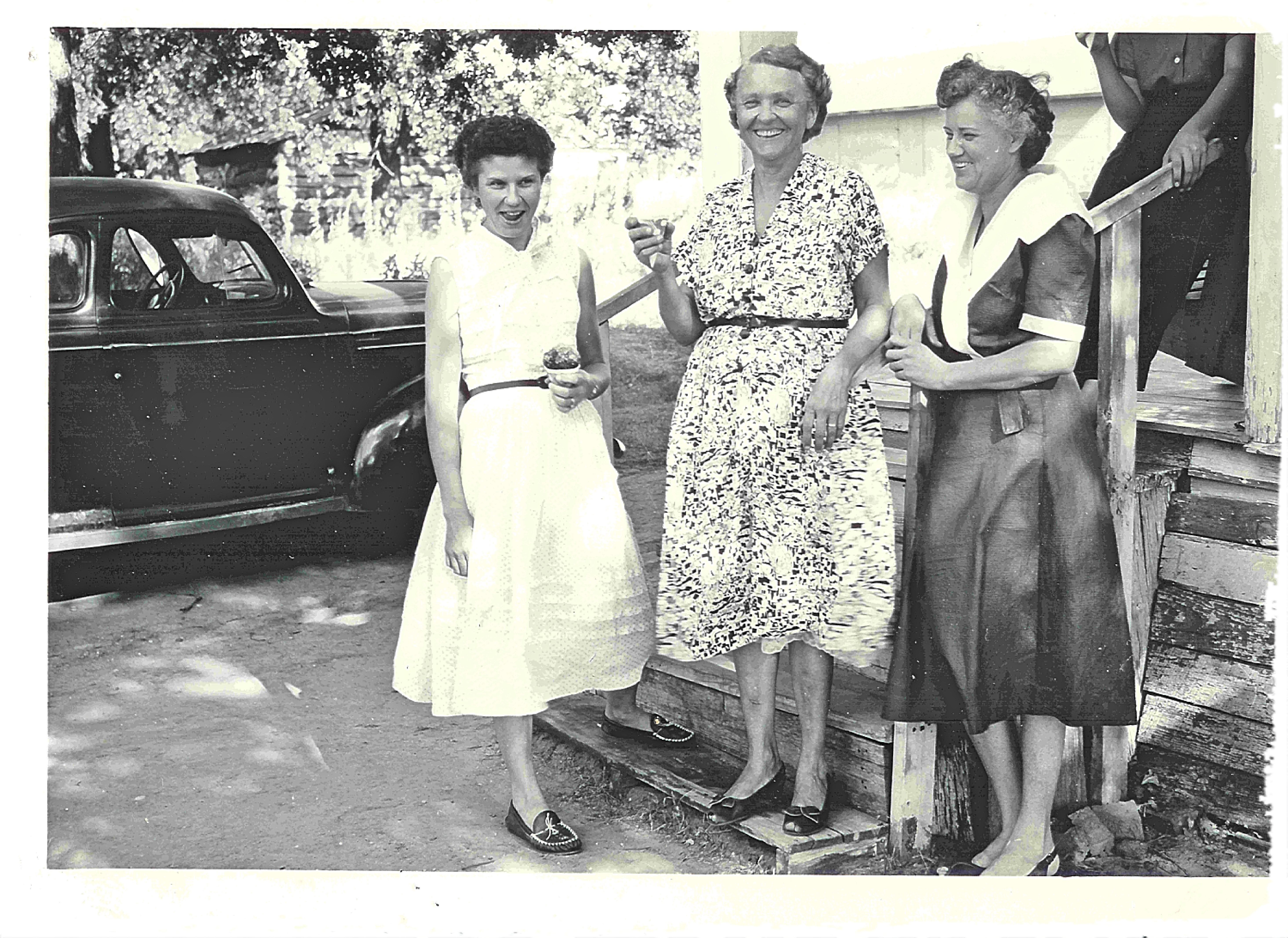
From the left: My mom, my maternal grandmother, and my aunt
We have been without a pet for almost three years. Our nerite snail slunk across the rainbow bridge shortly after we moved into our new home. The five gallon aquarium where he lived now sits empty inside the garden shed. Taking care of an animal requires a burden of care that we are not ready to assume. Not while we have the caretaking responsibility for Andrew’s mother. We were fortunate to buy a house already equipped with handrails and wood floors, wide doorways and an extra bedroom. But we found the best blessing in our backyard.
We have frequent visitors to our garden.
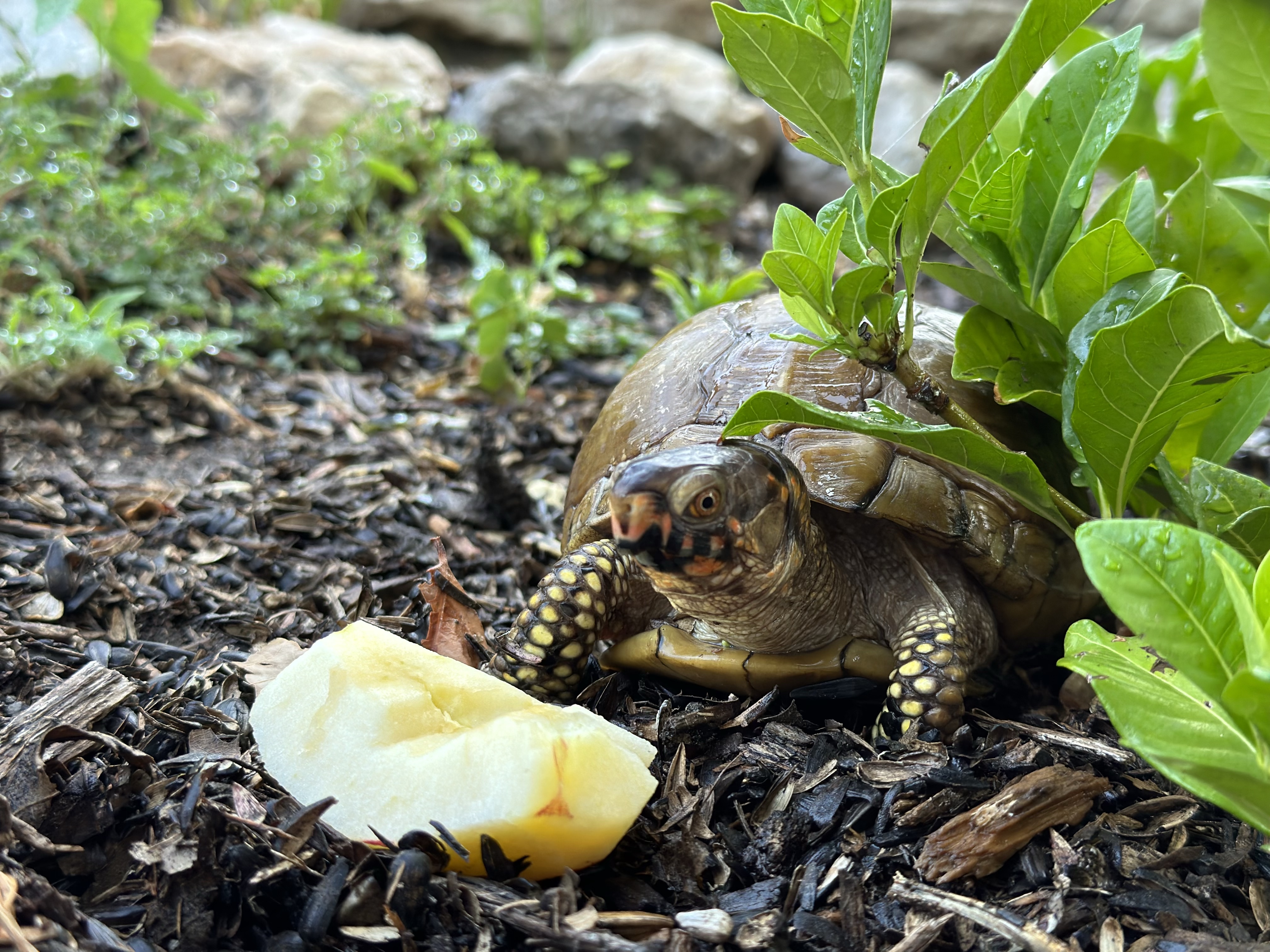
Myrtle the box turtle – photo by Andrew Shaw
This is the second year we have been visited by a box turtle. Last year, after confirming her gender, we christened her Myrtle. Female turtles have brown eyes and their shells do not have a flare at the bottom. Males tend to have red eyes and flared shells. Box turtles are not endangered, but they are listed as “vulnerable” as their habitats are shrinking. If you find one in your yard, don’t try to relocate them as they are territorial. Andrew and I believe Myrtle lived here near our creek long before we met with a realtor. We are happy to see her when we find her strolling through our flowers.
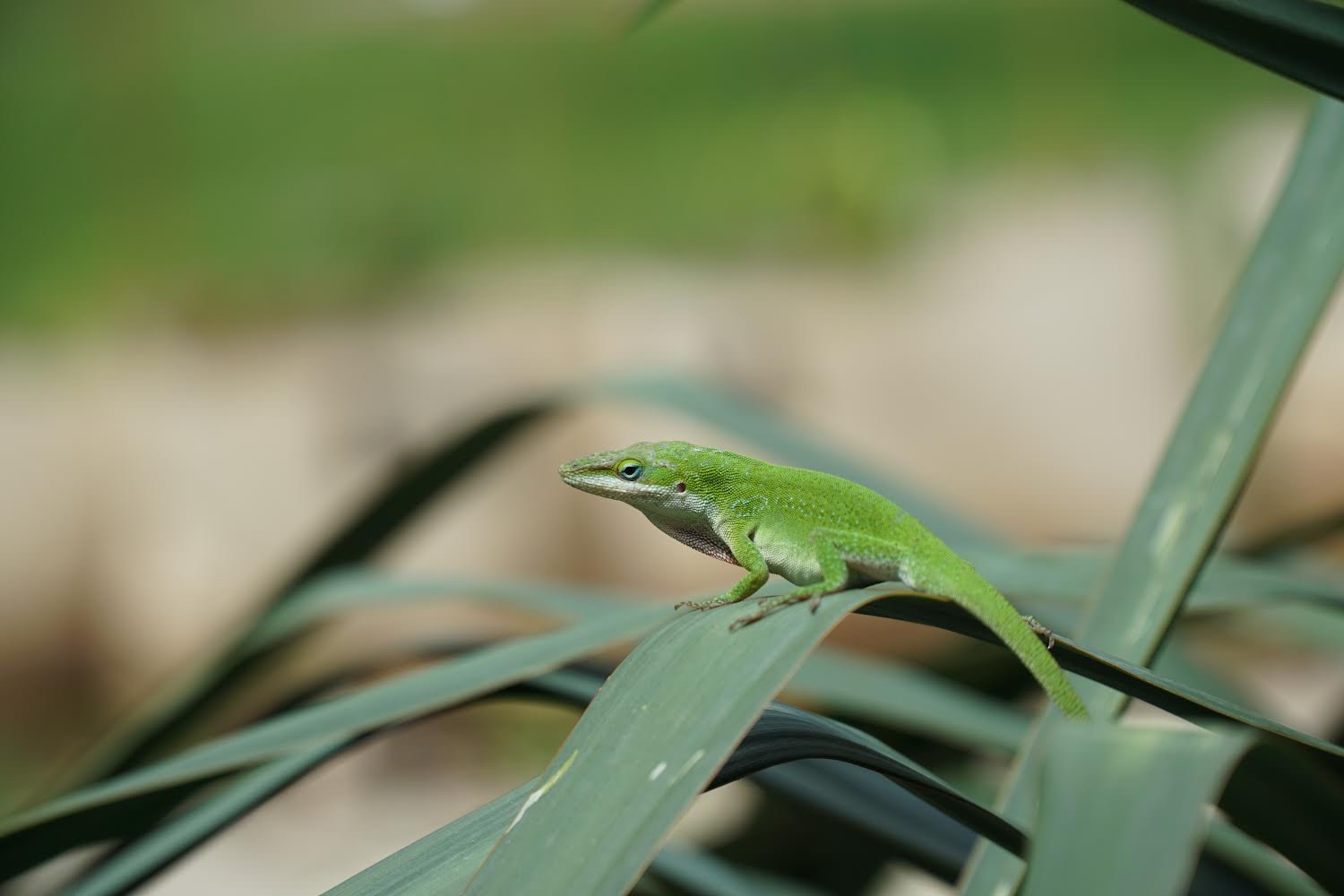
Green anole enjoying the bugs – photo by the author
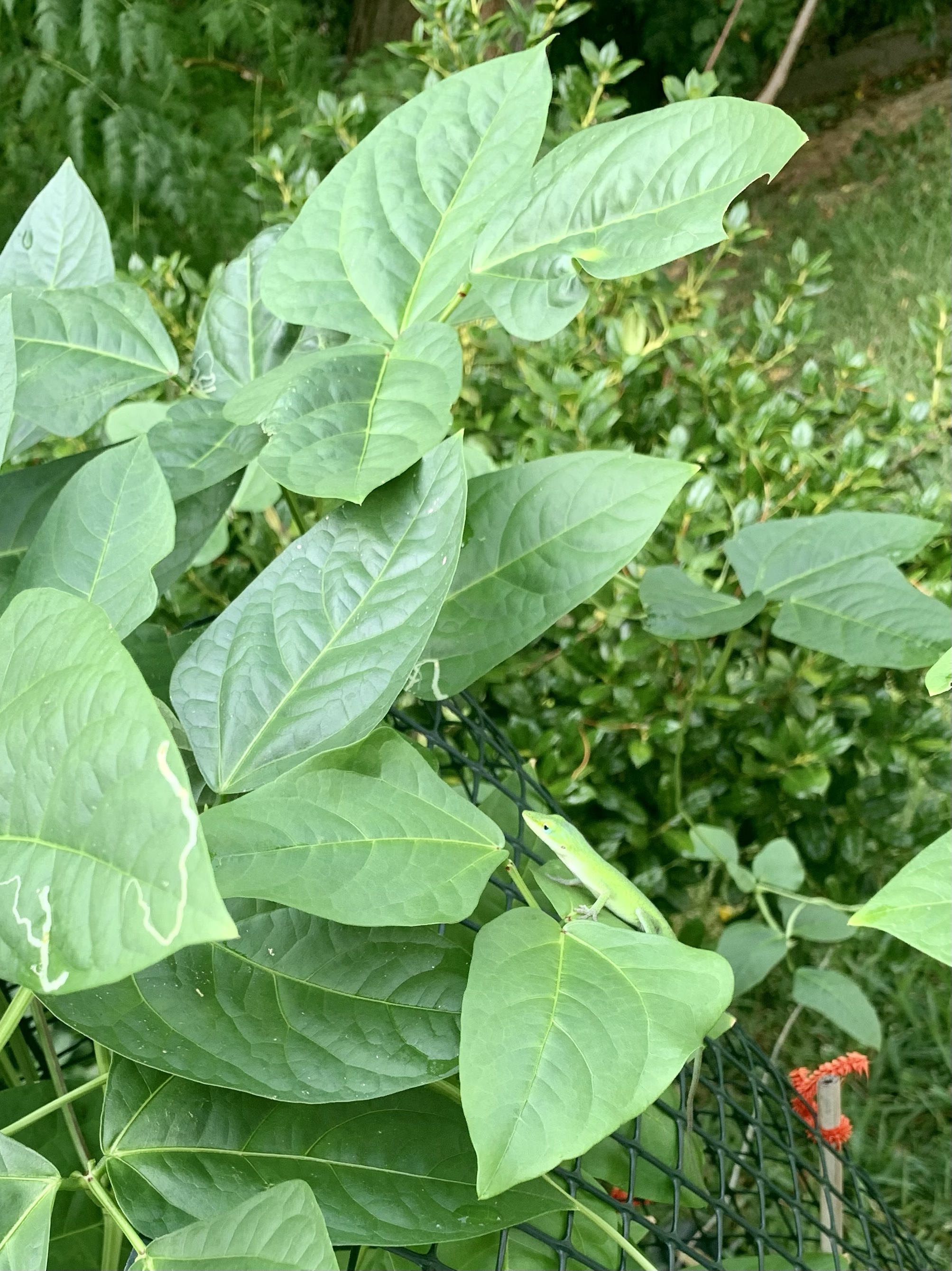
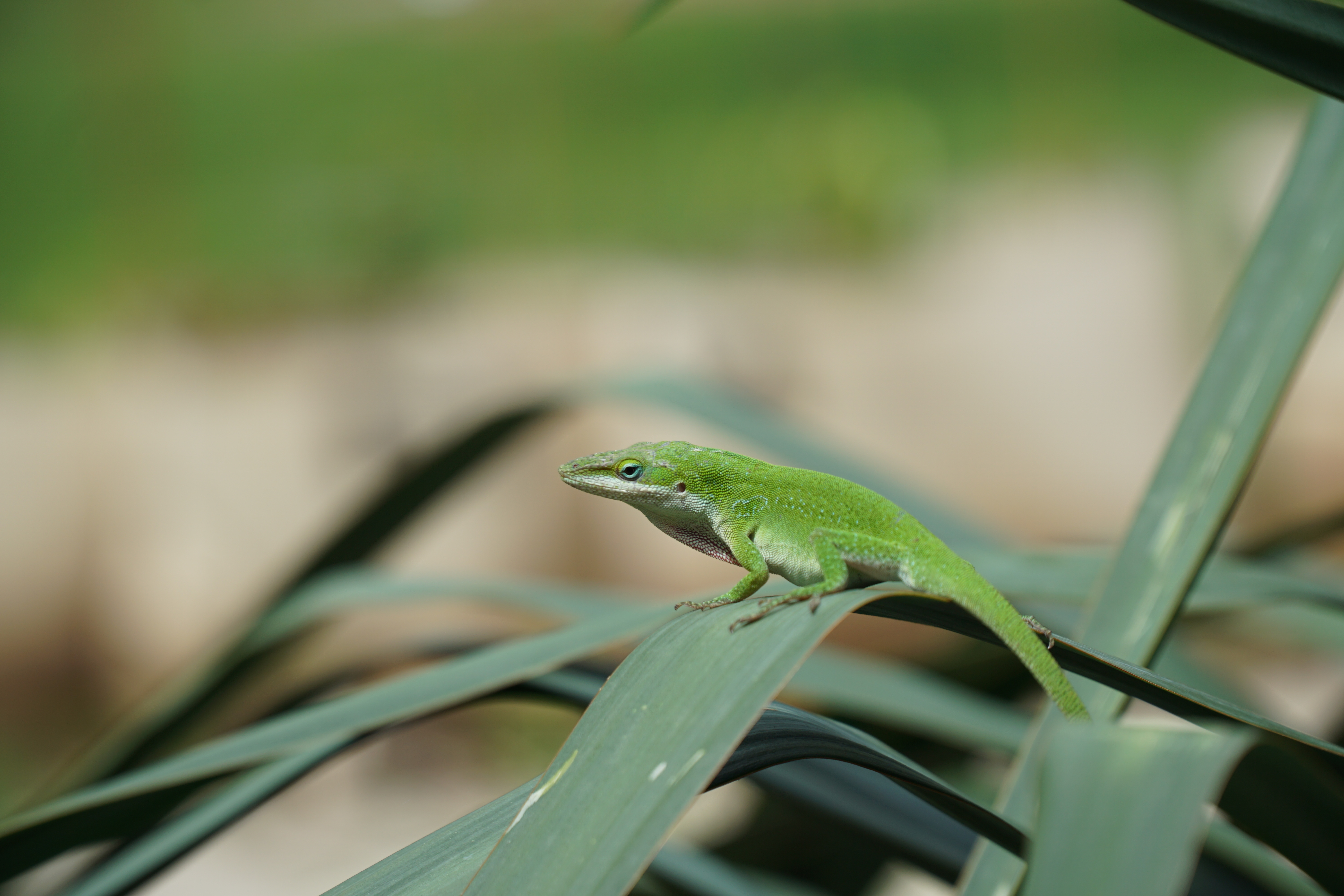
A multitude of little green lizards lurk among the plants. We call them all Jake. They are most likely all related and don’t seem to mind sharing that moniker. If I approach slowly they will allow me to offer them a dried meal worm. This, I feel, is an adequate reward for their hard work clearing the insects from our vegetables.
Small toad – photo by the author
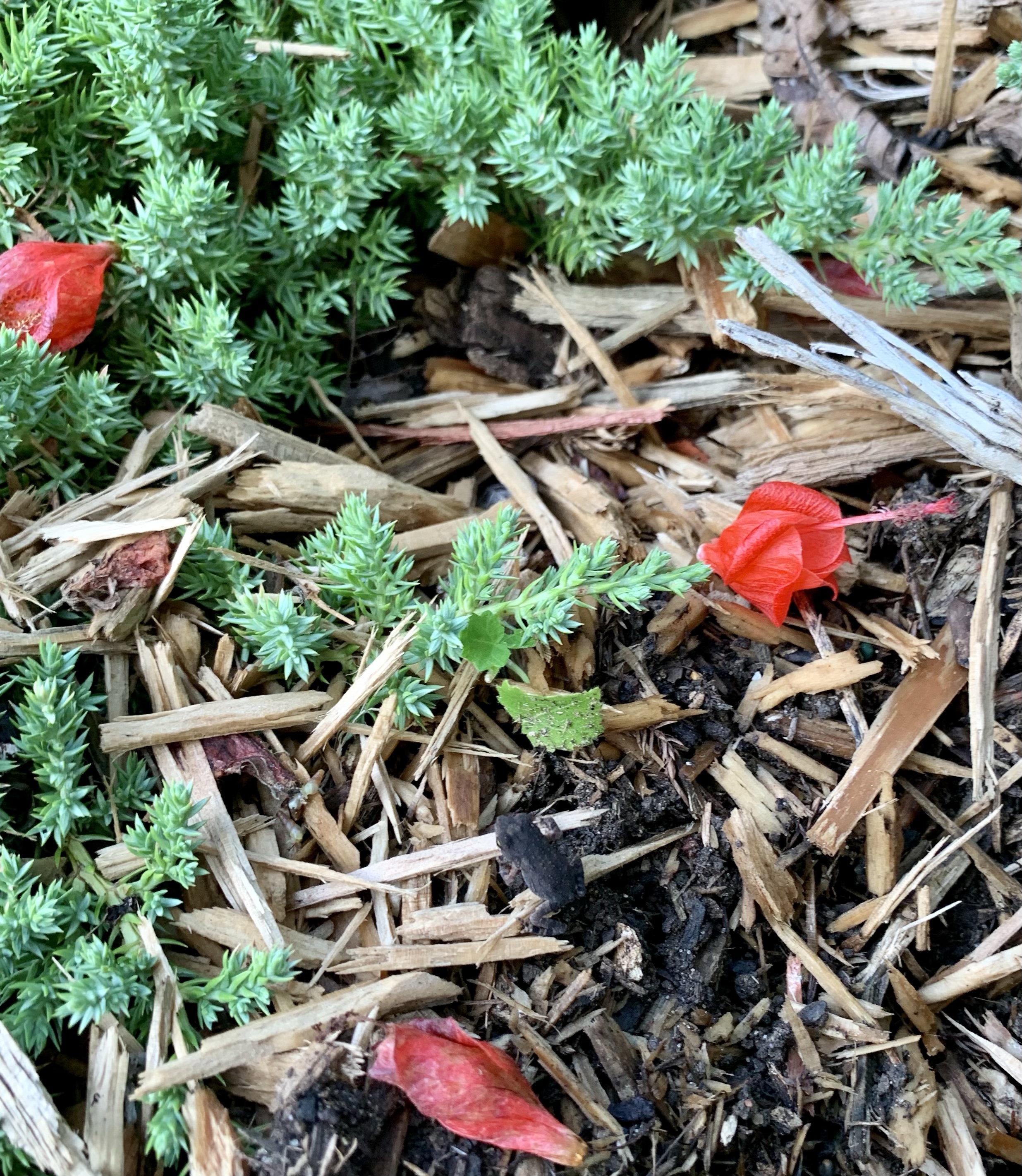
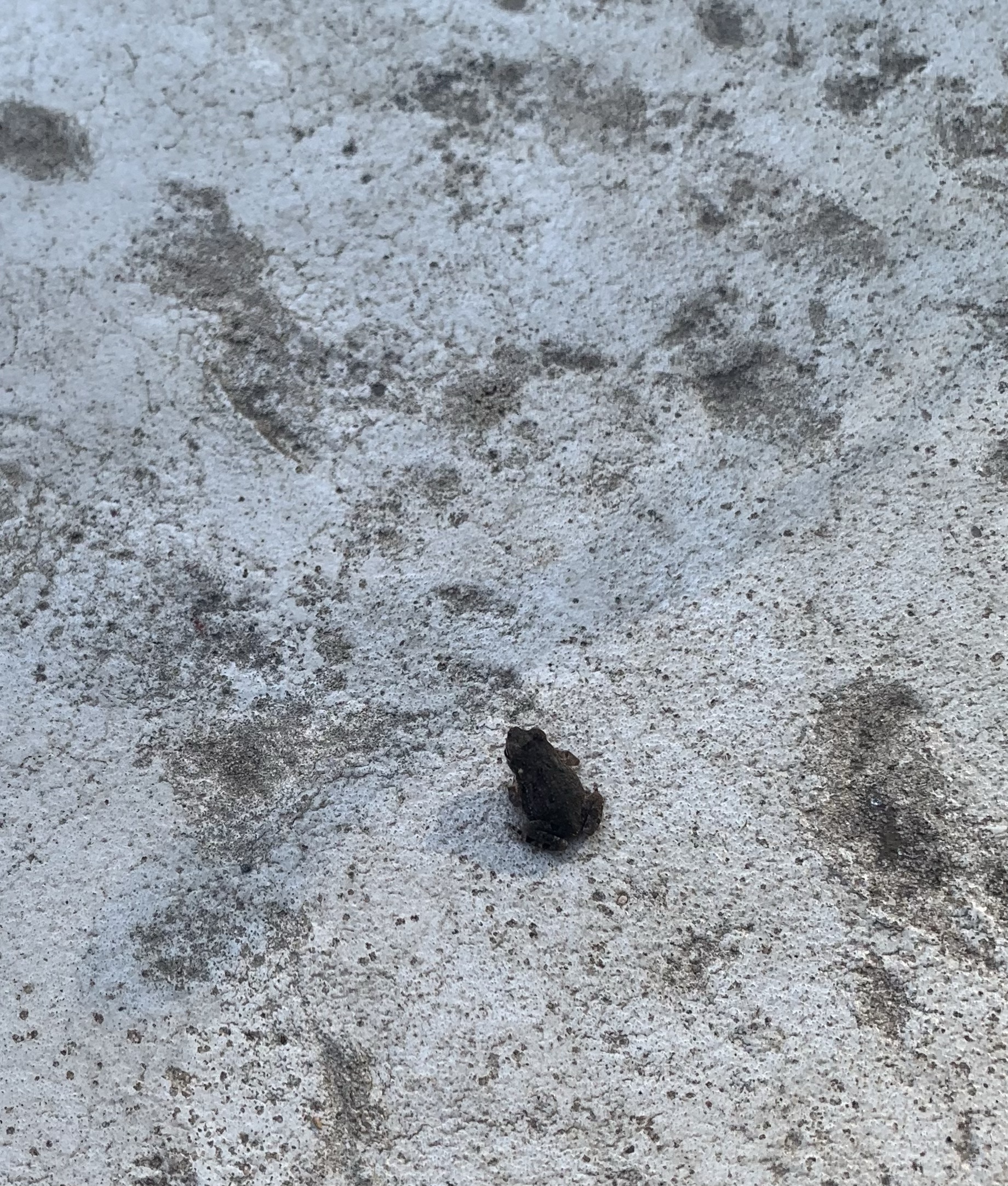
After a late summer rain finally soaked our yard, I found dozens of very tiny toads hopping across the mulch. Each one is barely the size of my thumbnail but they have an impressive jump when startled. I can empathize. The toad in the image above can be found in the center of the bottom third of the photo. If you can’t find him here is another pic of one I found on our walkway.
Very tiny toad – photo by the author
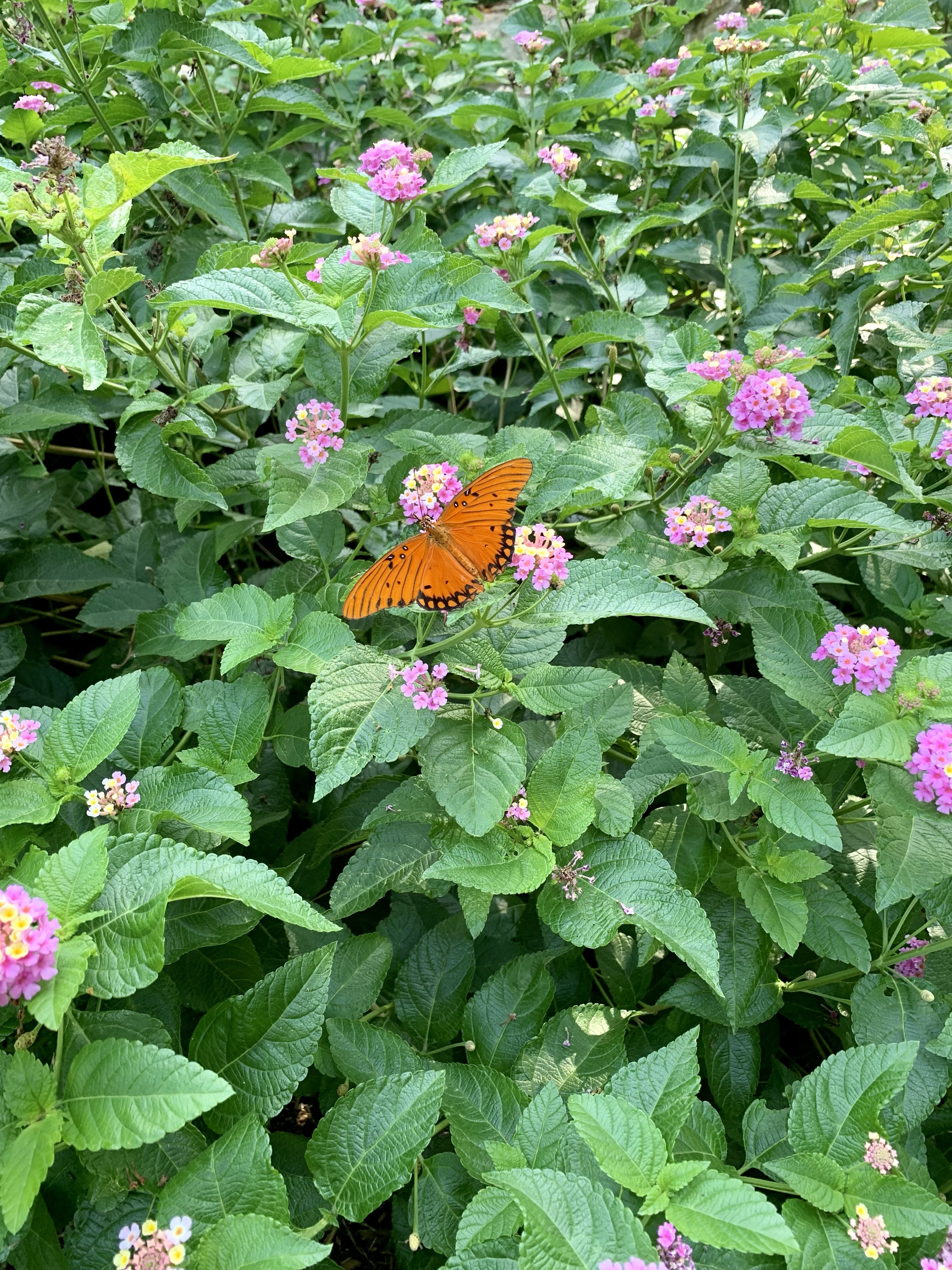
As summer ends, we keep the fallen leaves and brushy plants in the garden. Less work for us and more places for our wildlife to shelter when winter arrives. The lantana in particular has been a colorful home to bunnies and a draw for butterflies and bees.
Lantana – photo by the author
“In every walk with nature one receives far more than he seeks.” –John Muir
Bunnies and humans are a greater threat than zombies
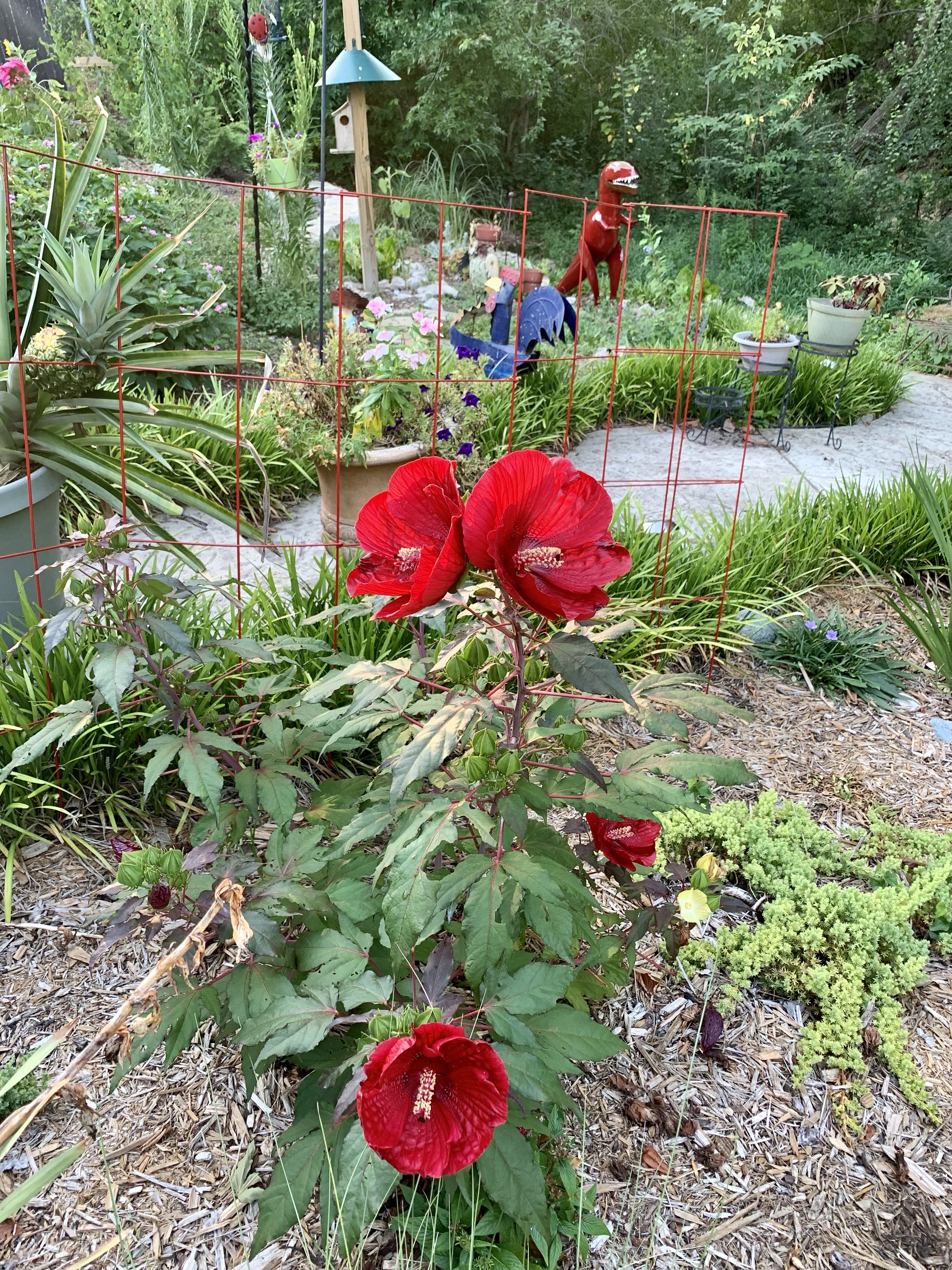
Our garden – guarded by metal chickens and a t-rex
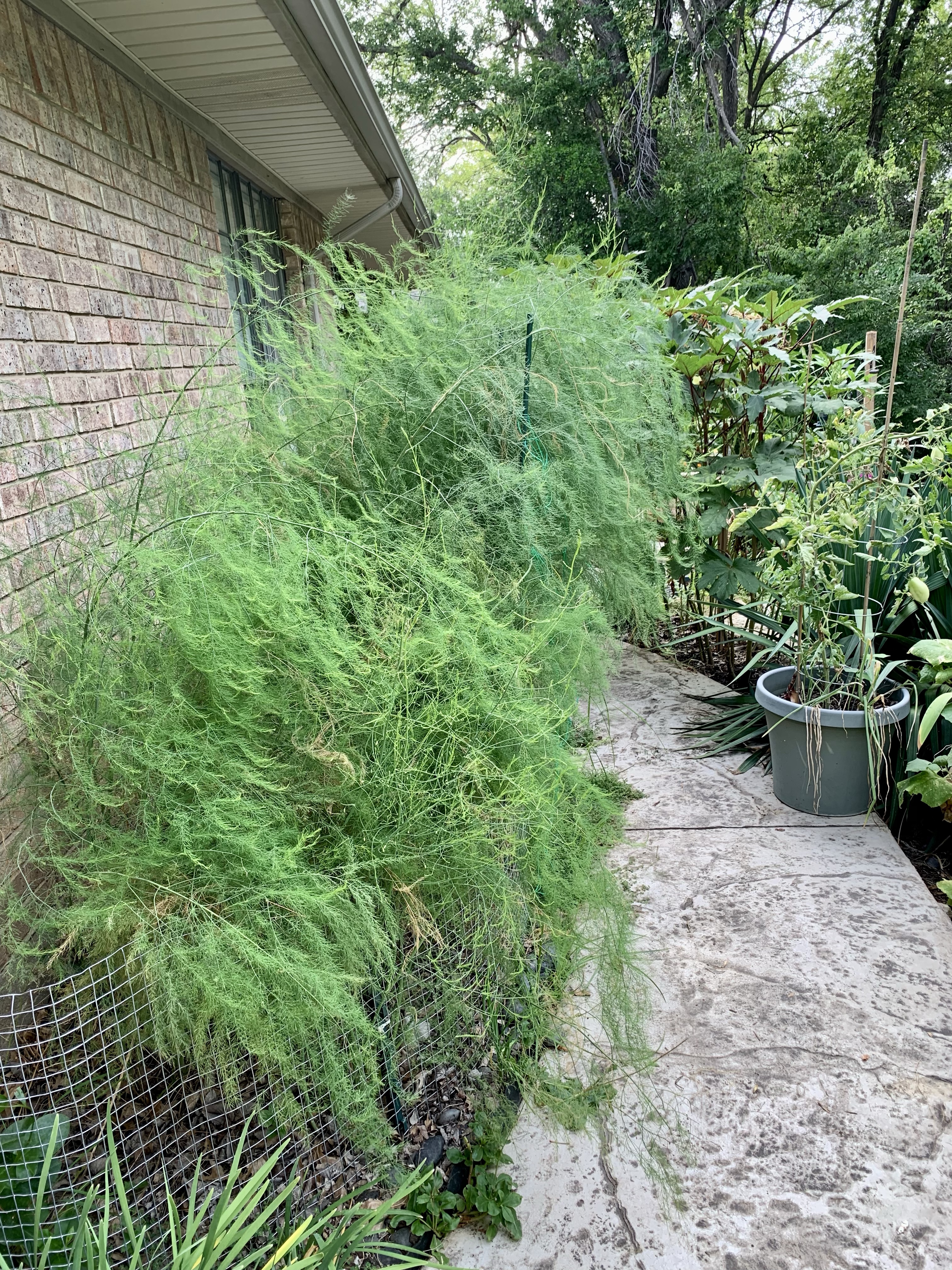
Here in Texas we are finishing another week of 100 plus degree temperatures. So far the tropical plants – the hibiscus, okra, wax mallow, and the Rose of Sharon – are thriving. But not all plants, nor all humans, are designed to survive in a climate akin to a blast furnace. While the mallow gang laugh at August, my tomatoes have wilted, the peppers gave up their blooms, and the vining plants dried up and crumbled off their stakes. Somehow the asparagus continues to force out new sprouts. I planted the roots two years ago, so next year will be the year of spears. The ferns have overgrown their little patch, hanging over the sidewalk so they brush against me when I wander past. I can’t resist running my hands through the soft tops and whispering to them, “Soon.”
The asparagus patch
Right after the asparagus began shooting up spears, I noticed that overnight the plants would disappear. Rabbits, I discovered, like the taste of fresh asparagus. The greater insult in this was that I could not yet harvest the spears for my own meals. Our solution was to install a short fence around the plot. Not so tall that I couldn’t reach over it, but tall enough that the bunnies could not. Eventually I enclosed most of my plants in some sort of fence. It has given me a new respect for the battle between Farmer McGregor and Peter Rabbit.
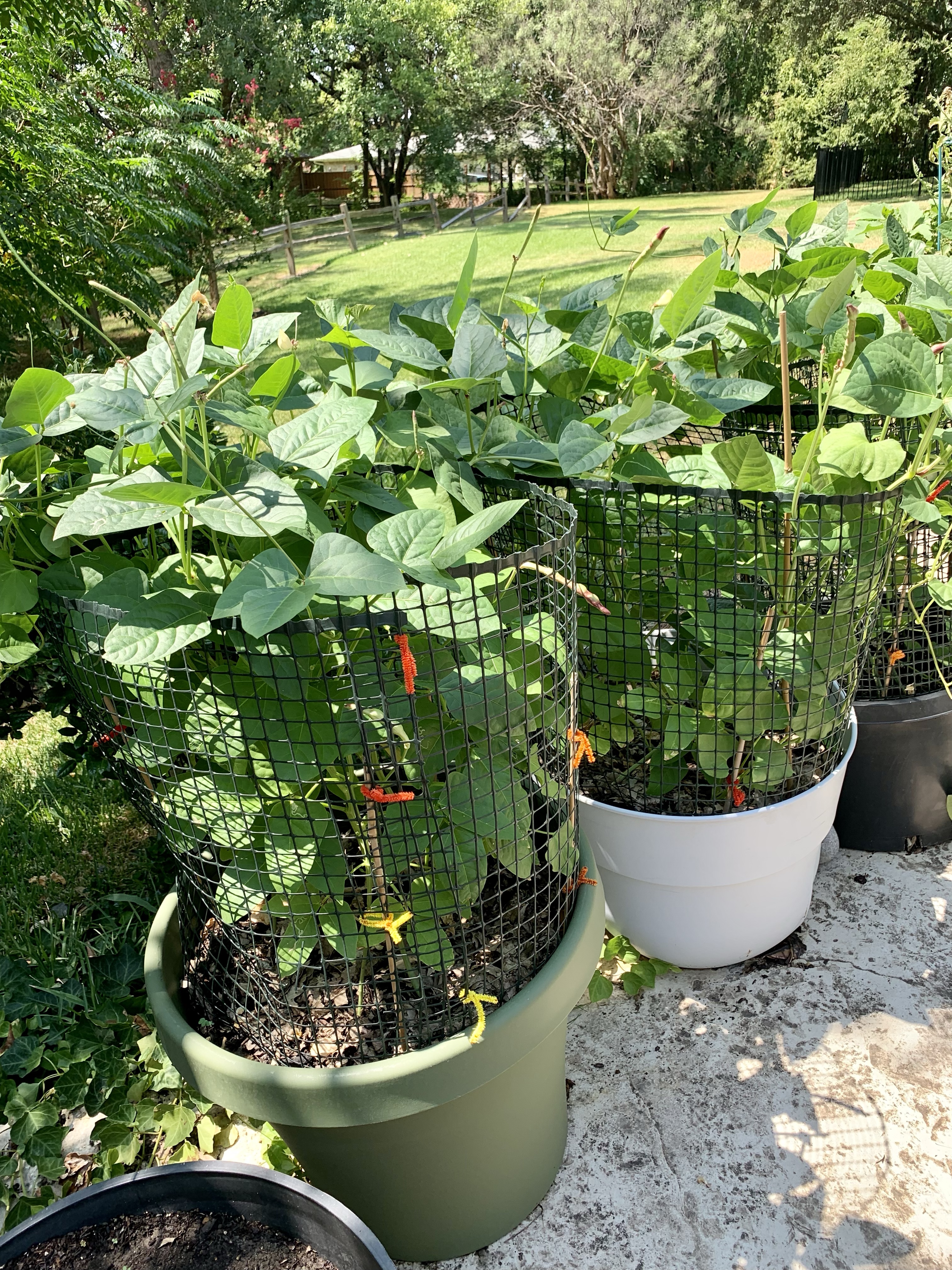
Black-eyed peas and sweet potatoes in pots
My parents always had a small garden and our summers were filled with fresh vegetables. My main motivation for growing my own food has always been an appreciation for the taste of home grown tomatoes and okra. The restful meditation that comes from working with plants is a much enjoyed side benefit.
Like many people, I felt an extra urgency to produce my own food during the Covid lockdowns, when we dealt with shortages. Back then, I remember trying to order seeds online and coming up empty with each click. Mostly I grew radishes and hot peppers on our apartment balcony, not exactly enough to sustain two grown adults. Since buying our house two years ago, I’ve expanded to large pots, grow bags, and some space in our flower beds. The dry Texas summer has turned our front lawn to brown straw, and I believe I am close to convincing Andrew to till it all under and plant corn.
One of the scariest movies I ever watched was Interstellar. It wasn’t marketed as horror, but science fiction. The plot revolved around a team of scientists who were searching for alternate planets that would support life, since earth had undergone so much ecological damage that world wide famine had resulted. This was a little too close to reality. I love horror, but I’d rather watch and read stories about zombies, demonic serial killers, and haunted houses. In those cases, I can close the book, exit the theater, turn off the television and reassure myself that those things are safely secured away from my own world. However, I only have to step outside in the blazing summer heat to imagine global ecological destruction. In that case, I always think of George Carlin’s words – “The planet will be here for a long, long, LONG time after we’re gone, and it will heal itself, it will cleanse itself, ’cause that’s what it does. It’s a self-correcting system. The air and the water will recover, the earth will be renewed.”
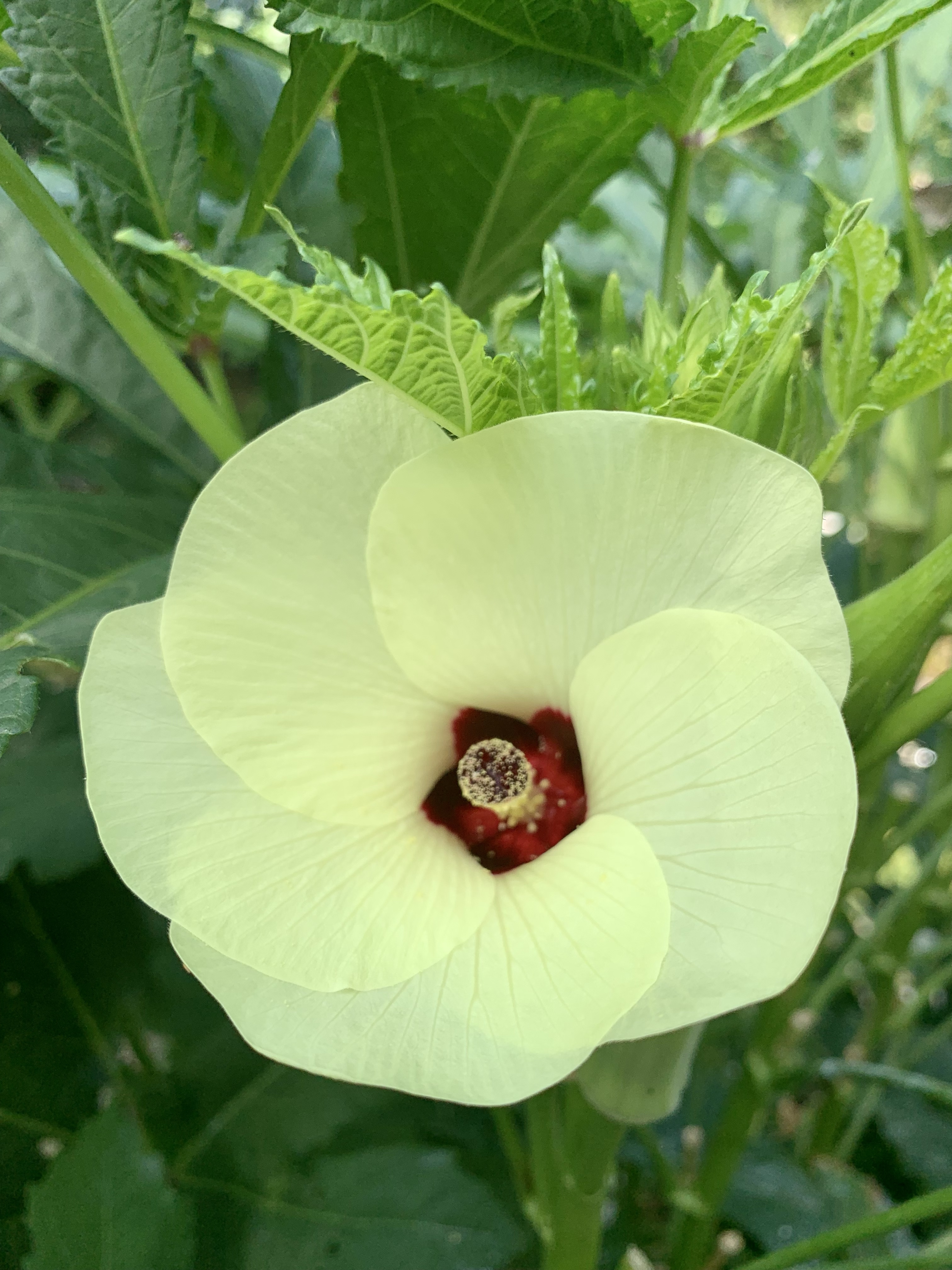
Okra blossom
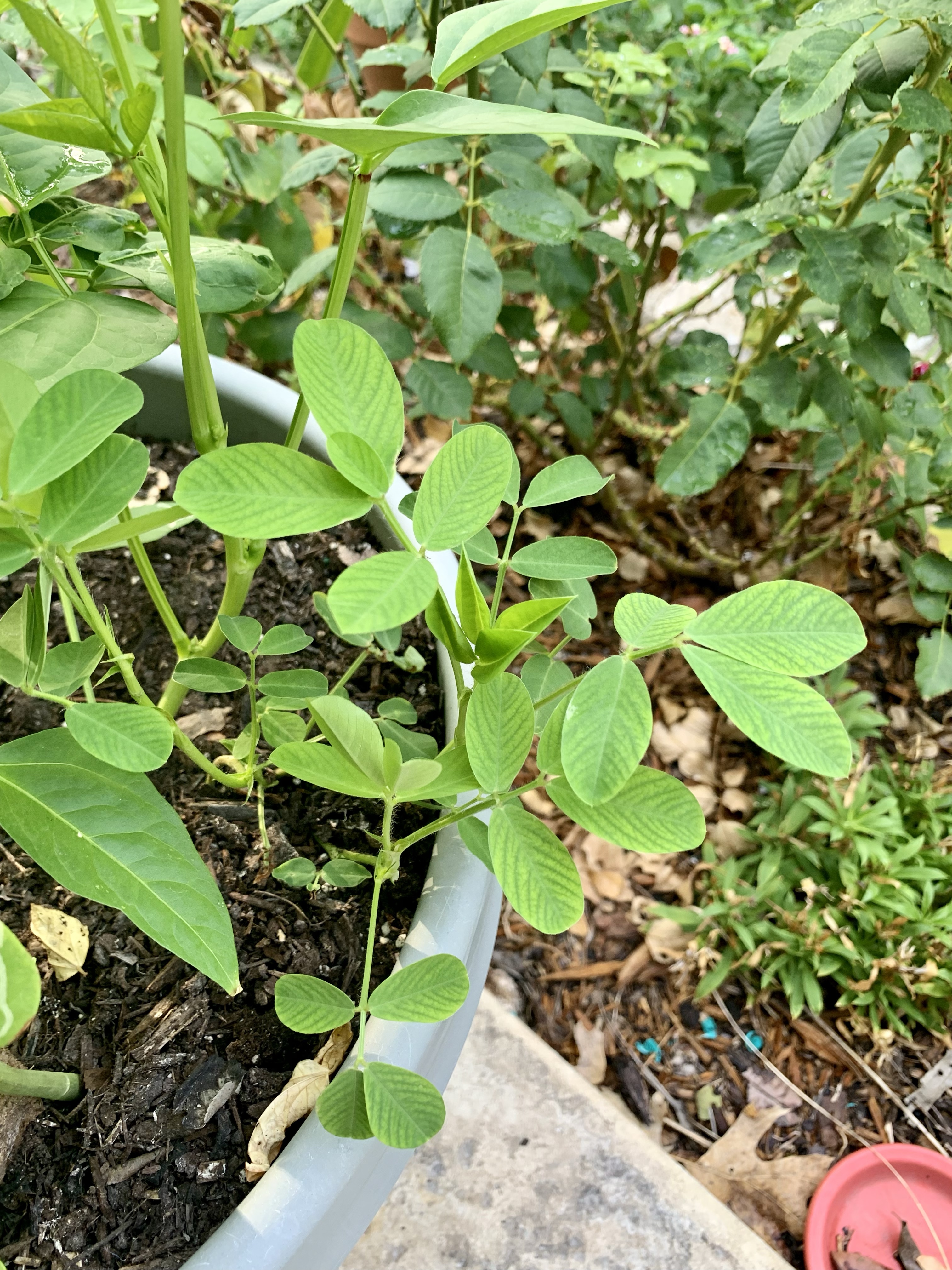
While we wait for the ecological apocalypse, the black-eyed peas and sweet potatoes thrive in their pots and don’t seem to mind the heat. Bunnies are not welcome in the garden. Birds and squirrels are okay, because they occasionally do their own cultivating – like the sunflowers that sprout around the bird feeder or the peanut plant that emerged from a flower pot of peas. It’s all good because my favorite color is green.
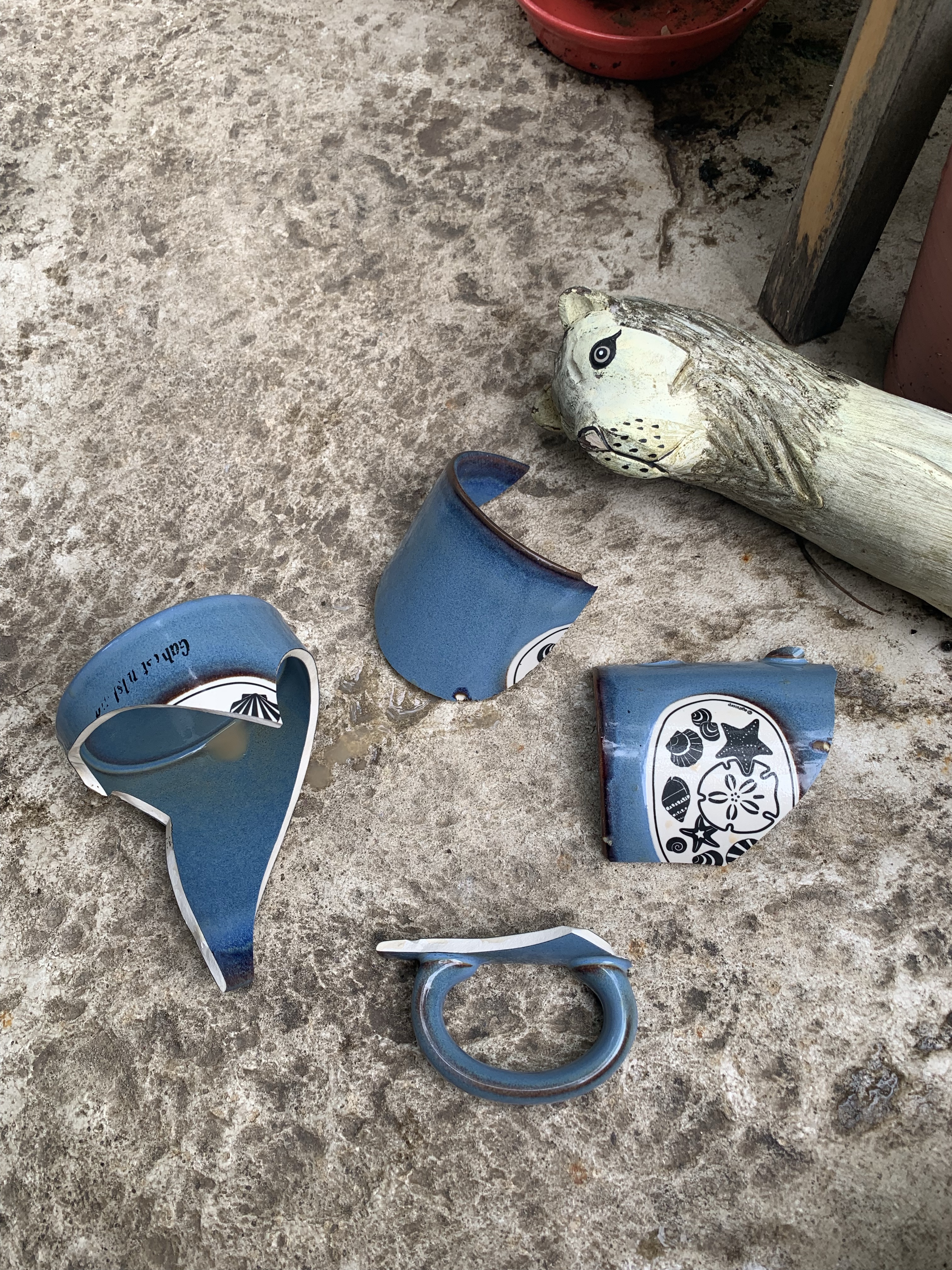
My memories are fragile as porcelain. I long to hold on to every second, recall and relive each happy moment before they slip and shatter, like my coffee mug this morning. Andrew and I were enjoying the view from our back porch, when I went to toss a peanut to a visiting squirrel. My right hand lobbed the treat, and my left hand joined in the motion, throwing instead my Galveston souvenir coffee mug to a confused and startled squirrel. The mug tumbled from my grip and broke into pieces on the concrete.
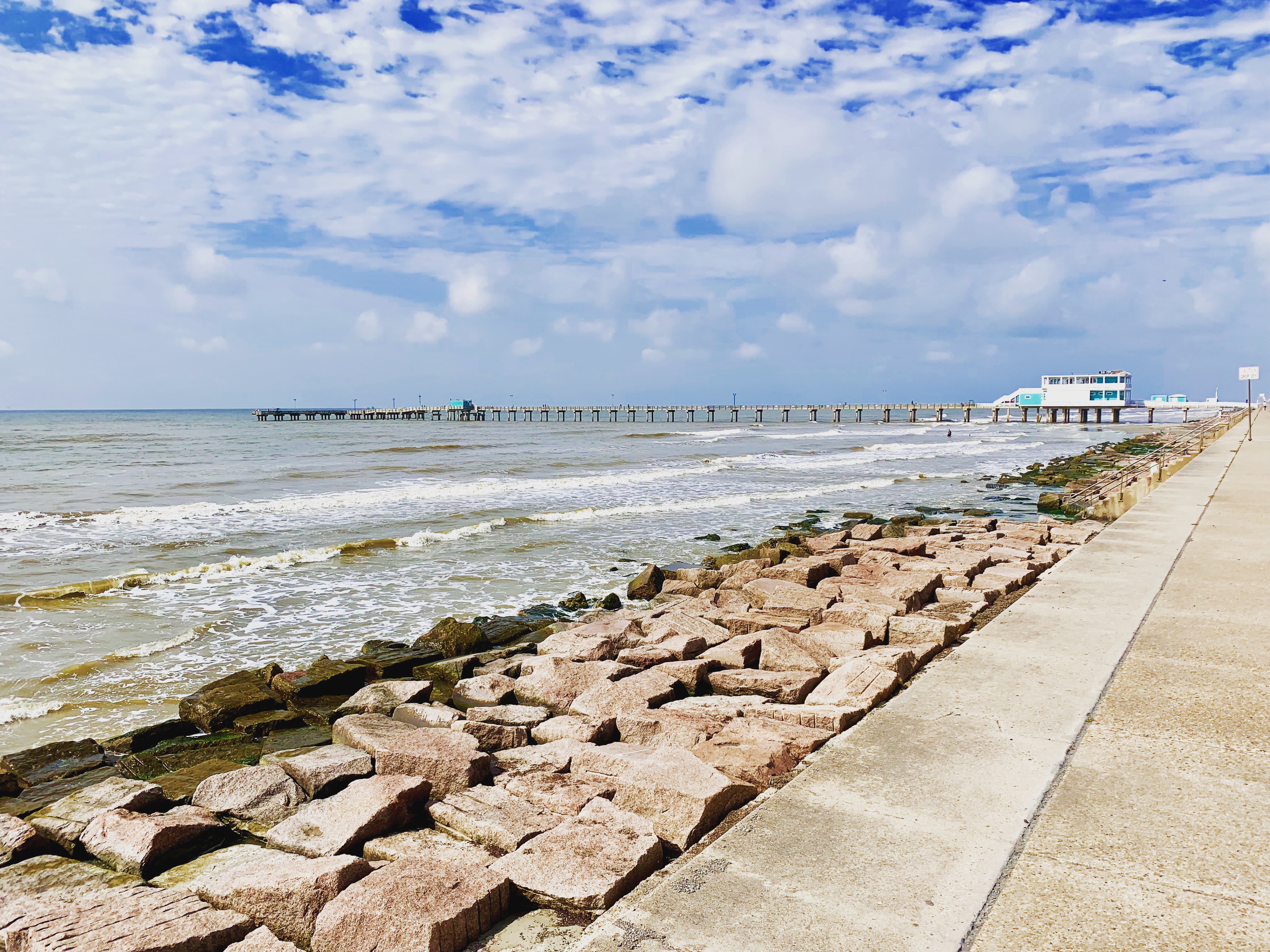
Photo by the author – Galveston Seawall
We visited Galveston after we married and before Covid. I can’t recall the year unless I look it up. Never good at remembering dates, I rely more and more on my phone, calendars, sticky notes. The desk in my office holds a rainbow of colored squares. I keep lists – groceries to buy, books to read, movies to watch, places to visit. This method works until I can’t decide whether “Luce” is a book, movie, or shorthand for lettuce.
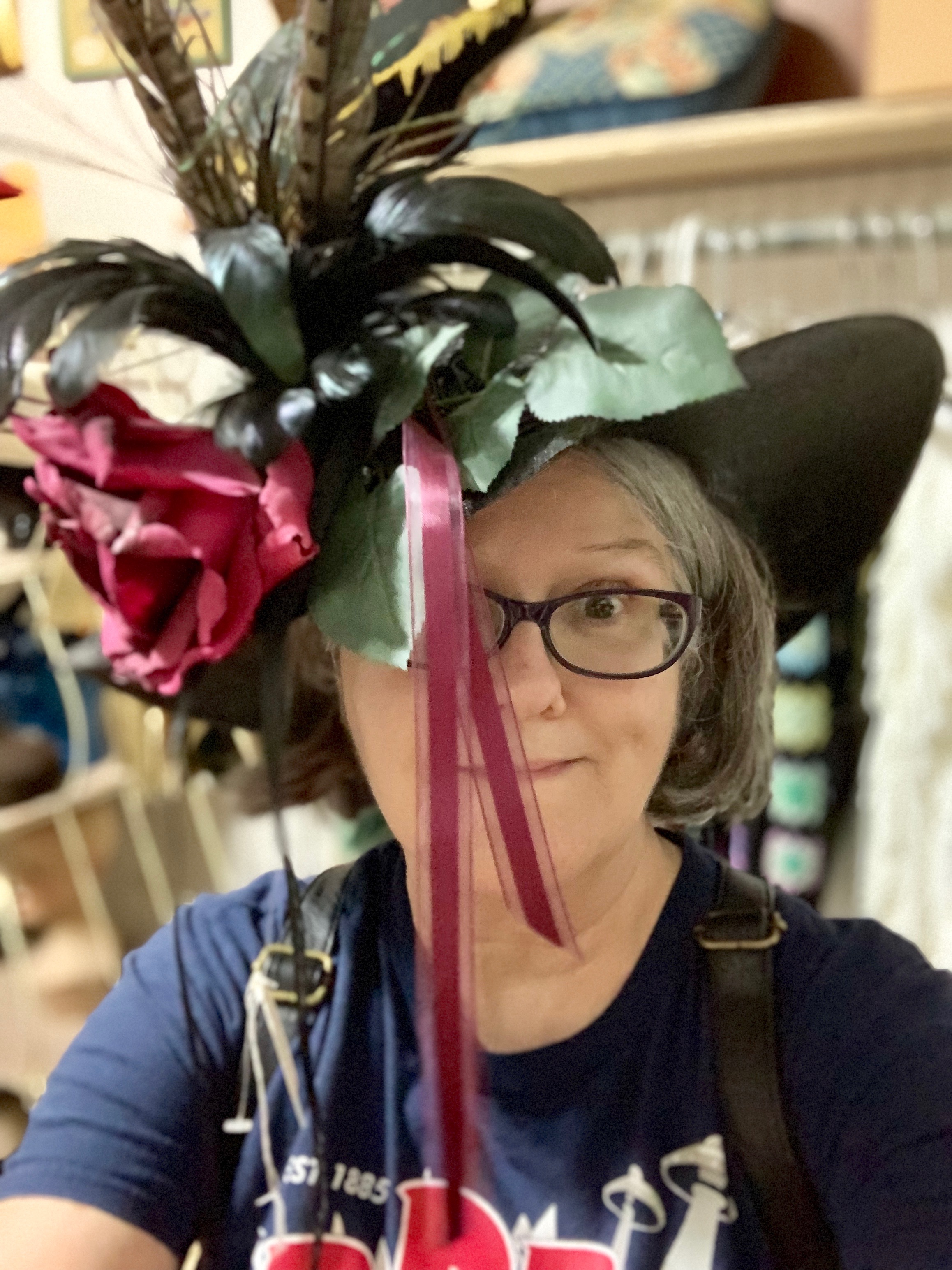
The author – trying on a hat at a shop in Galveston
“I’ll buy you another mug,” my husband said. “I bet I can find one on eBay.”
“No. It won’t be the same.” How to explain that the kitchsy souvenir held not just my morning coffee, but memories of strolling along the seawall. “We will have to go back to Galveston.”
I pushed the broken bits aside. No more physical remembrance, but I could look at the pictures we took on that trip if I wanted to recall the way the golden hour lit up the historic cemetery we toured.
Photo by the author – the Broadway Cemetery in Galveston
I have begun a journal detailing each trip we take – the towns we visit, shops where we find the best bargains, fun things we did and might want to do again. I don’t trust my mind to hold the details. There is so much already stuffed there. Why do I recall the register code to ring up a chicken chimichanga, twenty-eight years after I last waited tables at El Chico? It’s 808. The phone number at my childhood home was 542-0549. I can’t tell someone my current work number unless I have my business card at hand.
Do I remember how to drive to a friend’s house, what store carries the salsa that I like best, how many pints are in a quart? Absolutely not. But I do know that the dad from The Brady Bunch was an architect, and Darrin Stephens on the tv show Bewitched worked for an advertising firm.
We made plans to visit Galveston again, this time in cooler weather. I’ll record the trip in my journal, and note the places we go. We’ll wander through The Strand and visit the souvenir shops on the seawall. I’ll look for a replacement for my coffee mug, but this time I’ll buy two, in case I decide to chunk one at a squirrel.
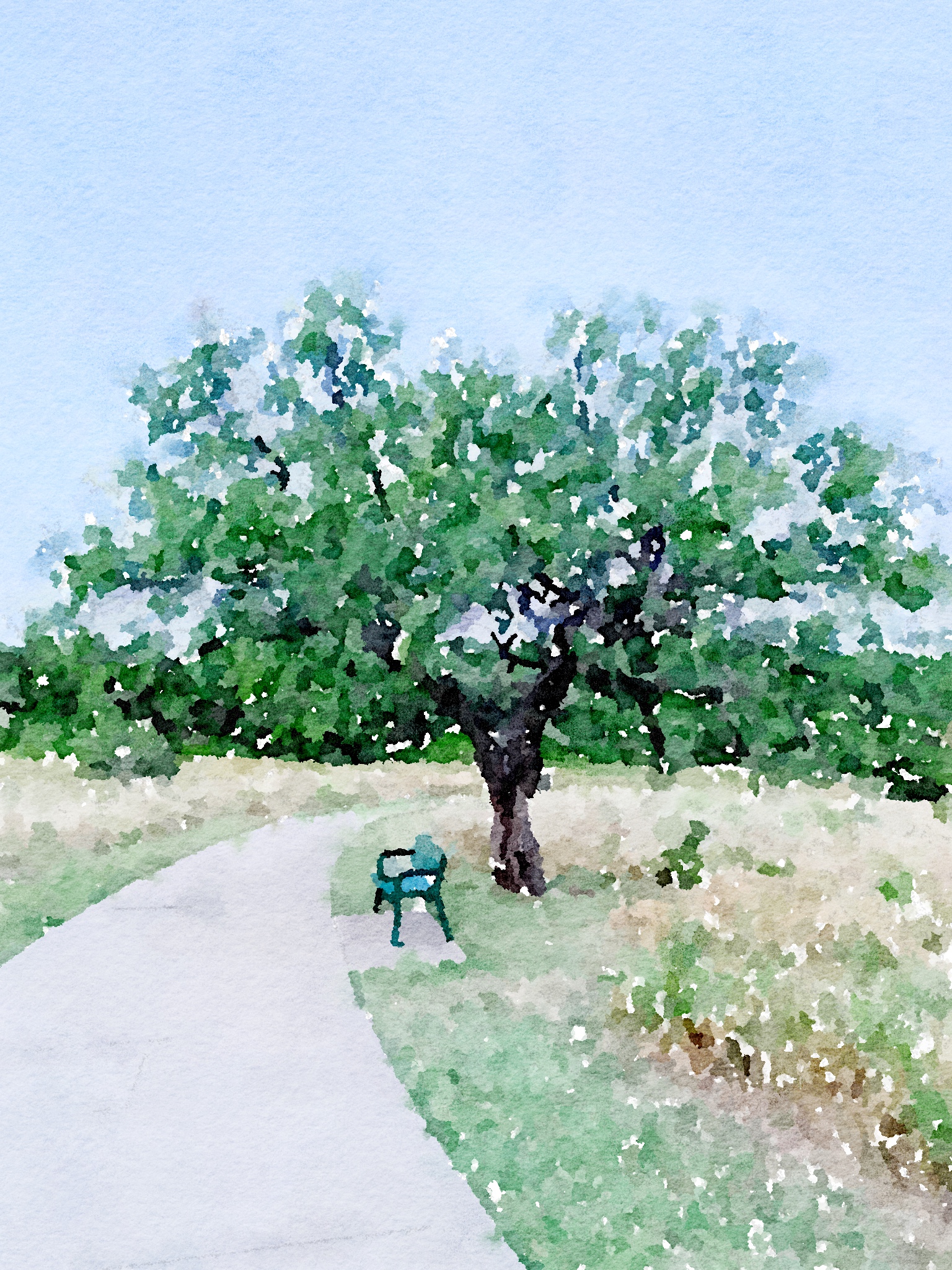
Photo by the author. Edited with the Waterlogue App
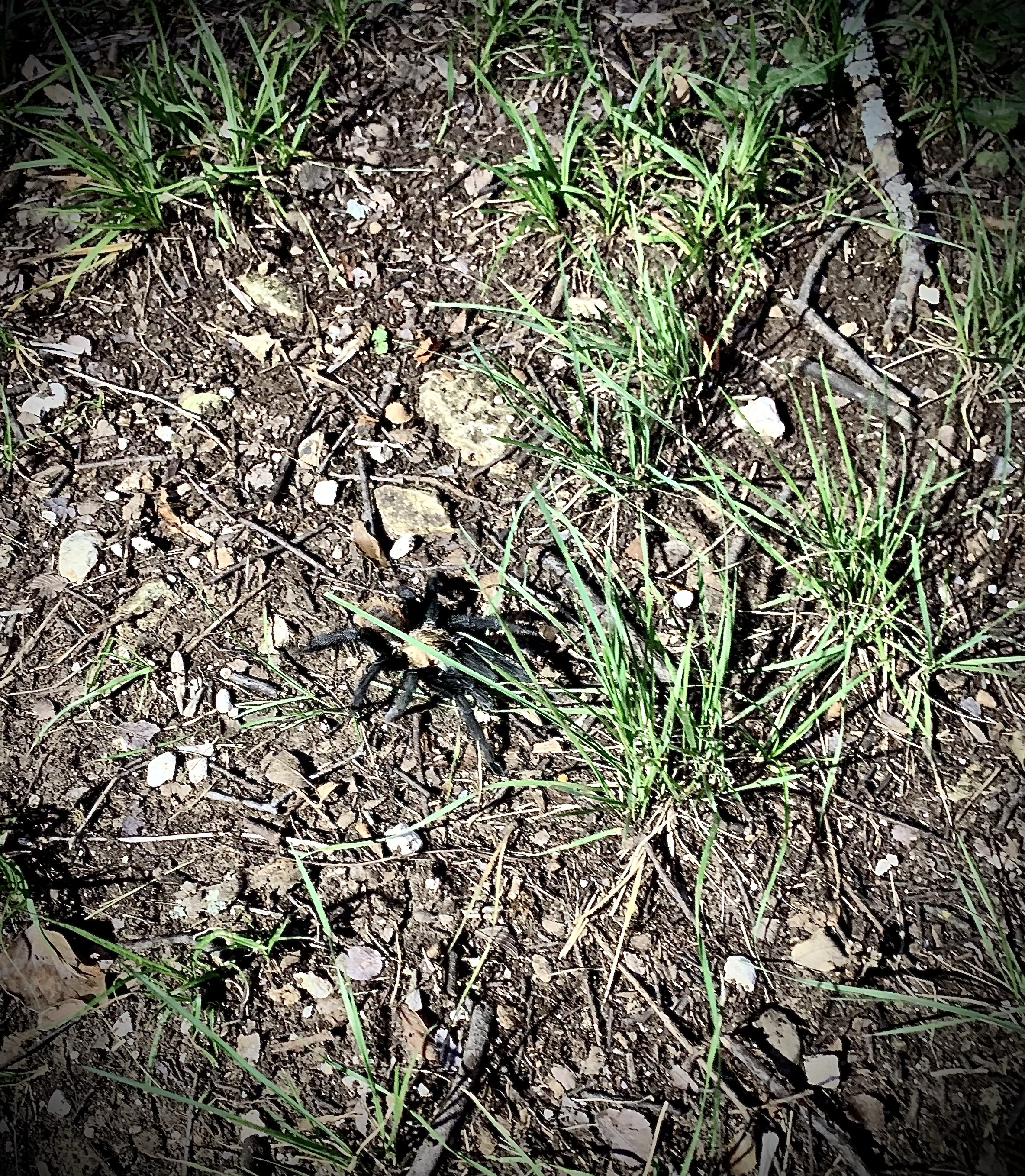
Summer is the season of love – for Texas tarantulas. Despite having eight appendages, they have no opposable thumbs and no way to access a special spider dating site. Like a shy single guy, the males venture out as the sun sets, searching for that one special arachnid lady. He must make a hasty love connection as the male tarantulas only live seven to eight years, while the females can live up to the ripe old age of twenty to twenty-five.
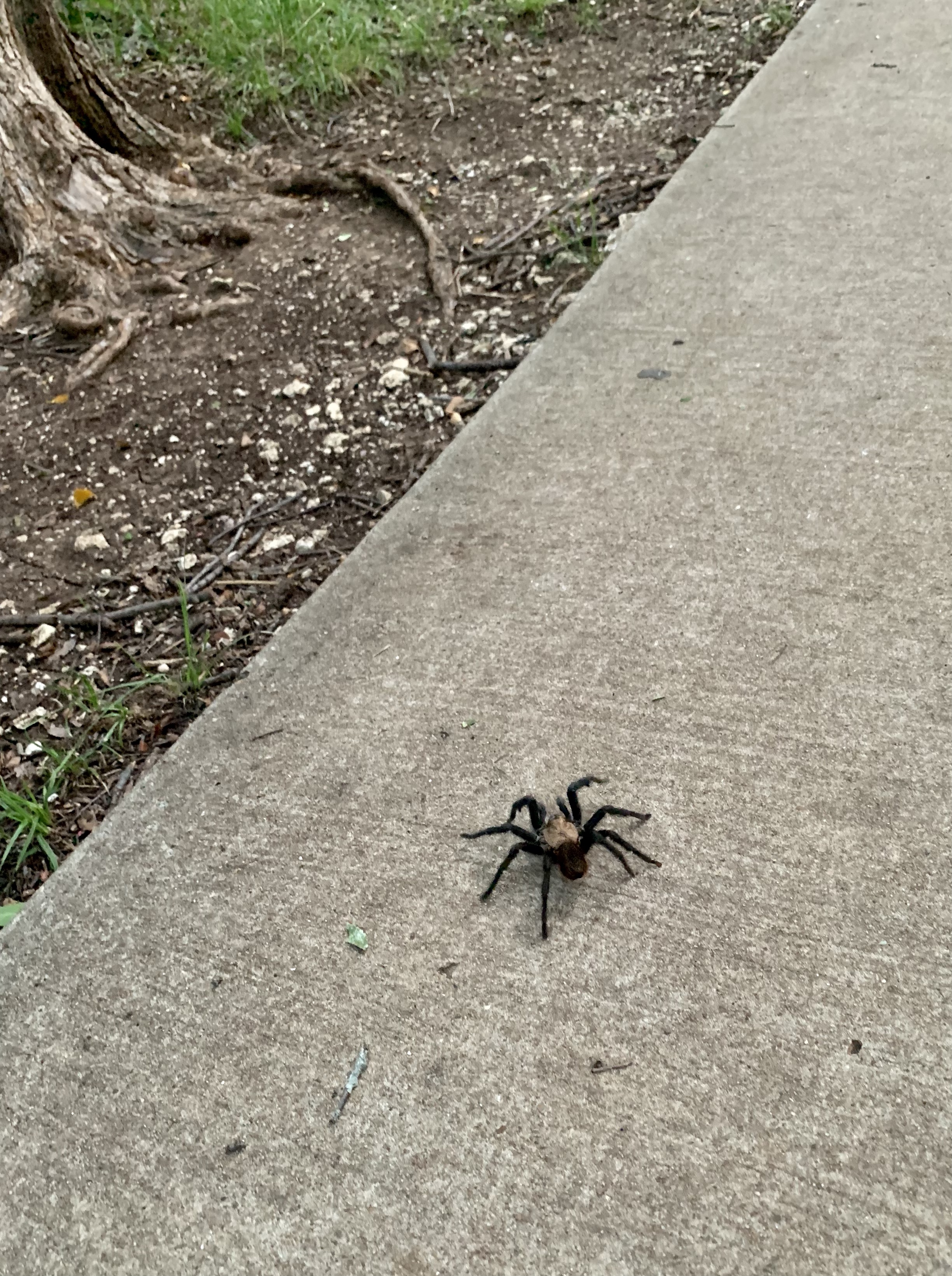
Photo by the author – male tarantula spotted at Arbor Hills Nature Park, Plano Texas
He hunts for his special love by scent, tracking a possible mate to her burrow. Once there, he taps on the fine webs at the entrance and hopes she’ll respond by swiping right in spider fashion. If the answer is yes, perhaps they’ll go out to dine on a fine meal of crickets before or after the romantic hook-up. However, if the female is not in the mating mood, she is apt to make a meal of her suitor instead. Either way, someone will have a nice dinner.
Photo by the author – Arbor Hills Nature Park, Plano Texas
I met Andrew, my husband, at Arbor Hills Nature Park. We had connected on a dating site and arranged our first date online. No need for a scent trail, I spotted him holding a Frisbee as he stood in a field near the parking lot.
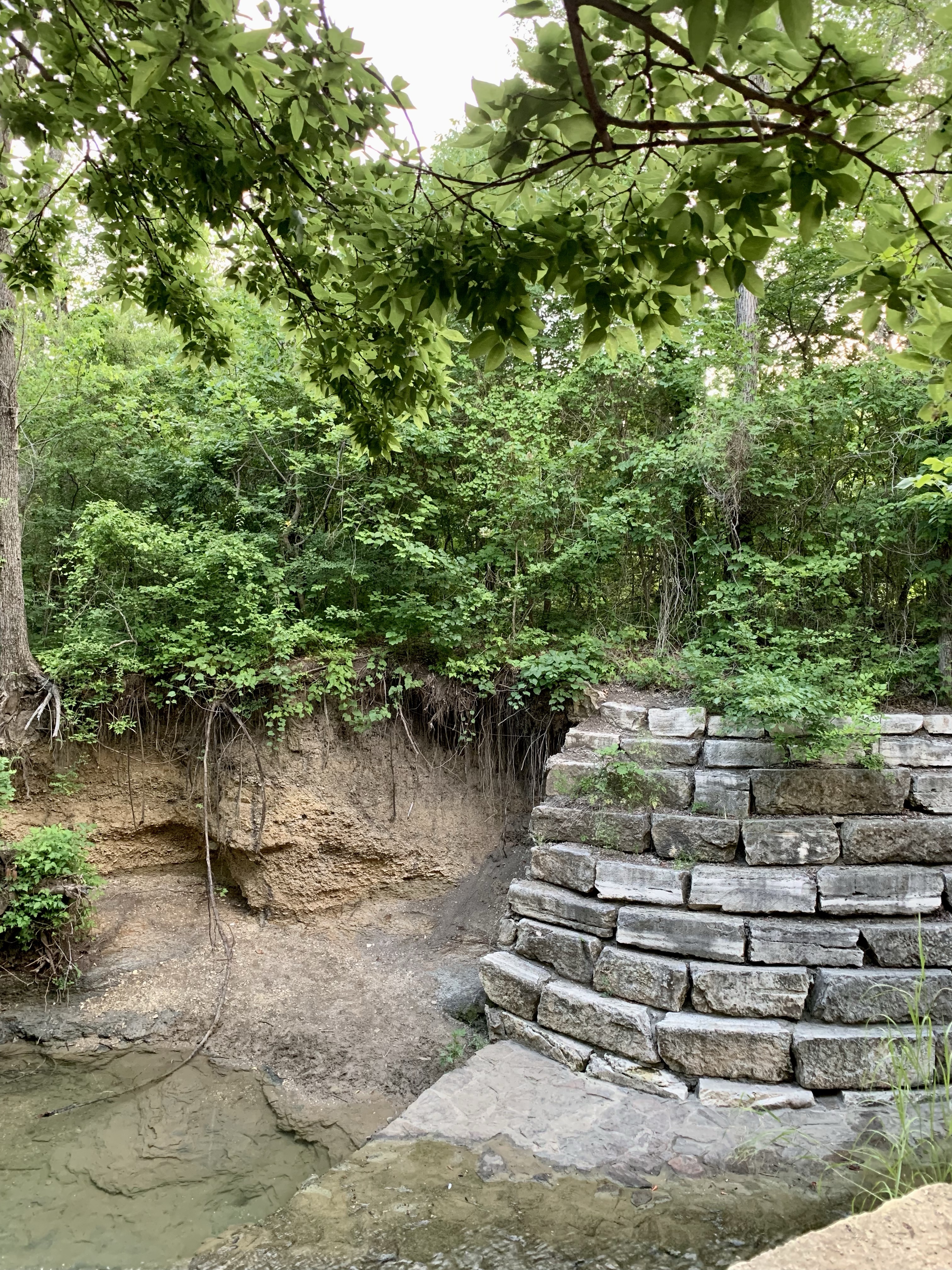
Photo by the author – the creek at Arbor Hills
Over the next few years we visited the park often, eventually sharing an apartment, our own cozy burrow, next to the nature area.
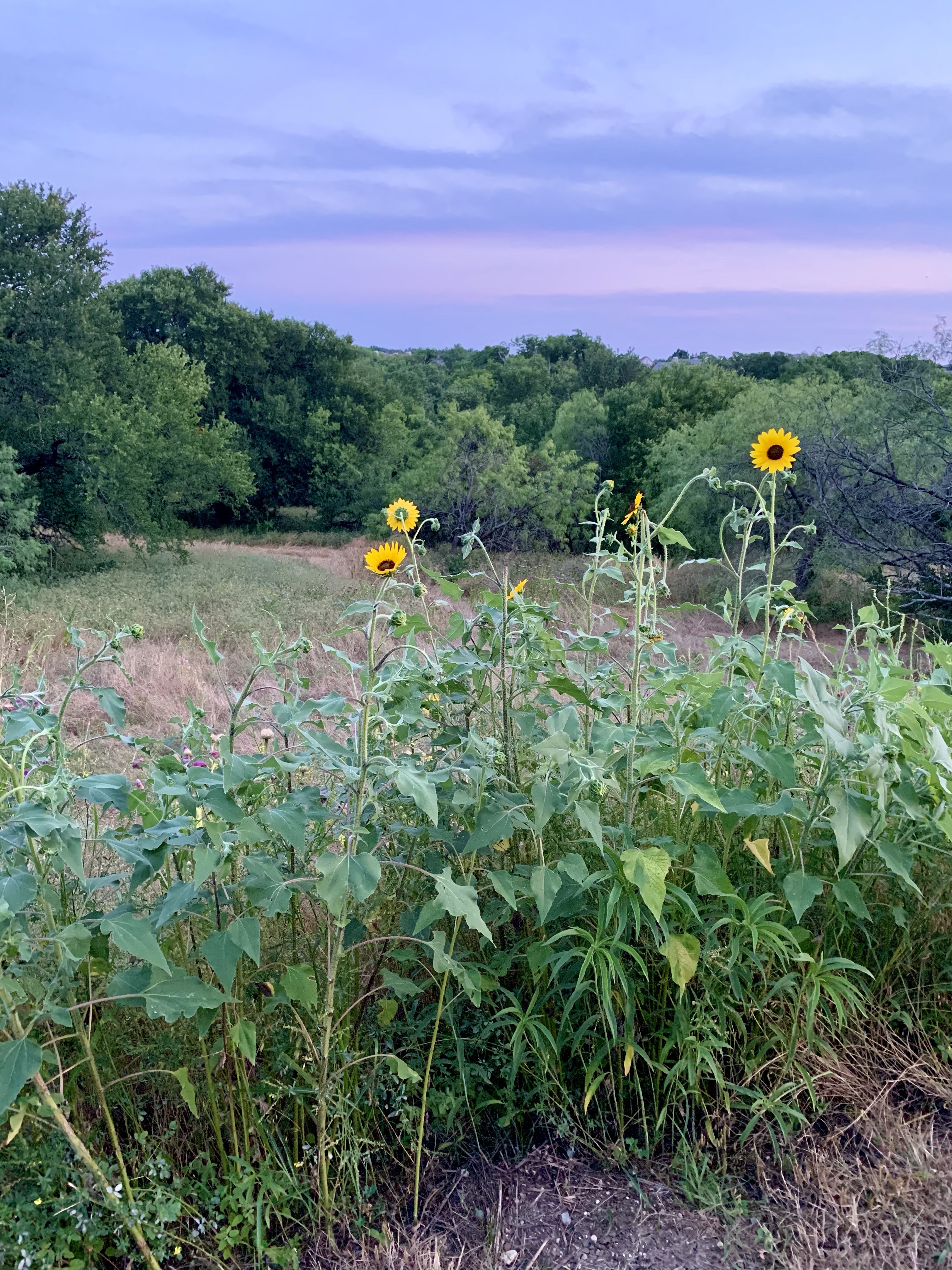
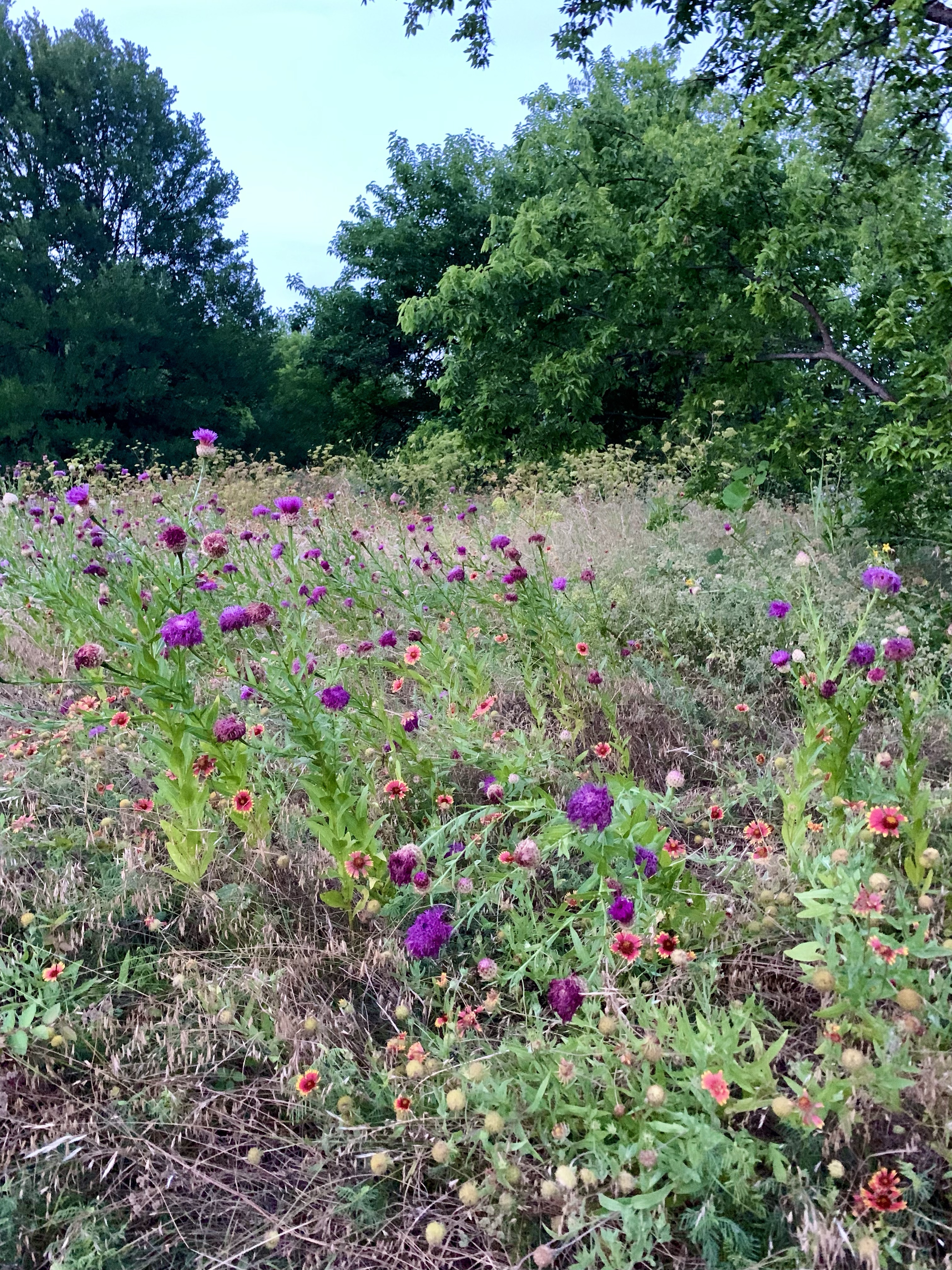
Photo by the author – wildflowers
Two years ago we bought a house and moved farther away from the park, too far to walk or drop in for night time strolls. Three weeks ago, before the summer heat turned the sidewalks to griddles hot enough to melt the rubber soles of our shoes, Andrew suggested an evening stroll at Arbor Hills. “The tarantulas might be out already,” he said.
Photo by the author – thistles and flowers
We arrived at dusk, at the last of the golden hour, right before the sky turned from blue to twilight lavender. Carrying flashlights, we hiked along the concrete trail that wound three miles through the park. In past visits we had often encountered the palm-sized, furry, brown female tarantulas. They crawled across the paths like something from a science fiction/horror flick, scurrying along on their own spidery missions.
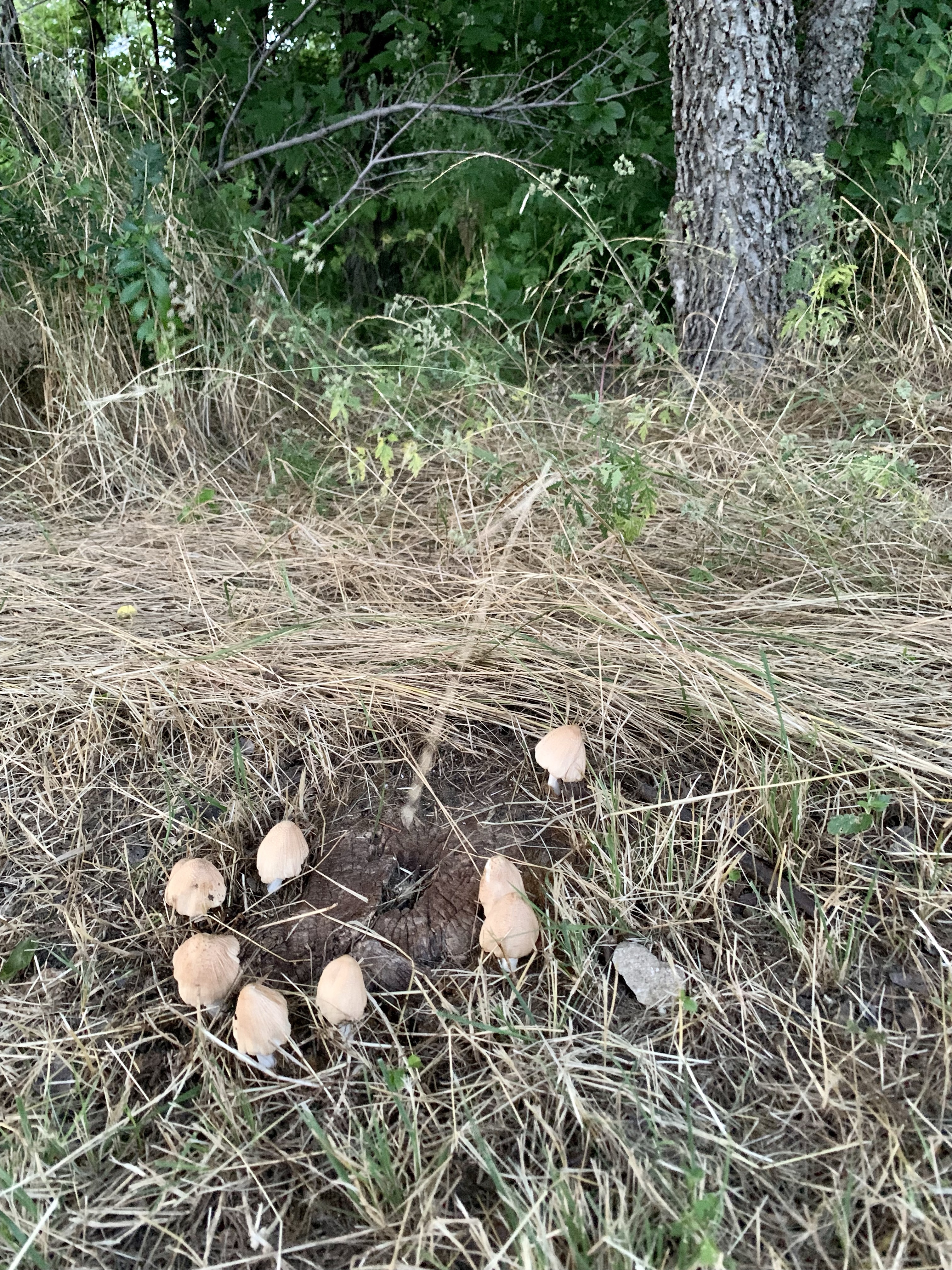
Photo by the author – mushrooms around a tree stump
“When will they be out?” I asked Andrew, as we drew near the back of the park.
“Look in the grass beside the trail. We’ll see the males first.”
A circle of mushrooms, a tiny Stonehenge, stood tucked in the dry grass. Andrew was the first to spot the tarantula.
Photo by the author
He emerged from the weeds and leaves and crawled onto the trail in front of us. Not monstrous at all, the tarantula weaved side to side along the concrete, like a bar patron leaving at last call. I snapped pictures and waved as he set out, determined to find love. I hoped he would find a mate that night, or if not, that he would keep searching. Arbor Hills was, after all, a good place to start.
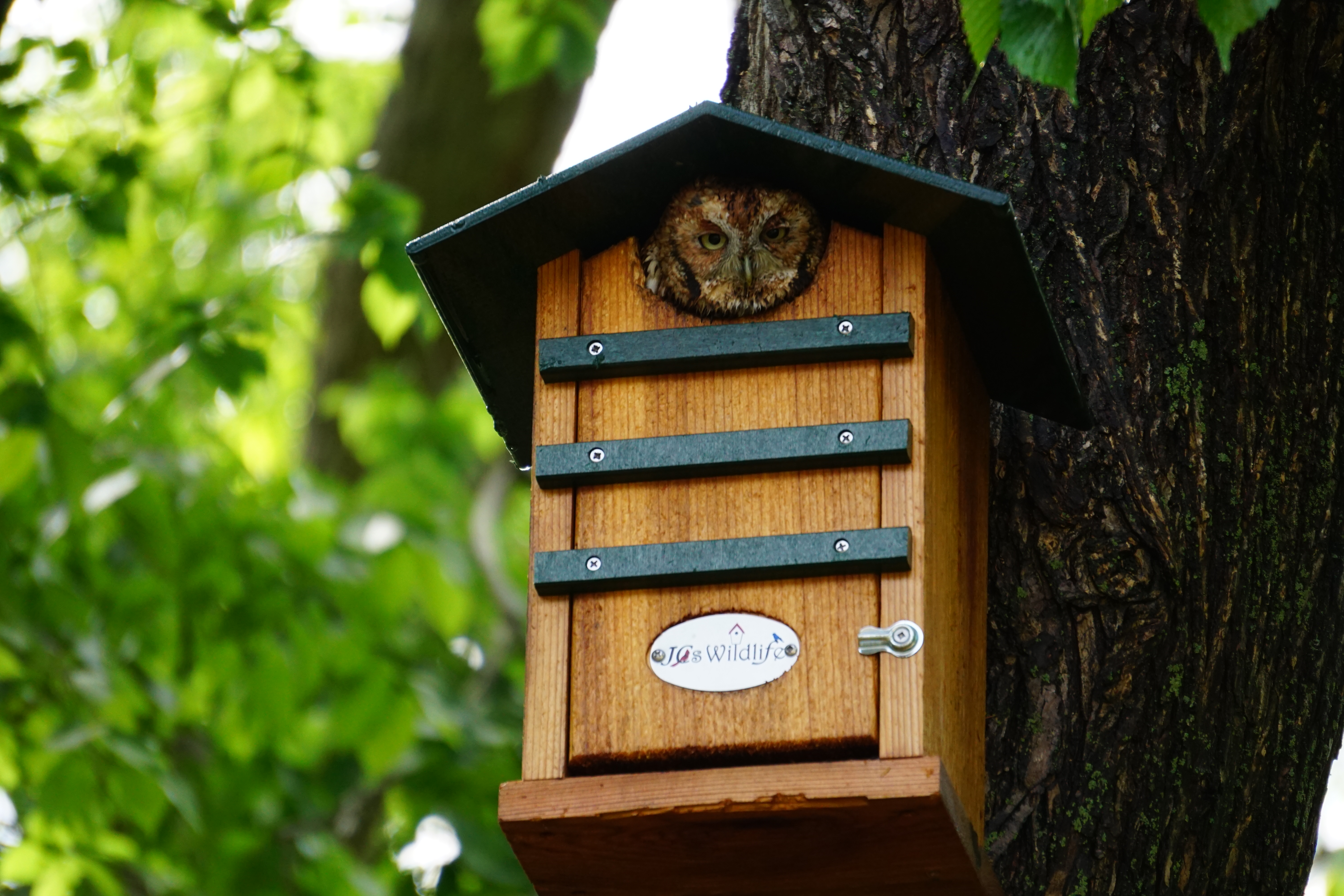
We installed the owl house with the goal of attracting a predator to our yard. Months back, we’d been overrun by a mischief of rats. They flooded our backyard every evening – a scurrying gray sea of rodents. Winter arrived and the tide of rats receded. Then, in late spring, we received our first resident owl. At first, Andrew and I rejoiced, happy to have our own rodent assassin on hand if the little buggers returned. Would we be blessed with owlets?
Excited, we broke out the binoculars. Andrew grabbed his camera and zoomed in for a portrait. With a creek bordering our property, we never want for wildlife. We were blissfully unaware of the consequences of inviting a bird of prey into our little sanctuary. After all, we had observed bobcats, raccoons, and possums wandering through our garden. I rely on a squadron of little green lizards to keep unwelcome bugs at bay.
Photo by Andrew Shaw
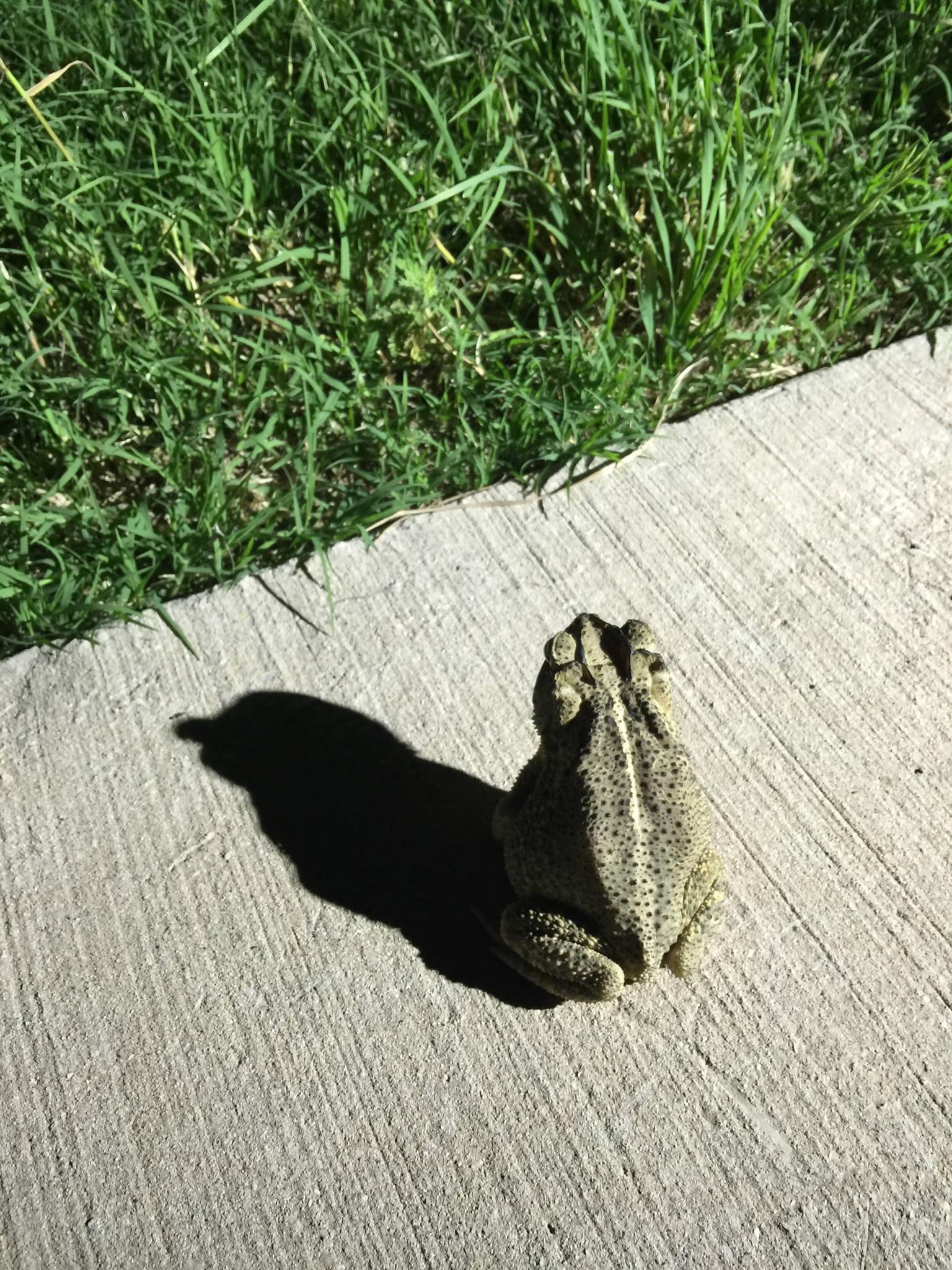
Along our sidewalk, toads alert on night patrol wait for juicy June bugs to stumble into their path.
Photo by Andrew Shaw
Not long after the owl first revealed itself, a chorus of squawks, chitters, and shrill whistles rose from our yard like a concert from an out of tune orchestra. Our visitor ducked back into the cover of the wooden house.
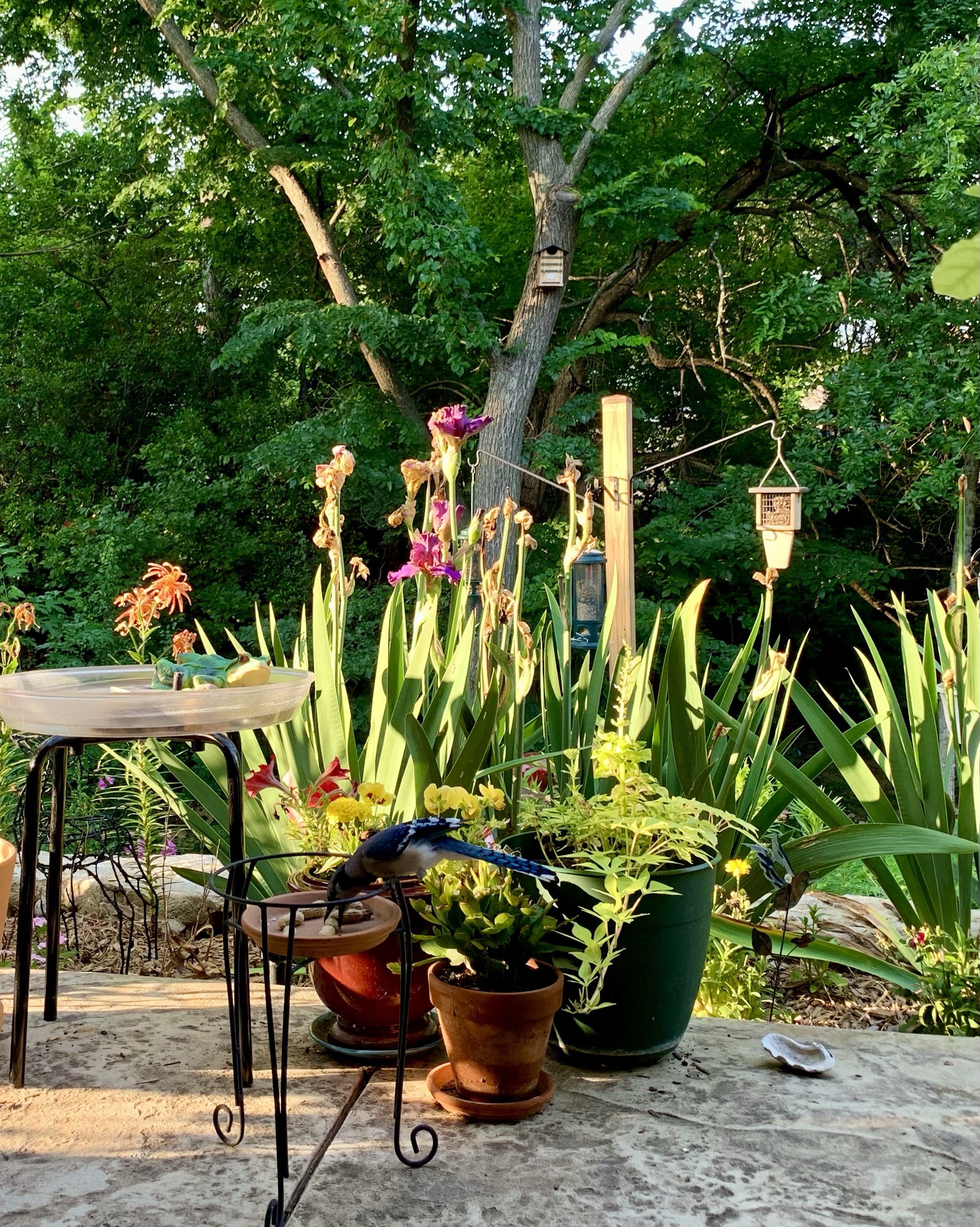
“What are they doing?” I waved at the flock of jays – a blur of blue feathers dive bombing the owl house.
Andrew stated the obvious. “They don’t like the owl.”
And no wonder. I realized we had placed the bird house directly overlooking our feeders. The ones where every morning a queue of owl-bite-sized wrens, chickadees, and finches appeared. Not so good for the victims, but a perfect opportunity for the bird of prey. We had installed a hotel room with a complementary breakfast buffet.
Photo by the author
Andrew and I joined in the ruckus, jumping and waving our hands while yelling “Shoo! Shoo!” The owl, unimpressed, poked his head out now and again to glare at us. Our songbirds – blue jays, cardinals, and chickadees – continued to squawk and dive bomb the bird house. This behavior is known as “mobbing” and occurs when birds feel threatened by a predator. They band together to harass the intruder. This continued throughout the day. The mobbing behavior reminded me of the short story The Birds by Daphne Du Maurier. Most people remember the Alfred Hitchcock movie based on the story. “We better remember to keep the feeders filled,” I told Andrew.
At last, at dusk, with the mob dispatched to their night time roosts, the owl emerged. He flew to the creek for a quick drink, then disappeared into the trees. We haven’t seen an owl since then, but we hear them sometimes. Possibly they are sharing the bad review of our noisy bed and breakfast.






 Let's Get Out of Here