I belong to a Facebook group called We Pretend it’s Still the 1970s. The rules are simple – post personal photos from that decade and comment on them as though whatever is pictured has just happened. No past tense, no mentioning the future. It’s an exercise in time travel that is both humorous and poignant.
I have yet to post anything on the page, but I’m a loyal lurker. The images remind me that I lived through that era. Scrolling through Olan Mills family portraits, prom snapshots, and polaroid pics of smiling girls with that Farrah Fawcett shag haircut – I can indulge in happy memories uncluttered by the anxious reality of my teenage years.
The past seems so far away, as though the events of the 1970s happened to a different person, not me. In a way, that’s true. I’m far from that teenager now, but sometimes I come across things that bring the memories back so vividly that I can touch them and feel their weight.
We’ve been organizing our household, trying to clear some of the clutter and decide which items are worth keeping, donating, or selling. As I sorted through decades of sewing supplies, I set aside anything I wanted to keep. I’ll hang onto the thread – wooden spools either inherited or bought at antique stores and plastic spools sporting the small green Walmart price stickers from before the age of UPC tags. There are at least two dozen spools of turquoise blue thread that Mom bought on clearance. It was a really good deal.
Me and my mom circa 1970s – I’m wearing a dress I made
My mother taught me to sew. First by hand with needle and thread, and then on her classic black Singer sewing machine. A junior high school home economics class rounded out my seamstress education. Throughout the 1970s I sewed dresses, skirts, peasant tops and anything else that could be whipped up over a weekend.
I don’t sew much now, although I do still own a sewing machine. Recently I took up quilting and I’ll hand stitch together the pieces while I’m watching television. It’s a relaxing hobby and it gives me an excuse to hold onto the boxes of thread. Eventually I might even use the turquoise color that my mother found so lovely. I think she would have liked that I found some use for it.
The cat arrived courtesy of Fedex delivery. This newest addition to our household was meant as a companion for my mother-in-law, Roby. She has dementia, and the robotic cat was designed to bring comfort to folks who would benefit from having a pet but who also no longer have the ability to care for one.
Kitty – Photo by the author
My husband Andrew and I had seen the description and photos of the cat, but nothing came close to preparing me for the unboxing. When I pulled back the last flap of cardboard, it revealed a creature not quite life-like, but also not quite resembling the toy we thought we had ordered. I lifted him from the box and set him on our dining room table. Not exactly the best place for a cat to perch, but this one wouldn’t shed or leave bits of litter scattered across the placemats.
Roby gathered him up, christened him “Kitty” and placed him on the dresser beside her bed.
Kitty – Photo by the author
The term “Uncanny Valley” was coined to describe the eerie feeling we get when something appears too close to human. Kitty in no way resembled a person, but he did share that characteristic of being too close to a living thing. In a dim light, from across the room, he reminded me of Church, the reanimated cat from the Stephen King novel, Pet Sematary. I know Kitty isn’t real, but I wonder if he might attempt to murder me in my sleep some night.
Kitty on his pillow
When Roby brushes his fur or pets his little mechanical head, Kitty unleashes a loud purr that sounds like gravel rolling in a tin can. If you rub him long enough, this noise is followed by his turning over for belly rubs. You can hear the gears grinding as he lifts a paw and rotates. His meow doesn’t sound exactly feline. Instead, the noise Kitty produces resembles the cry of a serial killer trying to lure us with an unsuccessful cat imitation.
Life with someone suffering from dementia has its challenges, but up until several months ago we had dodged one of the most difficult. Roby had never tried to wander from our home. Then, one evening while I was in a book club Zoom meeting, I heard the distinct click of someone unlocking our front door. I glanced out the window beside my desk in time to view my mother-in-law striding from our porch and toward the street. She didn’t seem confused about the journey – she moved like someone with an agenda.
“I’ve got to go,” I told the book club.
Outside, I rushed to get in front of Roby. “Hey, where are you headed?”
She gave me a suspicious squint and replied, “Anyplace but here.”
At that moment I couldn’t have agreed with her more. I imagined the neighbors watching and wondering why we had tossed our elderly parent out the door.
“You need to go back inside. It’s not safe out here.” If I thought a reasonable request would do the trick I was soon proven wrong. Roby tried to dodge around me. I threw up my arms and waved as I swayed back and forth like someone trying to divert a bear attack. This wouldn’t work for long. Although I outweighed her by at least seventy pounds, I couldn’t imagine picking up my five foot two mother-in-law and toting her back inside. Almost certainly there would be kicking and screaming, possibly from both of us. It was still daylight, the better to give everyone a good view of the tussle.
“I’m leaving and I’m not coming back,” she said.
By this time we had made it halfway down the drive. I considered letting her go. I could follow along behind her and pretend we were out for a nice stroll. My husband, her son Andrew, would be home soon. Perhaps he could pick us up if we made it to the interstate. Then I remembered the cat. “If you leave, Kitty will miss you.”
Roby frowned, but she stopped trying to get past me. She seemed to be trying to work out the connection between me, Kitty, and the awful place she had abandoned. We stood there, at an impasse. I decided to try going back inside. Maybe Roby would follow me, to make sure I didn’t bother the cat.
I made it to the front door. Roby didn’t move from her position at the end of the drive. She glanced back and forth between the sidewalk to freedom and the house. More encouragement was needed to lure her back inside. I went to her room and brought out Kitty.
“Here he is.” I held the cat by the scruff of its neck – no easy feat considering the creature was not soft and pliable but was instead polyester fur over a metal frame. Opening the lid to our plastic garbage bin, I said, “If you leave, Kitty goes in the trash!” This was an empty threat. At worst we’d sell him on Ebay. I shook the cat, and Kitty, interpreting this as a petting, began to meow and purr. Before he could twist in an attempt to roll over for belly rubs, I backed into the house. Roby, all thoughts of freedom now vanished, advanced on us like General Sherman marching on Atlanta. I dumped the cat on the dining room table and hid behind my office door until I was sure Roby was safe inside.
While Roby picked up Kitty and consoled him on his near brush with extinction, I locked and deadbolted the front door. My mother-in-law carried the cat back to his perch, and she settled on her bed beside him.
Roby hasn’t tried to leave since that day. Maybe her concern for Kitty keeps her grounded, or maybe she doesn’t remember what stirred her to escape. Thankfully, she forgot my part in the encounter. However, every time I see the cat I feel like I must apologize to him for my rough treatment. I know Kitty’s reactions are not governed by emotion – instead they are limited to his battery power. He isn’t a living animal, but in the dim light of the uncanny valley all it takes to make something real is our belief that it is.
I’m sharing a little story that I originally posted on Medium a couple of years ago. It’s a cautionary tale about having too much curiosity about the presents under the tree. Merry Christmas and Happy Holidays!
Do not Open Until
They were the ugliest ornaments he’d ever seen. “Are these supposed to be nutcrackers?” Adam held up one of the little carved wooden soldiers. Instead of the bright red of the traditional nutcracker, this one had a coat painted a dull maroon, the shade of an old scab. A scraggly beard adorned his face, as though the fellow had been on the run, without time to shave.
“They’re Santa’s soldiers.” Luanne, Adam’s girlfriend, grabbed hold of his wrist and scooped the figurine from his grasp. “This one’s Tom Toss. See, he has a little spear.
The soldier carried a long stick with a sharpened metal point. The glow from the living room fireplace glinted off the tip of the weapon. Too sharp, Adam thought, for something that children might handle.
“Santa’s soldiers?”
“Yes,” Luanne answered, “they guard the tree on Christmas Eve, to make sure no one snoops at the presents.” She gave him a pointed look, as though she suspected he’d be down here in the deep night, shaking boxes and disrupting the wrapping paper.
“A Christmas tradition, then.” Adam chuckled, hoping his laughter would cover up the disgust he felt looking at the ornaments. There were three more in the gold-foiled box. The remaining figures rested on a cushion of cotton, white like snow. Like the one with the spear, they all wore tall black hats and held their wooden arms stiffly at their sides. Luanne hung Tom Toss on the tree, then handed the box to Adam.
“I’ve had this one since I was a child. My grandmother gave him to me.” She lifted a chunky, round-bellied soldier to the Christmas tree. He carried a sledge hammer tucked under his arm. His coat was colored a mottled green, like camouflage. “Adam, meet Knockabout,” Luanne said.
“And this one?” Adam leaned over the box and brushed his finger across the face of a figure dressed in yellow. Unlike its square-jawed companions, this one had a pointed chin. The mouth gaped open, displaying rows of sharp teeth. “Ow!” Adam drew back his hand. A drop of blood welled up on his fingertip.
“Careful, that one’s Biter.” Luanne laughed. “And this one’s my favorite. He’s Pow Pow Boy.” This toy soldier was shorter than the others. His face, with its pug-nose and dots of paint to resemble freckles, resembled Luanne’s. A pair of boxing gloves covered his fists.
Adam, squeezing his injured finger, studied the tree as Luanne finished decorating. The four soldiers, posted at different points among the branches, glared from amongst the twinkling lights and silver garland.
“Remember, no peeking!” Luanne shook her finger at him. She wore a smile, but the past year of experience with the woman had taught Adam this was only the appearance of joviality. His girlfriend was dead serious about the snooping.
“Scouts honor, I’ll be nowhere near the tree tonight.” He wondered what she’d gotten him. Nothing too fancy, he hoped. Adam’s present to his girlfriend was a bottle of her favorite perfume and a gift card to the neighborhood coffee shop.
Luanne had carefully organized their Christmas celebration. Ice skating, caroling, shopping, viewing holiday lights—the whole parade of holiday events. She kept a calendar, with specific dates blocked out for each activity. The whole thing felt more like a ritual than the spontaneous enjoyment of the season.
At last they settled here, presents wrapped and fireplace blazing, in her family’s cabin. Tomorrow, Christmas Day, the rest of the clan would arrive. Luanne insisted they wait until Christmas Eve to set up the tree. On the way here, they’d driven to four different lots until they found a specimen Luanne deemed acceptable. “It has to be a Douglas Fir,” she said. “That’s what we always have.”
The sap that oozed from the cut trunk reminded Adam of bodily fluids. He considered it gruesome that this tree had only recently been a living thing, and now it was stuck here, festooned with gaudy tinsel and baubles. Like hanging ornaments on a corpse.
“Here’s to our first Christmas together.” Luanne lifted her glass of mulled wine in a toast.
Adam clinked his glass against hers. “Cheers,” he said. The first and the last, he thought. Adam planned to break up with her after Christmas, once a suitable amount of time had passed. Only an asshole would dump someone during the holidays. There was Valentine’s Day coming up in February, so he’d better make a clean split in early January.
An unfamiliar noise woke Adam in the middle of the night. Luanne dozed beside him, her arm flung out on top of the covers, her lips puffing out with each soft breath. He eased from the bed and listened for the sound. He heard it again, from the living room, a rustle and tap as though someone were knocking on the window.
Easing from the bed, he crept out of the room. They’d left the lights on the tree plugged in, and the living room lit up in flashes of red, blue, green. Outside, the wind buffeted the shrubbery lined across the front of the cabin. Adam peered out the window, his breath misting the cold glass. A branch skittered against the window, and Adam muttered, “That must have been it,” as he rubbed his palm to clear his view of the front porch.
A dark form lifted from the pines at the edge of the clearing. It floated over the cabin, the moonlight casting an ink-stain shadow on the snow. Adam started, before deciding the dark thing was an owl, hunting for dinner. He stepped back, forgetting the tree and the presents behind him.
One foot knocked over a stack of gifts wrapped in red and white striped paper, and as he bent to grab the pile, he elbowed the tree. The ornaments jingled and one of the nutcracker soldiers fell to the hardwood floor with a clack. This would have been bad enough, but Adam, unbalanced, stepped on the little figure.
“Oh! Crap!” He picked up the soldier and hung it back on the tree. The figure’s arm, the one securing the hammer, lay broken next to a package wrapped in green paper dotted with penguins. Had he been wearing shoes, the damage would have been worse. In the morning he’d confess to Luanne and offer to glue the arm back in place.
“I’m sorry, Knockabout,” Adam whispered. “We’ll have you right as rain soon.”
As he rearranged the gifts under the tree, he tried to remember the exact placement of each box. Maybe if he put them all back like they were before, Luanne wouldn’t notice the broken arm until later. He could blame her little brother, or maybe they’d bring the family dog, always a convenient scapegoat.
The last box was covered in white paper with glitter stars. The tag read “To Adam, From Luanne.” After he listened to make sure his girlfriend still slept, he picked up the box and shook it. Something shifted lightly inside. It was slightly larger than a paperback book, long and thin. Maybe it held the Patek Philippe watch he’d been lusting after. Adam felt a brief pang of guilt. If it was the watch, he’d have to stick around through Valentine’s Day at least. He tucked the package back under the tree.
Thirsty, he stopped in the kitchen for a quick drink before climbing back into bed. He was standing at the sink, a tumbler of water lifted to his mouth, when he felt a sharp stab on his ankle.
“Hey!” Adam shook his foot. A tiny mark, like a pinprick, leaked a bit of red down the side of his foot. Something small and dark scurried behind the kitchen door. A rat? He grabbed the door and flung it closed. Tom Toss, the toy soldier with the spear, stood there, only this time he wasn’t carrying the weapon.
“What the…!” Adam jumped. The soldier dashed past him, back to the living room. Adam turned to follow – certain he hallucinated the image. It had to be a rat, one that ran around on two legs. He’d check the tree, make sure all the ornaments were still there.
Adam made it halfway across the living room floor when Biter latched onto his calf. With a scream, Adam beat at the nutcracker until it fell away, tearing off a chunk of flesh as it went. Panting, Adam limped toward the bedroom. He’d lock himself inside, away from these monsters.
When he started down the hallway, a tall shadow rose to block the path. It was the one-armed Knockabout, a seriously pissed Knockabout, who had grown somehow, until the top of his black hat brushed the ceiling. He raised his hammer and Adam turned to race back down the hall.
He bounced against the walls, Knockabout’s thundering steps at his heels. The kitchen! He’d run into the kitchen where there were knives and things he might use as weapons. Adam spun around the corner and ran smack into Pow Pow Boy.
“No!” He collided with the toy soldier, now the size of a small boy. They fell in a tangle of arms and legs. Adam struggled to his feet as the boxer landed a glancing blow to his side. “Oof!” Adam lost his breath with a gasp. He crawled into the kitchen. Where were the knives? Frantic, Adam yanked open drawers, sending the contents clashing and crashing to the floor. At last, his hand closed around the hilt of a sturdy butcher knife.
“All right, you bastards,” he called, waving the knife. Pow Pow Boy appeared in the doorway and stood there, gloved fists lowered. Biter and Tom Toss, grown to the size of cocker spaniels, tip-tapped up behind the boxer. Where was Knockabout? And where was Luanne? Surely the racket would have awakened her. Unless this was all a dream, a side effect of too much mulled wine.
“Come on then, let’s have it,” Adam said. He’d taken a step toward them when he heard the patter of bare feet approach from the hall.
“What’s all this?” Luanne clutched her robe and stood in the doorway, beside Pow Pow Boy. “What happened to poor Knockabout?”
“Those things…” Adam said, pointing with the knife. He couldn’t explain, couldn’t find the words. If he pinched himself, would he wake up at last?
“You were snooping!”
“It’s not like that.” Adam had a moment, where he wondered why Luanne was not frightened or even curious why her toy soldiers had come to life. The moment passed, Luanne nodded to the gang, and then they were upon him.
******
He woke to light streaming in through the living room window, his field of vision partly blocked by evergreen needles. Had he fallen asleep underneath the tree? Then Luanne’s face loomed into view, impossibly large.
“There now, good morning,” she said. He tried to reply, but his mouth didn’t work. His jaws clacked together uselessly. Something was wrong with his arms – they were frozen at his sides. He clutched the knife from the night before, and suddenly it all came back to him.
“I think I’ll call you Slash Dash, my new special ornament.” Luanne smiled. Adam tried to scream, his wooden jaws stretched wide as she said, “We’ll have a lovely Christmas together forever.”
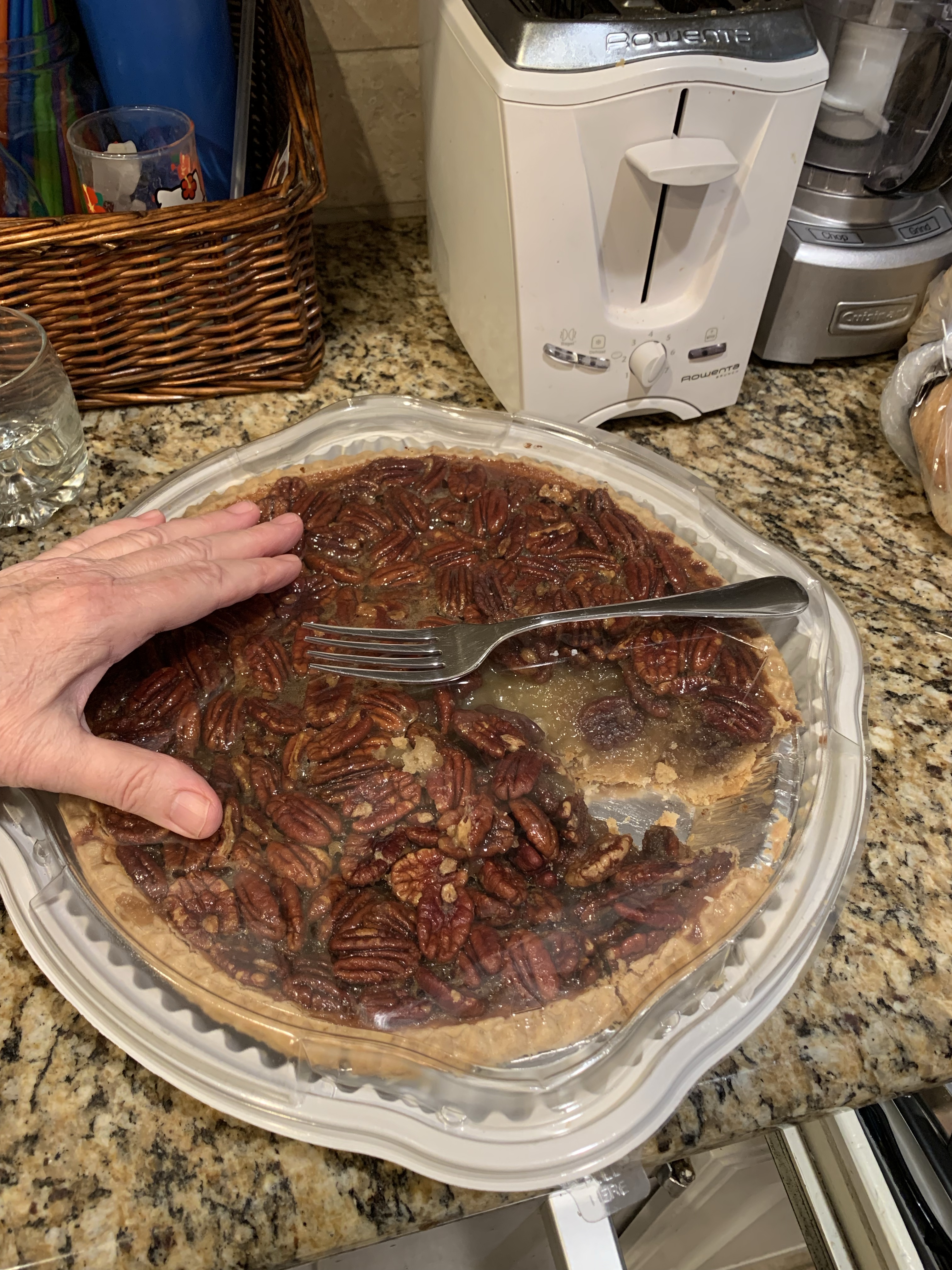
I love pecan pie. Yesterday, our realtor gifted his clients with Thanksgiving pies. We bought our house two years ago, in the middle of a crazy market, when investors were slinging cash like the Monopoly banker. Without his expertise, we wouldn’t have been able to find a place to call home. For that, we are grateful to Kreg Hall. The pie is a bonus. A large bonus, as I am the only one in our household who likes or can eat pecan pie. To make it last, I’ll freeze portions and enjoy it during the winter months. Each time I sit down with coffee and a slice of pecan pie, warm from the microwave, I’ll lift a fork in gratitude for the blessings we have and the good people in our life.
Below is a post from 2017. I wanted to share it again, I hope you enjoy reading it.
Join Hands, Give Thanks
I lived through two decades before I discovered that there were people in the world who made dressing with stale bread cubes instead of fresh cornbread. My oldest sister’s second husband, the nice one, was from somewhere up North. New York, I think. He had dark, pomaded hair swept up and back and he smiled and spoke with an accent I had only ever heard on television. He made a bread stuffing with oysters. I forgave him because it was delicious, each mouthful a feast of earthy black pepper mixed with the salty ocean taste of oysters. Home from college, my mother volunteered me to drive the two of us up to Malakoff, Texas, where my sister and her new husband had retired to life by the lake. In those days before GPS, I got lost following my sister’s handwritten directions. We arrived late, but to a feast still warm and laid out on their Formica topped kitchen island. I wish I had asked him for the recipe for that oyster dressing.
My mother made her dish the Southern way, with cornbread. She used white corn meal, soft as sand, with a bit of flour, scooped up and sprinkled in like snow. Baking soda and baking powder for leavening, for we all need incentive to rise. Buttermilk to mix, salt and bacon drippings for flavor, then all poured into her largest cast iron skillet, warmed on the stove so the crust will brown first. It came out like a pale yellow moon and filled the kitchen with the warm, sweet scent of corn. For the dressing she mixed in celery, onions, broth, and enough sage to repel evil spirits.
When I was young, we traveled to my grandmother’s house for Thanksgiving. Not over the river or through the woods, but past the lake and along Highway 380 the 15 miles to the town of Farmersville. My mother brought her cornbread dressing and a pie or two as her contribution to the meal. I held the warm pan of dressing on my lap where I sat in the slick vinyl backseat of our 1970 Oldsmobile and tried not to drool on the foil covering the pan. My grandmother’s wood frame house had a tiny living room decorated with an autographed photograph of a famous televangelist, before the fall. She sent him money and prayed for healing by laying her hands on her Chroma color television while he preached. The children, including anyone under the age of 18, were banished to the back porch. We fought over metal folding chairs and balanced our plates of food on our knees while we fended off the horde of feral cats living in my grandmother’s yard. The cats were only slightly outnumbered by my cousins.
Some years we visited my father’s family, where my aunts made their dressing and gravy seasoned with the chunks of turkey heart, liver, and gizzard that came packaged and concealed inside a store bought turkey. The first time I cooked a turkey I didn’t realize there was this hidden prize inside. I found them after, steamed and tucked under the skin at the front of the turkey, where his neck would have been if it weren’t shoved up into the body cavity. The neck was roasted too, because I didn’t know there was a second, secret scrap part buried inside my turkey.
My first husband was from Missouri, and the bread stuffing his mother made was moist, but thick, and had to be scooped out in chunks. My father-in-law, an honest, hard-working mechanic and assistant Boy Scout leader, led the prayer each year, insisting that we all stand before the table and join hands. You haven’t really experienced Thanksgiving gratitude until you’ve had to convince a squirming toddler to stay still during a ten minute blessing while the aroma of roasted meat and cinnamon spiced pumpkin wafts over you in a moist cloud of steam you can taste.
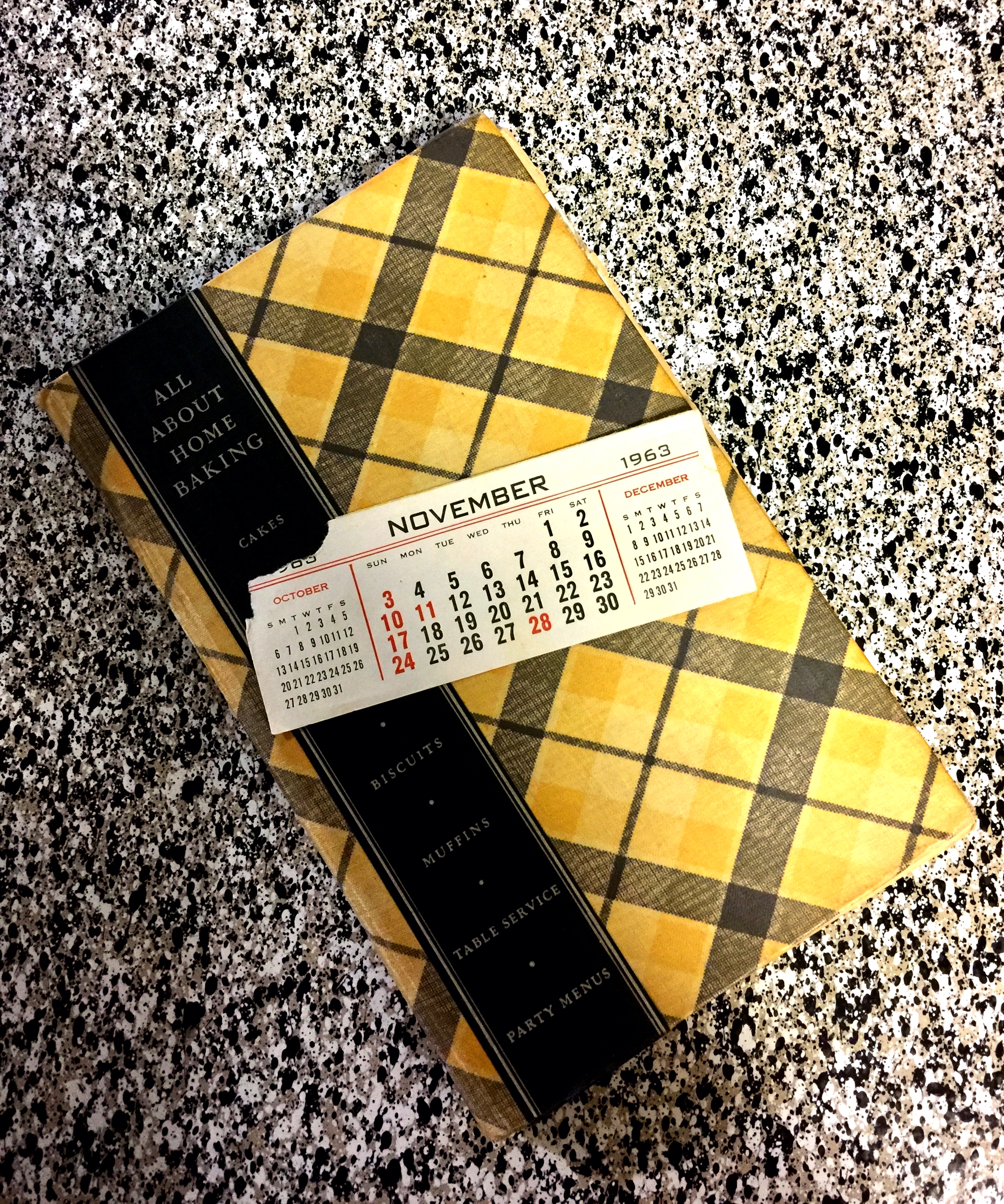
My mother stopped cooking a turkey for Thanksgiving after my parents divorced, when it was just the two of us left at home. She would roast a chicken instead, and make her cornbread dressing. I never saw her consult a cookbook. She cooked from memory, measuring out ingredients to taste except when she was making a pie or a cake. After she moved into a nursing home, I found a cookbook tucked away in a box she had stored in her laundry room. The book, All About Home Baking, had penciled notes in the margins and tucked inside the front cover, scraps of lined paper with recipes written in her delicate, looping cursive. Brittle, yellowed pages from a 1963 calendar fluttered out like falling leaves when I turned the pages of the book.
I roast a turkey every year, even when there are just one or two guests and my vegetarian husband at the table. This year I’m cooking both turkey and a ham. I’ll make cranberry relish from fresh cranberries and oranges and add so much sugar that it passes for jam. We’ll have pumpkin pie and a minced meat pie like my mother used to make, even though no one but me will eat it. It is a deliberate luxury on my part to have a whole pie to myself. My husband, Andrew, will mash potatoes so they come out just the way he likes them, a little bit creamy and with a few tiny lumps. When he leaves the kitchen I will sneak in more butter and salt to the dish.
I don’t cook my mother’s cornbread dressing. I’ve fallen from grace and into the boxed, instant variety but at least it’s the cornbread version. I’ll make traditional green bean casserole with crispy fried onions on top and a spinach rice casserole from a recipe my aunt gave to me. I don’t put marshmallows on the yams, instead I’ll serve them with a pecan streusel topping like my ex-husband’s mother, my first mother-in-law, made.
The guests at the table, the cooks in the kitchen, and the fellowship changes, just as the feast stays the same. I touch my past as my hand stirs the pot, preps the bird, and kneads the bread. I bow my head in silent thanks and join hands with all, even those who are absent from the table. Join hands, bow heads and give thanks. Give thanks for the love we are all about to receive.
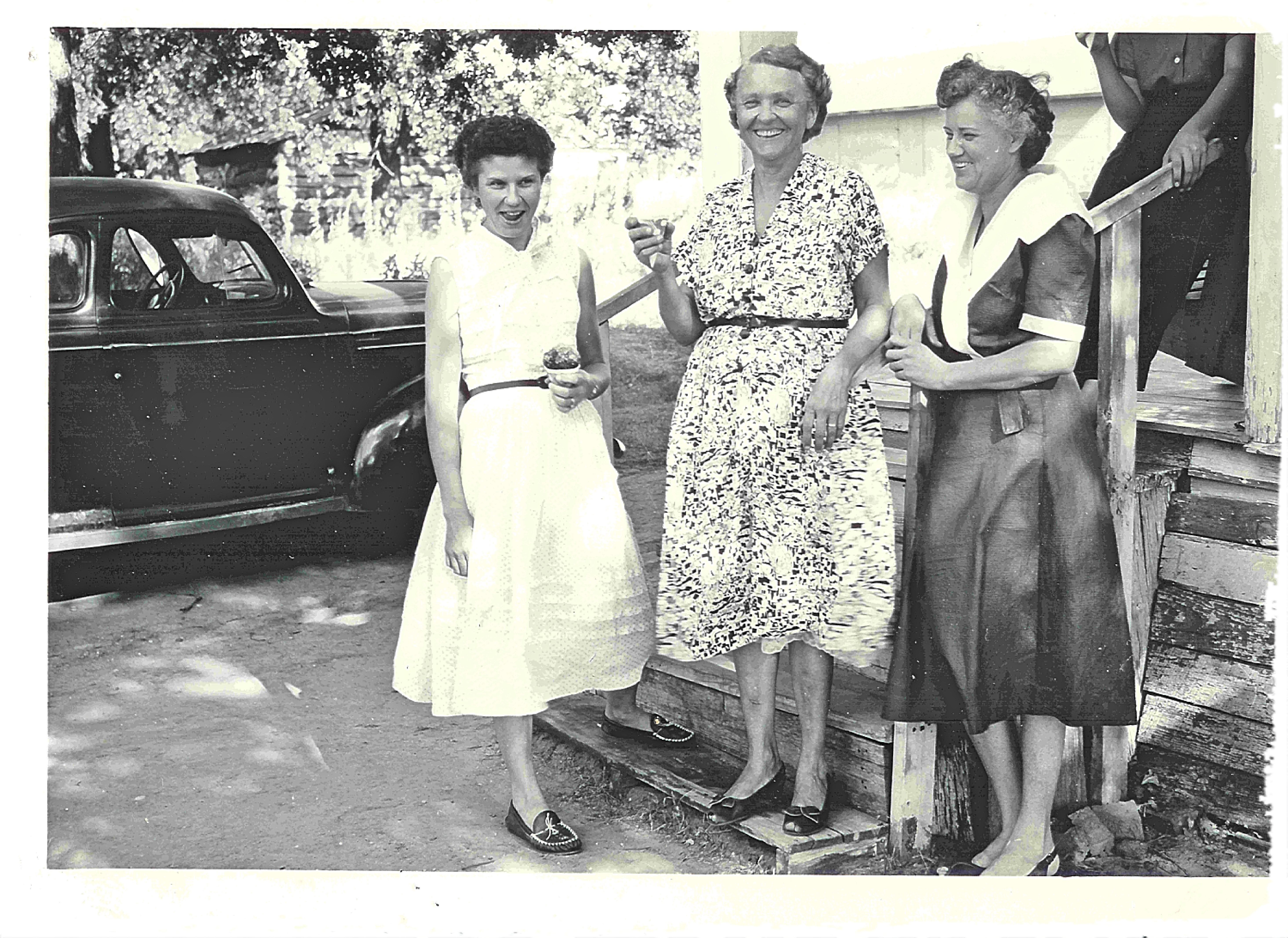
From the left: My mom, my maternal grandmother, and my aunt
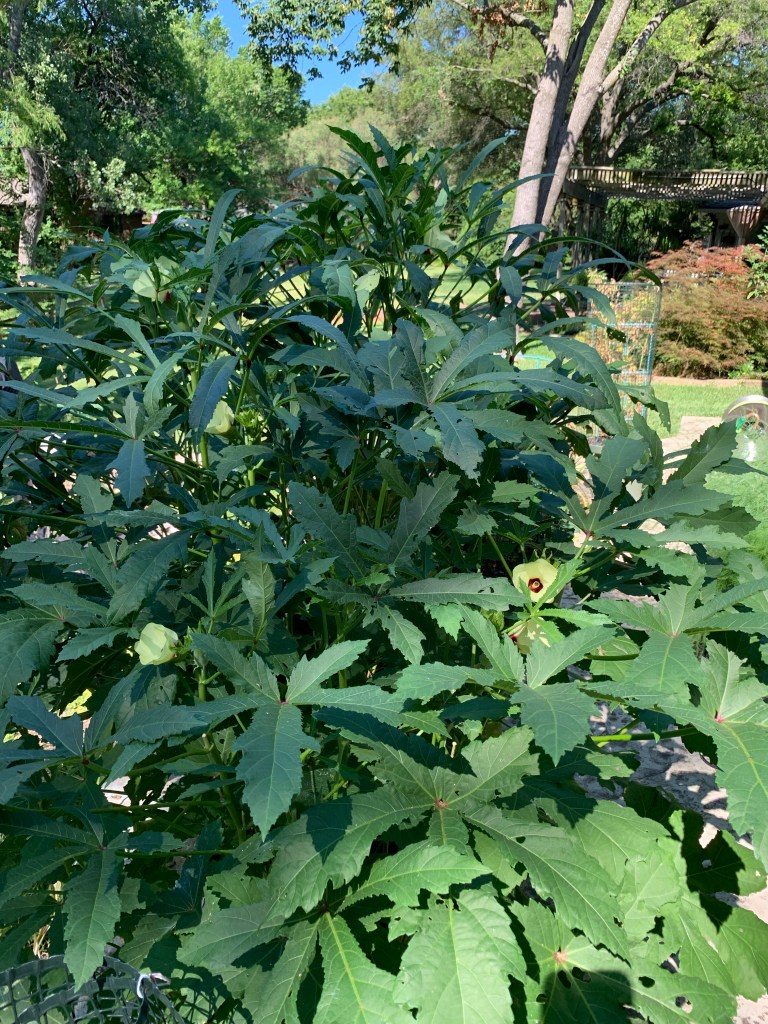
I come from generations of gardeners. When we moved into our house last year, it was too late in the summer for planting. I vowed an early start in the next season. This year, however, brought mostly failed experiments with container gardening. My tomatoes grew weary in the dry heat, dropping leaves and blossoming worth with small, wrinkled fruit. I tried summer squash – remembering the butter yellow vegetables my mother grew. My plants protested confinement in pots, however large. But one hardy vegetable flourished in the ten square feet I allotted it. Okra, that heat-loving Southern staple.
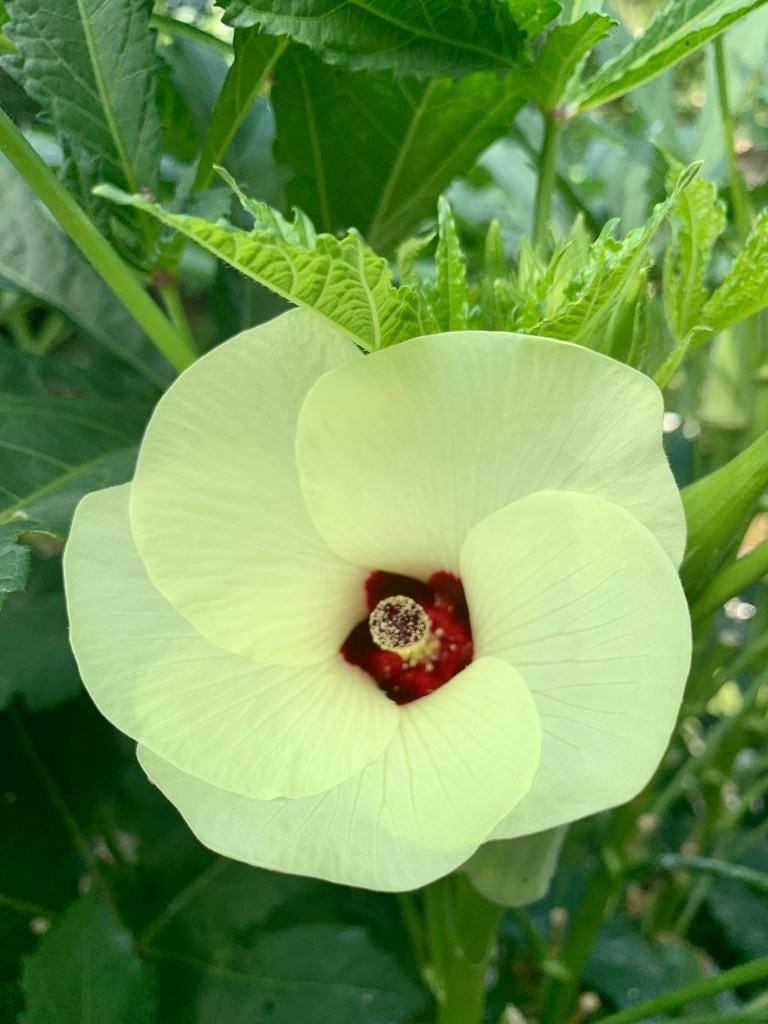
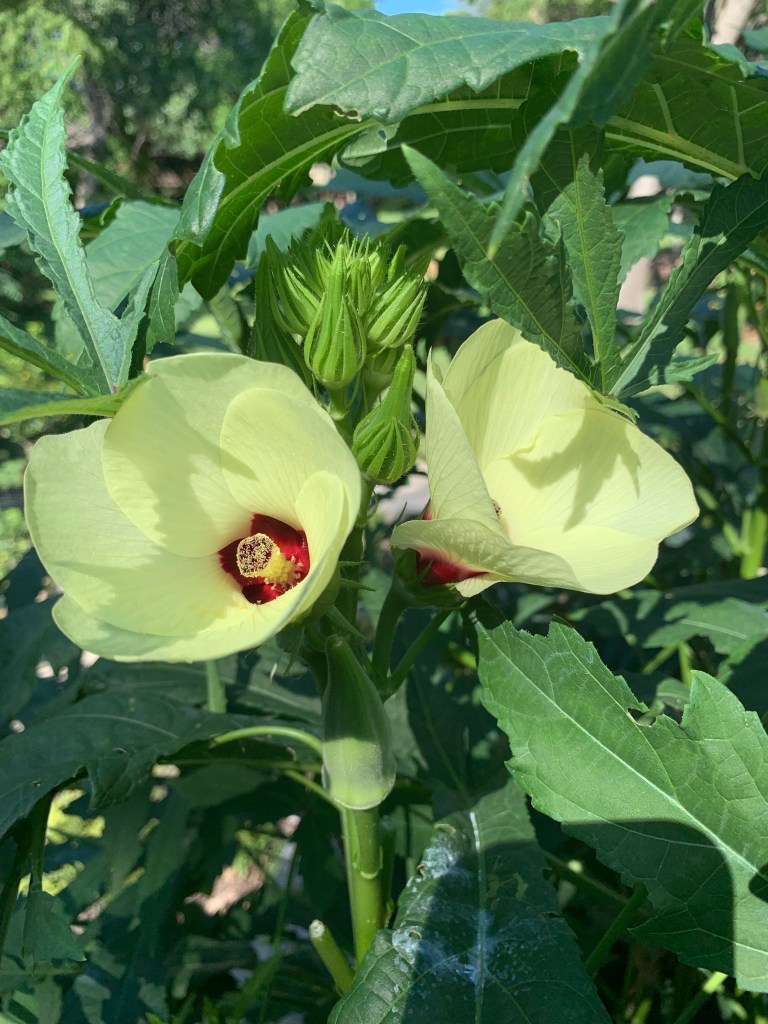
It’s one of the easiest plants to grow, and it makes an interesting addition to your garden. The yellow blossoms with their deep red centers reveal the plant’s place in the mallow family, a relative of the hibiscus. A little water, lots of sun, and you’re rewarded with hardy, heat-loving stalks and enough okra pods to share with your friends and family. Okra is best right after it is picked. The stuff you see in a grocery store most likely will be soft and wilted. If you don’t have a spot to grow it yourself, pick it up at a Farmers Market. Okra is delicious roasted. Boiled it makes a tasty thickener for stews and gumbo. My favorite way to cook it is to bread it in either corn meal or flour and fry it.
Okra
The blooms open in the early morning sun, around the time I set aside for harvesting the pods. Bees circle the plants, landing and picking up their fill of pollen while I brush aside the broad leaves and search for the tasty green okra. I’m growing Clemson Spineless – a kinder variety from the one I picked as a child in my mother’s garden. Those plants and their pods were covered in prickly spines that raised red welts on the tender flesh of my arms. The rash, however, was payment for the reward – plates of crunchy, cornmeal breaded and fried okra.
Okra plants in my garden
As I pick the pods, I can imagine the taste of the crispy chunks. Okra has a flavor that reminds me of cool green grass. It tastes like summer. I remember my mother, setting the table with fried okra and red slices of tomato. She pan-fried her okra in shortening with a little bacon grease mixed in for flavor. I cook mine in canola oil and skip the bacon grease. Like my mom, I use a cast iron skillet. Each bite I take I taste the past.
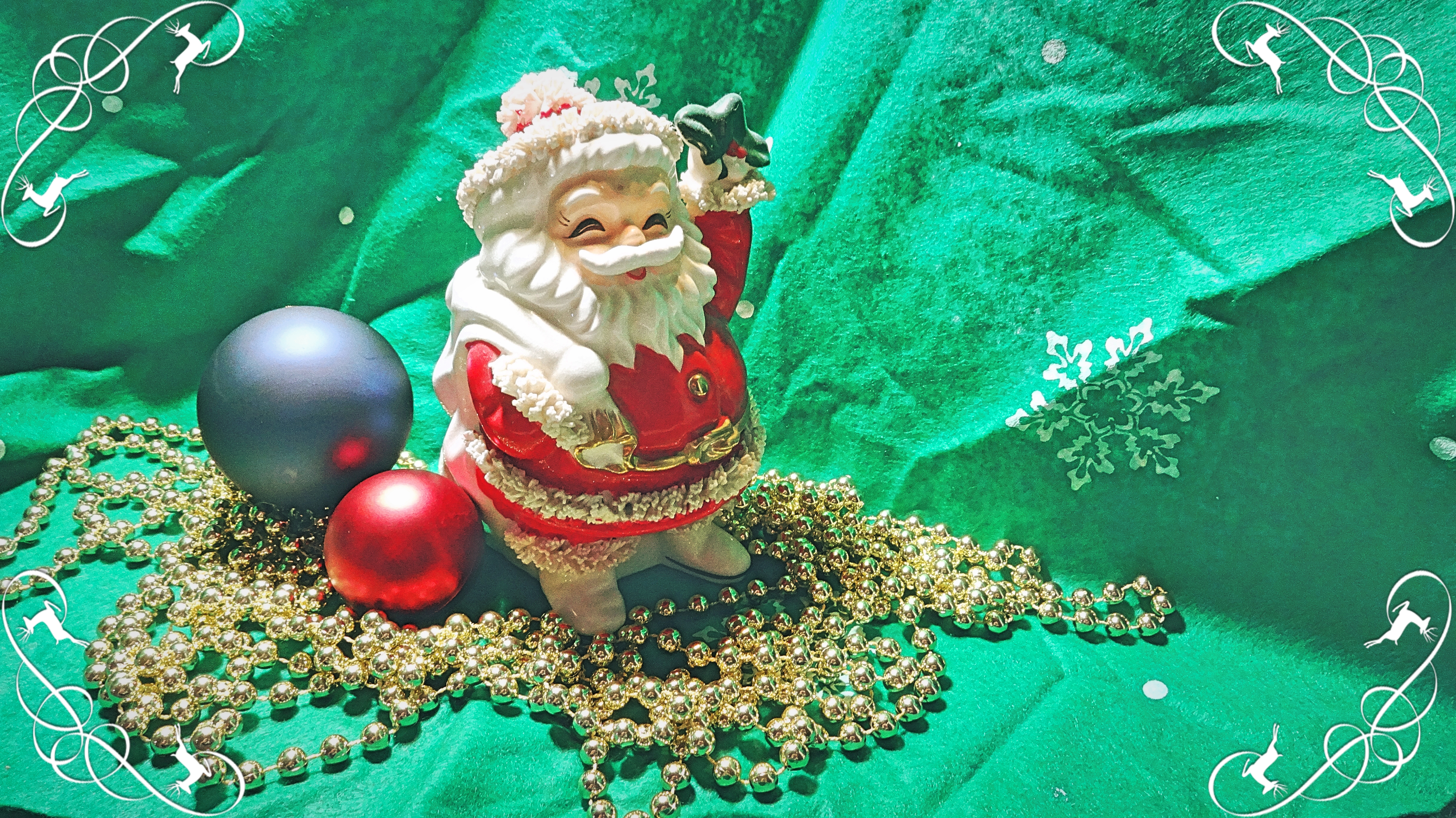
It’s Christmas Eve, and I’m looking for Santa. Not the jolly elf in red pajamas, my Santa is a six-inch tall ceramic bank. He’s just like the one my mom had, the one she saved quarters in all year to have money for Christmas. Mine doesn’t have quarters. It came without the rubber stopper at the bottom, and any money I stashed there would fall out like it does from my wallet when Bath and Body Works has their 2-for-1 sale.
Birthday presents were purchased with S&H Green Stamps. We did all our grocery shopping on Wednesdays, double stamp day at the Piggly Wiggly grocery store. The cashier would hand out a strip of the little green trading stamps, the number of stamps calculated based on the dollar amount of groceries purchased. I got to keep and redeem at the Green Stamp store any books where I had licked and stuck the stamps on the pages. I remember them tasting like spearmint, this may or may not be true.
I bought my Santa bank at an antique store in Jefferson, Texas, spurred on by a desire to replace each iconic artifact from my childhood. You know you’ve reached a certain age when every toy you ever owned is now “vintage” and “collectible.”
Every year in December my mom would bring out the bank, and I’d help her drop the coins into dusty paper wrappers. She’d pull out the stopper and pour out the quarters, a pile of clinking silver on the tabletop. Always quarters, and never dimes, nickels, or those useless bitter pennies.
I knew my parents bought my presents, but I also believed in Santa – the one with the flying reindeer. How can you believe in something and yet know it isn’t true? Have you ever looked at a triple chocolate cake and said to yourself, “I’ll just have one bite?”
I had a stocking every Christmas, and Santa always left one orange, one apple, several peppermint canes, and a handful of nuts. I’d have presents too, bought with those carefully wrapped quarters. The years went by, the name “Santa” on the gift tag replaced by “Mom” or “Dad”. We still stayed up late to watch the television newscasters predict the path of the jolly elf’s journey.
My mother loved stories, she’d act out the tales of Br’er Rabbit and recite what she remembered of Tom Sawyer’s adventures. She loved Santa and the Tooth Fairy equally. I believe she got as much of a thrill placing the gifts under the tree and the quarters under my pillow as I got joy in receiving them.
I finally located my Santa bank on top of the book shelf in our dining room. His face is familiar, and when I pick him up, I can imagine the heft he’d have filled with coins. My parents filled my childhood with the wonder of a magic elf who’d visit the good boys and girls on Christmas Eve. I wasn’t disappointed to learn the truth, because the best gift they gave me was the gift of imagination.
My mother, grandmother, and aunt in Farmersville in the 1950s
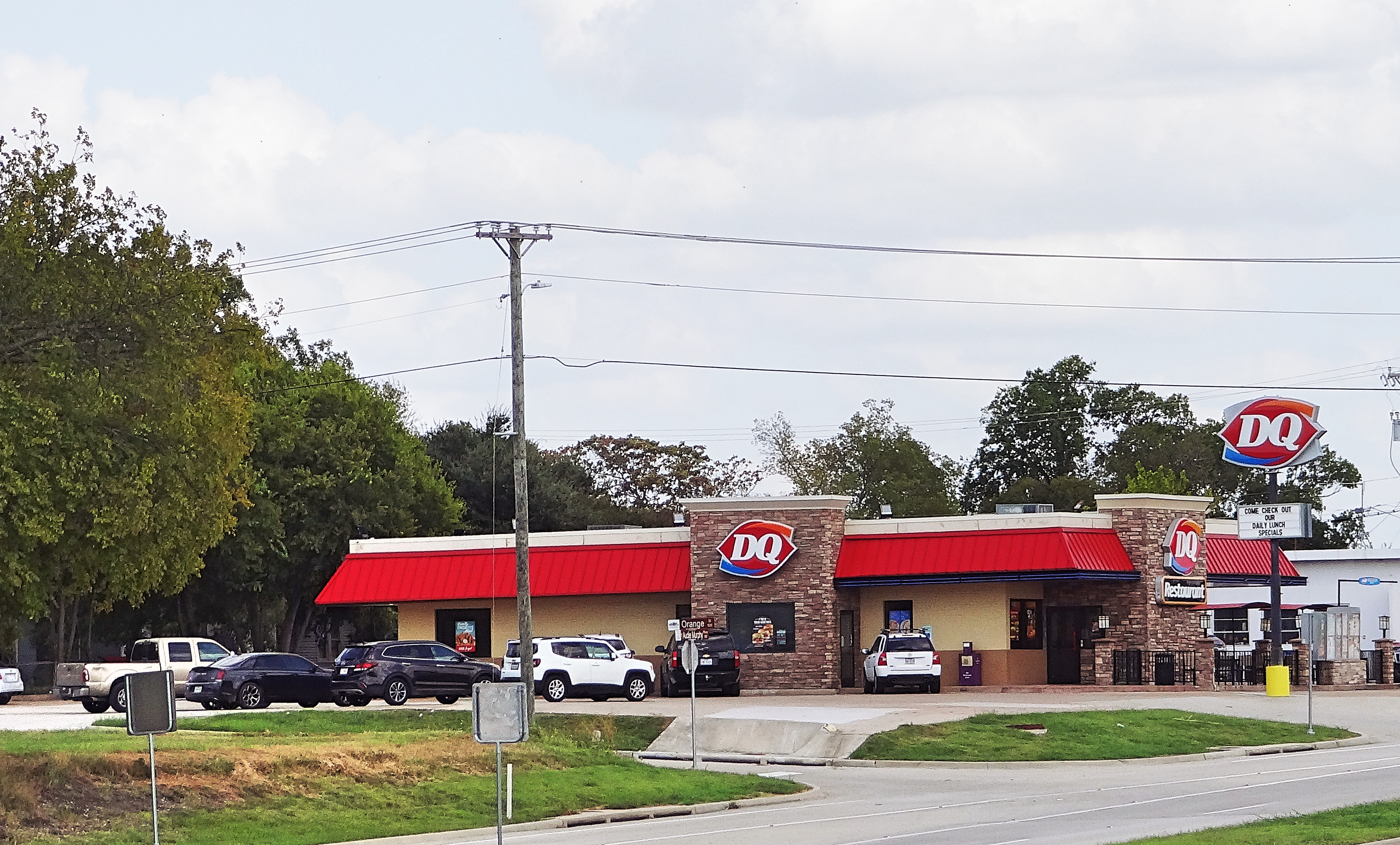
The places we visit are never as perfect as they are in our memory. My grandmother’s house in Farmersville, Texas no longer exists. A remodeled version of the Dairy Queen I visited as a barefoot child sits beside the highway and still serves up chocolate dipped cones and cheeseburgers. You can see the Dairy Queen from the overpass where I used to stand with my cousin and spit on the cars passing below.
Dairy Queen – Photo by the author
My husband and I drove up to Farmersville on the weekend, a short day trip from our home. Over bridges spanning the lake, past trailer parks and fireworks stands to the little town that was once the Onion Capitol of North Texas.
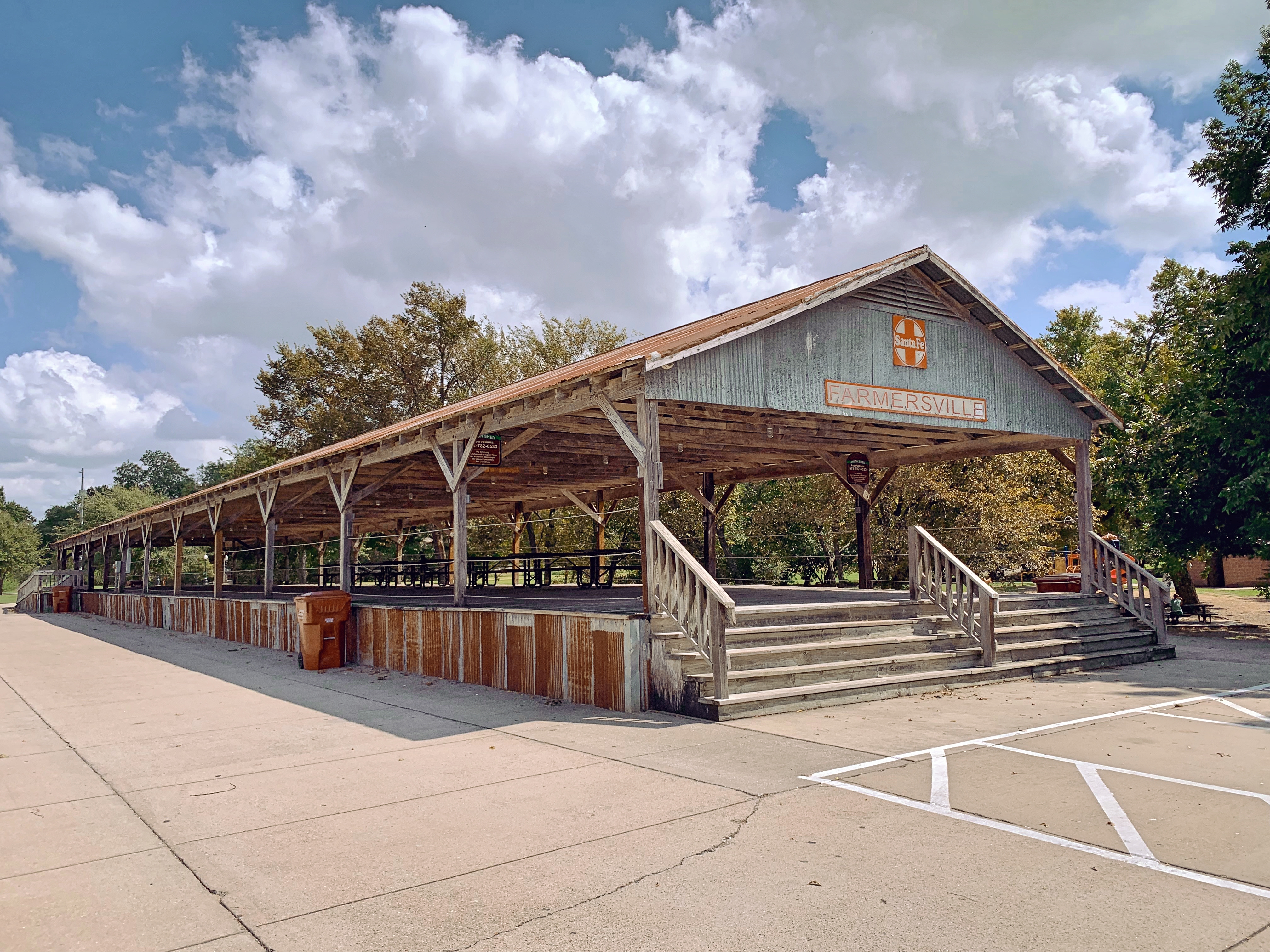
The Onion Shed in Farmersville, Texas – Photo by the author
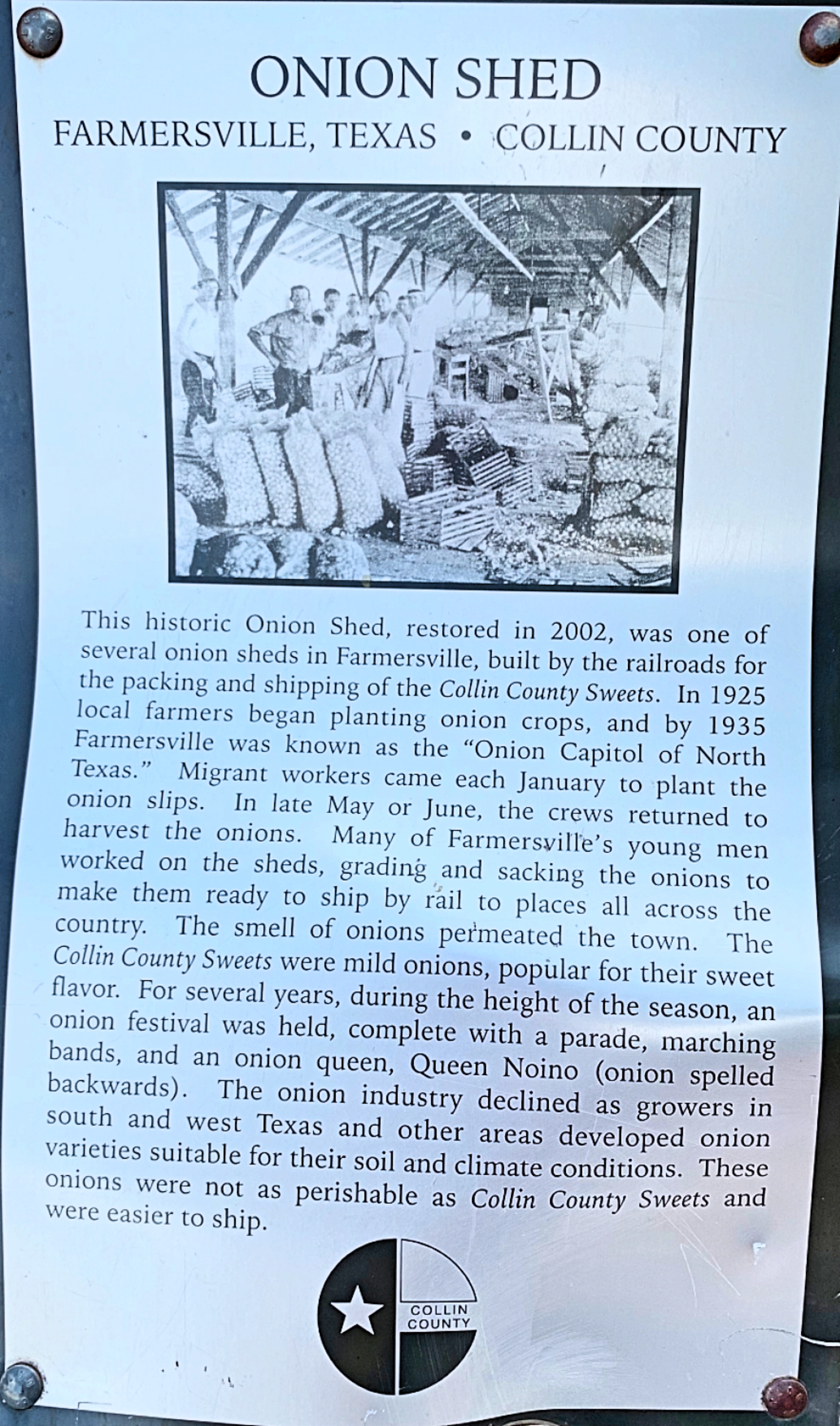
The Onion Shed sits near the town square. In the 1960s I helped my mother and grandmother fill burlap sacks with discarded onions, the rejects spilled and tossed onto the grass from the railway cars where the Collin County Sweets were loaded for shipment. No longer filled with the round yellow bulbs, you can find a flea market there on the first Saturday of each month.
The plaque at the Onion Shed
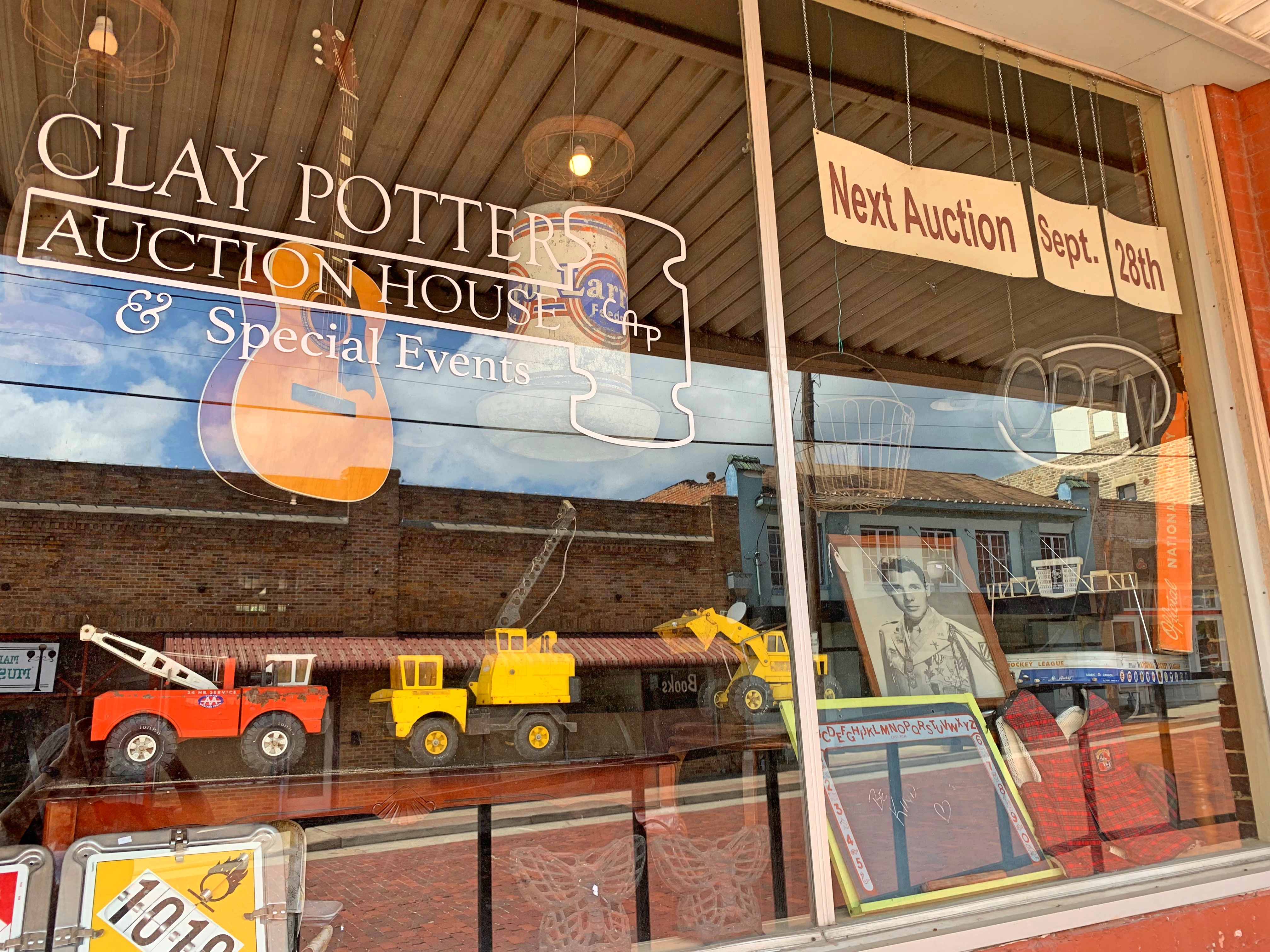
A portrait of Audie Murphy among the items for sale at the Clay Potter Auction House
We wandered through antique stores on the town square. I am always surprised to find the toys like those from my own childhood, stacked on dusty shelves and labeled “vintage.”
There were no toys in my grandmother Mattie’s wood frame house. A print of Jesus knocking at the door and a framed copy of the TV Guide with Johnny Carson on the cover decorated her living room wall. If I slipped from my mother’s view I would have just enough time to explore Mattie’s bedroom. I could hide under the fuzzy chenille bedspread and peak out through the fringe skirting the bottom where it brushed the floor. Visiting children were turned out into the yard, chased from the house by apron-wearing women too busy with cooking and serving to put up with our foolishness.
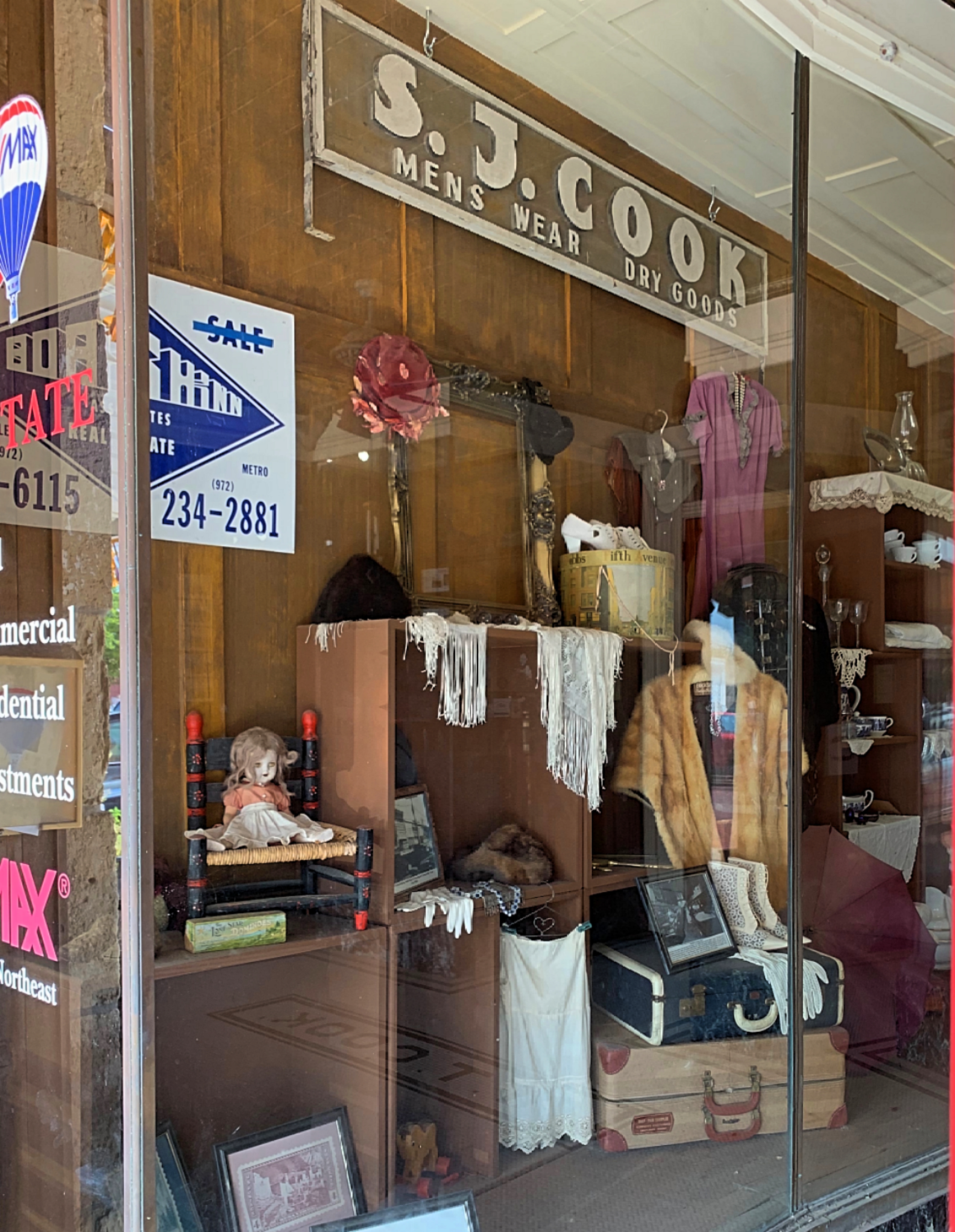
Window display – Photo by the author
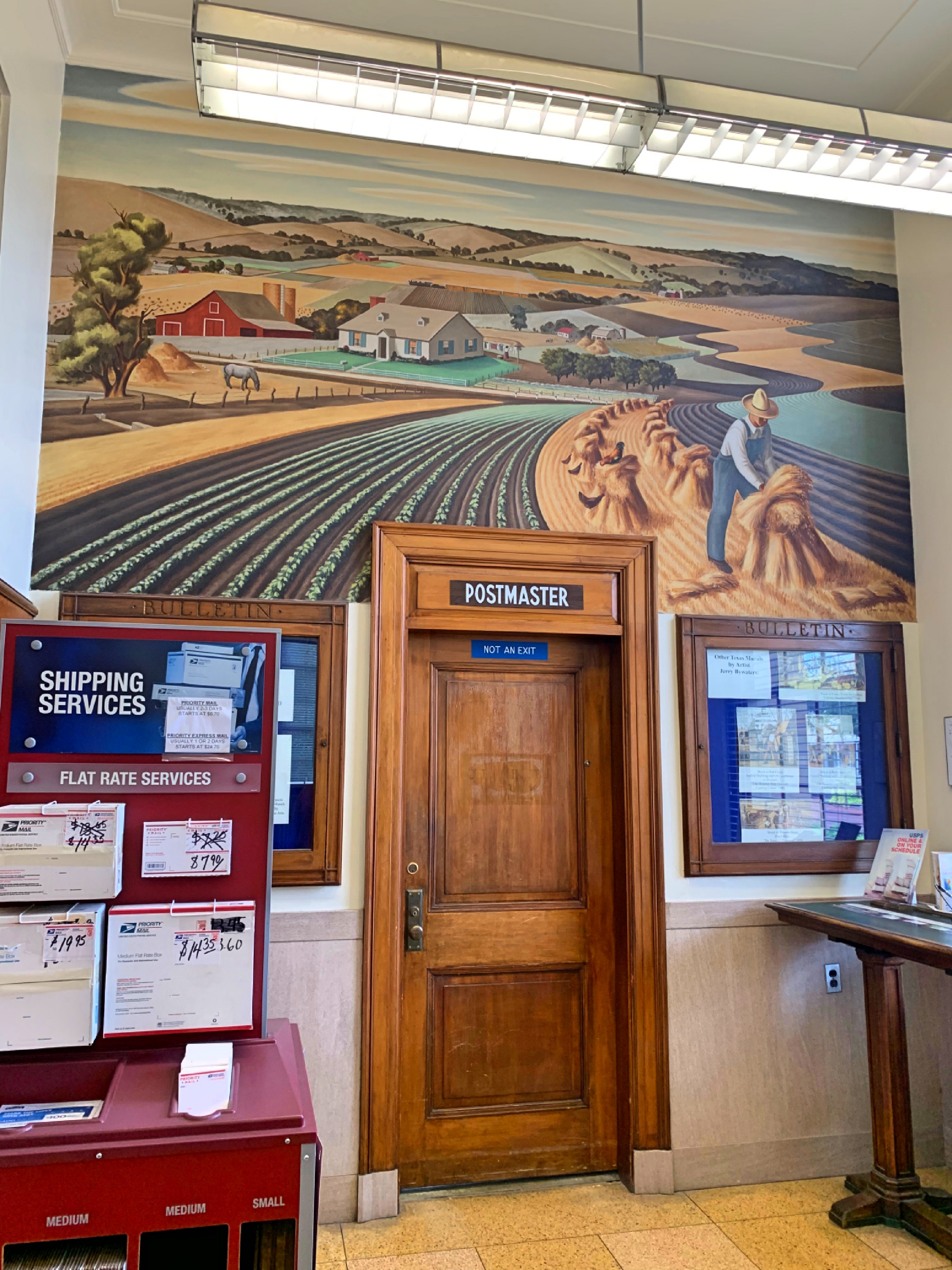
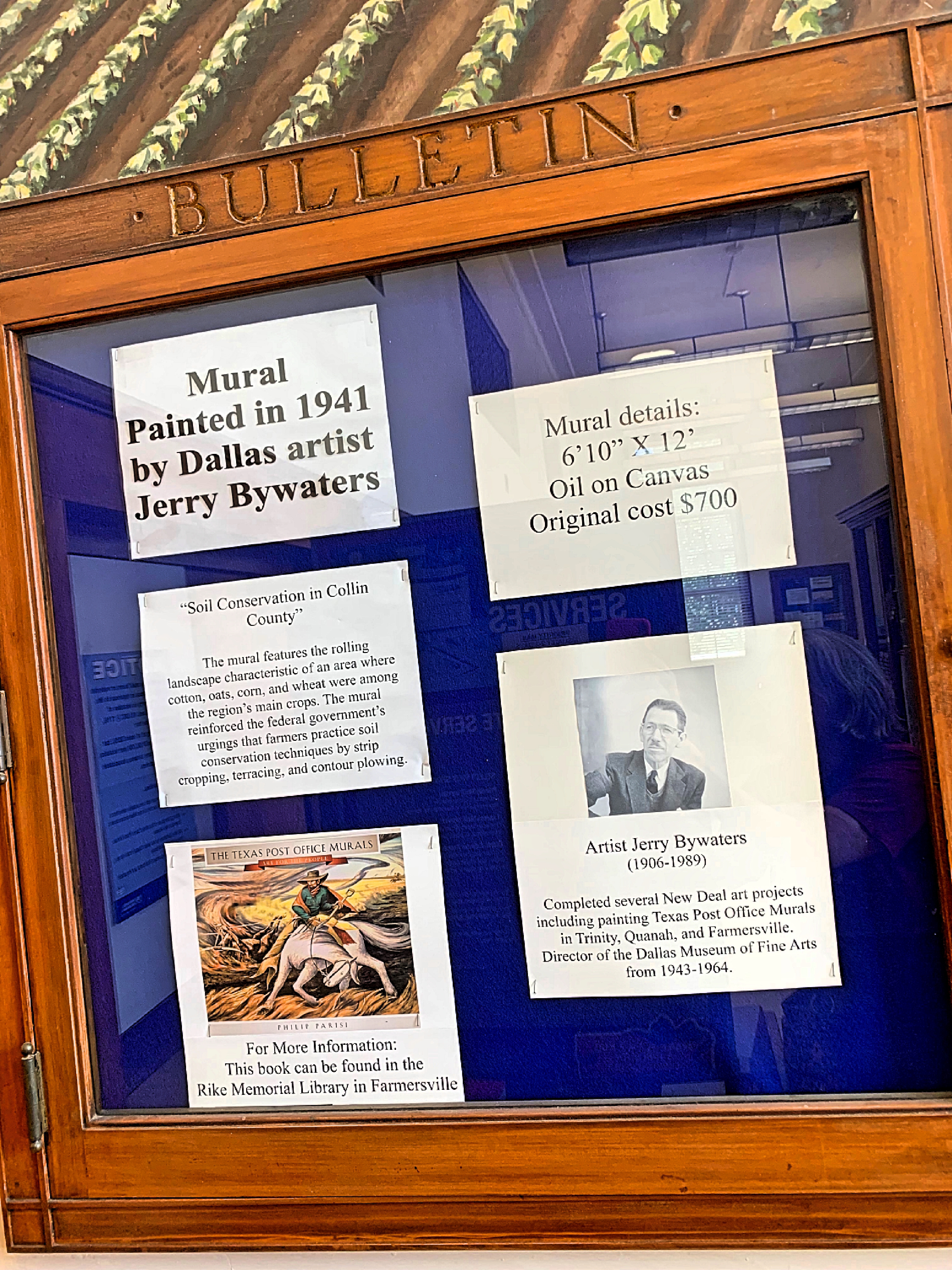
Small towns often have treasures tucked away, to be uncovered by those with time and patience to wander. The post office sports a mural painted in 1941 as part of the Works Progress Administration (WPA).
WPA mural in the Farmersville Post Office – Photo by the author
A short walk to downtown from Mattie’s house, over the railroad tracks and to the pecan tree shaded park, and I could find the snow cone stand there in summer. Crushed ice in a paper cone that dissolved as the treat itself melted to slush in the heat. But I could drink the last of it, my hands, lips, clothes stained red, purple, blue, green.
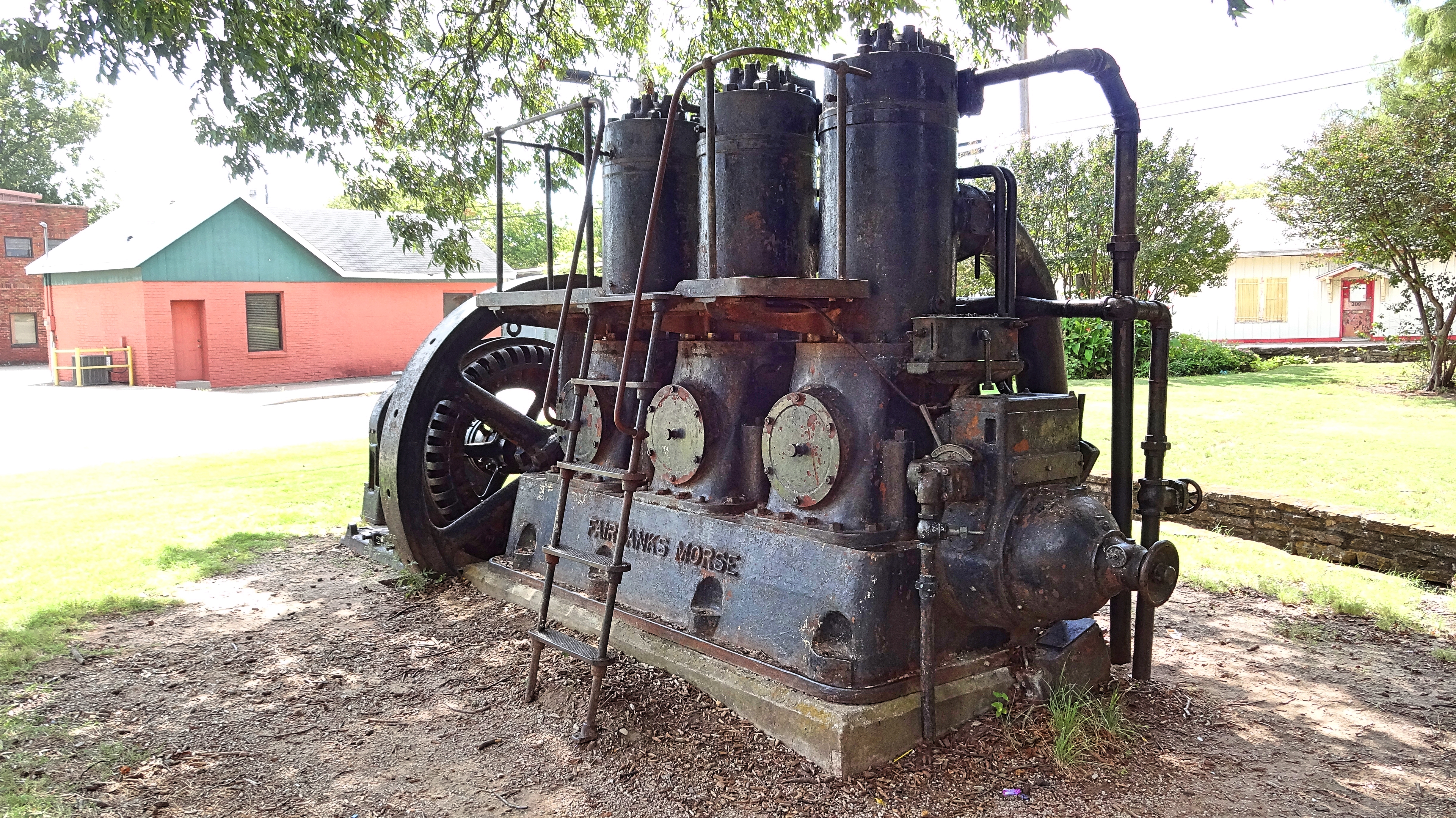
Old Electricity Generator in the city park – Photo by the author
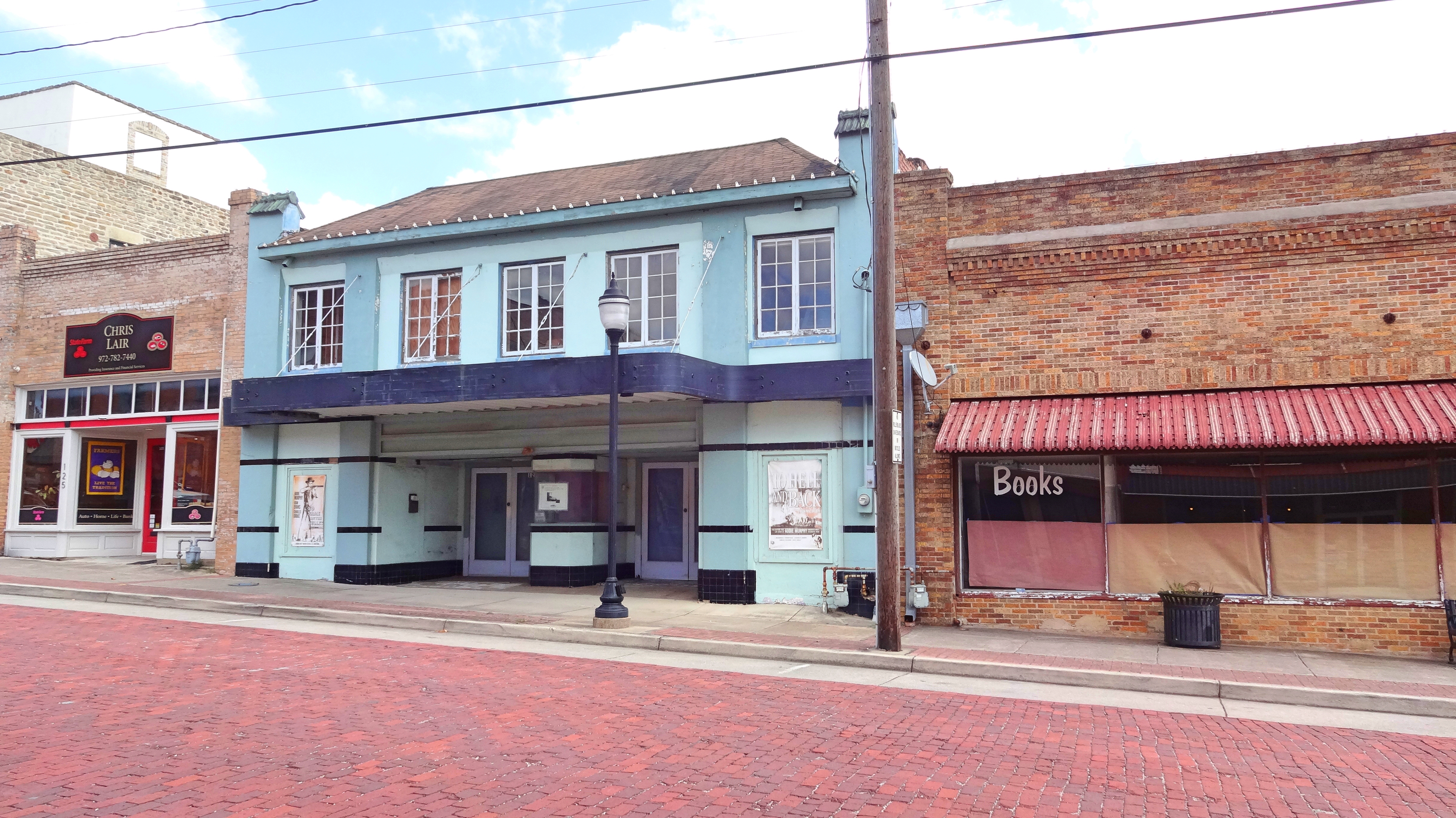
There were no snow cones for sale on the day we visited, but I bought a Dr. Pepper from one of the stores. Andrew and I sat and shared the drink on a bench near the old movie theater downtown.
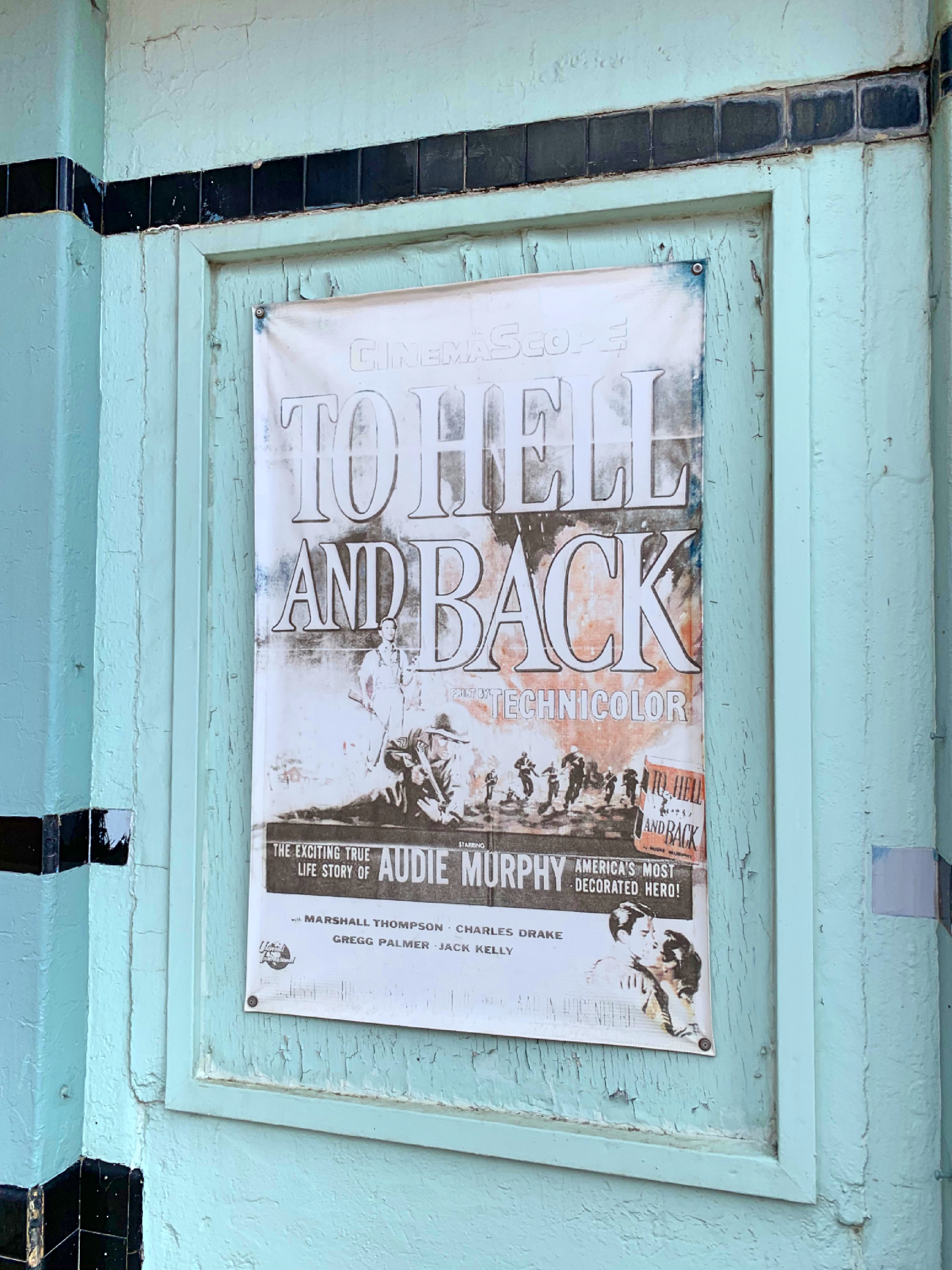
The movie theater in downtown Farmersville, Texas – Photo by the author
Closed for years, posters from films starring the hometown hero, Audie Murphy, hang on the front. I imagine my mother there on a Saturday night, palms slick with butter from the popcorn.
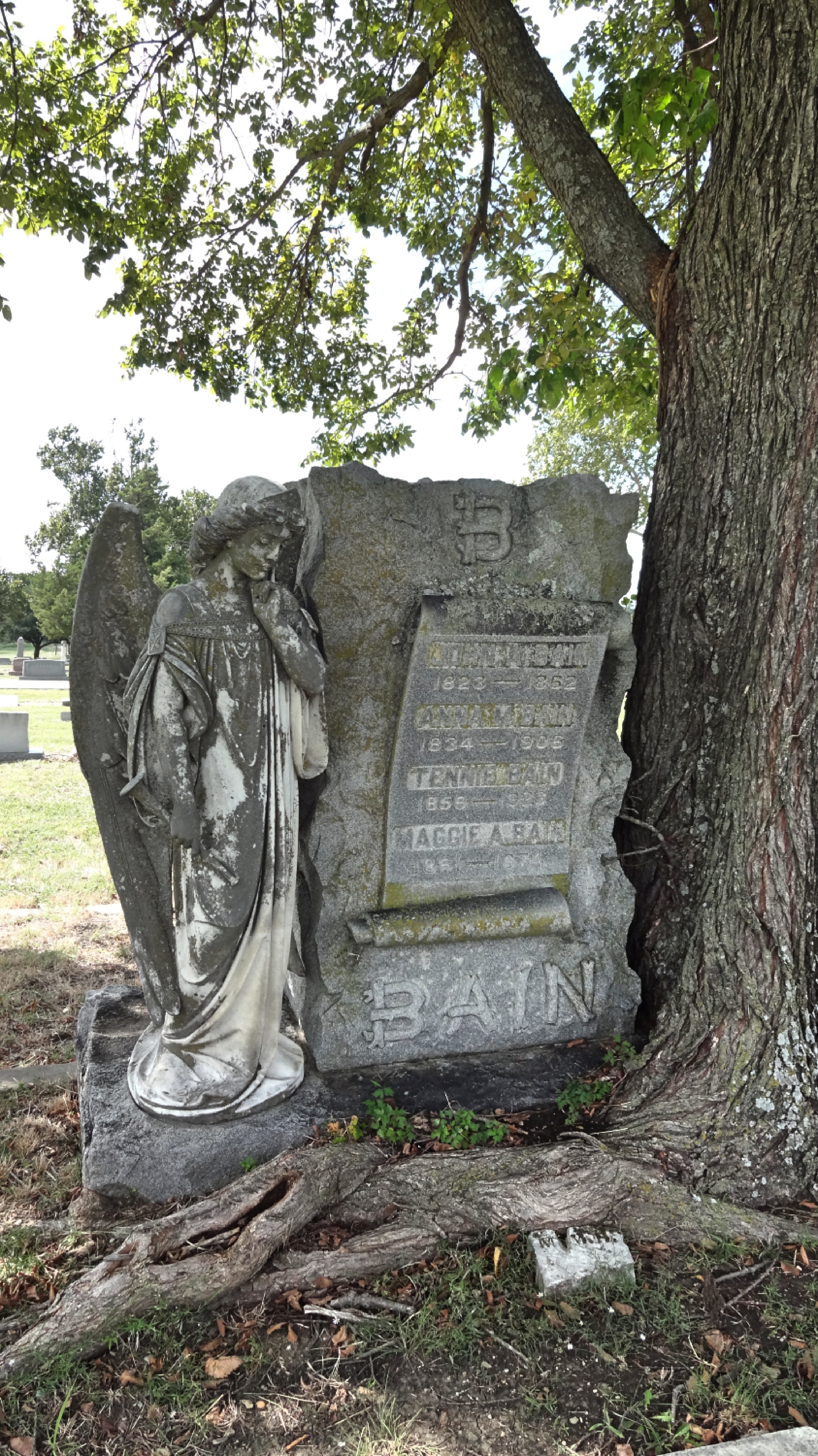
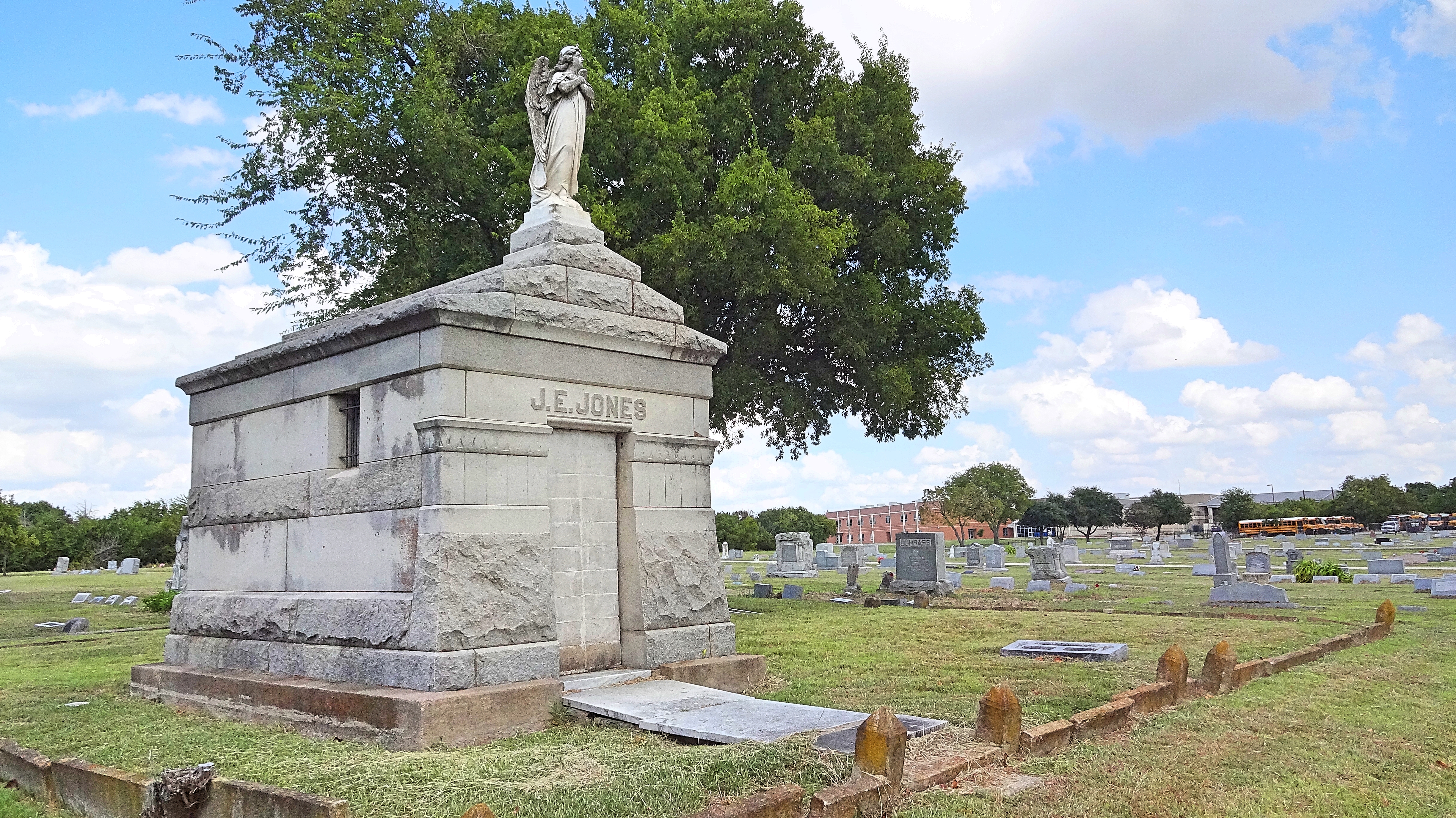
We ended our visit with a stop at the Odd Fellows Cemetery. My grandparents, Grover Cleveland Cullum and Mattie Elizabeth Watson Cullum, are buried there, as are their parents. We searched for their graves but couldn’t locate them. I hadn’t been there in years and the day was too hot for much effort. The one place in town that hadn’t changed but I couldn’t rely on my memory to find the family plot.
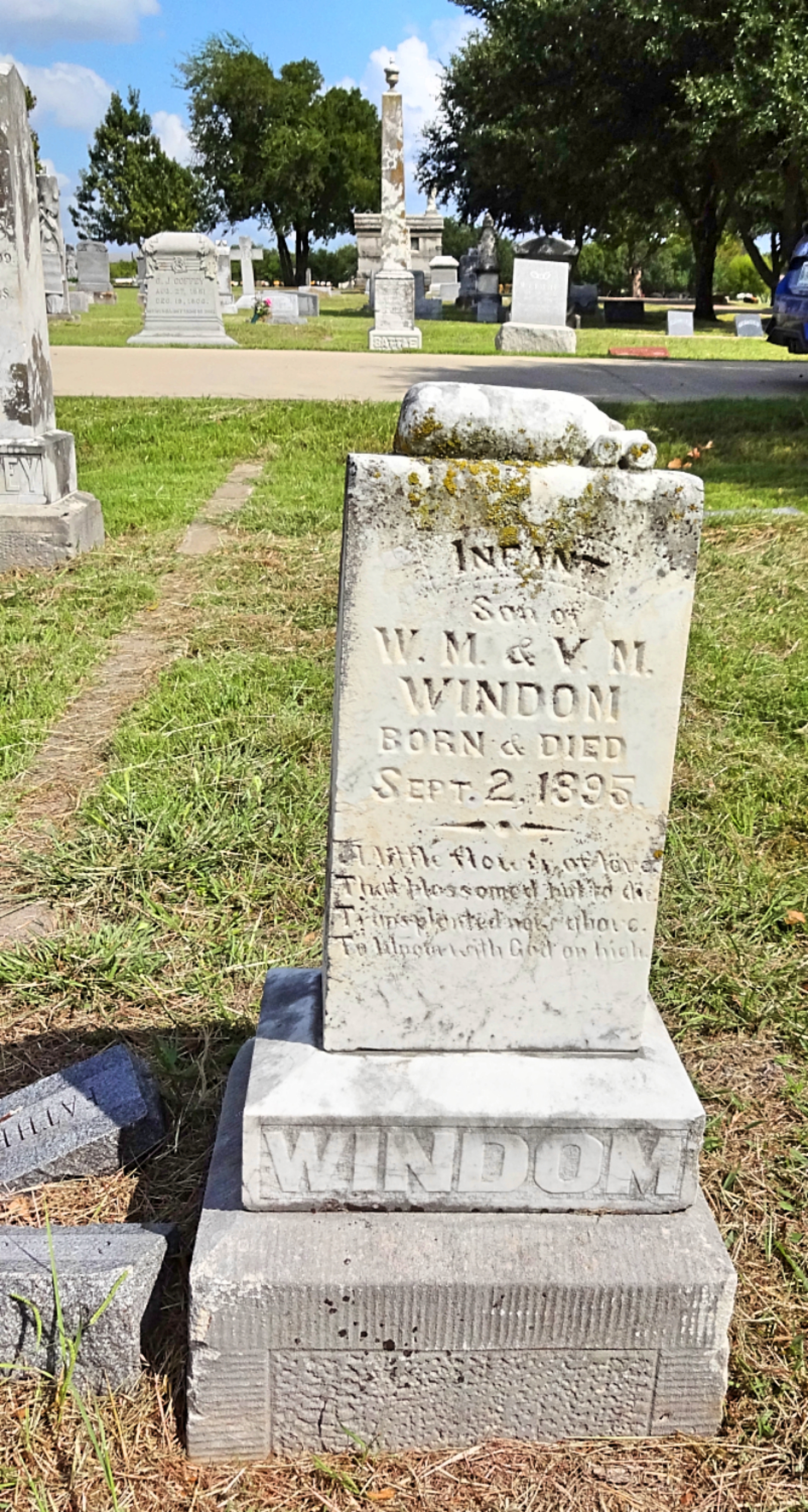
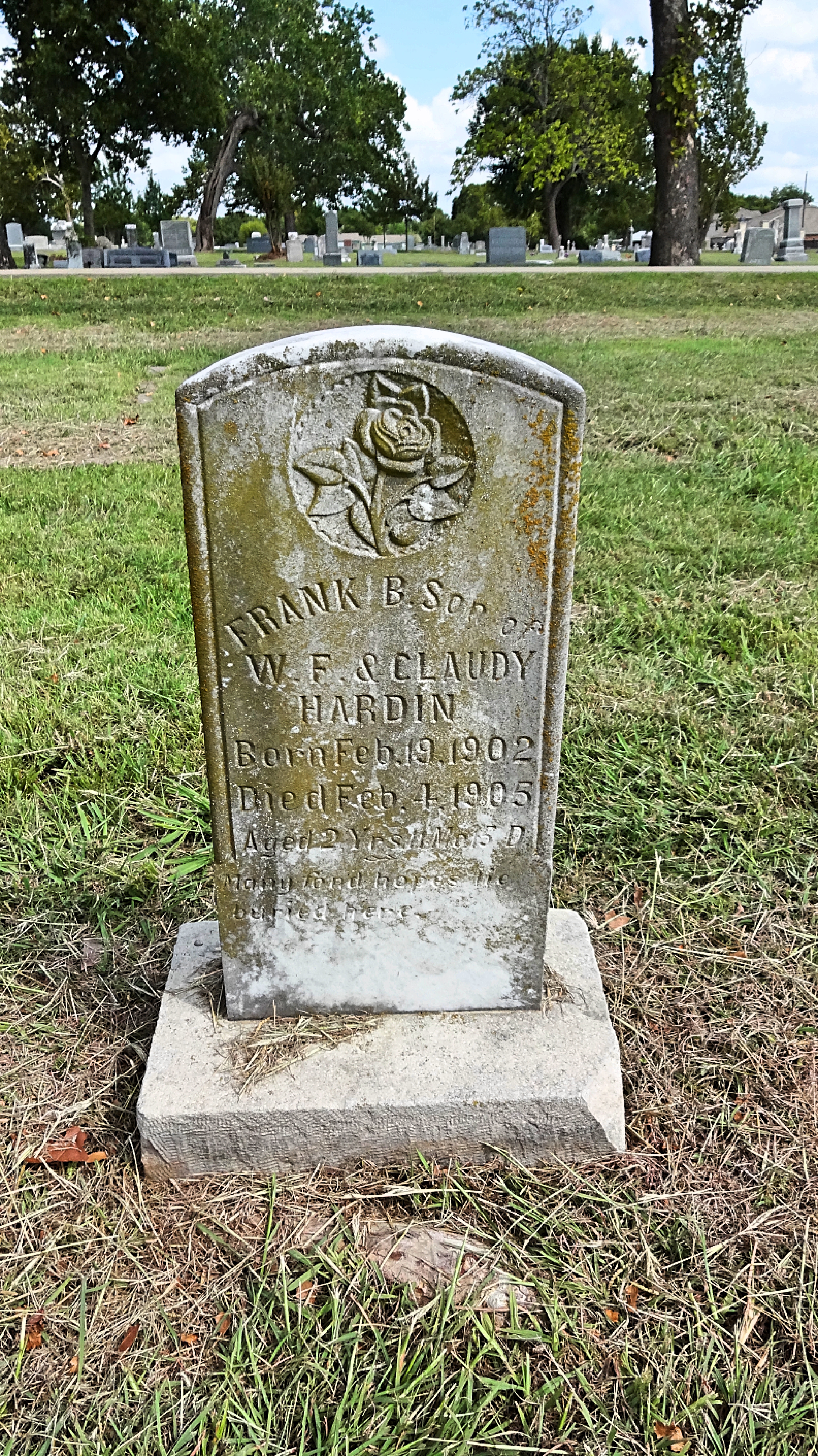
We did see some interesting gravestones.
Farmersville 100F Cemetery/Odd Fellows Cemetary
“Some of these people were alive during the Civil War,” Andrew commented.
“Yes,” I said.
Tired and sweaty, we climbed into our air conditioned Honda and headed home. Past the shops downtown, the onion shed, the park, the railroad crossing, stopping at last near the overpass so I could hop out and snap a photo of the Dairy Queen. Then onto the highway and home, leaving behind the layers of memory. My mouth, dust dry as I lean over a metal guardrail, the low mournful train whistle in the dusk, the sharp scrape of sidewalk on bare feet, the candy syrup from a grape snow cone, icy cold contrast to a dog summer day. The scent of sweet onions, yellow and round as baseballs, hidden like Easter Eggs in the soft green grass.
In 1980, after my sophomore year in college at Texas Woman’s University, I waited for the letter that would lead to a pivot point in my life. Some months before, I had applied through the Baptist Student Union to be a summer missionary. I signed up, not out of deep religious conviction but because I did not want to spend the months between semesters living in my mother’s house.
Other students testified they had received God’s call, but I would have hung up in a panic, sure the almighty had a wrong number. I hoped to be sent to some distant exotic location. The recruitment flyer posted in the Baptist Student Union featured pictures of happy, smiling young people wearing shorts and working in places like Brazil or Hawaii. I pictured myself returning from summer vacation with a tan and a suitcase full of coconuts. Instead, I landed in West Texas, at a town called Big Spring. My assignment was to work in the chaplaincy department at the state psychiatric hospital located there.
“I’ll be spending my summer in the state hospital,” I told my friends. The joke always got a laugh as long as I explained that I wouldn’t be going as a patient.
My family never talked about mental illness. The youngest of seven children, I was born on my mother’s 42nd birthday. My older brothers and sisters had all escaped from the house by the time I started school. I remember my amazement that my childhood friends could come in and out of their houses at will.
In our house, when I came inside, I had to stop in the laundry room and take off all my clothes and toss them in the washer. Naked, I walked through the house to the bathroom to shower and then dress in clean clothes. We did not have carpet, instead my mother insisted on covering all the floors with vinyl, so she could mop with the pine cleaner she favored.
Everyday activities, like getting ready to leave to go shopping, involved a complex set of steps that ended with my mother putting on her shoes at the back door. Any interruption, like a ringing phone, required her to start the process over from the beginning. I fell on a piece of metal once, slicing my thumb down to the bone. My mother left me sitting on the front porch clutching a bloody washcloth, for almost an hour, while she went through the compulsive rituals that would allow her to leave and drive me to the emergency room.
“Oh, mom just likes things clean.” This was the closest the other family members came to admitting something was wrong with my mother. I never had a birthday party, never had friends overnight, and rarely invited anyone to come play in my yard—they might ask to come in and use the bathroom, and that would require explaining the whole undressing part. My mother’s obsessive-compulsive disorder required hand washing at the minimum after any physical contact. A hug would have required a scrub down like what might occur at a biological warfare lab with a leaky air filter.
My routine at the chapel in Big Spring did not include leading any prayer sessions or bible studies. Instead of torturing the residents with my singing or praying, I handed out hymnals at the Sunday and Wednesday night services, helped lead a puppet group, and visited with the residents. I would often wonder at the ordinary people who were patients at the hospital.
Until that summer I had been taught that mental illness should be hidden away, like something shameful. On a bookcase in our house there was a bowl made up of ceramic tiles. I dusted that shelf and that bowl for years before I learned my mother put it together during a stay at Terrell State Hospital when I was a toddler. Like her anxiety, depression, and OCD, it was there all the time, in plain sight but disregarded as though it were invisible.
One of my duties as a summer missionary was to give speeches at various churches, summer camps, and bible study groups. I abandoned any traditional speech and instead told about the strange guiding force that must have led me to the place I had denied all my life — an understanding of my mother’s mental illness. It wasn’t too far a stretch to speak of forgiveness and acceptance, and of following those with love.
Terrye is a native Texan who enjoys writing stories set in her home state and other strange places. In her free time Terrye enjoys exploring antique, junk, and thrift stores for inspiration and bargains. She’s had stories published in small print and online journals, and writes short, humorous essays for her blog — https://terryeturpin.com/. Sign up with the link below to follow her newsletter.
Despite the crying during our last visit, we took our grandson, Will, back to the Heard Museum to see the robotic dinosaur display. When you are shorter than three feet tall anything larger than a cat is intimidating, especially if it has sharp teeth and looks like it might eat you.
“He’s had a whole year, surely he’s recovered by now,” I remarked to my husband, Andrew.
Soon after Andrew and I began dating I warned him that, although we were past the risk of producing children, if he stuck around he would be in danger of exposure to grandchildren. I have been preparing for grandmother status half my life. I picked out my grandma name, “Mimi”, right after my son and his girlfriend announced their engagement.
Andrew’s grandpa name is “Hoppy”, the unfortunate result of letting a toddler select the name. I warned Andrew, but he began by trying out grand-père. A French accent proved too difficult for an 18-month-old who wasn’t born in France, so it left us with Hoppy and Mimi.
My grandmother was old before I was born. We visited her on holidays where I sat in her living room long enough to absorb the smell of mothballs and mentholated back rub into my clothes. Her third or fourth husband, Mac, was my step-grandfather. He wore striped overalls and had a glass eye he popped out to frighten children. I was determined we would be a different sort of grandparents.
That afternoon at the museum we began with a brisk walk through the lobby crowded with young parents and knee high children and wove our way in a quick jog past the toys in the gift shop. As I pushed open the glass door that led outside, I held onto Will’s hand as I explained, “The dinosaurs on the outdoor trail aren’t alive, they’re just robots.”
This was not as reassuring as I intended. I realized with some irony we expect our young ones to believe in Santa Claus and the Tooth Fairy, but then discourage their fear of evil robotic monsters.
We stopped at the first dinosaur on the trail. It appeared to be strolling out of the wooded area behind it, brandishing sharp claws and grinning at us with impressive rows of teeth in its gaping mouth. Bright purple and blue vinyl covered the dinosaur in a pattern that would look smashing on a pair of boots. A nearby sign announced the design was chosen by children. Will stood just above waist high beside me and gripped my hand. “I’m just small,” he announced.
“Yes,” I agreed, “but you are also brave.” Will squinted at the robotic animal and then looked back up at me as though he were about to question my judgement.
“Was it this color last year?” I asked Andrew.
“I don’t think so, and I seem to remember it was carrying a Halloween pumpkin.”
“I’m getting bigger, but right now I’m small,” Will repeated as we stood there. The dinosaur roared and nodded his head up and down as though he agreed that Will was indeed, bite-sized.
We trudged on to the next display, a Triceratops. It was the size of a small car, but I felt encouraged, as this specimen was a plant eater. However, this particular herbivore roared just like the meat eaters. It also shook its giant horned head from side to side and moved its mouth as though chewing a tasty, boy-shaped morsel.
Photo by Terrye Turpin
“Why can’t they have at least one dinosaur that chirps, or sings a little song?” I complained to Andrew as Will huddled behind me.
We continued our stroll down the trail, stopping for a moment to enjoy each exhibit, at least until the roaring started up. Will hiked along bravely. When Hoppy pointed out a huge, ancient oak tree, Will said “That’s a scary tree,” but he roared back at some of the dinosaurs.
We approached the final dinosaur, a forty-six foot tall T-Rex, and Will stopped and held up his arms. “Carry me Mimi! I’m small!” I scooped him up, and he watched over my shoulder as we marched past the overgrown lizard.
Will wrapped his arms about my neck and we followed along behind Hoppy down the trail and past the T-Rex. From the moment your children are born, they are just looking for some way to prove you wrong, but to your grandchildren you are infallible. There are people who never experience this level of unconditional love unless they own a dog.
Once we were past the dinosaurs Will spotted a play area of child-sized wooden houses meant to resemble a pioneer village. Andrew and I settled in and watched him pour rocks into a metal bucket. I tried to snap Will’s picture, but freed from the pressing danger of robotic dinosaurs, he spent his playtime rushing off to explore the little houses at the frontier town. Every shot I took was of his back as he ran away from us.
I won’t always be able to pick him up, but he won’t always need to be carried. How reassuring it must be, however, to know there will always be someone who trails behind, watching over us, and ready with strong arms to lift us when we can’t go on. When we turn to them and plead, “Please carry me, for I am just small.”
The Dublin Bottling Works — Home of the original Dr. Pepper and definitely not a clear liquid. (Photo by Terrye Turpin)
At my last physical my doctor mentioned it had been five years since I had a colonoscopy.
“That long, huh? Gee doc, the whole experience was so pleasant it seems like only yesterday.”
Every time I light a candle in my bathroom, I feel like I’m setting up an altar to the god of poop.
I successfully delayed the colon conversation by mentioning my cholesterol. I’ve found as I grow older I can deflect almost any uncomfortable medical inquiry by bringing up another body part.
The first time I had a screening colonoscopy it took my doctor three years to convince me. She seemed puzzled that I continued to dodge major illnesses, so I felt I owed it to her to try one more test to see if we couldn’t find something. I called to make the appointment, and they told me I would need a designated driver to chauffeur me home after the procedure. Because I had spent 30 hours in labor with him, I nominated my oldest son, Robert. A few days before the big event he accompanied me to pick up the aptly named Super Bowel Prep Kit at the pharmacy.
“That will be $73,” the cheerful cashier said as she rang up my purchase.
“Holy crap!” I said. Robert laughed behind me.
I felt that for $73 the stuff should come with a sommelier, someone to uncork the bottle, swirl the liquid around in a glass, and remark on the bouquet. Reluctantly I paid for the purchase with my rapidly depleting medical flex spending card and we left with the kit — two 8 ounce bottles of clear liquid that each had to be mixed with another 8 ounces of water and then chased with yet another 16 ounces of water within an hour.
On the way back to my apartment I held up a bottle. “I wonder what it tastes like?”
“I bet it tastes like ass,” said my twenty-eight-year-old son with all the smug self-assurance of someone at least two decades away from having to drink 32 ounces of ass flavored liquid himself. We tried out different names for the drink — “Turd Tonic”, “Poopy Potion”, and finally decided the winner was “Caca Cola.”
The instructions for my prep assured me I could have all the clear liquids I wanted during the process. I enthusiastically mixed up a dozen servings of lemon and pineapple Jello. Red gelatin was discouraged in horrific detail. I discovered all the clear liquids I wanted were considerably less than the amount of clear liquids taking up room in my refrigerator.
The actual prep went as expected. I took the advice found on several internet sites and bought adult diapers to wear during the experience. They worked so well I wondered why I didn’t wear them all the time. Robert stayed with me in the beginning but when the real fun began, he left for his apartment.
“I’ll see you tomorrow!” I called out from behind the bathroom door.
The pharmacist had warned me that the prep was “very effective” and by the end of the second dose I had to agree. My colon was so clear the doctor could probably see all the way to Cleveland.
I couldn’t have anything to eat or drink the day of the colonoscopy and this worried me before I understood that by the end of the first day I wouldn’t want anything to eat or drink on the second day.
The morning of the procedure Robert strolled into my apartment. He wore an Iron Maiden t-shirt featuring a rotting corpse on the front.
“I’ll drive on the way there,” I told him.
When we arrived at the clinic I checked in while Robert discovered they didn’t have Wi-Fi in the waiting room. A smiling nurse escorted us back to a little room and I met with the doctor who would perform the colonoscopy. He looked slightly older than my son and had very nice hair.
“Awesome t-shirt dude!” he said to Robert as he flashed the metal sign and they slapped hands.
The doctor briefly explained the procedure and then a nurse brought over a hospital gown and a brown paper bag. She told me to take off all my clothes and put them in the bag.
“They’ll call when I’m ready to leave,” I tossed Robert my purse and phone as he bolted out the door.
After I stuffed my clothes into the paper bag, the nurse took a black marker and wrote my name on the outside, just in case they needed to use it as evidence. I hopped onto the narrow hospital bed as the anesthesiologist came in to meet with me. He also had nice hair and a lovely smile. He looked and sounded like the actor Antonio Banderas.
“How are you feeling?” he asked as he placed his hand on my arm. He had very warm hands.
“I’m okay,” I responded, with as much confidence as I could while my bare ass stuck to the sheet covering the bed.
“Don’t be nervous, I promise you won’t remember anything about the procedure. You will just have a little nap now.”
I smiled up at him from the bed and tried not to look nervous, despite his being one of the most handsome men to see me half naked. He kept his warm hand on my arm as he helped me turn over on my side. Then he bent down to gaze into my eyes and ask, “Do you have any loose teeth or dentures?”
My doctor came in and fussed around with something behind my back as he hummed what sounded suspiciously like “Run to the Hills”, complete with shredding guitar solo. I no longer felt nervous, I felt old and tired as I fell into the promised nap.
I had read all about the unpleasantness of the prep but what no one mentioned was how wonderful were the after-affects of the sedative they give you. I woke up to the sound of “Slow Ride” by Fog Hat playing on the room’s sound system, which was appropriate since I hadn’t felt that stoned since 1975.
“How are you doing?” asked the nurse as she took my arm and helped me to sit up.
“Wow,” I replied.
“Would you like a drink? We have Coke, Dr. Pepper, and Sprite.”
I chose a Dr. Pepper, and when the nurse asked if I wanted a regular or a diet drink, I replied, “Oh, I want a REAL Dr. Pepper!”
When Robert arrived to pick me up, I was still enjoying my not-clear drink. The nurse warned us “Go straight home. No shopping and don’t make any legal decisions or sign any documents today.”
“Can I take my Dr. Pepper with me?” I asked.
On the way home I buckled into the passenger seat of the car, propped up against the door, and enjoyed the rest of my soda while Robert drove with his usual reckless abandon. The drugs were still kicking in, so I didn’t mind when we charged through yellow lights and swerved around corners.
I wanted to make some profound comment on how wonderful it is to have a family, and how much I loved and appreciated him. Tears welled up in my eyes and I spoke in a hoarse voice.
“This is the best Dr. Pepper in the entire world.” I reached over to pat my son’s arm.
“Those must be some fantastic drugs, Mom.”
We continued on towards home, where we would listen to Iron Maiden on the stereo, watch television together, and have anything we wanted for dinner, including six or seven servings of pineapple Jello.






 Let's Get Out of Here