I cut my writing teeth on short stories. Sometimes, they were very short. Working on a novel is quite different. But I’ve found the process of choosing the right words to express what I want to be similar to those exercises in flash fiction. Maybe I learned something? Time and editing will tell.
For now, here are five of my favorite very short stories. Four of them were published in online journals and I’ve included links at the end of this post.
Despite the brief length, each is a complete tale. I hope you enjoy them, and the photos. All the pictures here are either ones I’ve taken or photos of me. I try to pick shots that match the feeling and mood of the stories.
This first piece is fiction, but I’d be lying if I told you it doesn’t sit close to truth. Unless you were super popular in school, I think you can relate to those feelings of being an outsider in the midst of your peers. And maybe even the popular kids felt that way at times.
The inspiration for this one wasn’t my own high school reunion, but an abandoned school that my husband and I drove past one Sunday afternoon. Hence the last lines in the story.
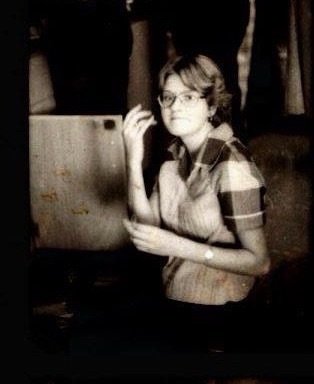
The author, photo from high school album
Reunion
I open my email and scroll past a black-and-white photo—stone lions crouching at a high school entrance. Recollection rings like the end of day bell. Rushing from locker to class, brushing past people who don’t see me, don’t feel me. I inhale the scent of rubber-soled shoes on a waxed gym floor. My arms sag, heavy with books sharp against my chest. Thirty years unravel, an unruly thread.
The invitation, sent from a name I’m supposed to recognize, gradually slides down my inbox, behind offers for car repairs and notices of bills now due. That high school has long emptied of anyone I care to see again. Ghosts linger like clouds of chalk dust, and wander empty halls that echo with phantom footsteps. They climb the stands and cheer for games now played only in memory.
That evening, I mention the reunion to Mark, my husband.
“Thirty years is big. Are we going?” He asks.
I shrug. “I don’t think so.”
I log onto Facebook and find the reunion group. Former students have posted pictures. Squinting at the images, I try to reconcile the faces with those captured in the yearbooks on my bookcase.
I request to join the group. A week later, the group admin replies and asks, “Who are you?”
In high school, she had sat next to me in algebra class. Now, she’s the person organizing the reunion. After searching through my email, I find and delete the invitation.
Months later, on a slow Sunday, Mark and I drive past a building marked for demolition. Broken windows cast blank stares. A shadow flickers like a waving hand, and somewhere inside I imagine a bell ringing. I tell my husband, “I went to school there. I think.”
THE END
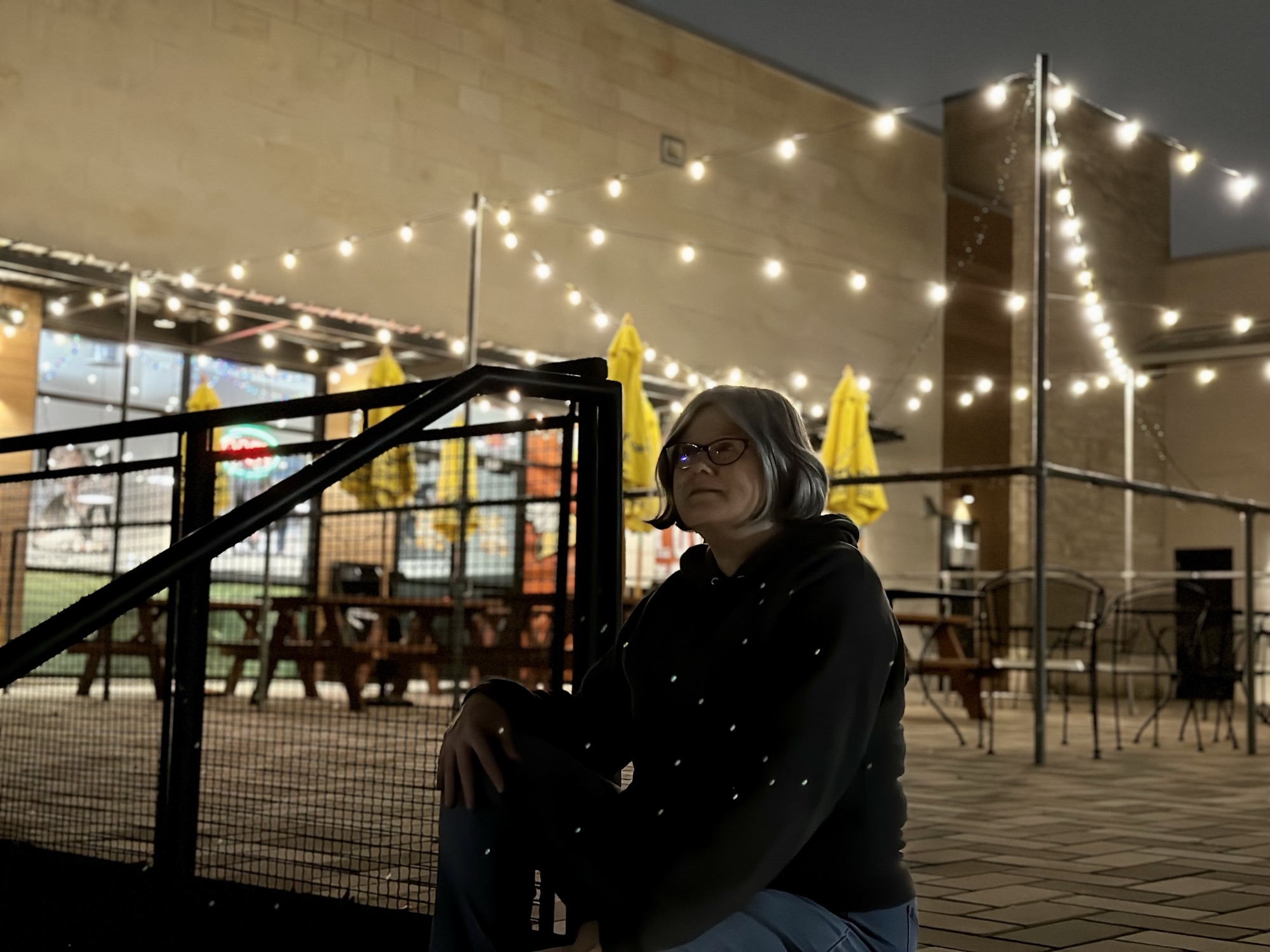
The author, photo by her husband
This next one if my favorite micro fiction story that I’ve written. It has that feel of the Old West, blended with a crime thriller. If you like it, you would probably enjoy one of my favorite movies: Hell or High Water.
Photo by the author
You Can Tell a Lot About a Person by What They Leave Behind.
Fifty-six years of bad choices ended in a job cleaning toilets and sweeping used condoms from under sway-backed beds at the Star Motel. Nobody traveled there except oil tankers, tumbleweeds, and truckers dodging weigh stations.
Photo by the author
The place paid in cash – enough to linger, not escape. Drunken nights spent listening to West Texas wind, dreaming of something else. One day, I opened a nightstand drawer, expecting a water-stained bible. Instead, a snub nose revolver lay coiled like a black snake. I climbed into my rusted-out Ford and tucked the gun under the vinyl seat.
It waited there, a dark possibility.
THE END
Photo by the author
This next one was a contest entry for Globe Soup. The contest required entries to use the word “hollow”. It didn’t win anything, but it found a home eventually and was published.
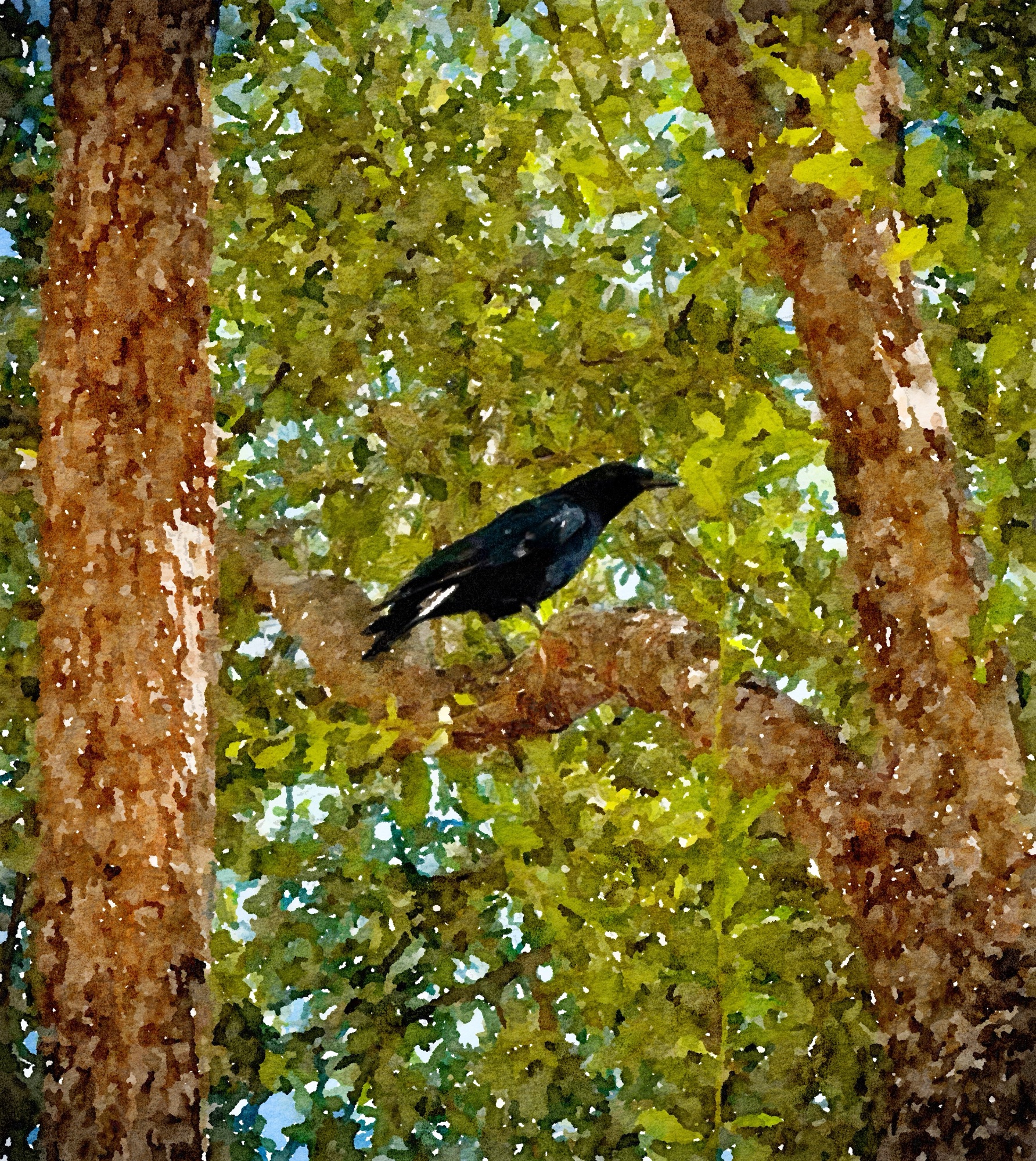
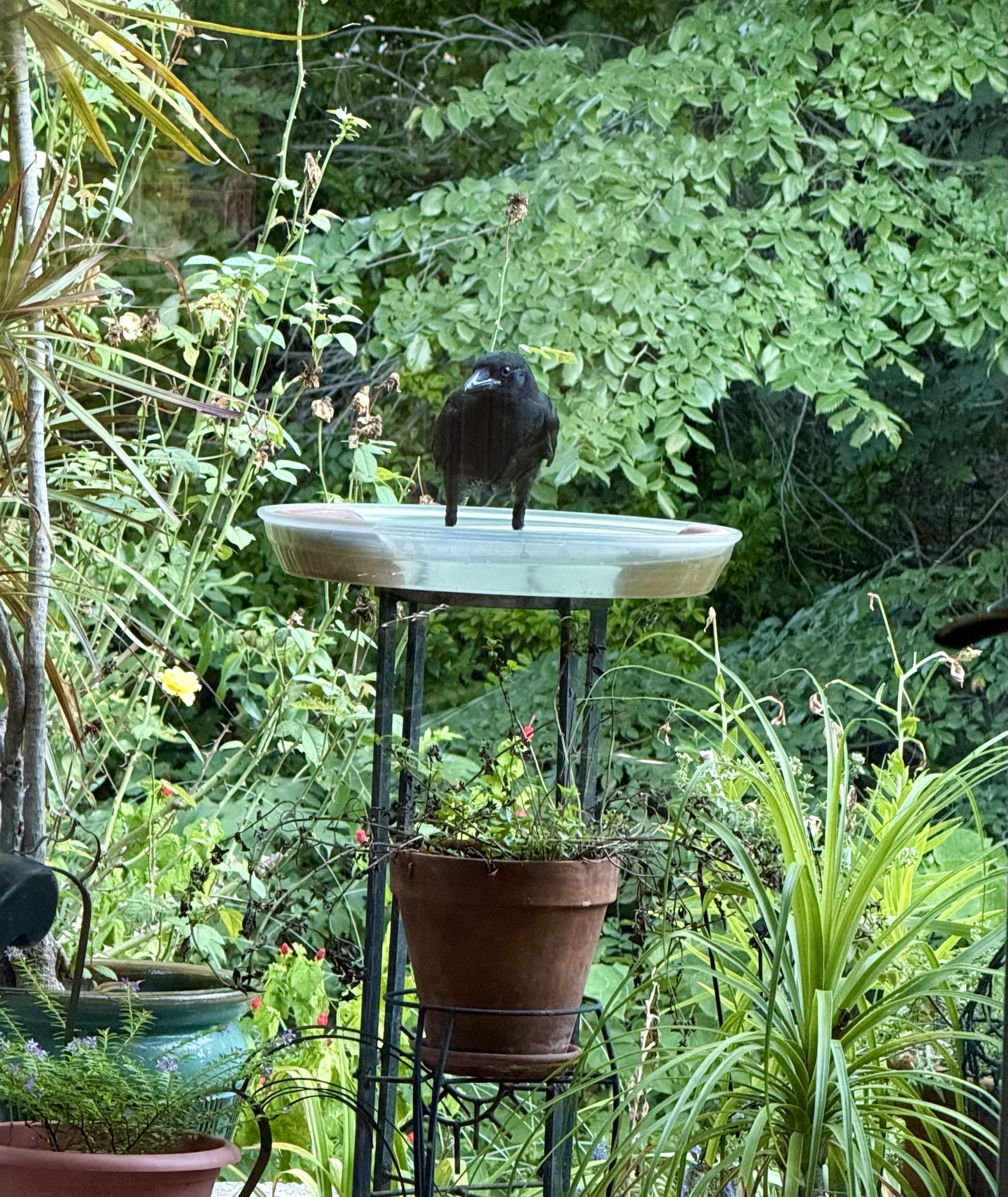
We enjoy feeding birds at our house, and crows are frequent visitors.
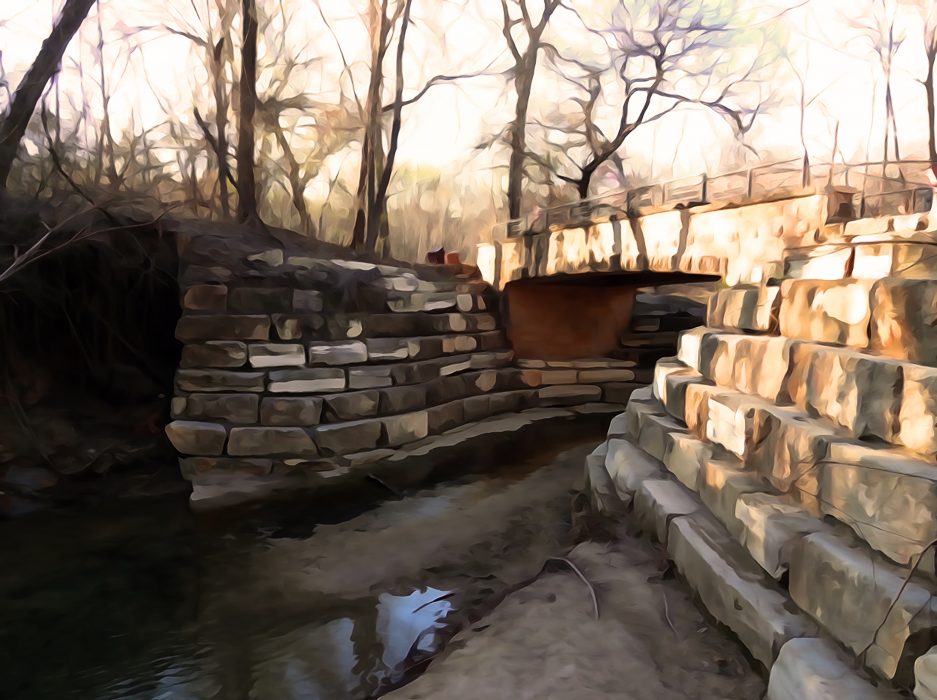
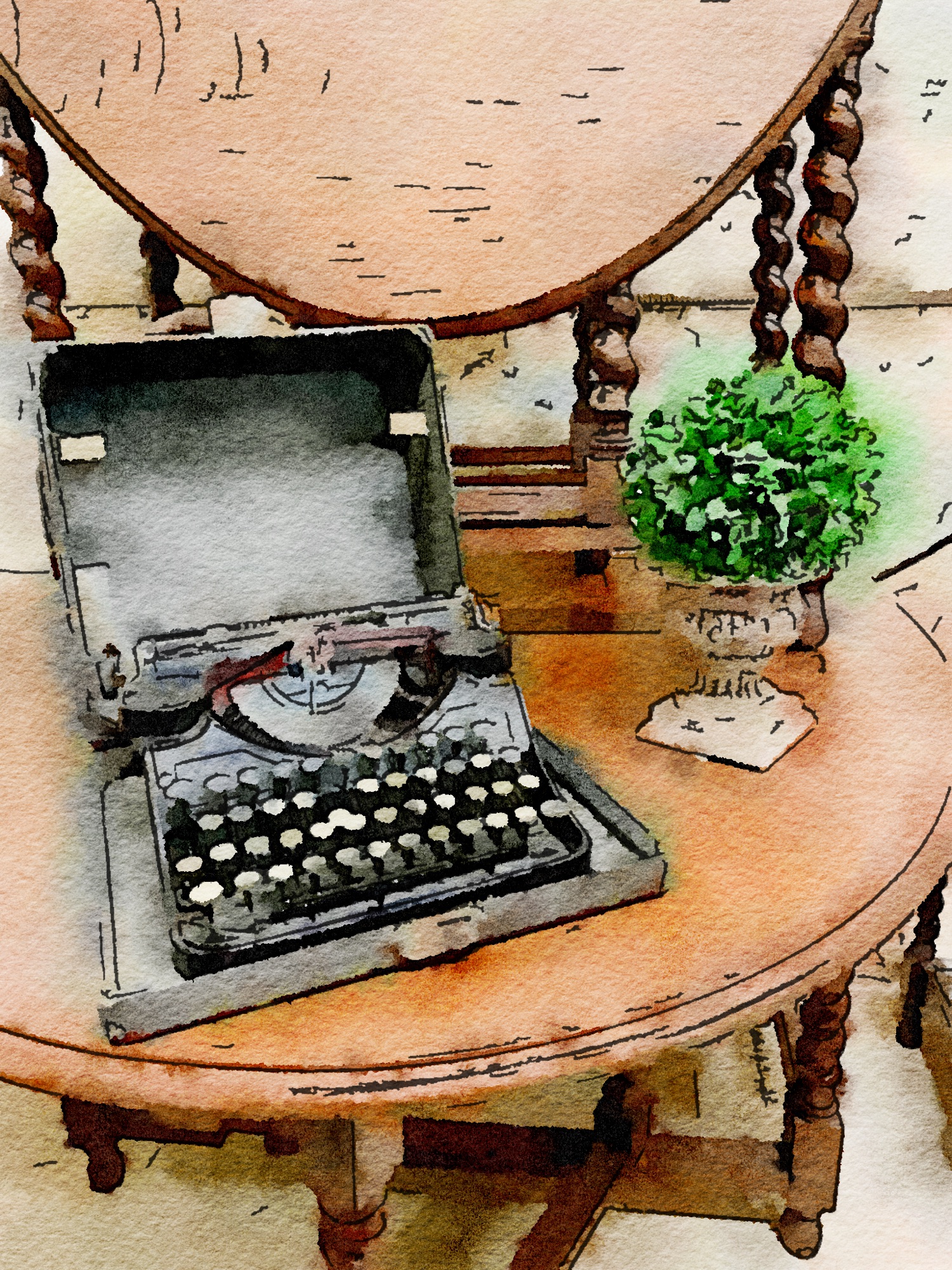
Photo by the author, edited with the Waterlogue app
An Empty Heart Holds Only Echoes
The day after her husband’s funeral, a crow crashed into Vera Scott’s patio door. At first, she overlooked the small black body on the other side of the glass. The collision’s hollow thump had been so loud she had expected something larger to have caused it.
She kneeled and picked up the bird. Lined above them in the trees, a murder of crows assembled. Cawing, they hopped from limb to limb—loud, black clad mourners.
Photo by the author
Tired of death, she willed the bird to stir. A shiny eye blinked. With a rustle of ebony feathers, the crow flew—hollow bones lifted weightless.
THE END
Most of the horror stories I write tend more toward Gothic fiction, with haunted houses and ghosts set in Texas or other strange places. I’ll never kill off a dog, cat, or child in my tales, but grown adults are fair game.
This little story is one that keeps popping back in my imagination, begging for more words. It’s a bit dark, but not gory.
Photo by the author
What is Planted in Despair Will be Raised for Vengeance
We buried her in the spring, in the field where summer poppies bloom. Nothing holy grew from our grief, scattered like seeds across her grave.
Her mother’s tears watered the ground. Her lover’s guilt summoned the reaping. Had we recognized in time the truth of her death, he would have joined her under that cold blanket of dirt.
Her bones rose—white roots clawing through black soil to reach the sun. Conjured with regret, she will glean the good with the guilty.
We could have salted the earth to kill the curse, but fall is the time for the harvest.
THE END
Photo by the author
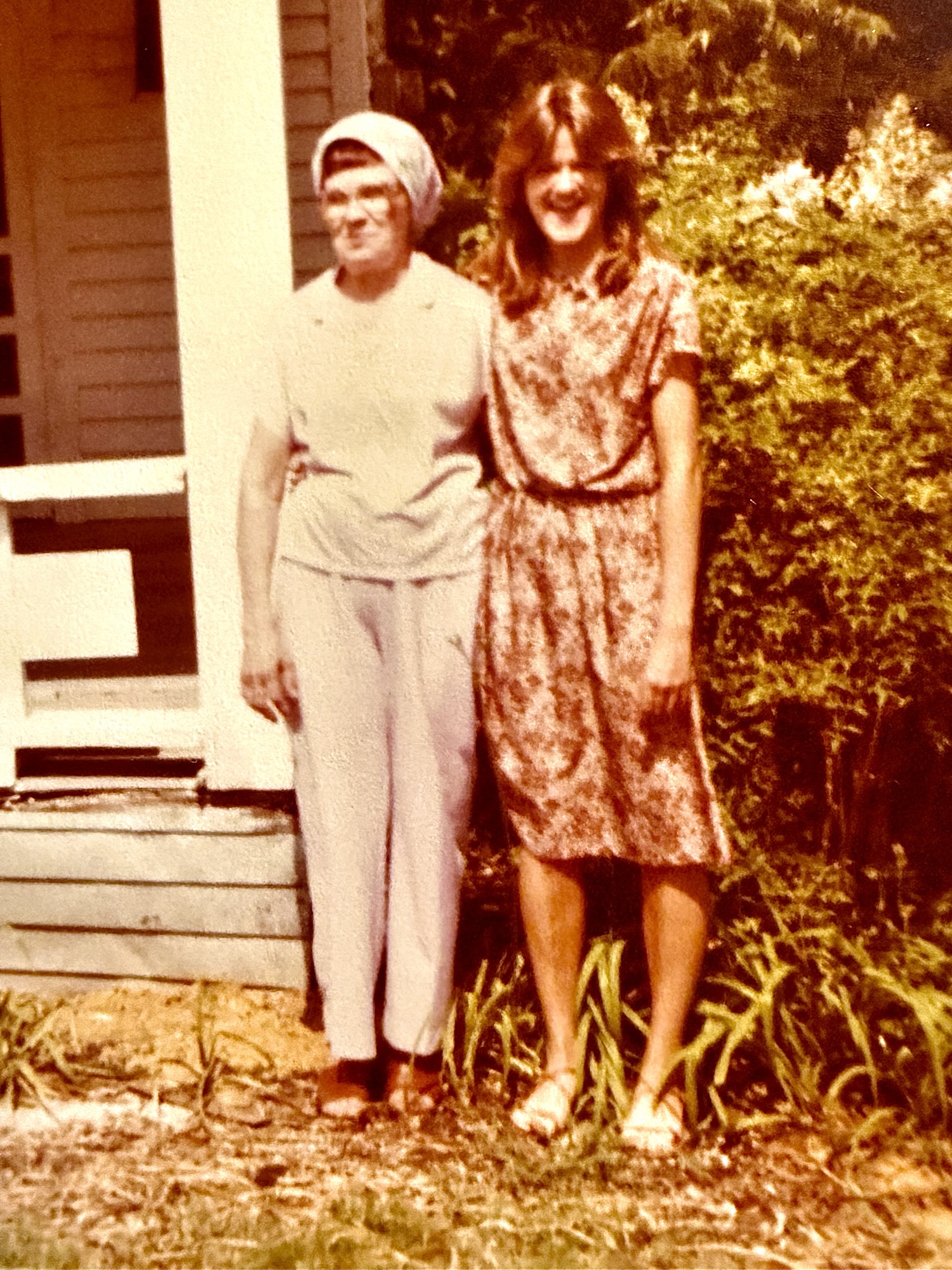
My relationship with my mom had the normal ups and downs, plus the complications from her undiagnosed mental illness. By the time this picture was taken we had reconciled and we had relaxed into enjoying each other’s company.
The micro fiction below was an entry in a contest. My entry didn’t win or advance and I haven’t tried to submit it anywhere. Instead, I chose to share it here.
I don’t remember the exact prompt, but it was something like “packing for a trip.”
I chose a darker interpretation of that prompt.
My mother, Christene Hamilton, passed away in 2010 at age 92. Departed finally on that last journey.
The author and her mother, Christene, sometime around 1982.
Wishing You Weren’t Here
My mother will not go. Her empty suitcase waits, ready to be packed.
Photographs faded to blue and green, recipe cards in her careful printing, a hairbrush threaded with silver, scarves scented with her perfume—all lie scattered nearby.
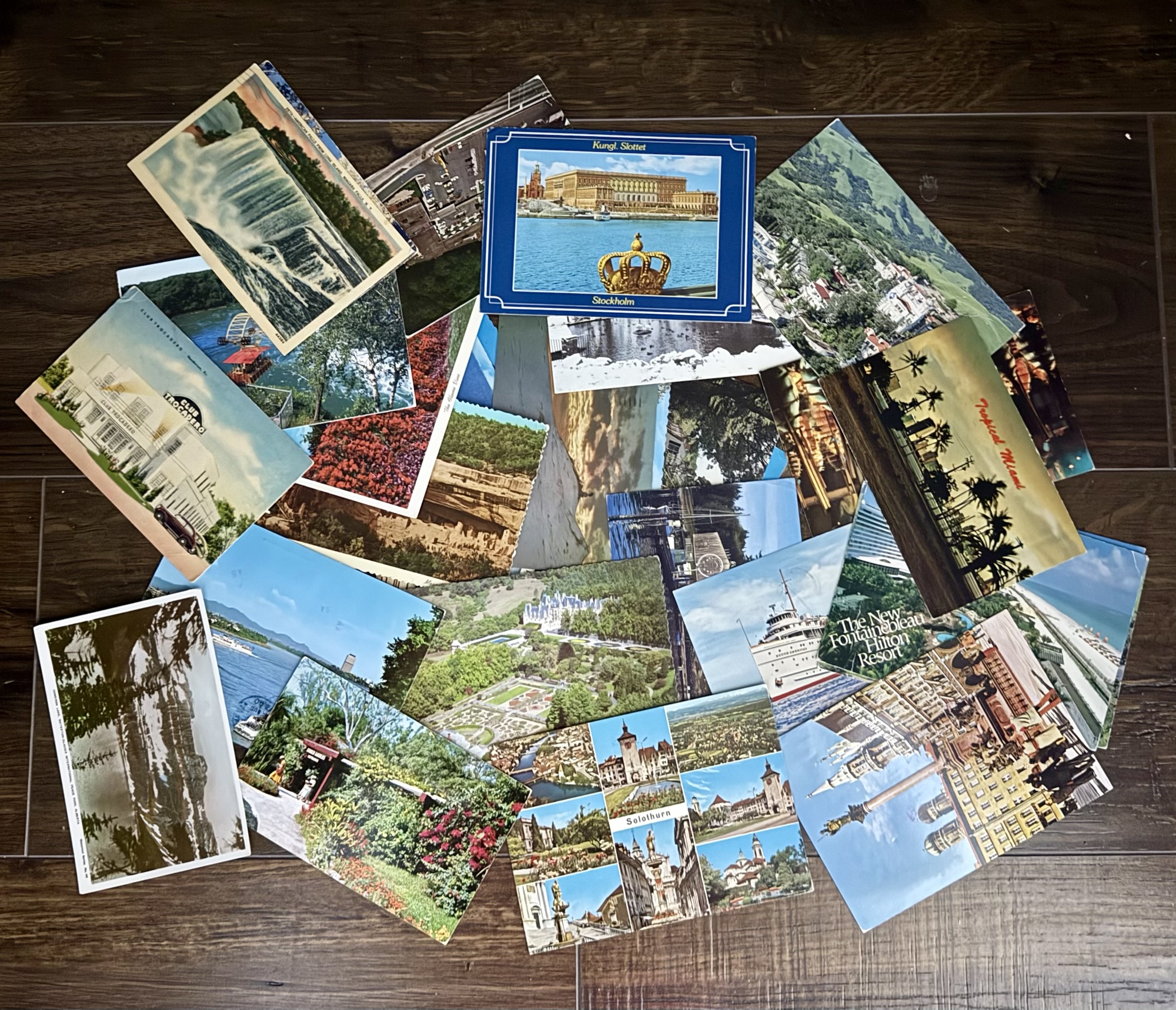
I add postcards from places never ventured, menus for foods never tasted. The yellowed fabric of her wedding dress goes in last. Out of sight, lest regret serve as an anchor. The coin for Charon’s crossing gleams beside the case.
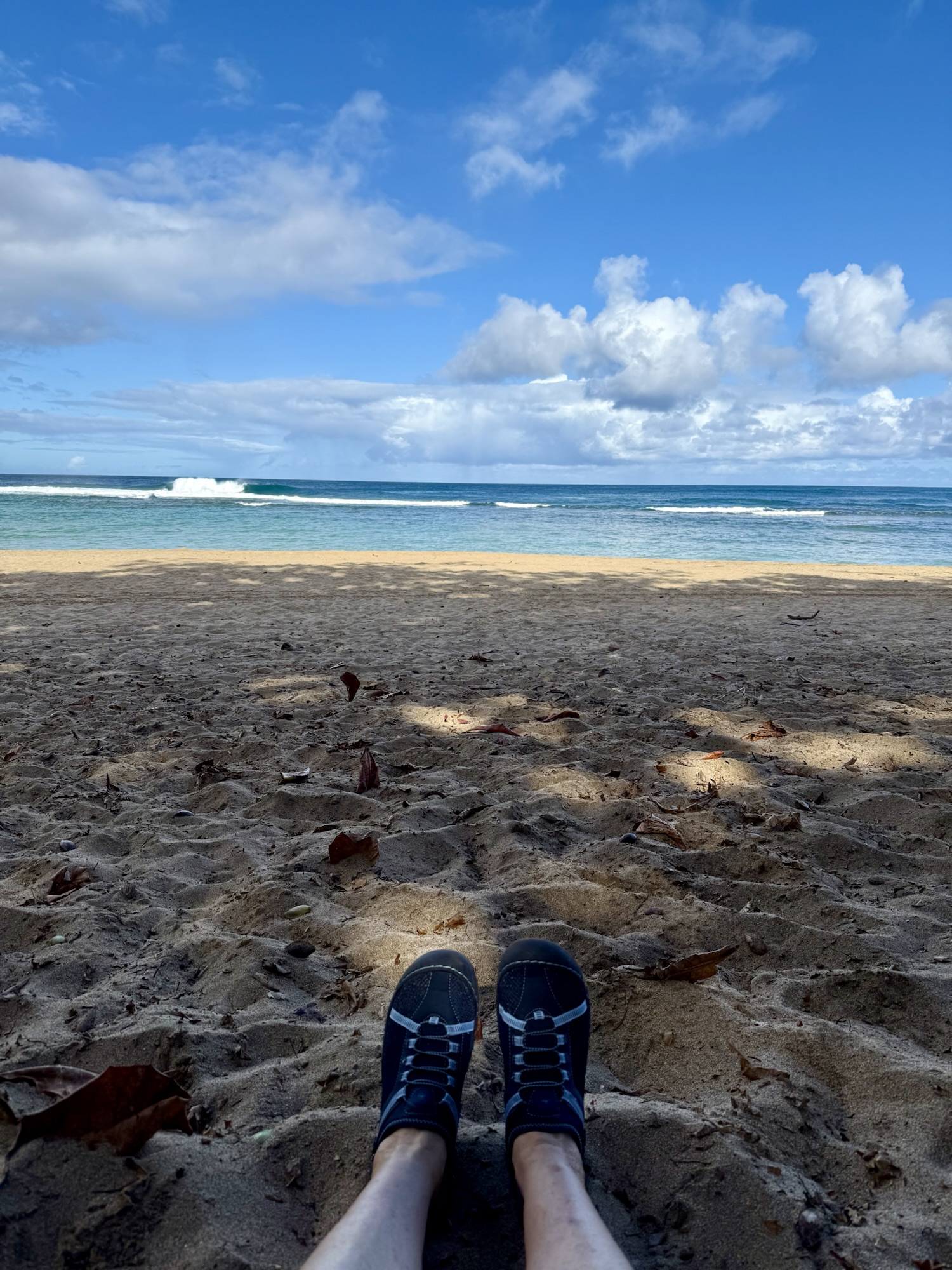
Photo by the author. Beach on Kauai, HI
I am sorry for this long journey, our distance fueled by bitter words.
When she leaves, who will love me then?
THE END
Photo by the author, edited with the Waterlogue App
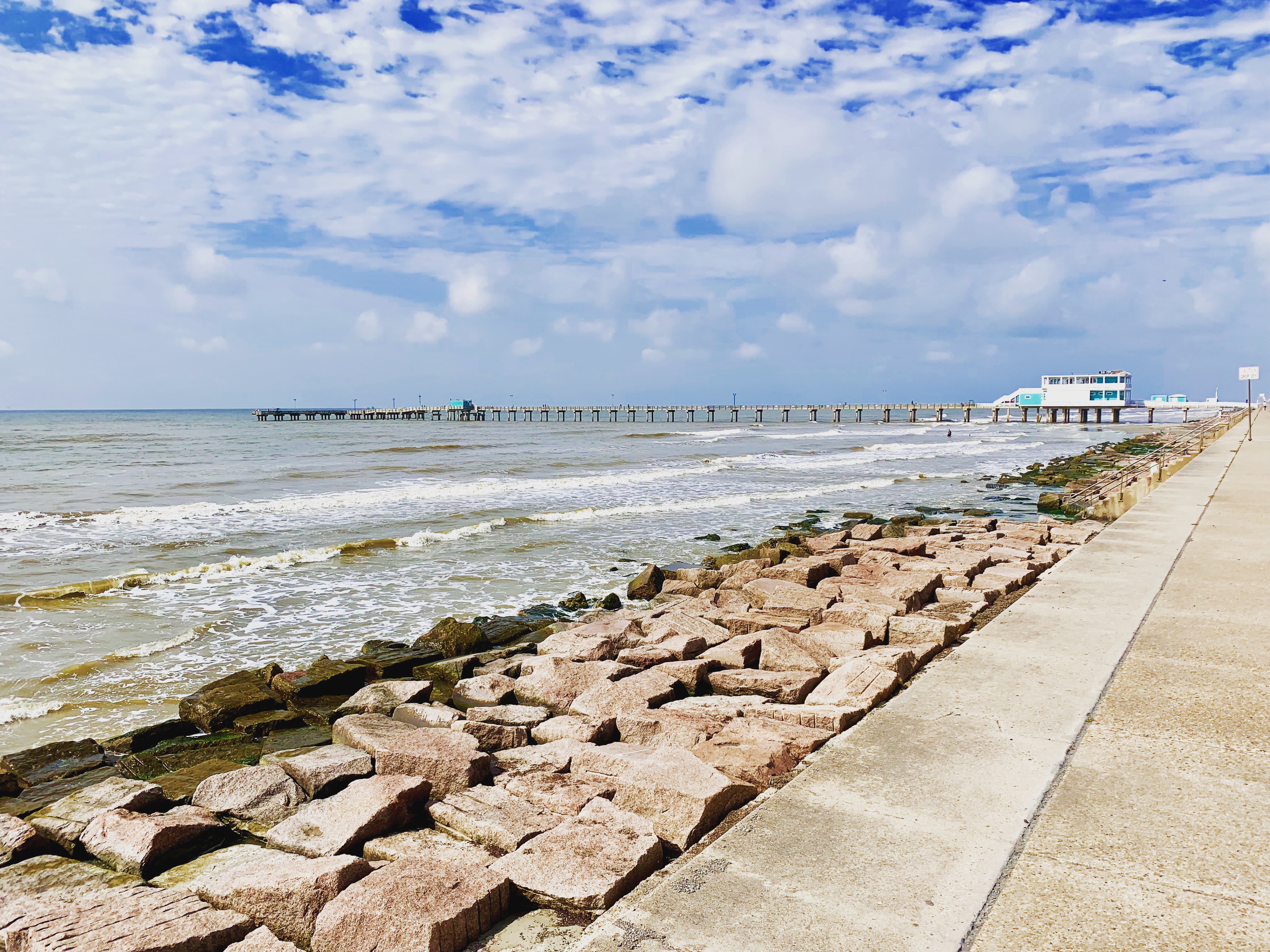
I wrote the first draft of this story while taking a writing class. The setting is based on some actual places in Galveston, Texas and all the photos in this post were taken by me during the trips I made to that island. Inspiration is the perfect reason for exploring.
The story sat in a file on my computer for a year or two, until I finally polished it enough to submit it to a writing contest. It didn’t place in that competition, so back in the file it went.
I went looking for something to post tonight, found it, and resurrected it here. There are ghosts of a sort in this one, but it isn’t particularly scary.
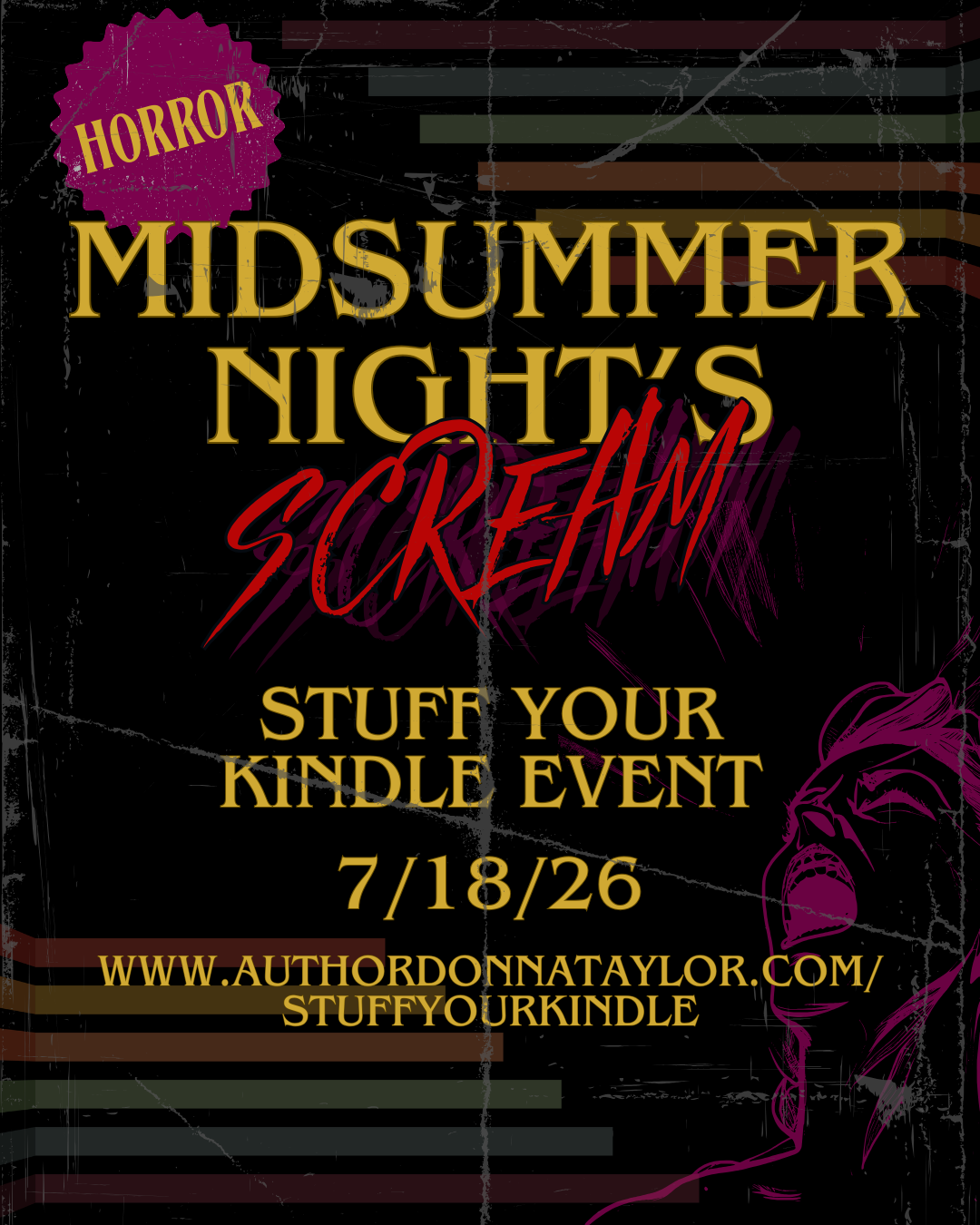
Speaking of scary stories, my book of short stories will be one of those listed in a “Stuff Your Kindle” event this Saturday, July 18. In case you want to pick up some free and .99 ebooks on that day (including my book, The Imposter and Other Stories), I’ll post the event graphic and link at the end of this post.
And now, here is my story. As always, thank you for reading!
GHOSTS IN GALVESTON
They rolled into Galveston after midnight, Dee and her boyfriend Emery. After they checked into the motel, Dee strode barefoot across the damp carpet in their room and wedged open the metal door to the balcony. Behind a curtain of gray mist, the sea lay hidden, revealed only by the sound of waves breaking against the seawall and the salt scent of the ocean. In the parking lot below, a solitary smoker lifted a cigarette, the lit end like an orange star that rose and fell.
Back inside, she joined Emery in unpacking their bags. Her case held, along with her clothing, a pocket-sized field guide to the island, the tattered paperback romance novel she never had time to read, and tucked at the bottom, a sturdy square cardboard box with eight pounds of bone-white ash. Until this trip, the ashes had rested on the shelf in her coat closet. The last reminder of her dead husband, Mack, she planned on spreading them here, in Galveston. If there had been anyone else to take on that chore, she would have gladly handed it off.
Emery dumped a handful of tourist brochures on the bed. A high school history teacher, he carried a list of landmarks he wanted to visit. “What should we do first?” He fanned a pair of folders. “The palace or the mansion?”
“It doesn’t matter. We’ll get to both of them, I expect.” She studied the pictures on the brochures—The Moody Mansion with its red-brick masonry and the white stone exterior of the Bishop’s Palace. Which had she toured with Mack? They went to Galveston every other summer until the year he died. Dee believed that by returning to all the places they had visited during her marriage, she might replace the terrible memories with good ones. It had taken her two years to get back to Galveston, the last spot her dead husband haunted. With luck, she’d leave him here.
Natural disaster and faulty recollection threatened her plan. The name of that restaurant, the one where she had dined on fried shrimp, the coating so crisp and flaky—floated out of reach. Dee wanted to test if the food tasted better when she sat across from someone who didn’t chastise her for every bite, who didn’t resent every small happiness she found.
Hurricane Ike wiped out the Balinese Room, the shady night club where Frank Sinatra sang to oil barons sipping margaritas. A gaudy amusement park sprang up on a new pier off the seawall, and Murdoch’s Gift Shop was destroyed and then rebuilt. Dee had purchased cheap trinkets there and hidden them from Mack to avoid the inevitable argument about how she squandered his money. She always had her own job, her own paycheck.
Dee encountered the ghost on their second day on the island, while she and Emery browsed antiques in a store in the Strand, the historical shopping district. They visited a bookstore, a candy shop, and a crystal store. Dee bought a necklace in the crystal shop, a silver chain with a heart-shaped azurite charm. She liked the blue color of the stone, and liked the charm even more when the black-garbed shopkeeper told her, “Good choice, azurite is for memory.”
“Help, please?” Dee handed the necklace to Emery. She lifted her hair from the nape of her neck and he fastened the clasp, his fingers brushing her skin. “Smile,” Dee said, as she took a selfie of them together.
In the bookstore, Dee got Emery to pose under the hurricane watermark etched into a post. The date, September 13, 2008, hovered five feet above his head. While he leaned against the post, Emery used his index finger to push up his glasses. By the end of the day, smudges would cover them so thickly that Dee wondered if he could see. She lifted her new phone, bought for this trip, and snapped his photo.
Their last stop downtown, the antique store, Dee wandered through the jumble of dusty furniture, rusted metal objects, and age-clouded glassware. A wall of broken wooden chairs covered one end of the space, as though stacked there to prevent an intruder from bursting through. Dee framed and focused the shot, then glanced back to where a short older woman, the cashier, spoke to Emery. He lifted his head and laughed, brushing back a lock of dark hair that fell across his forehead. A tiny, star-shaped scar was there, hidden by his hair. Dee liked to think she was the only one who could see it. When they lay in bed at night, she liked to trace its white outline with her finger. She asked him once, “How did you get this?”
“I don’t remember,” he had said. “It happened a long time ago, when I was a toddler.”
This answer amazed Dee. She knew the history of every mark on her body.
“We should go upstairs and look around,” Emery said, after he left the cashier. “This used to be a hotel, built in 1913. It closed and reopened in the 1940s as a bordello.”
“Mm hmm.” Dee nodded. In the space, filled with dividers and cabinets, it was easy to imagine an open lobby filled with travelers and, later, by customers of a different sort.
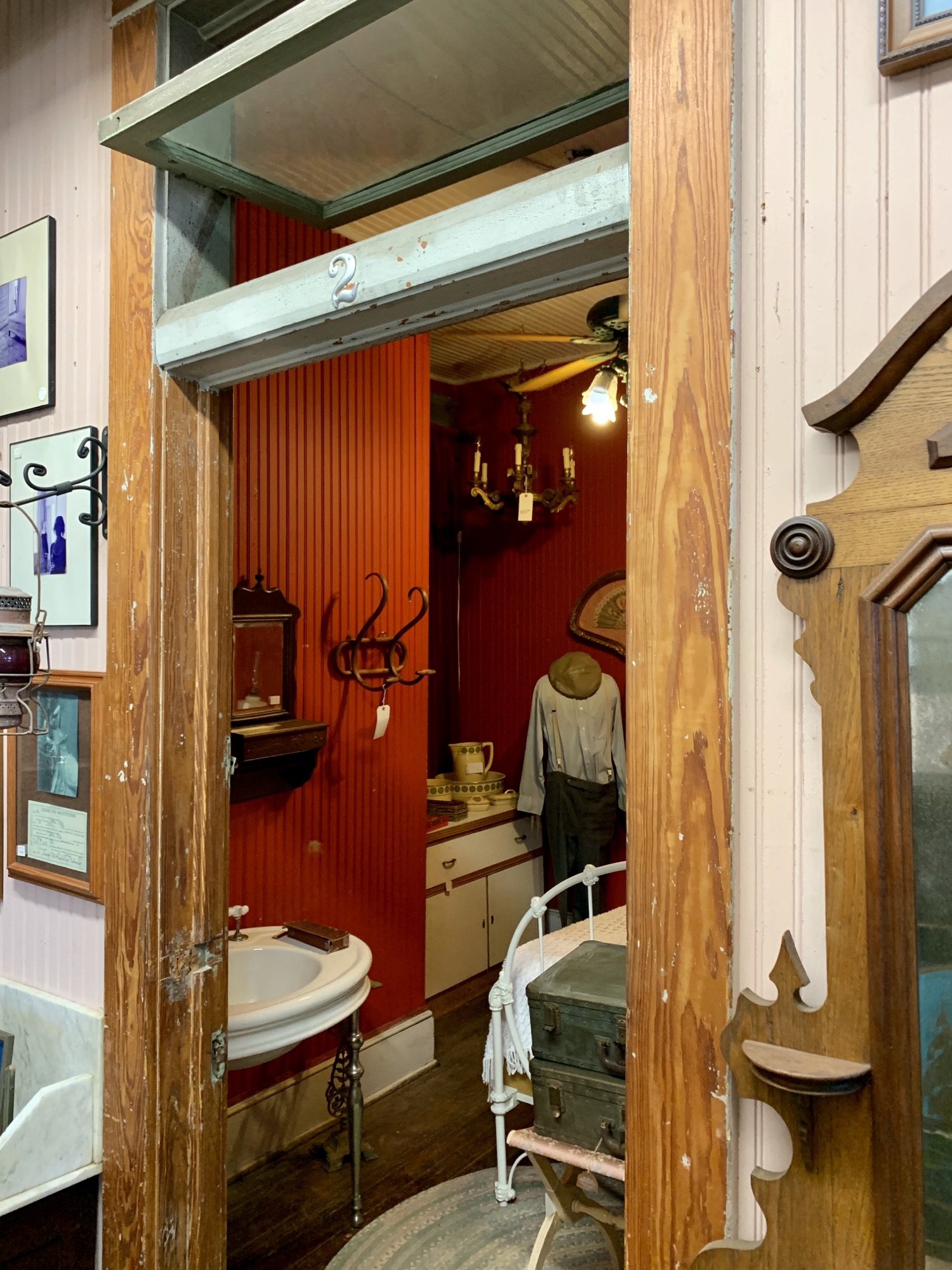
They climbed the creaking wooden steps to the second floor. The rooms were laid out along the outer walls and decorated with antique furniture. Metal room numbers, their paint scratched and faded, were hammered into the wood frames below transom windows at each door.
The first room they stopped in, Dee ran her hand across the velvet coverlet on the bed while Emery dug through a box of old phonograph records. The place smelled like damp cardboard and dust. Faded landscapes hung on the walls, and the nightstand beside the bed held a porcelain wash basin. A vintage tea towel, embroidered by someone’s great-grandmother, lay folded beside the bowl, as though the room’s occupants had stepped outside for a bit.
“This is so cool,” Emery held up a Cole Porter album. “It’s like a museum, but everything’s for sale.”
“I guess that was true back then, too,” Dee said. She smiled at his enthusiasm. Had she been here with Mack, he would have complained over the prices, the maze-like crush of the hallway crowded with furniture and knick-knacks. She held up her phone. “I’m going to look around.”
What would it have been like for the women living in these rooms? Like captive birds, held here at the whim of men. The place felt small, claustrophobic. Dee thought of the baseball bat Mack had kept by their front door, and the loaded gun in the hall closet. “Just in case,” he’d said, part of the paranoia that made him count the used batteries, scratched DVDs, and broken fishing lures scattered throughout their house. As though anyone would break in to steal their rubbish.
In the hallway, Dee dodged an older couple studying the price tag on an oak dresser. She passed rooms occupied with shoppers and left them alone. Through the phone’s camera app, Dee studied the composition of furniture crowding the hallway. A flutter of white at the far corner of the building drew her.
Voices faded as ambled past rooms barely more than closet-sized. The air grew colder the closer she got to the end of the hall. The hair on her arms stood up, the atmosphere charged with static. Dee halted at the threshold. A young woman stood at the window, staring through the glass. A tumble of auburn hair hung to her waist. She wore a linen nightdress, the loose cloth exposing one pale, bare shoulder as the ghost turned, looking past Dee at the hallway outside the room. The spirit’s eyes widened in terror and she backed against the wall.
“It’s okay.” Dee reached a hand out to the woman. Resisting the urge to glance behind her, Dee swallowed the words in her dry mouth, about to told the ghost, “Run.” Instead, she snapped a photo without taking time to focus. With the touch of the screen, the phantom woman disappeared. The picture illuminated in the preview showed only the white lace curtains.
“What did you find?” Emery appeared at Dee’s side.
“Did you see that?” she asked.
Emery shook his head. “See what?”
“Nothing. No, wait. I thought I saw a ghost.” She showed him the picture on her phone. “But there’s nothing there.”
Dee supposed that if any place were haunted, it would be Galveston. Over six thousand people died in the Great Storm of 1900. After the hurricane, they loaded the dead onto barges and dumped them at sea, only to have the corpses wash ashore days later. Workers buried many of the bodies where they lay, scattering ashes from funeral pyres along the beach. Anywhere you stepped, you could walk across a grave.
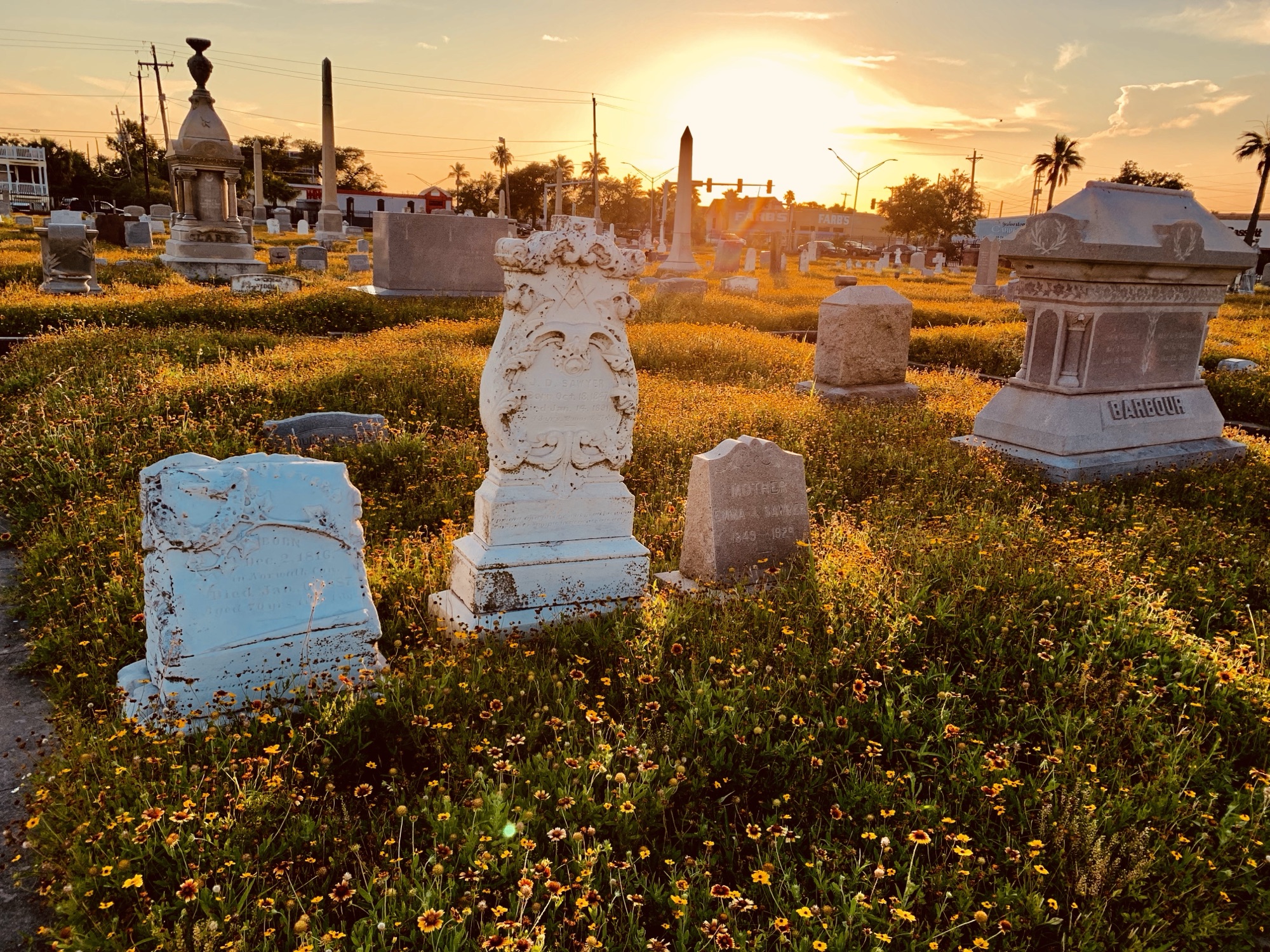
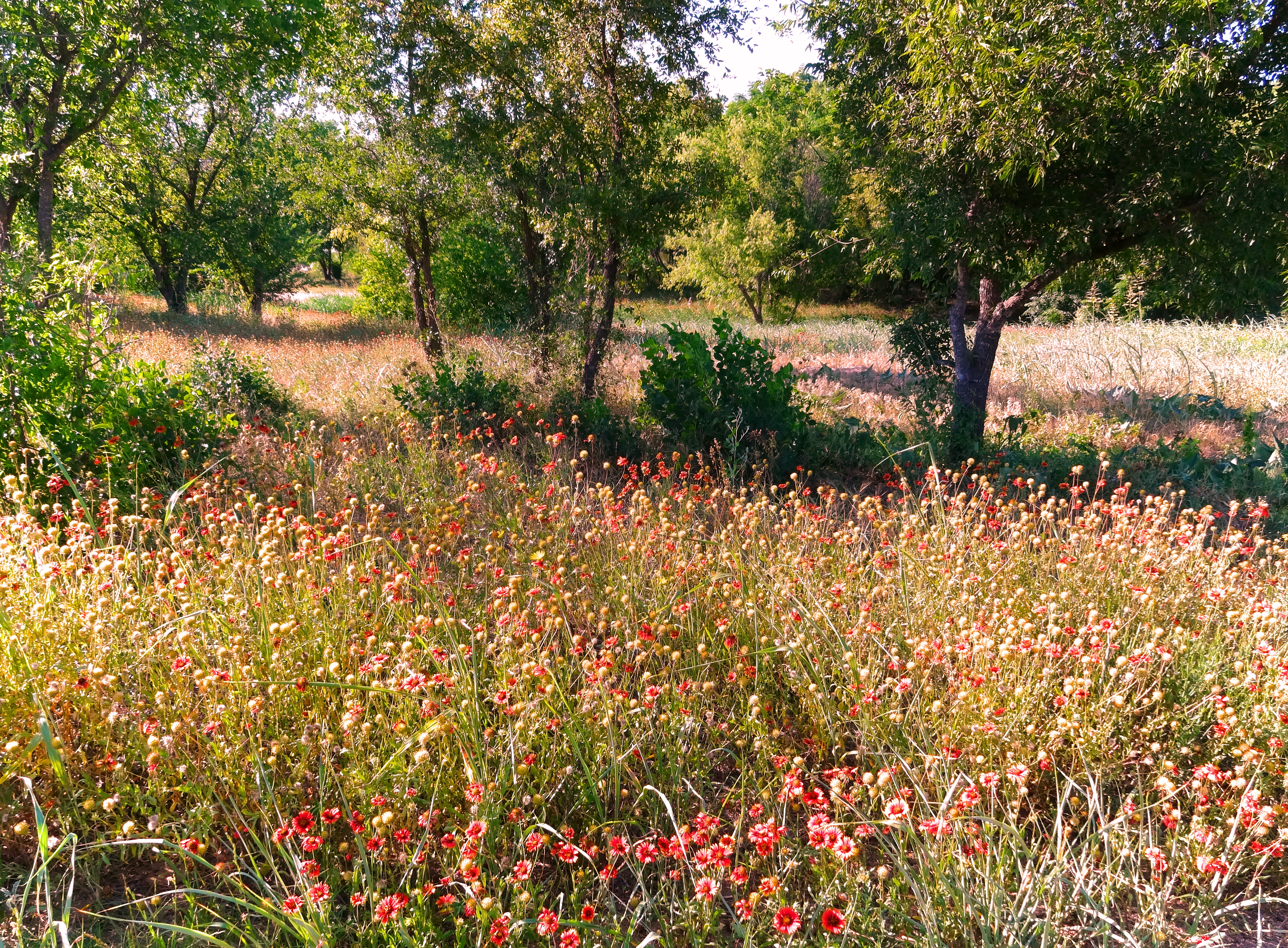
They left the Strand, and on the drive back to their motel they came upon the cemetery in the center of the city. Yellow sunflowers and golden evening primrose covered the graveyard. The sun hung low in the sky, casting the last of the light over the field. The blooms blazed as though the ground were on fire.
“Can we stop?” Dee asked. “I’d like to photograph the cemetery.”
While Emery read the inscriptions on the headstones, Dee strolled beside him. Tall monuments flung long shadows across the graves. Wear and fading had worn away many engravings, leaving only faint lines to mark those buried there.
“Sad, isn’t it?” Dee ran a finger through the green moss covering one tombstone. “How will they know who is buried here?”
“There’s a saying I’ve heard—that a person dies twice. The first time is their physical death and the second death is the final time someone says their name.”
As far as Dee knew, Mack had no family. An only child, his parents died before she met him. No friends, no far-flung cousins to carry his ghost. In the end, she would be the one to speak his name.
They had wandered toward the far end of the cemetery by the time the sun set. Her phone’s camera reduced the plots to quaint postcards, showing sleepy cherubs and palm trees dotting the grounds. Too dark now for a decent shot, Dee turned with Emery to head back to their car.
They hurried along the gravel path through the center of the graveyard, racing the sunset. Dee spotted a figure leaning against the gray marble of one of the larger mausoleums. She couldn’t see his features clearly, yet his posture seemed familiar. For six months after Mack’s death, Dee imagined him everywhere. Once, she’d abandoned a cart of groceries and left the store because she spotted a lanky man dressed in the same type of tan cotton duck jacket that Mack used to wear.
As though her memory had conjured her dead husband’s ghost, Dee shivered and grasped Emery’s hand. Reassured by the physical touch, she matched her steps to his until they reached the car. She refused to look back at the graveyard until she buckled her seat belt and Emery started the car. The figure, whatever it had been, was gone.
That night, back in their room, Dee lay sleepless. She waited until the quiet whistle of Emery’s breath slowed and she could be sure he slept, then she rose and pulled the box with Mack’s ashes from her suitcase.
At the beach, she kicked off her shoes and waded into the warm Gulf. The receding tide slapped against her thighs as she drew out the plastic bag that held the cremains. With only the moon to witness, she tossed a handful into the sea, then poured the rest after. She hoped the surf would carry him far from shore as she whispered, for the last time, “Mack.”
THE END
I hope you’ve enjoyed this story, and if you’re in the mood for more fiction with ghosts and ghouls, the link to the Midsummer Night’s Scream Stuff Your Kindle Event is below.
Photo by the author. Edited with the Waterlogue App
This story was first published in 2019 in the magazine The Weird and the Whatnot. I included it in my book of short stories, published in 2020. That book, The Imposter and Other Stories, has languished over on Amazon since then. I haven’t done much to promote it. In fact, I often forget that it’s out there.
Next Saturday, July 18, that book will be included with several other horror ebooks in a “Stuff Your Kindle” promotion organized by a writing contact of mine, Donna Taylor. https://www.authordonnataylor.com/stuffyourkindle
She will be posting more on her website soon for the event, and I’ll be sharing over on Instagram and here once it kicks off.
In anticipation of this event, I thought I’d share a story that was included in the book, to give folks a look at the type of writing and stories that are in The Imposter and Other Stories.
A Token for the Journey
Together, Dottie and Bill packed the car the night before their last road trip. They rose early the next day and headed out of Oklahoma City along the old highway, now part of OK-66. The car, a restored Candy Apple Red 1967 Mustang convertible, hummed along the blacktop like she understood where they were headed, as though Bill could take his hands off the wheel and the car would continue on, in no hurry to reach the destination and happy for the journey. Bill had promised the Mustang to their grandson, but first the boy had to finish college. For now, the pleasure of driving this fine automobile was Bill’s, and he carried it all with him—the car, the road, the memories—as they started their odyssey.
Bill mapped the route months before the trip, picking out the bits and pieces of the old Route 66 highway (the parts not swallowed up when Interstate 40 bulldozed through and killed off the small towns along the way). He aimed to land in Arizona before they turned around to head home. One benefit of old age. They didn’t have to stick to anyone’s schedule but their own.
“Will we get to Tucumcari before dark?” Dottie asked that morning as she smoothed out the road map and traced their course across the folds and crinkles. Parts of their sojourn might take them to areas of spotty phone reception, but the main reason they brought the paper version was nostalgia. They would drive past places they visited years ago on their honeymoon trip from Oklahoma to Los Angeles. Back then, they’d relied on maps and road signs to navigate; it didn’t seem fair to cheat the course with electronic gadgets.
Dottie, in her lemon-yellow capri pants and crisp button-up shirt, looked cool and sweet against the red vinyl seat. With her hair pulled back in a dotted scarf and the rhinestones in her cat eye sunglasses flashing in the morning sunlight, she looked much younger, like the girl Bill had married fifty years ago. Right then, it seemed they’d have more good days than bad ahead of them, but this wasn’t something they could count on.
“We’ll make Tucumcari long before dark. And we’ll hit stops along the way, maybe have a late lunch in Amarillo, at the Big Texan,” Bill said.
Dottie smiled and nodded as she slipped a dog-eared copy of Edith Hamilton’s Mythology out of her purse. It was her favorite book to read when they traveled, an anchor that reminded her of her days as a teacher. Mornings were best for her, she kept more of herself after a good night’s rest.
They made their first stop in Clinton, Oklahoma, at the Route 66 museum. The nation’s first completely paved road, Route 66, wound like a river of asphalt 2,448 miles from Chicago to Los Angeles. Bill climbed out of the car and trailed along behind Dottie, the old wound in his leg giving him grief after being cramped up behind the wheel of the Mustang. They browsed through exhibits that might have come straight from their own recollection of the Mother Road. Bill’s first trip down that river had been as a kid in the backseat of his father’s Chevy.
Bill followed as Dottie wandered through the museum, her eyes lit up like a kid’s. It was good to see her so animated. Lately it seemed she spent too much of her days along Lethe, the river of forgetfulness in Greek myth.
When they got to the last display, Dottie turned to Bill. “I’d like to browse through the gift shop.”
“All right. Remember we’re in the Mustang, so don’t buy anything we have to haul halfway across the country.” Bill watched his wife disappear behind a wall of coffee mugs and t-shirts.
Bill leaned against the car while he waited for Dottie to finish her shopping. Standing there, staring out over the parking lot at the blue horizon, it reminded him of those days in the past when he waited for her outside shopping malls. Back then, he’d have a cigarette to pass the time, and the memory of it had him draw in his breath, tasting tobacco and ash on his tongue. Bill glanced at his watch, worried he’d made a bad decision leaving Dottie on her own. He pushed off the car, ready to go into the store, when he spotted her walking out the door of the museum.
“Now don’t fuss, but I got you a little something.” Dottie laughed as she opened the car door and handed Bill a white paper bag with the museum logo. He pulled out a key chain with a tiny metal token, a round replica of the old Route 66 road signs.
“Well look at this, it’s just right isn’t it?” he asked as he ran his finger along the edges of the little white shield. It was slightly bigger than a quarter. “I guess it’s our lucky charm,” Bill said. He clipped the Mustang’s keys onto the chain and twirled the miniature road sign before starting the motor. The afternoon had turned out nice, sunny but not too hot, so they put the white vinyl top down before they pulled out of the parking lot.
Outside Amarillo, the old highway became the service road for I-40. The Mustang would handle the interstate just fine, but they rolled along beside it and let the interstate truckers blast past in a rush of diesel-fouled air. The road stretched out in an unbroken silver line straight to the horizon, flat plowed fields on either side. Short green corn stalks poked out of the red dirt, reaching their leaves like arms to the sun.
Past the town of Soncy, they crossed I-40 to the southern frontage road so they could pass by the Cadillac ranch. Bill slowed down to take in the sight of ten classic Cadillacs buried nose down in the muddy field. They were slanted at the same angle as the great pyramids of Egypt. Layers of peeling paint coated the autos in a riot of color that, to Bill, looked more like vandalism than pop art.
They first spotted the hitchhiker there. He stood at the edge of the frontage road where the asphalt gave way to loose gravel. Dressed in an olive-green army fatigue jacket, at first glance he blended in with the tall grass behind him. He held a hand-lettered cardboard sign that looked as tattered as his clothes.
“What do you think he’s doing all the way out here?” Dottie asked as they cruised past.
“It is a little odd that someone dropped him there.”
Bill glanced in the rearview mirror and saw the guy watching as they drove off. His long hair and sparse beard reminded Bill of Odysseus, on the tail end of his journey home to Ithaca after the Trojan war. From his post on the roadside, the hitchhiker took one hand off the sign to wave, and Bill mashed down the accelerator. The pony car rumbled in response, a quarter-sized hole in the exhaust making the engine sound louder and larger than the stock 289 V8 under the hood.
The highway stretched out to the horizon, an unbroken line of grey. As the day grew warmer, heat waves shimmered across its surface and a mirage appeared ahead of them, turning the road into a false waterway. Soon they arrived in Adrian and stopped to stretch their legs at the Midpoint Café. The white painted concrete block building looked much the same as it must have in 1928. The couple pushed through the doors and walked into a dining room from the past, complete with Formica-topped tables and vinyl covered chairs with chrome legs. They slid into a booth near the front. As Dottie settled across from Bill, he spotted the hitchhiker in the last booth from the door.
“Isn’t that the guy from outside Amarillo?”
Dottie turned around, her forehead wrinkled. She clutched Bill’s elbow as she bent her head to whispered, “Someone must have picked him up.”
Bill wondered how he ended up ahead of them. Maybe his ride took the faster route along the interstate, instead of the scenic old highway. The hitchhiker hunched forward in the booth, hands cupped around a thick china mug. A dirty green duffle snuggled up against the bottom of the booth. The man turned toward them and lifted the coffee mug in a salute as though he knew they had been talking about him.
The hitchhiker got up to leave and Bill suggested they linger over coffee and pie. He didn’t want to walk past that guy on the way to the Mustang. When they got up to pay, Bill peeked out the front glass. He saw no one in a faded army jacket. As he dumped a handful of change onto the counter, the key chain with the road sign token clattered out amongst the dimes and pennies.
“Don’t suppose you take this do you?” Bill said, holding up the souvenir so the Route 66 logo faced the cashier.
The woman replied with a tired shake of her head, and Bill laughed as he dropped the keys into his pocket. “Better not give up my good luck,” he said.
They hopped back on the frontage road and followed I-40 until the exit for Glenrio, the ghost town on the Texas and New Mexico border. They pulled the car off the road and climbed out to wander past the rotting wooden buildings that had once housed a café and a motel. Dottie snapped photos with her digital camera as Bill kicked through the high weeds surrounding a deserted gas station with rusted pumps. An abandoned car, a beat-up Oldsmobile with primer-grey fenders, sat on blocks beside the building. The wind picked up, whistling in with a cool front. They’d need to put the top up for the drive into Tucumcari. Black clouds rolled in across the horizon and the air smelled like rain.
“We better head out before the rain starts,” Bill called out to Dottie as he turned back to the car.
As he hiked back to the Mustang, he stumbled, his bad knee locking up, and an adrenaline jolt of pain caused Bill to gasp and clutch his chest. Fear ran through him as he slumped against the car. What would happen to Dottie if he fell and broke a hip, or worse? Bill leaned on the warm metal of the fender and zipped up his windbreaker. When his hand found his pocket, he felt the little metal road sign, the key chain Dottie had purchased that morning. His fingers smoothed over the cool, slick enamel and his breathing slowed.
Bill turned around to search for his wife. A blur of motion at the corner of the gas station turned out to be a tumbleweed. Heavy blue-black clouds drifted over, blocking out the rest of the sunlight. A flash of lighting reflected in the grime-smudged windows of the gas station and revealed what looked like a face pressed to the glass inside.
“Dottie?” he called, thinking she’d somehow gotten inside the building and couldn’t find her way out. She appeared from behind the station, weaving as she stumbled on the broken asphalt at the edge of the lot. She stopped, looking around as though lost. Bill had his hand on the car door, ready to limp over to her, when she spotted him and waved. He sighed and eased into the car to wait for her. As she shut the car door and buckled herself in, Bill stared in the rearview mirror. The flat landscape reminded him of Amarillo, and the hitchhiker. Bill scanned the horizon, half expecting to see a man holding a worn cardboard sign.
They pulled into Tucumcari, New Mexico, as the rain started. There was still time before sundown, but the storm clouds hid the sun enough that they spotted the neon lights of the Blue Swallow Motel as they cruised through downtown. The sign promised refrigerated air and TV: as good a place as any to rest for the night. The room had a rattling air conditioner and a queen-sized bed covered in a fluffy white chenille spread. Bill showered and Dottie called Ray, their oldest, to check in. Ray sold insurance in Dallas, and he kept a rolling tally of their chances of meeting catastrophe. Bill listened in on their conversation until he heard the slur in Dottie’s voice, then he reached over to take the phone and tell Ray goodnight.
The nightstand held a black, hard-backed Bible, and Bill pulled it out and flipped through the thin pages. A verse from Revelation drew him in, and he dozed off reading about the Four Horsemen of the Apocalypse. The rumble of thunder and the flash of lighting from the storm outside merged with a dream of Dottie held hostage somewhere far off. In the nightmare, he clutched an old-fashioned rotary phone receiver to his ear and heard his wife’s voice, faint and scratchy, as she pleaded for rescue. Like she was Persephone abducted by Hades and kept in the underworld, only this time there would be no returning to the world above. Where she called from, Bill could never reach.
The next morning, they woke up to more rain. They checked out of the motel and Bill lugged their bags out to the car.
“Oh! I know that man,” Dottie said, pointing.
Somehow, it was the hitchhiker, Bill realized with a start. The stranger turned around then, looking right at them and holding the cardboard sign, soggy and wilting in the damp. As he walked toward the Mustang, the hitchhiker folded the sign and tucked it under his arm.
“I wonder if I could impose on you for a ride,” he said as he halted at the side of the car near Dottie.
“There’s not much room,” Bill began, then stopped as he saw Dottie staring at the hitchhiker as though she were puzzling out his name. He reached out to touch her arm. “We don’t know this fellow,” he said to her.
Her eyes cleared, and she shook her head. “No one should have to stand out here in the rain. The back seat’s small, but you could probably fit if you don’t mind not being able to stretch out your legs.” Dottie looked up at Bill, waiting.
“This is a fine automobile.” The stranger brushed a hand along the side of the car. Bill frowned, something about the way the hitchhiker touched the car did not set right with him. The trailing fingers seemed possessive, as though the stranger were stroking a lover’s waist.
“Where you headed?” Bill asked. “We’re taking the long way, going down the scenic road along old Route 66, you’d be better off with someone else.”
“I’m not in a hurry to get where I’m going,” he said. And with that, Dottie opened the car door and tilted the seat forward so the guy could climb in the back.
The rain cleared, and the passenger sat back and didn’t speak up again as Bill steered the car onto the interstate. Settled into the soft leather seat, the hitchhiker smiled and gazed out the window. Bill decided they would stay on the highway and take 25 up through Glorietta, enjoying pretty scenery at least. When they stopped in Santa Fe, Bill would drop the guy off and tell him to get another ride. The decision made, Bill relaxed to the hum of the car wheels on asphalt.
The roadside scenery changed from stunted brush and red rocks to the green of pines and juniper as the road climbed through New Mexico. The postcard perfect landscape reminded Bill of other trips they’d made along the old route. He could almost forget the stranger in the backseat, but a glance in the rearview mirror brought the man’s face into view. Each time the man met Bill’s gaze. The stranger stared into the reflection until Bill felt a heaviness in his chest, as though a thick rope wrapped around his heart and he had to look away.
In Santa Fe they cruised through downtown, past shops in terracotta stucco and pastel colors. Bill left the hitchhiker at a busy intersection, near a sidewalk art sale. The man didn’t protest, and Bill relaxed as they drove away. After they lucked into a vacancy at a pleasant hotel near downtown, they spent the rest of the day shopping and sightseeing.
At dinner Dottie pushed her plate of enchiladas away after a few bites. “You finish it, Ray. I’m just not hungry.”
Bill took her hand. “It’s all right, sweetheart, let’s go get some rest.” He did not tell her she’d called him by their son’s name.
That night Bill fell into a deep sleep, but in the darkest part of the night, he jolted awake with the strange feeling that someone stood over him, but when he sat up, there was only Dottie lying next to him. He lay back, but felt restless and didn’t want to wake Dottie, so he dressed and stepped outside to check on the Mustang. He pocketed the keys and rubbed the cool enamel of the little Route 66 road sign attached to the chain.
The lights in the hotel parking lot cast a yellowish glow over the cars, transforming the bright red color of the car into a coppery orange shade. A light mist hung in the air, creating halos around the streetlights. Bill limped a circle around the Mustang and turned to watch the red glow of the taillights from a passing car until they disappeared down the road. When he looked back at his car, he saw a white figure at the far edge of the lot.
It was a woman, her sheer white robe fluttered behind her like wings.
“Hey!” Bill called, and the woman turned and came toward him. It was Dottie. Her steps were sure and quick, and as she rushed to him her face changed, her brow smoothing and her cheeks filling with youth and beauty, until she no longer resembled the woman who had set out on the road with him. The robe and nightgown draping her body molded into the shape of the wedding gown she’d worn all those years past.
“Dottie!” Bill reached out for her and she glided by, a wintry wind in her wake. He twisted, grabbing at her arm, but his hand passed through the robe, as though he grasped a spider’s web. Confused, Bill felt as though he’d lost something. He bit the inside of his mouth, hoping that if he was dreaming, the pain would wake him.
His wife paused before the road.
“It’s time,” Dottie said. She folded her hands across her breast and turned her back on him to step off the curb.
“Time?” Bill asked. The answer came from his dreams, the bad ones, the ones where he’d woken up screaming. The road, once a ribbon of asphalt, now flowed as a river of black water. Somehow, Bill knew if she stepped into that river, she’d be lost to him forever. He’d always feared he would be the first one to go on that last journey, leaving her behind to struggle through life without him.
“No!” Bill called as the hitchhiker appeared beside Dottie. Bill recognized him then for who he was. Not Odysseus, the wanderer, but the ferryman, Charon, of Greek myth. The one who helps others on to their last destination.
As Bill reached for his wife, the ferryman spoke.
“I’m here for her journey,” he said, and stretched out his hand to grasp Bill’s arm.
A jolt of pure pain fired straight to Bill’s nerves, and his mind went back to that ominous place the other night, to the dream he’d had when he listened to Dottie’s voice calling, but could not go to her. His knees hit the pavement, and he knelt there, gasping as the road beyond the parking lot wavered and shimmered in waves.
A cool hand grasped his shoulder, and Bill looked up to find Dottie standing there, one hand held by the stranger.
“Take me instead,” Bill stumbled to his feet and reached out to the ferryman. Nausea gripped him and he bent over, clutching his stomach. Sweat beaded on Bill’s forehead and a sharp spike of agony pierced his brain, like a nail driven in behind his eye.
Charon scowled as he shook his head. “Only one passage is paid.”
“Does it matter then, who you take?”
Bill shuffled into the dark river. He expected the water to swallow him, but he felt solid ground beneath his feet. The cold, however, rushed over his legs as though he waded in ice water.
“Is it time to leave?” Dottie faded, the white mist that made up her figure melting like wisps of smoke. “Have you seen my husband? He always takes my hand.”
“Oh Dottie.” Bill couldn’t leave her behind, lost without him to watch over her. “Take us both, then,” he said.
But Charon shook his head and pulled Dottie further into the river. A gondola, draped in black sackcloth and trimmed in ebony, floated up to them.
Desperate, Bill thought to bargain with the ferryman, and pulled from his pocket the only thing he thought might work.
“If it’s a journey you want, climb in and let’s go.” Bill tossed the keys to the Mustang, and the ferryman scooped them from the air.
“You have a coin?” Charon puzzled over the round bit of enameled metal attached to the key chain, the Route 66 token.
“I’ve paid for my passage, isn’t that the deal?” Bill asked.
The ferryman nodded and took the keys. When he touched Bill this time, there was no pain, only a bright white flash of light. The age spots on Bill’s hand vanished, his wrinkled, loose skin plumping and filling with the strength he’d had forty years back. When Bill looked back to the parking lot, he saw his body, an empty shell, curled against the asphalt where he’d fallen the first time Charon touched him.
The river vanished, leaving the dark grey asphalt of the Mother Road, and the red convertible idling in the center. How else would they take the last journey? They’d motor down the old highway and it would be new again. The route would be exactly as in their memory of all the journeys they’d taken.
There was Dottie, with her rhinestone sunglasses and ruby lips smiling, a folded map under her arm. “Come on, slowpoke. We’ll put the top down,” she said.
The ferryman sat in the driver’s seat. Dottie laughed and Bill smiled at the sweet sound of the girl he loved. They climbed into the back seat, and Bill no longer feared the destination. They would travel there together.
THE END
I hope you liked this tale and be sure to check out the ebooks that will be either free or greatly discounted on July 18!
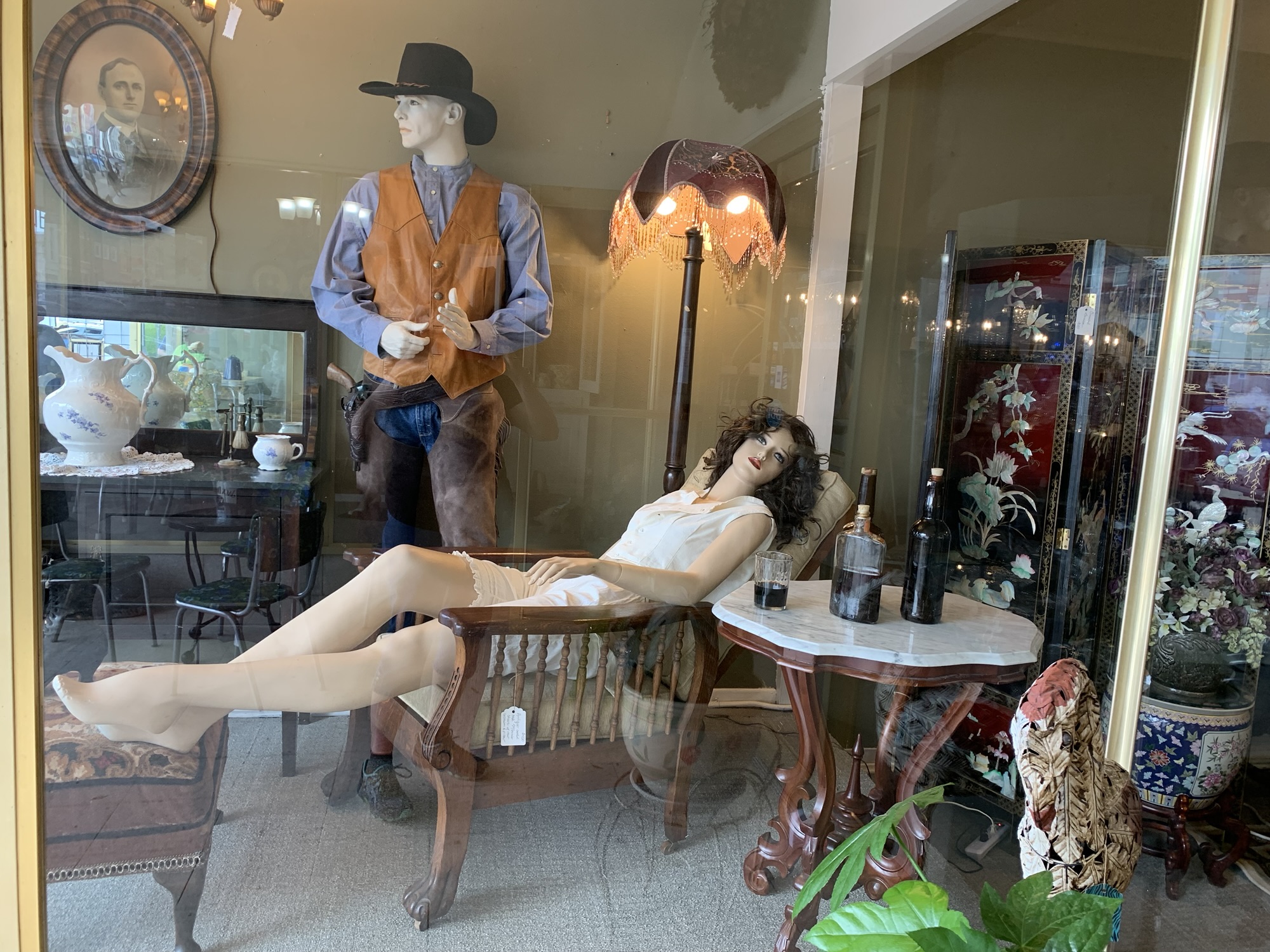
Robbing a casino would be a crazy big start to a criminal career
Photo by Terrye Turpin
Iris scanned the casino, the weight of the gun in her pocket an anchor. A cloud of cigarette smoke hovered over the clanging slots, wisps of it drifting down. The gamblers stared at the machines, mesmerized like worshipers begging for answers from their gods. Perched on stools in front of the slots, their faces lit by the flashing lights, each pull of the lever was a prayer. Even when the spin hit a payout, and gold tokens clattered out, they never lost that dazed expression, just scooped up their winnings without a sound and fed them back into the machine.
She carried a round gold coin in her left hand. Exactly like the tokens held by every gambler in the casino, one side featured the image of a four-leaf clover. The other side held a horseshoe. Unlike every other casino she’d ever been in, this one used only this chip on every game, not just the slots. No telling how much it was worth. There was no denomination printed on the coin, only the name of the casino—The Elysian.
She resisted the urge to drop the token into one of the slot machines, because she knew one thing for sure – the devil loves a loser. Iris had known this from the time she was a kid in thrift store clothes, stealing food and smokes from the convenience store near the trailer park. Bad luck followed her into the Army, giving her a gift of shrapnel in her back and memories she buried with her dead comrades.
Squeezing past a crowded blackjack table, she spotted Felix, the second man in their group. Tall, and so thin he barely cast a shadow, Felix shifted from foot to foot in a weird dance. Their third member, her boyfriend Chance, should be joining them. Broad-shouldered and solid, people often mistook his size for power, when it was Iris who could deadlift twice her weight.
The building felt impossibly huge, bigger than the outside had suggested. An endless row of slot machines stretched at the back of the casino. And the more she wandered the floor, the more packed it became with people. She could swear she hadn’t seen the front doors open. Where were they coming from?
Felix raised his chin at Iris, then stepped over to the roulette wheel. She made her way to stand on the other side of the table, across from him. They kept an eye on the bulky fellow whom they had determined was the only security detail. The bulge of a gun under his suit jacket gave him away.
A silver-haired woman dressed in a thin gray cloak brushed past Iris and slid a handful of tokens onto the square marked for black. The wheel spun and dropped the ball onto 18 red. Without pausing, the old woman dumped another pile of gold onto the table. Where had she pulled those from? Granny didn’t look like she had money to spare. Iris shook her head. It wasn’t her problem. She wasn’t there to stop anyone from blowing next month’s rent money. She was there to rob the place.
They had hatched the plan two weeks ago, when Felix stopped by Iris and Chance’s apartment. Felix had just finished a run through Mexico. He’d driven a semi down to Tijuana, unloaded a trailer filled with hijacked televisions and picked up a different sort of cargo. On his way back to Vegas, he took to the back roads, avoiding weigh stations and troopers. He described the casino as though it were a pot of gold at the end of the rainbow.
“I came over a rise and there it was, lit up like Christmas,” he told them. “Nothing else around for miles.”
Iris called out from the kitchen, where she was stacking plates in the dishwasher. “Are you sure you weren’t hallucinating from all that trucker speed?”
Felix laughed. “Oh, hell no. I did wish there’d be something to see besides asphalt and cactus.”
“So, you stopped and checked it out?” Chance asked.
“Sure did. I’ve been looking for a score like this.”
Iris joined them in the living room. As Felix described the casino, she stood behind Chance, where he sat on the couch, and placed her hands on his shoulders.
“This place is old school. The slots are mechanical, and I didn’t see a security camera anywhere. It was past two a.m. and it was packed. Imagine the money going through there.” Felix scratched at a scabbed-over sore on his arm.
“I don’t know.” Chance twisted around to peer at Iris. “Sounds too good to be true.”
Chance stared at her, waiting for her response. He always followed Iris’s lead, waiting for her to make the important decisions. She’d have to weigh this opportunity carefully. Chance and Felix had been friends for years, but unlike Felix, Iris’s boyfriend had never done anything illegal. Robbing a casino would be a crazy big start to a criminal career.
“It might be too good, but it’s also true. Look here.” Felix set a gold token on the coffee table.
Iris walked from behind the couch to pick up the coin. The token was heavy, real metal, golden and warm as though it had absorbed sunlight. How much was it worth? She imagined stacks of these coins and bundles of dollars. Hundreds, thousands, enough money to buy whatever you wanted.
When she had been in the Army, she had dreamed of being stationed somewhere cool and green. Instead, she had temporarily traded the Nevada desert for the sand in Iraq. She learned to dismantle and put back together both rifles and Humvees, and one of those skills got her employed at a fast oil change place. Decent money, but not enough to get her out of the desert.
Holding the token up to the light, she frowned, thinking about how long she would have to work to save enough money to get them out of the shitty little apartment where the rent went up every year and sand blew in through the cracks in the window frames. How many years of dealing with rude customers, smelling the stink of oil and exhaust, digging the grease from under her nails?
“A place like that, it’s bound to have guards, even if it doesn’t have cameras,” Iris said. She dropped the coin into her pocket. “We’d have to get out quickly, have an escape route planned,” Iris said. “We need a fast car.”
Grinning, Felix bounced in his seat. “I can get one.”
“And a gun,” Iris added.
At this, all three quieted until Chance cleared his throat. “We hit it, we’ll be set up for life. Head down to Mexico and live like kings,” he said.
“Okay,” Iris said. But not Mexico, unless it was someplace on the gulf. The beach might be fine—lie there on a towel and sip margaritas and listen to the ocean. “We’re in. There’s one more thing we need, and this is how we do it…” She told them her plan.
On the night of the robbery, Felix arrived in a 2019 Dodge Charger. Iris didn’t question where he got it. It took them two hours to reach the casino, following Felix’s vague directions. Iris rolled down the windows, filling the Dodge with the scent of sage and sunbaked earth. The asphalt road spooled out like a gray ribbon. She had been about to give up and turn around when the glow of neon green lit the horizon.
They circled the building, and Iris noted the back entrance to the casino. She parked next to a 1956 Chevy with a thick layer of dust coating its turquoise paint. All the cars in the lot were covered, as though a sandstorm had blown through. Iris checked the safety on the pistol Felix had given her, then tucked it into the waistband of her jeans.
Gold columns stood on either side of the revolving door at the casino entrance. Iris paused for a breath at the top of the steps leading to the door, while Felix and Chance hung back behind her, waiting. She had the option to turn around, leave, and the guys would follow her. Instead, the door spun open as though inviting them in.
They split up to reconnoiter the space. When they met at the roulette wheel, Chance sidled up next to Iris and spoke in a low voice. “Found the office. It’s at the back, past the blackjack tables.”
“That’s got to be where they store the cash,” Iris said.
She tapped the side of her nose—the signal to start their plan. Felix and Chance set off. They each had a single smoke bomb, and in forty-five seconds they would light them.
Iris weaved through a crush of people. The closer she got to the office, the more bodies crowded in around her. She mumbled excuses as she pushed against unyielding flesh. Not one of them talked, and each had a vacant stare like those in a trance. It was as though these gamblers knew what she intended, and they were determined to stop her. She had to get through. That money was hers.
She was at the start of the hallway leading to the office when she heard Felix yell, “Fire!”
The people in front of her parted, then shuffled forward, away from her. Iris expected screams and confusion. In fact, their plan depended in part on this. In the rush of people escaping the fake fire, Felix and Chance would slip out and meet her with the car at the back. Instead, the only sounds were the continued ringing and whirring of the slot machines. A fog of blue and gray smoke filled the casino and filtered into the hallway.
Iris passed through the crowd. Behind her, they swayed and bumped into each other. A low hum sounded, like an electric motor starting up. She ran toward the office. Just as she reached the door, a gunshot boomed from the casino floor. And at last, someone screamed. Then another shot, another scream.
Iris turned. Should she go back? No. Whatever had happened out there was over. Banging on the metal door, Iris yelled, “Fire!” Whoever was inside ignored her. Maybe no one was there? An alarm sounded, the blare of a claxon horn overpowering all other noise.
Again, she beat on the door. The alarm cut off. She drew the gun, then with her free hand grabbed the handle to the door. It swung open.
Iris stepped across the threshold, and the door shut behind her. Inside was a darkness so thick it felt solid. She reached out a hand, fumbling. Her fingers brushed the edge of a table, and when she swept her hand across it, she knocked loose what she thought must be a stack of the gold chips. They clinked as they struck the floor. She fell to her knees and scooped up as many as she could with one hand, then dropped the pistol so she could pick up more coins. The door opened.
The security guard stood at the opening. He raised his gun, the barrel a giant blank eye staring at her. When he spoke, his voice sounded like it came from a deep well. “Win? Or lose?”
For an answer, Iris grabbed for her gun. The blast from the guard’s gun deafened her. Pain blazed hot through her chest before the world turned cold and black.
She woke outside the casino, on the steps leading up to the revolving door. The guard stood in front of her, and she flinched when he lifted his hand. But this time it was empty. He took her arm and led her through the doorway.
“You chose to lose,” he said in answer to her unspoken question.
She followed him inside, to an empty seat before a slot machine, and dropped her gold token into the machine, pulled the lever, and prayed for paradise.
The story below is one I wrote last year for the NYC Midnight 500 word contest. I’ve held onto it, thinking maybe I would expand it and put it into a book of short stories, but the longer I put that off, the less interest I have in editing. There are folders on my computer filled with half-finished stories. At least this one is complete, although it could have used a few more words. But it’s enough for now and it gives me something to post on the weekly blog.
One of these days I’ll pull those other stories together into a book. I don’t feel too guilty letting them sit. I’ve started work on a novel, and I’ll use that as an excuse for now.
This one is a horror story and it’s a bit dark, so be warned.
Counting Dead Flowers
On my fourth trip to the cellar, the rotten step collapsed. Luckily, most of my weight had shifted, my foot planted on the next tread. Cursing, I gripped the handrail, glancing over my shoulder at the gap where the middle board had been. Much of the stairs lay in shadows due to the burned-out bulb at the top.
I could imagine my sister Ivy chiding me for not replacing it. She’d be angry enough that I was here alone. “Don’t go without me. I’ll be there by Thursday at the latest,” she’d said.
Three days had passed since our father’s death. Eager to begin the search, I had sorted through the mounds of newspapers, broken dishes, empty takeout containers, and discarded electronics that filled the home like barnacles on a ship.
I’d arranged our father’s cremation. There was no point in a funeral—the man had no one other than Ivy and me. He had lived alone in this house for twenty years.
At the bottom of the stairs, I weaved through the cardboard boxes I’d moved to clear a path to the back. The place stank of mildew and the damp earth of the cellar’s dirt floor. My shadow, cast by the pale light of the bare bulb on the ceiling, hovered over the old chest that I had uncovered. Made of cheap particleboard, one end had rotted out, spilling the contents. A child’s jump rope lay coiled on top of the chest. Lifting the rope, I recalled the rhyming song we had chanted.
I know a secret. Can you guess?
which little flower he likes best?
Setting aside the rope, I scooped out folded sheets of paper, yellowed and dotted with black and green mold. Childish handwriting covered the pages that could still be read. I shivered, remembering the scratch of pencil against paper as I created a list of names.
Daisy, Rosy, Violet, Belle,
hide in the cellar, and don’t you tell.
Upstairs, the front door creaked open, followed by my sister’s voice. “Lily?”
Frantic, I tried to stuff the papers back into the chest, but they slid out, along with a stack of Polaroid photos.
Sister doesn’t care, sister doesn’t mind.
How many petals will you find?
Her heels tapped along the wood floors. I turned over the first photo. A pale face stared at me. One of the missing girls we’d planted in the cellar dirt. How many were there? I kept getting the number confused with the count at the end of our jump rope rhyme. One, two, three, four—we stopped when he had the first stroke, when I was twelve, Ivy fourteen.
“Where are you?” Ivy’s steps halted.
“Down here.”
She wanted to confess, to set the past right. Would a jury forgive our acting as lures for the innocent? No. We clipped them, gardeners deadheading blooms.
Counting the steps as Ivy descended, I picked up the rope. If the broken tread didn’t do the job, I would finish it.
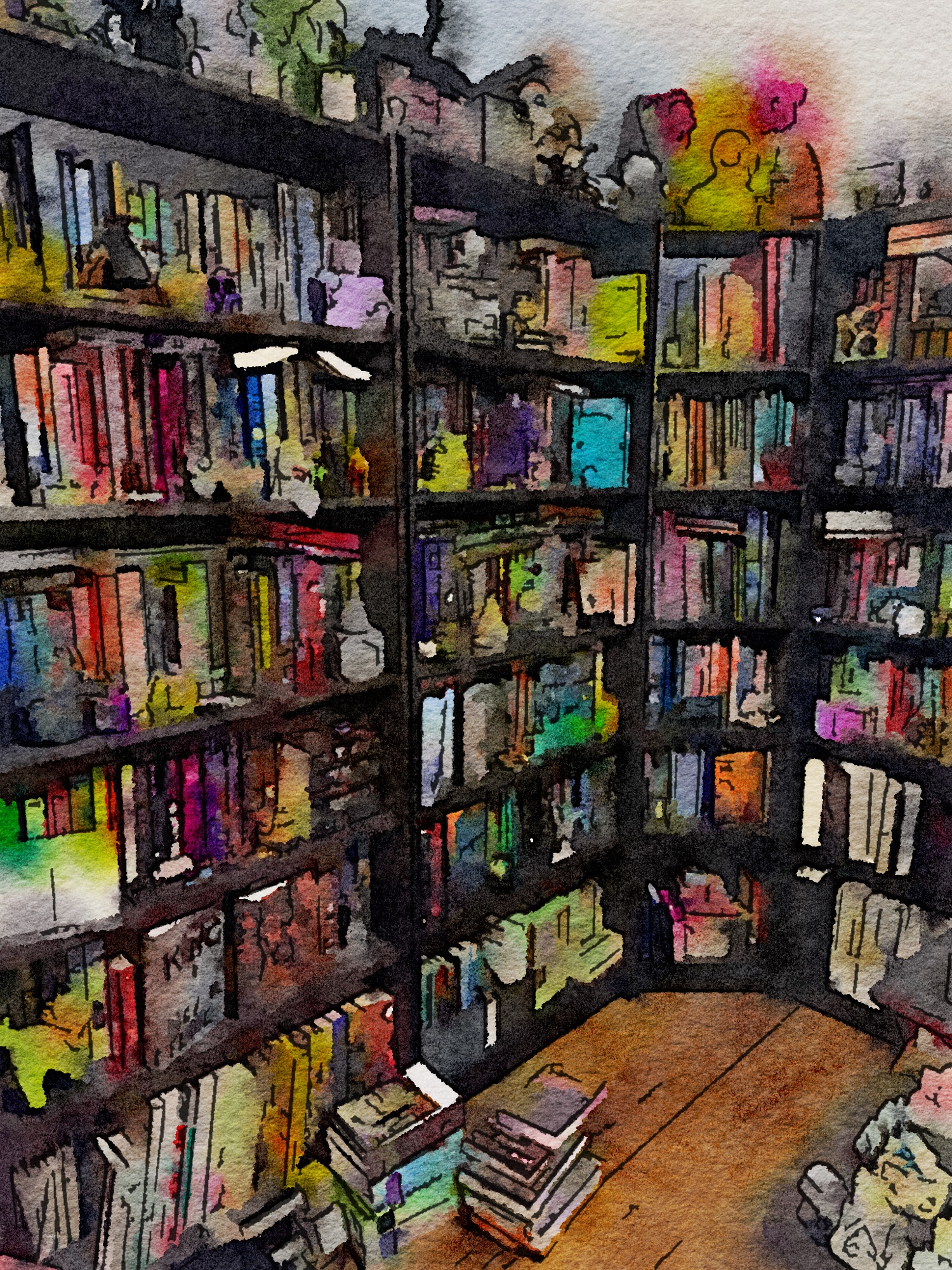
My home library – photo edited with the Waterlogue app
I’ve always felt like there’s no such thing as too many books. I reassure myself that it isn’t the number of books I own, instead the problem is the limited amount of shelf space in our house. I haven’t set a resolution or any reading goals – that is a sure path to failure in my opinion (and based on prior experience). Instead, I’m rewarding myself with reading time instead of doom-scrolling social media. Also, I’m trying to read with a focus on the writing and come away from each novel with something useful I can apply to my own work.
Photo by the Terrye T.
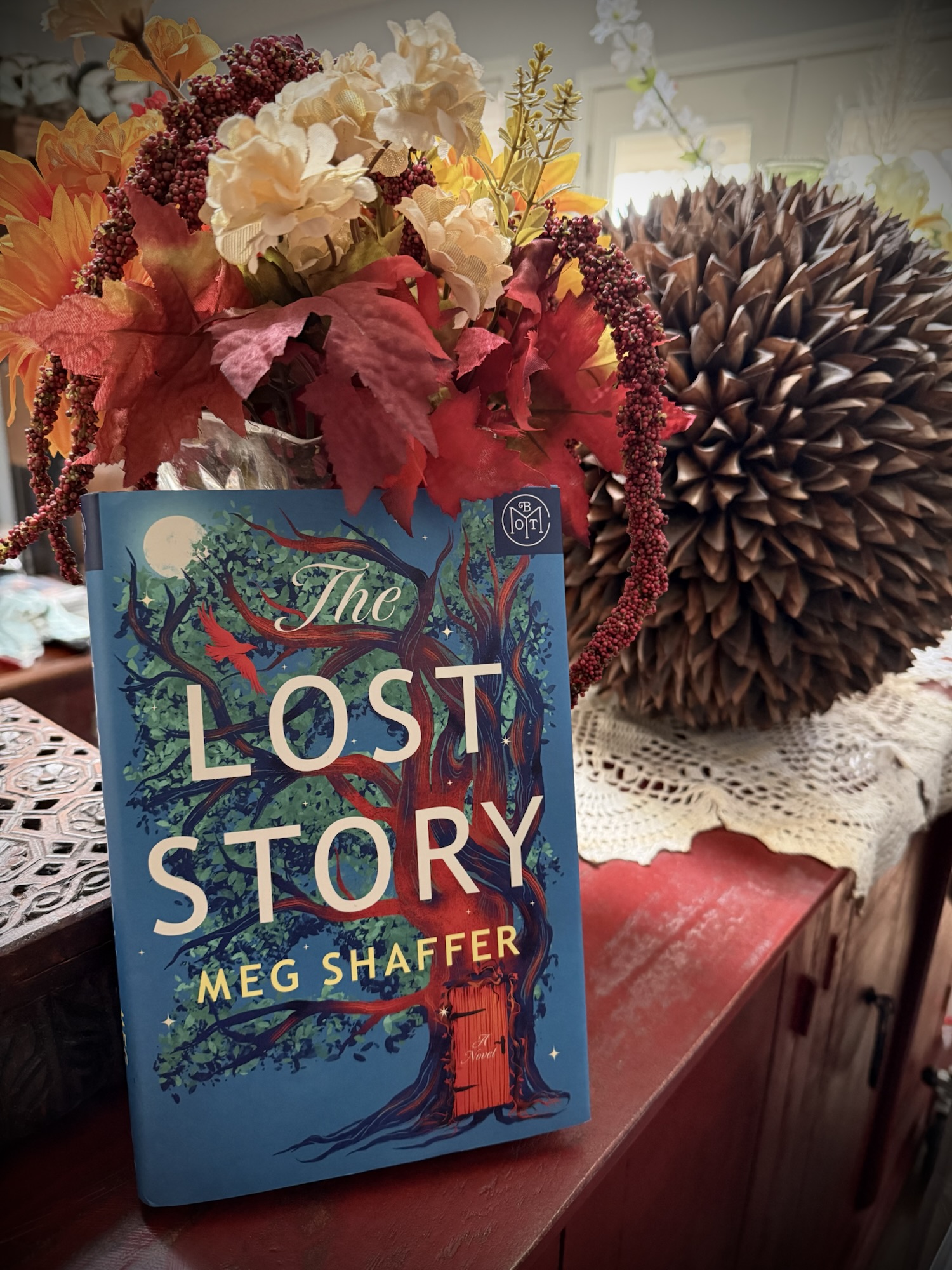
I started off the year with The Lost Story by Meg Shaffer. This is a portal fantasy that features a cozy queer (M/M) romance. The author captured the characters so well I became invested in the love story between Rafe and Jeremy.
Although I did enjoy this book, it fell short in some places. It is a portal fantasy, and there are chapters written in the point of view of an omniscient “storyteller” that give the novel the feel of a fairy tale, but at times this feels a bit intrusive and like an unnecessary explanation of events and how we as readers should interpret things. There are three main characters – Emilie, Jeremy, and Rafe. Emilie is searching for her sister who went missing years ago, and she enlists Jeremy to help in the search. He, in turn, gets Rafe to lead them to the portal. The world building is fair, but for this length of a novel it seemed to take too long for them to get to Shanandoah, the fantasy land where most of the action takes place. Although Emilie’s search is the reason they venture to Shanandoah, not very much of the story is given to develop either Emilie or her sister. The romance portion is very well done and the characters of Jeremy and Rafe are both well drawn, but so much of the story is given over to them and not enough, in my opinion, to the fantasy portion of the story. This makes the ending feel a little too convenient and easy. Overall though I’d recommend this book because the style of writing drew me in and I was invested in the characters and wanted them to succeed.
What I learned from this book: I think if you go to the trouble to create a character, that character deserves time on the page. And I really don’t like the omniscient narrator.
Photo by Terrye T.
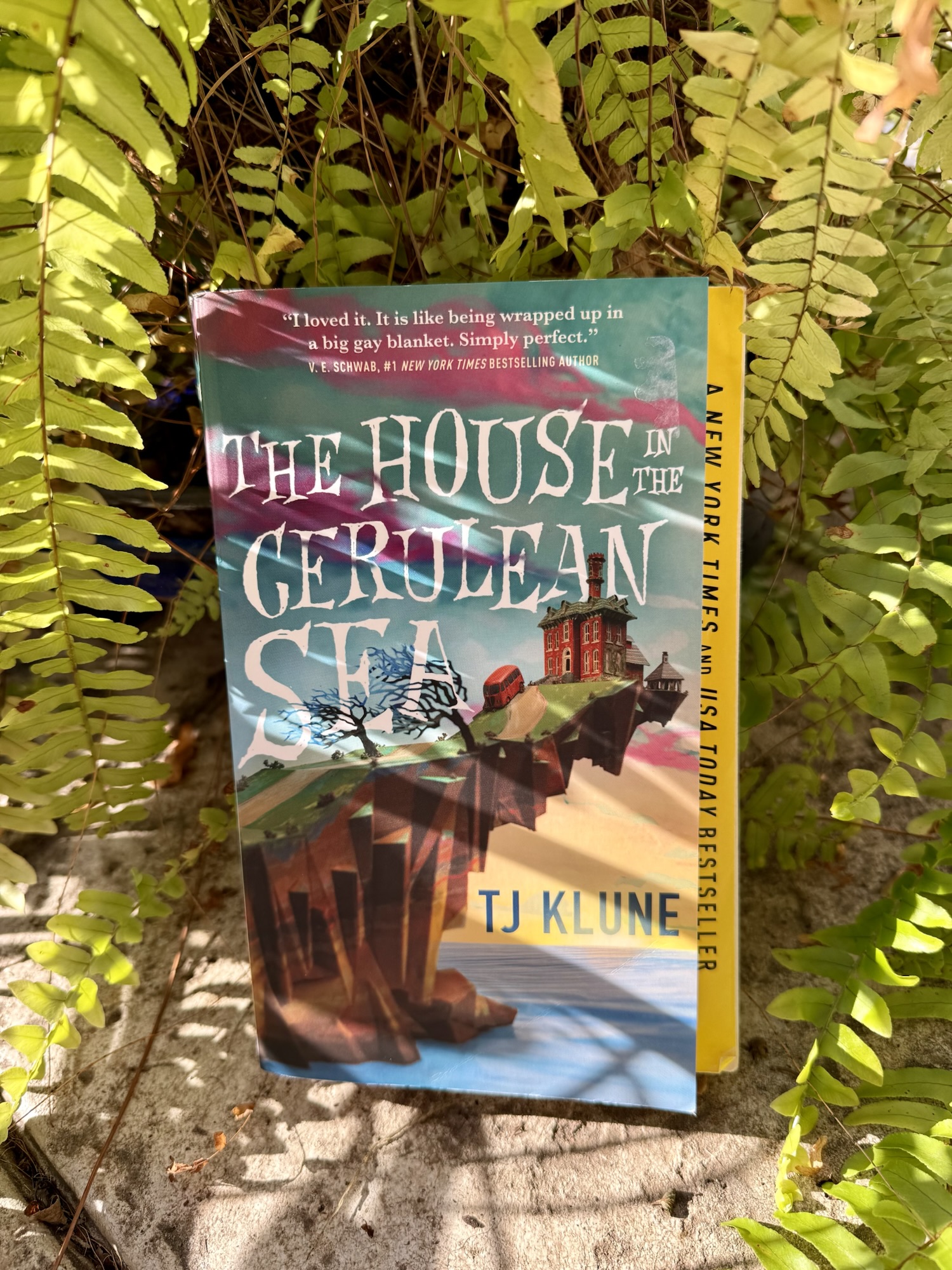
This is the second fantasy book I read last month. I enjoyed the characters and in general I love overall vibe of TJ Klune’s books. The story centers around an orphanage for magical children and the adults who care for them. There are themes of found family, overcoming prejudice, and being true to oneself.
My takeaway: Good example of close third person point of view, giving the reader an intimate look into the emotions and perceptions of the POV characters.
Photo by Terrye T.
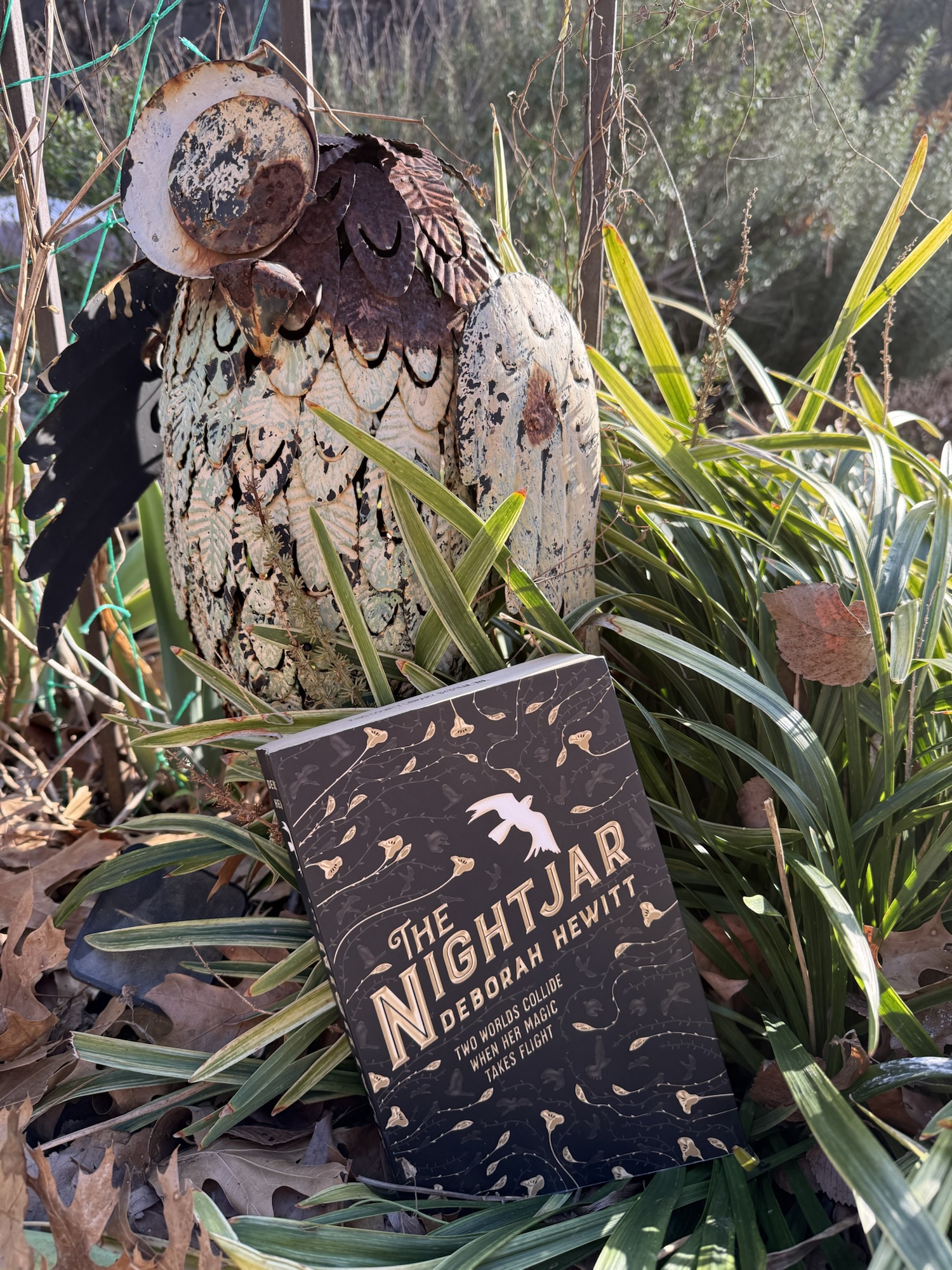
This is the first book in a series. I bought the second book, The Rookery, at Dollar Tree, without realizing until later that I needed to read The Nightjar first. Oh woe! Tragedy! I had to buy another book in order to read the one I bought.
This is another portal fantasy, with a magical world existing alongside the real world London. I love that concept, that there might be a secret, alternate universe existing right alongside ours. (I’m still looking for the entrance)
The magic system in this story is one I haven’t seen before – every person has an invisible bird guarding their soul. The main character, Alice, has the ability to see those birds, and an evil faction wants to make her use that ability to hunt down the people with magical talent. There’s a romance subplot that doesn’t get very far in this book, but maybe the characters get together in the sequel.
The lesson here: Nail down the details of any magic system in your writing. Try a new spin on the old tropes.
Photo by Terrye T.
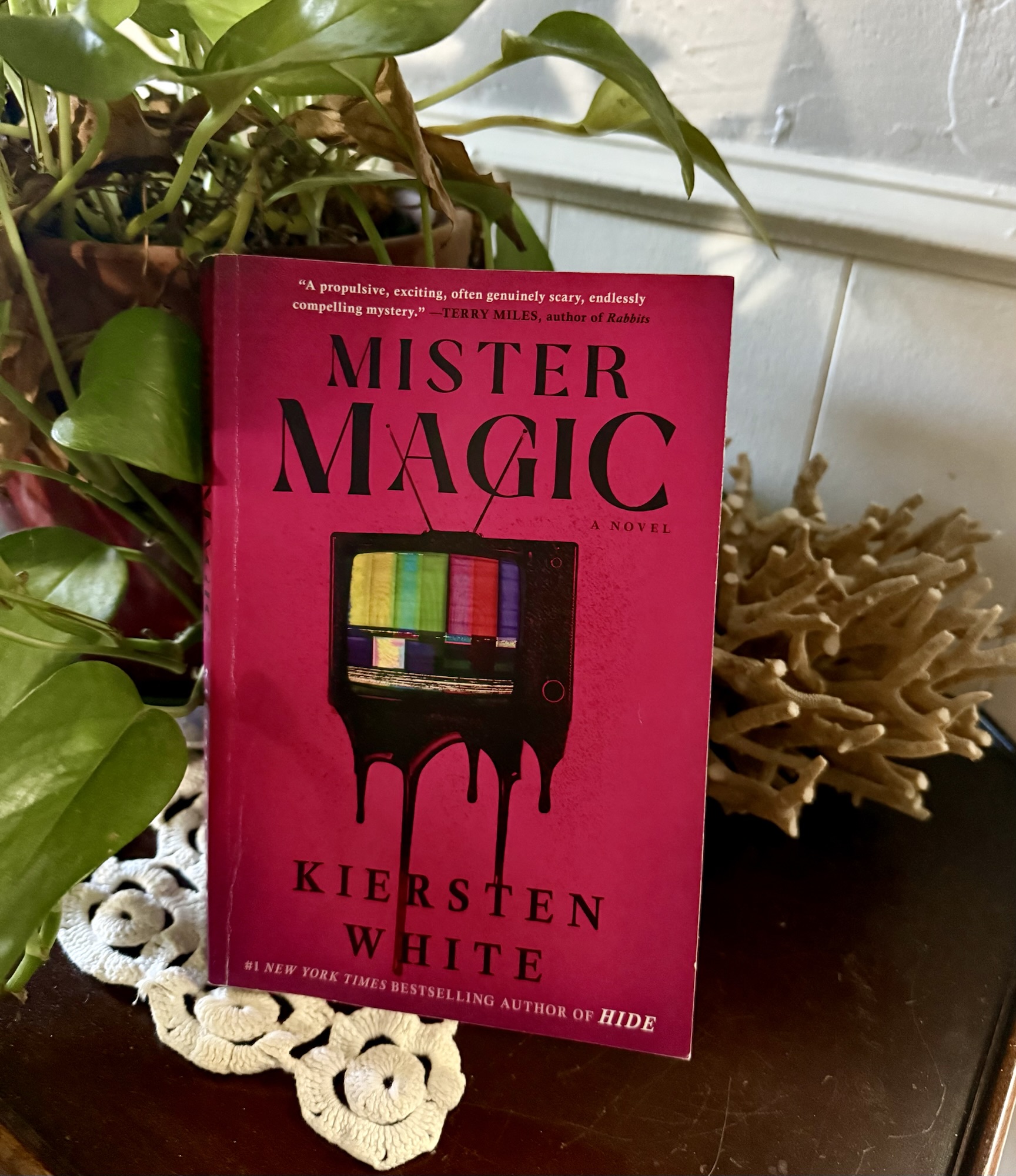
This was almost my first DNF (did not finish) for 2026. I ended up skimming through the chapters to get to the end. And I still don’t know what happened to everyone at the conclusion. It was a confusing and slow read, probably because the main viewpoint character had lost most of her childhood memories around being on the show Mr. Magic. She had only a vague understanding of the events in the past and the details about the weird and ominous show were revealed through the perception of other characters. I felt this isolated me from the tension and horror. This book could be enjoyed by readers who liked House of Leaves or Head Full of Ghosts, another two books I just couldn’t get into.
Photo by Terrye T.
I loved this book. The cover is deceptive – I went into it thinking it might be a mild mystery story and instead got full blown horror with demon possession. Nice! Parts were so scary I had to put the book aside after dark. Plus there was an ending so messed up it made me smile with appreciation. This is toxic family drama to the ninth degree.
Lessons: Build up the characters first, and then let really horrible things happen to them. Drop hints about the ending long before the last chapter, so that when everything wraps up the reader is left smiling because it all makes sense.
Photos by Terrye T.
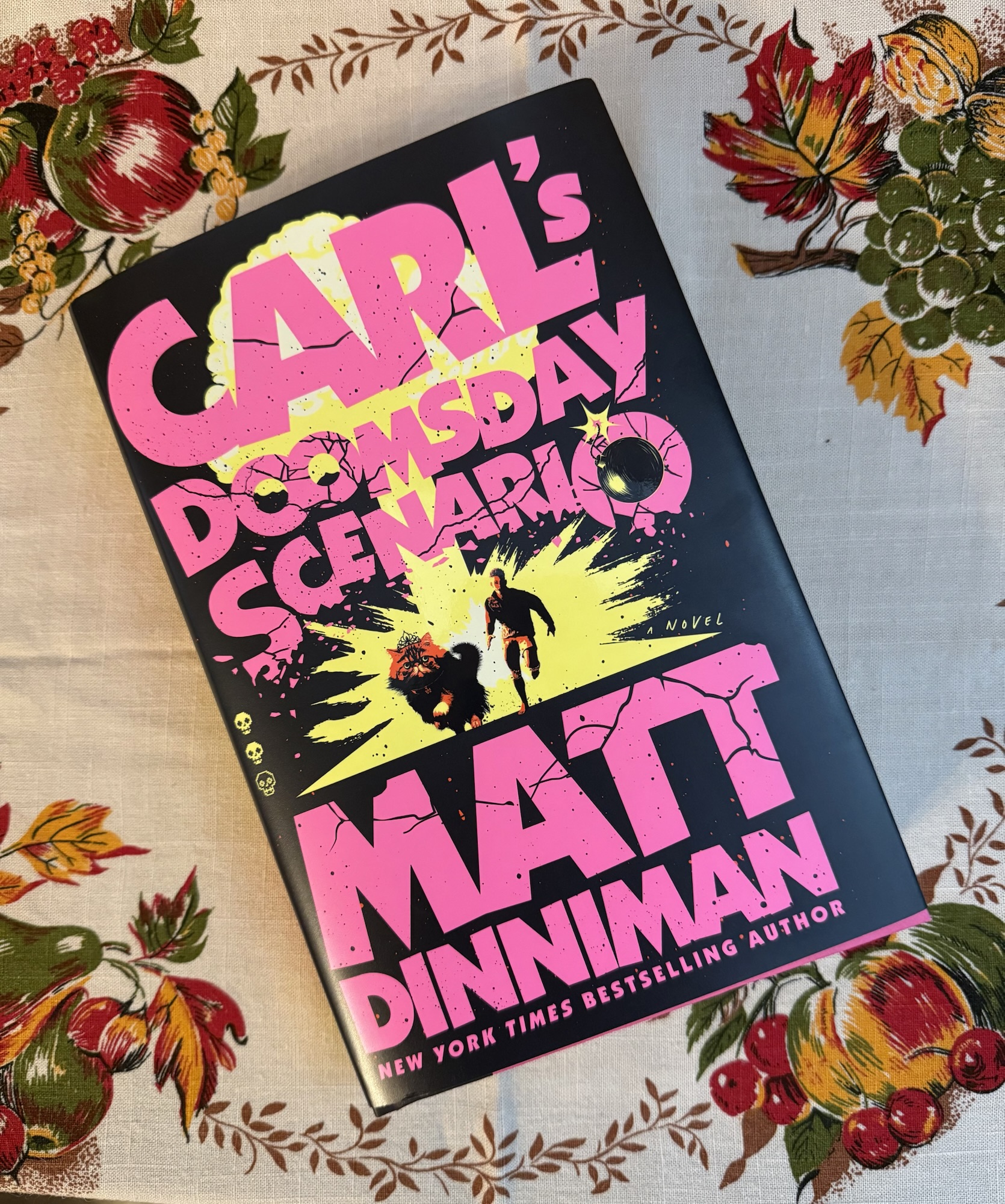
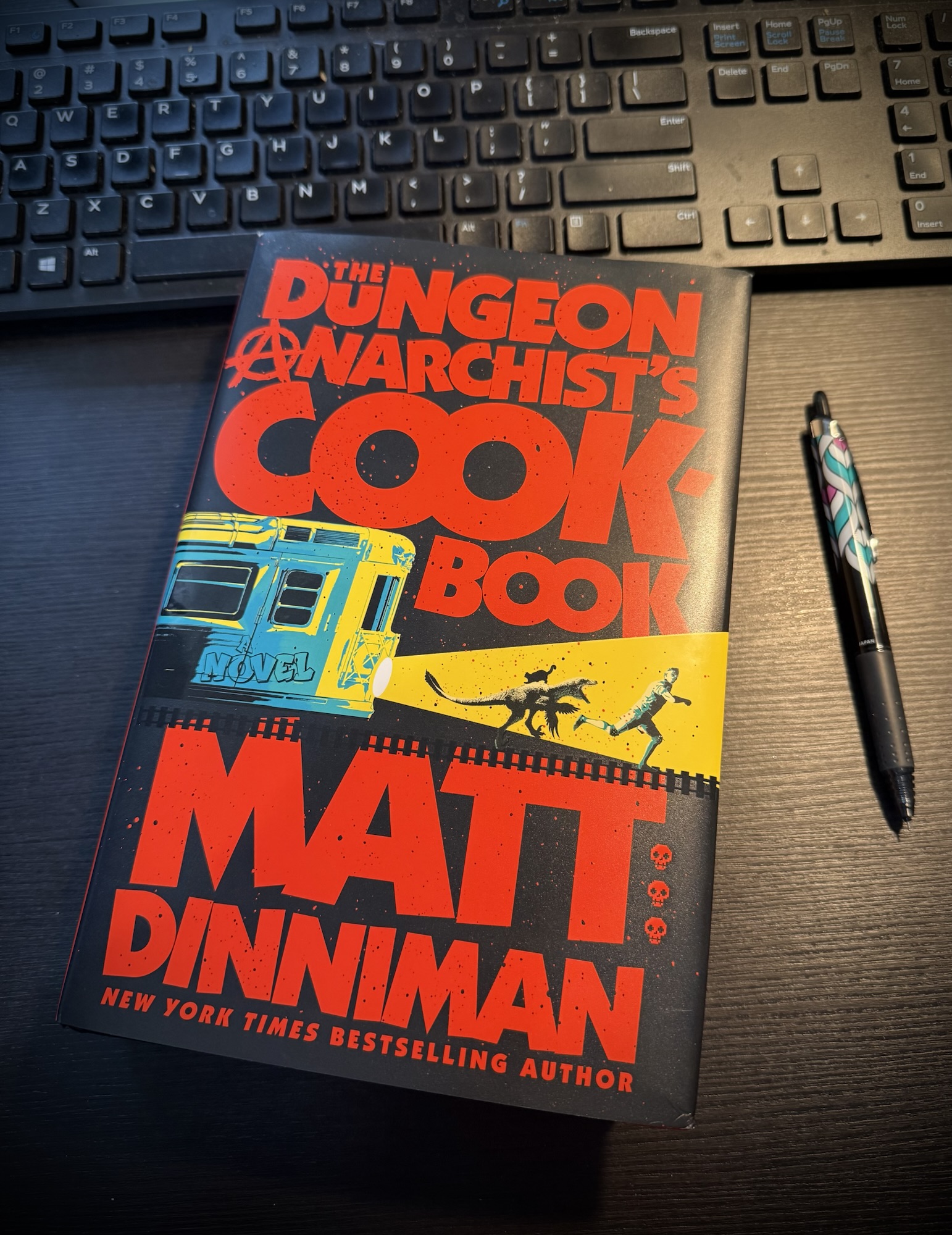
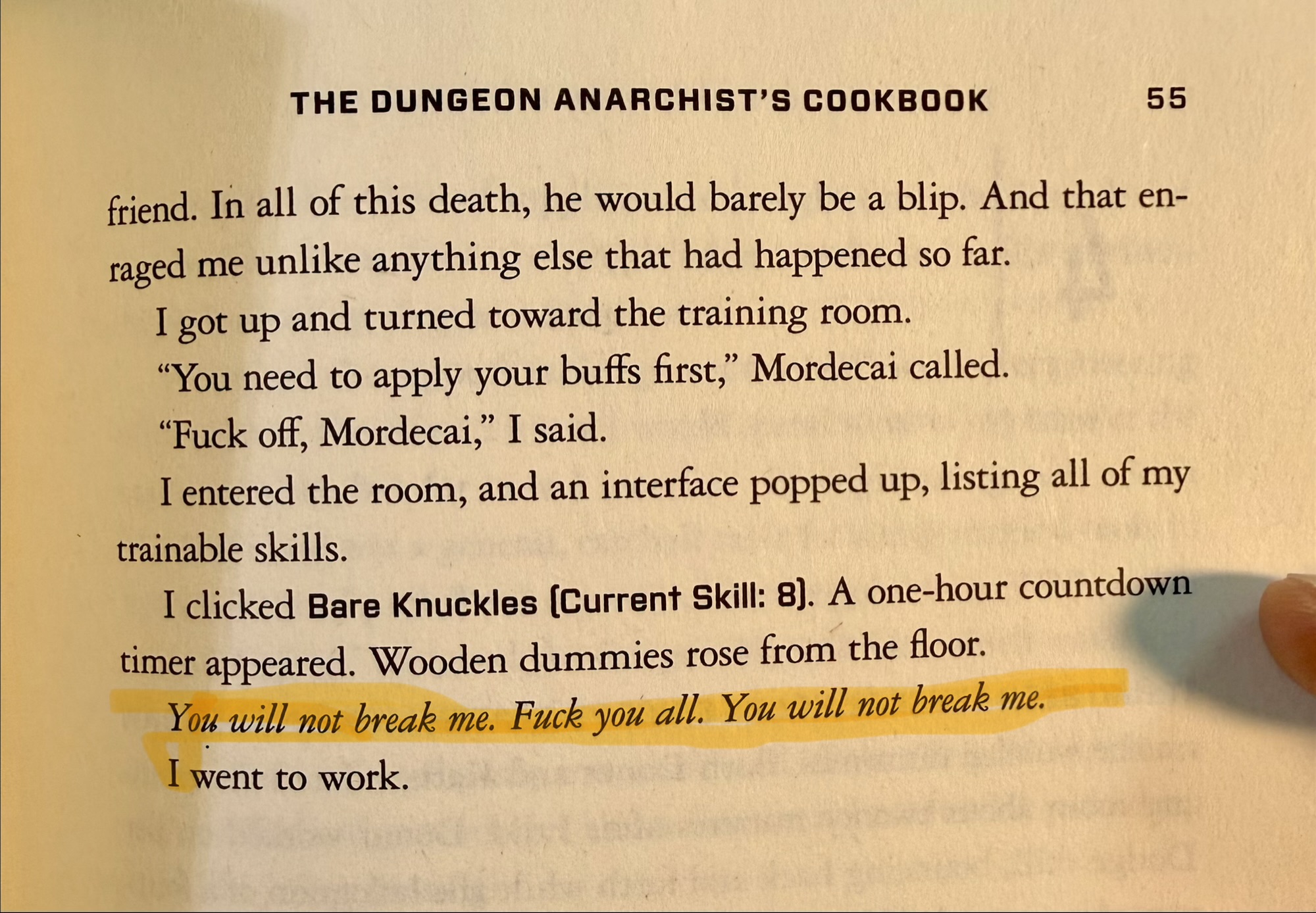
I finished up the month with another two books in the Dungeon Crawler Carl series by Matt Dinniman. These books are the perfect escape from the craziness going on in the outside world. I’d much rather experience the trials of Carl and Princess Donut as they fight their way through the alien dungeon, battling monsters and dodging deadly traps. However, in the midst of the escapism there are lessons on perseverance.
This week’s story was my first entry into the Not Quite Write flash fiction contest. The challenge includes three prompts. One of the three is what they called an “anti-prompt” where the requirement is to break a named writing rule. For the round that I entered, the rule to break was “use active voice.” The other two prompts were: include the word “crane” and include the action of burning something.
I enjoyed writing the story, even if I didn’t place in the contest I still ended up with a nice little story to post here.
The Magic of Crane Flies
Erin Welch dropped the match onto the brush pile, and with a crackle, the dry tinder ignited. The leaves were burned in the evening, because that’s the way it was always done, as her grandmother had taught her. Leaning against her rake, Erin studied the sparks rising into the dark–orange blooms against the purple dusk. The autumn scent of wood smoke filled the air. Soon, they would be drawn to the light.
Minutes later, when the glow lit up the trees, the first crane fly brushed against her cheek. She captured it in her cupped hands, and its six spindly legs tap, tap, tapped against her palms. Others arrived, drunkenly flying above the flames, their wings reflecting amber light. Easy to believe they were faeries, with their long bodies and large eyes.
Erin’s grandmother, Dinky, had always said that crane flies were made for magic. During their short lives, they never ate. Instead, they spent their time reproducing for their next cycle stage. Such determination to foil death had led to their kind surviving for millions of years. Across the yard, inside Dinky’s cabin on the fireplace mantel, was proof–a fossilized crane fly, stamped on a chunk of shale.
“Capture one and it’ll grant a wish,” Dinky had said.
Adulthood cares banished belief in enchantments. Until now, the week after her grandmother’s death. Careful not to damage the trapped insect, Erin whispered her request and released the crane fly.
It joined its mates above the flames, as sparks swirled and joined to form a familiar figure. Before Erin could blink away the apparition, her dead grandmother stepped beside her.
“Nothing like a good fire.” Dinky held her hands out to the flames, as though to warm them. Her body flickered like a pixelated image. As in life, her ghost stood barely over four feet tall, her short stature the inspiration for her nickname.
“Grandma?” Erin’s breath hung in a cloud. The night air turned winter cold. She edged closer to the fire for warmth.
“I’m here.” There were so many things she wanted to ask her grandmother. She tried to touch the ghost, but her hand passed through.
Gusts of frigid wind scattered the burning leaves. Erin rushed, stamping out pockets of flames. When she finished, Dinky’s ghost had vanished.
“No!” Frantic, Erin tossed handfuls of dried leaves onto what remained of the fire. Despite her efforts, only sparks floated above. The ground circling the fire held dozens of the crane flies, their stick bodies motionless. She dropped to her knees, the cold soaking through her jeans as she scrambled, hoping to find one alive.
She wanted more time. So many things left unsaid. She strode to the cabin and went inside. The wish had only lasted for as long as the crane flies lived, so what better magic than something captured forever? Erin picked up the fossilized crane fly and made her wish.
A short story from the 2022 NYC Midnight Flash Fiction Contest
Photograph by the author
In November 2022 I made it all the way to the final round of the NYC Midnight Flash Fiction Challenge. The story I submitted didn’t land on any of the prize levels, and I filed it away until in 2024 when I reworked it into a tale that was accepted and produced for the Drew Blood’s Dark Tales podcast. Writing is often like that, we take scraps of ideas and piece them together like a quilt. This story changed quite a bit from the original, but one thing that stayed was the object that had been one of the NYC Midnight prompts – a cloche.
Here is the original story, in its unedited glory. Once again, I hope you like it, but if you don’t – don’t tell me.
The Price of Guilt
Beth pulled up the email with the instructions for the rental cottage’s lock. Assured a late arrival would be okay, she grabbed her bag and the half-empty wine bottle from the passenger seat. A single yellow bulb illuminated the porch. In its glow, she studied the damage to her car. A crack zigzagged down the front bumper. Clots of dark red liquid were smeared across the damaged running light.
Hurrying to the front door, she imagined the crunch of steps behind. Inside the house, a tiny fireplace took up one wall, bookcases on either side. Scattered among the dusty books were dozens of cloches. The bell-shaped covers reflected the light, concealing their contents until Beth stood close enough for her breath to fog the glass.
Each cloche held a tiny woodland tableau, filled with moss, twigs, and stone chips—scenes from fairy tales. The old stories, where starving children wandered lost in the woods and maidens had their hearts carved out by jealous witches. Desiccated butterflies, with their tattered wings, clung like fairies to miniature branches. Scattered within the greenery of one were the delicate, yellowed bones of a small animal.
She found the bedroom at the end of a short hall, across from a bathroom no larger than a closet. The antique door knob turned with a squeal as the door opened on rusted hinges. Beth dropped her bag on the bed and gazed at the four walls. There were no windows in the room.
The metal framed bed took up one wall, and a scarred oak dresser rested across from it. Another cloche sat atop the dresser. This one held a miniature replica of the cottage, and a screen of tiny trees. Minuscule bits of rock trailed along the inside front of the glass, circling to the tree line.
She pressed her palm to the rough texture on the blank wall, then tapped across the area with her knuckles, expecting to hear a hollow sound. When she realized the missing window would have faced the edge of the forest outside, she shivered, grateful to have missed that view.
The pipes in the bathroom groaned and rusty liquid spun down the drain, the color like bloody water. Gagging, she retreated to the bedroom to undress and snuggle under the heavy patchwork quilt. She took one last check of her phone. No messages.
She woke from a dream that drifted from her memory like smoke. Cavernous darkness surrounded her. Beth fumbled for the bedside table and her phone. Her hands met open air. She stood. Sweeping her arms out, her fingers brushed across the textured wall. She traced her steps back to the bed, but somehow missed it. Her back thumped the far wall.
Her heart thudded. The taste of sour wine rose in her throat. She scooted sideways to the next corner, then to the next, and the next. Finally, her hip bumped against the dresser. She brushed her fingertips over the cloche’s cool, rounded glass. For a second, she closed her eyes and when she opened them, a window appeared in the wall.
The moonlight streaming through the opening revealed the dresser as the only furniture remaining. No door, no bed, no table, no purse, no luggage, no phone. A sound escaped her, half-gasp, half-laugh. Taking a breath, she shook her head. Cool air brought the clean scent of pine and juniper. The walls and ceiling of the room pressed upon her, as though they shrank with each breath she drew. Outside, the open expanse called to her. She climbed through the window.
Ahead, the tree branches dipped in the wind, waving her forward. When she came to the road, she strolled on, despite the bite of gravel under her bare feet. Tire marks dug into the soft earth of the shoulder. The accident had been miles back, but here, dark blotches dotted the grass. A path of flattened weeds led into the brush, as though something large had dragged itself from the road. The tree trunks at the edge of the forest held strange symbols carved into their bark. Runes, scratched into the pale inner wood. The hair rose on her arms.
“An animal,” Beth chanted. “It was an animal.” Her mind recalled the stooped figure rising in her headlights, two black shapes like horns sprouting from its head. A deer. Wouldn’t a person have cried out? It happened so fast – in the time it took for her to glance at the phone in her hand.
A strangled cry sounded, half moan, half growl, like no animal she had ever heard. Beth jumped and raced back to the cottage. If she didn’t look, she wouldn’t know.
The space was back to how she’d found it. Door straight ahead, bed to her right, with the covers thrown off as she’d left them. When she glanced behind her, the wall had closed. No more window. Rushing to the door, she jerked it open. Down the hallway, through the living area, to the front door and then outside again. She didn’t stop until she crashed into a solid barrier. Knocked off her feet, she moaned and crawled forward, one hand held out. Stumbling upright, she banged her fist against the hard, clear surface. Glass.
“No!” She crawled to the cottage and inside to the windowless room. The dresser top sat empty—the cloche gone. Her world tilted, the floor beneath her swaying like the deck of a ship. She fell. Scrambling to her feet, she spilled from the room, rushed down the hall and out the front door. A huge red eye stared at her, distorted by the curve in the glass. It placed the cloche, her world now, on the shelf, then left. At the doorway, the thing crouched and lifted its horned head. The silhouette was exactly how it had appeared in her headlights. Beth stumbled backwards into the cottage. She stretched out on the bed in the windowless room and closed her eyes at last.
The End
If you’d like to hear the story inspired by this one you can listen to Drew Blood’s podcast on YouTube here.
I submitted the story below to a contest recently. It didn’t place so I’m sharing it now. In this one the genre was open and I was assigned two prompts that had to be included: career advisor and mosaic. I went with fantasy/magical realism with a humorous touch. I hope you like it, but if you don’t, please don’t tell me.
Afterlife Positions Available
An hour and ten minutes after Ellen Tyler collapsed into the koi pond at the Dallas Arboretum, she woke in a sterile white room. A fluorescent light buzzed overhead. Was this a waiting room, in a clinic or hospital? She hoped they took Medicare. Puzzled, she patted her chest. Her clothes – the same cargo pants and matching shirt she had dressed in that morning – were dry and clean.
Right before splashing in the pond, she had felt nauseous and dizzy. She had leaned over, snapping a photo of an orange carp, until a sharp pain in her arm made her drop her iPhone into the water. When she reached to retrieve it, she blacked out. Afterwards, blue and red flashing lights, shouting, and her sister Trina’s shocked face filled some of the blank spots in her memory.
The door on the other side of the room swung open and a tall, wide man filled the doorway. He wore a wrinkled gray suit and had the pleasant, smiling expression of a television weatherman predicting sunny weather.
“Hello! Sorry about the wait. We weren’t sure when you would arrive.” He stuck out his hand. “You must be Ellen. I’m Milton.”
Ellen squeezed the man’s hand. Then, not knowing what else to do, she followed him into his office. A dull metal desk filled one half of the room. Files, folders, and yellowed paper covered the desktop and overflowed onto the floor. Milton stooped and removed a cardboard box from his chair, then pulled over a wooden chair for Ellen.
The white walls held two posters—one had a photo of a kitten clinging to a clothesline and the words “Hang in There” scrolled across the top. The other sign featured a montage of at least thirty images. A sheet-covered cartoon ghost held the center square, surrounded by several other pictures that looked like they belonged on the covers of horror novels. There was a gnarled being with knife-sharp nails, a thin man with solid black eyes, and a transparent, shrouded figure. As she stared at the poster, one of the images, a woman clothed in a long black dress, waved at Ellen.
“Where the hell am I?” she asked.
Milton’s face turned red. “You’re not in…” He coughed, “…that other place.” He shuffled a stack of papers and pulled out a glossy brochure. Handing it to Ellen, he said, “This is the Career Placement Agency for the Afterlife.”
“Wait.” Ellen fanned herself with the flyer. “I’m dead?” How could this be? She had celebrated her 71st birthday last month, but she had also received a perfect checkup from her doctor.
“You expired this afternoon.” Milton laced his fingers together. “Heart attack and drowning.”
How embarrassing. Ellen always assumed she would pass quietly in her sleep at age 101. What a ruckus she must have caused. Trina would never forgive her for insisting on tromping around in the summer heat instead of enjoying an afternoon matinee in an air-conditioned movie theater. Her sister loved the movies. Trina would have to find someone else to share her senior discount pass at Movie Plex.
“I thought the afterlife was filled with harps and angels, not work.” Ellen held up the brochure. The cartoon ghost from the wall poster graced the cover. The title, written in Comic Sans font, read “Guiding Your Choice for Eternity—A Mosaic of Diverse Opportunities.”
“These experiences are designed to bring purpose to your life after death. I’m here to guide you in choosing which form your spirit will take.” Milton pointed behind him, to the collage of images. “Each afterlife represents at least one of our six core skills—comfort, entertainment, education, inspiration, caution, and remembrance. For example, you could choose Lady of the Lake or ectoplasm entity.”
“I drowned in the damn koi pond, Milton. I can’t imagine haunting knee-deep water for the rest of my time. And that ecto thing just looks like a blob of green goo.”
“You have leftover anger issues. Maybe a spot as a poltergeist?”
Ellen huffed. “Spend eternity chunking pots and pans in someone’s kitchen?”
“It’s not just pan chunking.” Milton sat up straight. “It’s entertainment.” When Ellen didn’t respond, he continued. “Do you like travel? I have an opening for a Vanishing Hitchhiker.”
“Can I give it a trial run?”
Milton clapped his hands. “Of course! I’ll see you back in a week.”
After the first three nights of waiting on a desolate country road for a car to pass by, Ellen wished that time would pass more quickly in the afterlife. The fourth night, a farmer in a rusted pickup with bad shocks gave her a ride. Grateful for the company, she forgot to vanish, and rode with him into town. She had to walk the six miles back to her post.
When the week was up, she met with Milton again. Her past wasn’t dark enough to qualify her as a revenant. She wasn’t deeply melancholic, so wraith would not be a good fit. She would end up a ghost orb, floating over a swamp and being mistaken for a ball of gas.
“What else is there?” Ellen pointed to the cartoon ghost in the collage. “How about that one, but without the sheet?”
Milton sighed. “I hoped to place you in an entertainment or inspiration position. Most of the other careers require a commitment to a static location.”
“That’s fine. And I know a perfect place.”
Ellen floated along at Movie Plex, creating cold spots in the ladies’ restroom and leaving the scent of popcorn in newly cleaned theaters. Her sister bought a ticket the second week, for the new Tom Cruise flick. Ellen settled in the empty seat next to her and whispered, “Hello.” When Trina turned her head to peer at the vacant spot, Ellen waited until the air conditioning kicked on with a burst of cold, then brushed a strand of hair from her sister’s face.
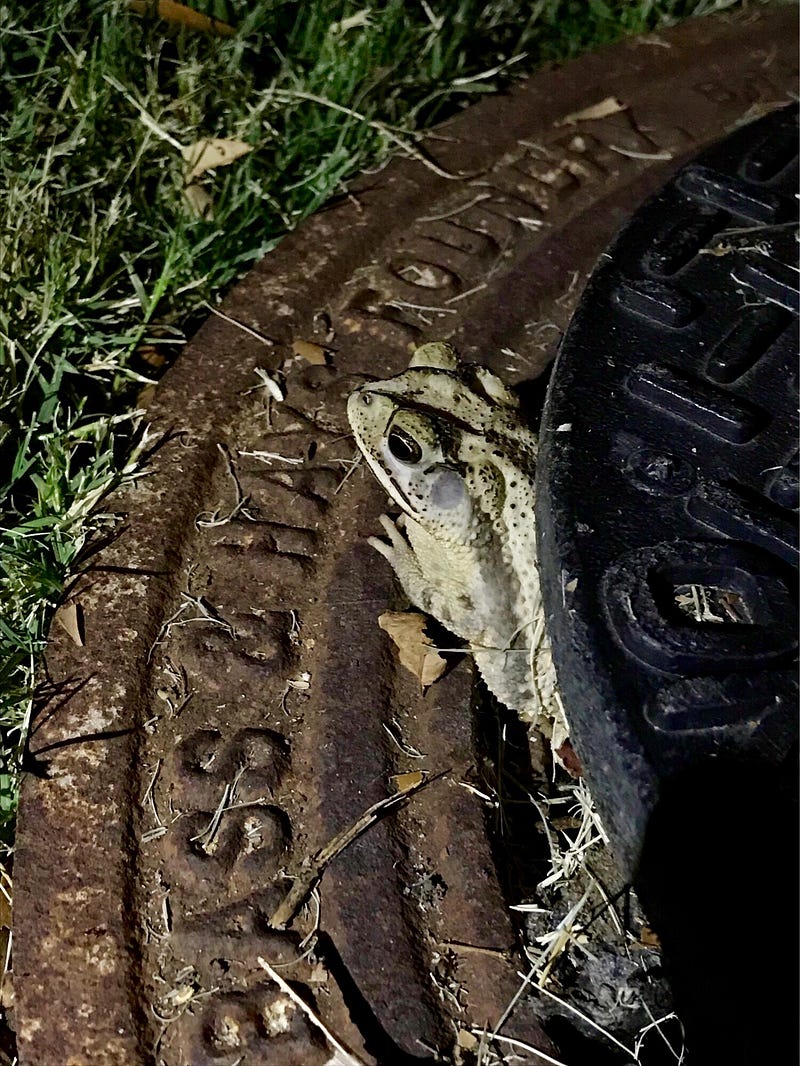
To her chagrin, she discovered that the entrance to the underworld was not guarded by Cerberus, the monstrous three-headed dog, but rather by a small, disgruntled toad.