Breathing in, I calm body and mind. Breathing out, I smile. Dwelling in the present moment I know this is the only moment.– Thich Nhat Hanh
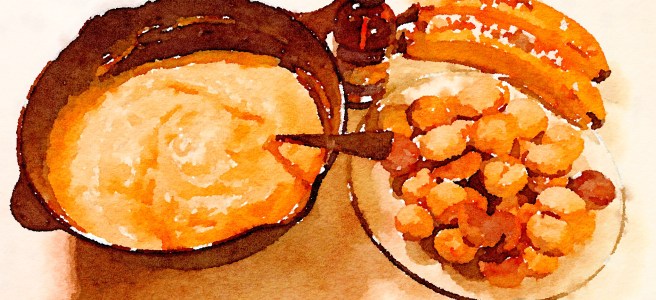
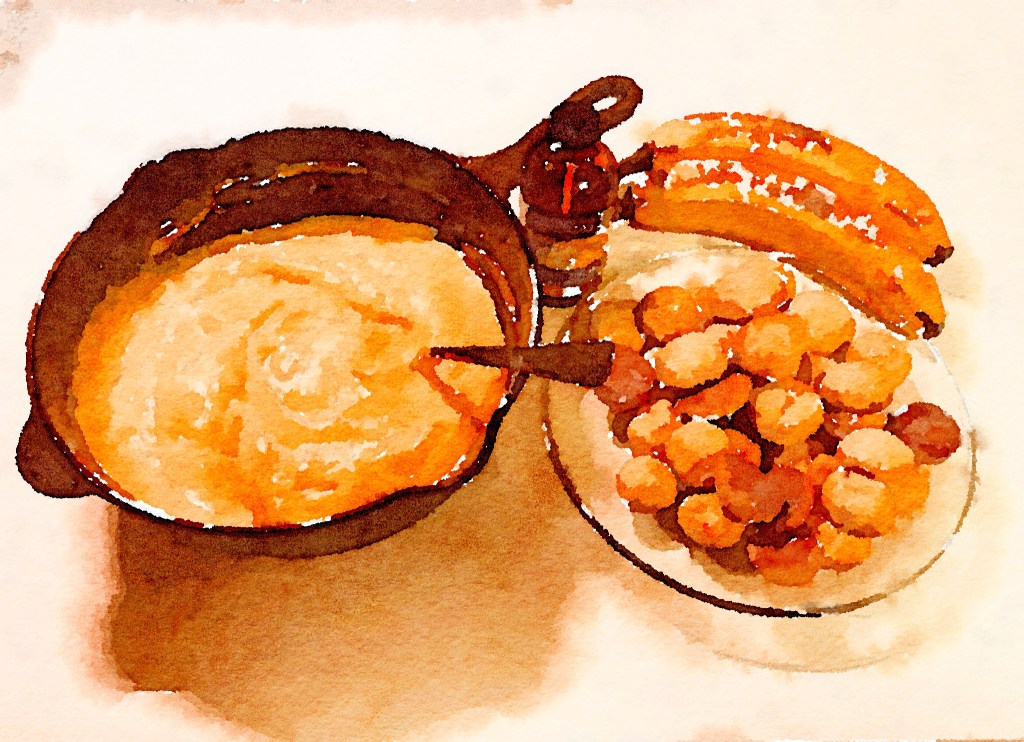
Photo by the author – image enhanced with the Waterlogue App
We got our produce delivery today and the box included four bananas. I still have two bananas left from the previous week. Bananas, it seems, are not in short supply. I haven’t been able to find flour anywhere, and I’ve gone so far as to put a 50 lb bag in my online cart at a restaurant supply store. I would have ordered it too, despite the $20 delivery fee. But it was sold out.
I see folks selling flour on Ebay, for twice the price at the grocery store – if the grocery stores actually had flour in stock. I’m not a charitable person. I’m wishing weevils on all those Ebay capitalists.
Andrew suggested we plant wheat, but our balcony is too shady for large scale farming. I’m trusting my 5 lb bag of flour will last until the current crisis is over.
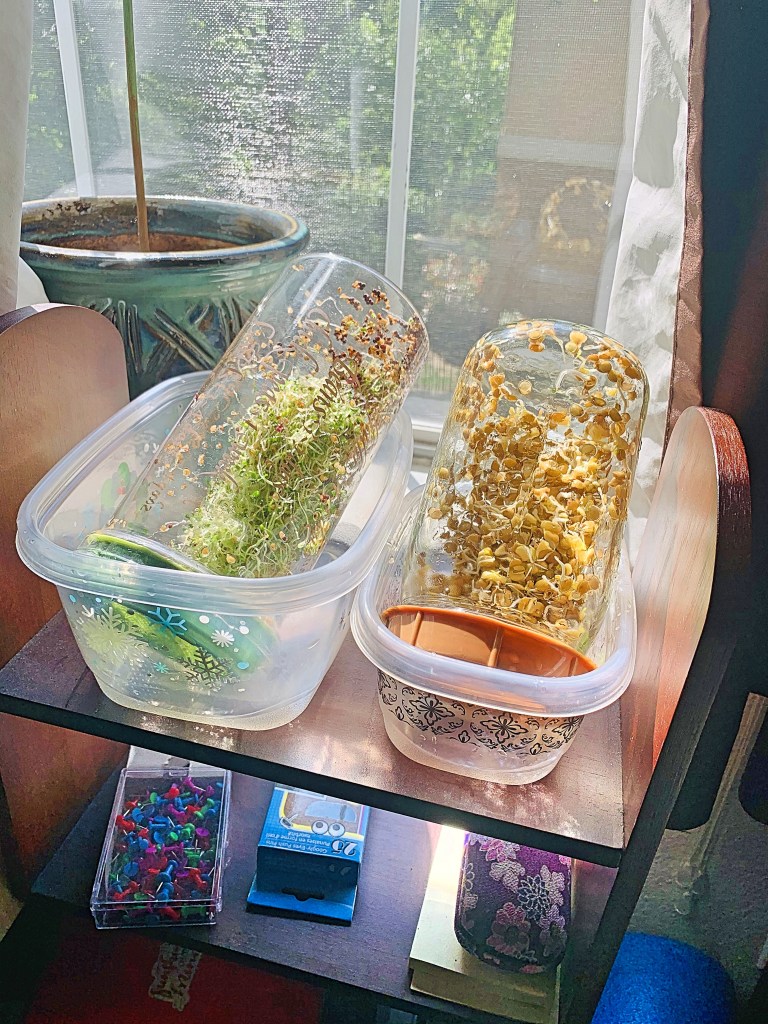
I have, however, started a crop of a different sort.
Sprouts!
Andrew and I are fortunate. We both have jobs and we’ve been working from home, our only inconvenience the inability to just run out and purchase things. This would be tolerable and healthy for our budget, if it weren’t for the stress the loss of control brings.
This morning as I unpacked our produce box and considered the two sad bananas left sitting on the counter from the previous week, I decided I wanted banana pudding.
“Do you want to go to the store and buy ‘Nilla wafers?” Andrew asked.
I considered the logistics of grocery shopping. Gloves, mask, hand sanitizer, dodging crowds of shoppers who can’t seem to grasp the concept of social distancing – “No thanks,” I said.
I decided instead to make the entire dish from scratch. It turned out pretty well, plus I had the satisfaction of creating something I wanted. Who knew cooking could bring back some sense of control to my life? (I guess the people buying up all the flour already knew about the power of baking.)
I found the recipe for my made-from-scratch banana pudding here: I Am Baker
I’m trying my own sourdough starter next, acting on faith that flour will be back in stock soon.
Our rented Buick rocked as the tractor trailers and rock haulers zipped past on the highway. I gripped the door handle, certain a homicidal maniac steered each truck rushing by, intent on racking up another victim on their way to the West Texas oil fields.
We had selected the Buick from a fleet of options. We assumed the larger car would be safer and more comfortable than my ten-year-old Honda. The rental car’s bucket seats fit anorexic teenagers, not late middle-aged women, and my butt had grown numb over the miles since we left Dallas. If not for the thrill of certain death in a fiery car crash, the rest of me would have fallen asleep staring at the flat scenery on our way to Carlsbad, New Mexico to tour the caverns.
One arm draped over the console, my husband Andrew stared through the windshield, judging how much room he needed before he could squeeze the Buick in between the cement truck and the oil tanker in the next lane.
“Would you like to stop and see the Odessa Meteor Crater?” Andrew asked.
Everything I know about meteors I learned from movies, television, and comic books. They don’t have a good reputation. Anything tied to the phrase “extinction event” is something to avoid. Another semi rocketed past, blowing sand and gravel across us. As Andrew steered the car back into our lane, I answered “Sure.”
I’m a big fan of bizarre roadside exhibits. I imagined a meteor crater would be a giant hole in the earth, similar to the Grand Canyon, but smaller, less grand. Maybe they would have a viewing station and tiny plastic meteorites for souvenirs. I got out my camera and checked the battery, to be sure I was ready to take pictures of the stunning vista.
Andrew turned off the main highway and bumped along a rough road paved in potholed asphalt. We arrived at a gated entrance in front of a metal-roofed, tan brick building. A sign on the side proclaimed we had reached the Meteor Crater Museum. The place could have been any other standard government building- a place to renew your driver’s license or pay your water bill.
I pulled myself from the tight embrace of the bucket seat and climbed from the car, camera at the ready. Leaning against the Buick, I turned around and searched for a glimpse of the crater. I didn’t want to fall into some crevice and break a hip right at the start of our vacation. The landscape stretched out to the horizon, broken only by scraggly desert plants and medium-sized chunks of limestone. In the distance, oil field pump jacks bobbed up and down like dinosaurs.
“How much further is the crater?” I asked. When I shielded my eyes and squinted through the swirling dust in the parking lot, the most interesting thing I noticed was a concrete picnic table.
“It’s right there,” Andrew answered, pointing. “That dip in the ground.”
The sandy soil past the parking lot sloped down in a shallow bowl. If I held my head just right, I could make out a circular shape to the area. We strolled along the little path that wound through the crater and read the educational signs that told about the history of the site, until I grew tired of the heat. Andrew stopped to admire an anthill, and I walked on ahead to the museum, hoping for a water fountain and air conditioning.
The exhibit area was slightly larger than my living room, and staffed with three people, two men and one woman, sitting on rolling chairs behind a glass counter. They all turned to greet me as I strolled in. I picked up a brochure explaining the history of the crater. It must have been larger when they discovered it in 1892. The crater was formed 63,000 years ago, so I forgave it for being filled in with West Texas silt. I know how fast dust can accumulate if you aren’t diligent. If only we had visited sooner.
I looked over the small pieces of meteorites on display and glanced at the scientific charts and graphs. At last I stopped in front of a framed photo of a woman reclining on a hospital bed. This was Ann Hodges, a woman struck by a meteor in 1954 when it crashed through the roof of her house. I imagined her stretched out on her couch, relaxing with a book maybe, or watching television, her face illuminated with the blue glow from the screen. Maybe the accident happened after a commercial for Geritol or the new RCA Victor Portable Radio, her peaceful night shattered by a huge rock falling through her ceiling. Did she know what hit her? Or did she suppose Fidel Castro had targeted her, a housewife in rural Alabama, with a missile meant for Miami?
I turned from the display as Andrew walked over to stand by my side.
“I found the t-shirts!” he said.
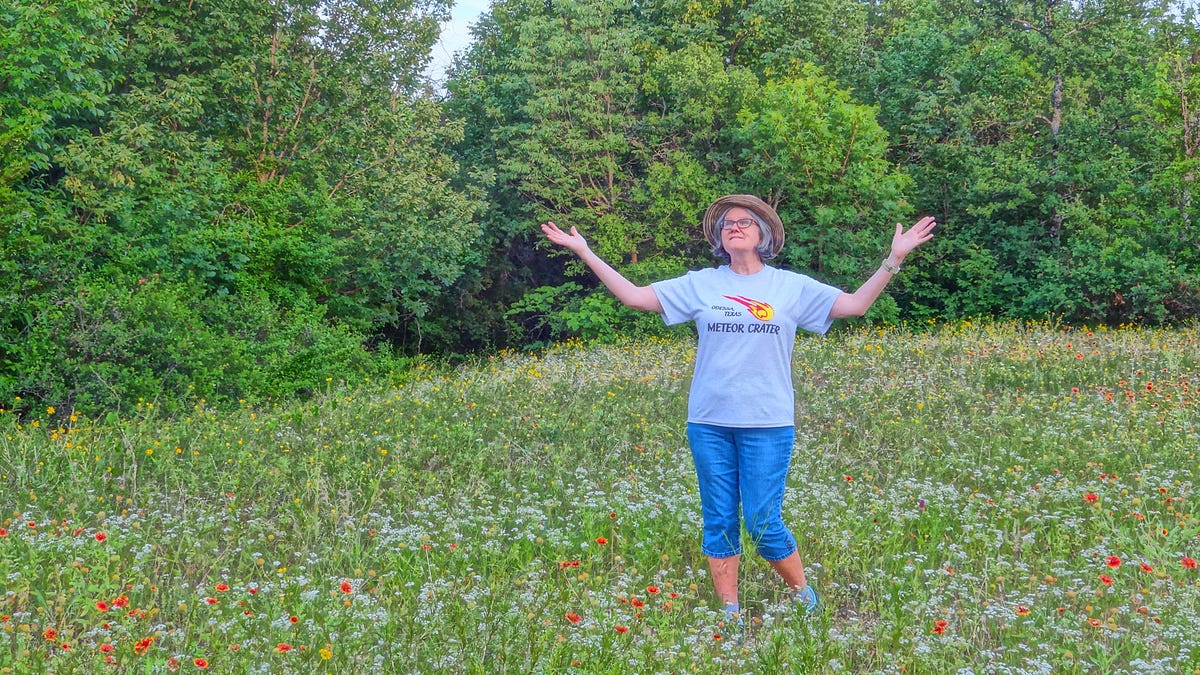
He held up a gray shirt with “Odessa Texas Meteor Crater” printed on the front. A yellow and red meteor streaked down toward an innocent cartoon superhero, or a reclining woman.
All three staff members assisted me as I purchased the shirt. We left the cool air conditioning and stepped out into the bright sunlight of a West Texas summer. The blue sky overhead held no threat of hail, lightening, or flaming rocks. As we strolled across the parking lot toward the Buick, I decided the risk of venturing out on the highway was worth the reward of finding new places to explore. I was just as likely to be struck by a meteor at home while I lounged on my couch.
At the Odessa Meteor Crater
Terrye is a native Texan who enjoys writing stories set in her home state and other strange places. In her free time Terrye enjoys exploring antique, junk, and thrift stores for inspiration and bargains. She’s had stories published in small print and online journals, and writes short, humorous essays for her blog — https://terryeturpin.com/. Sign up below to follow her.
Another version of me has dirt under her fingernails
Photo: Geri Lavrov/Photographer’s Choice/Getty Images Plus
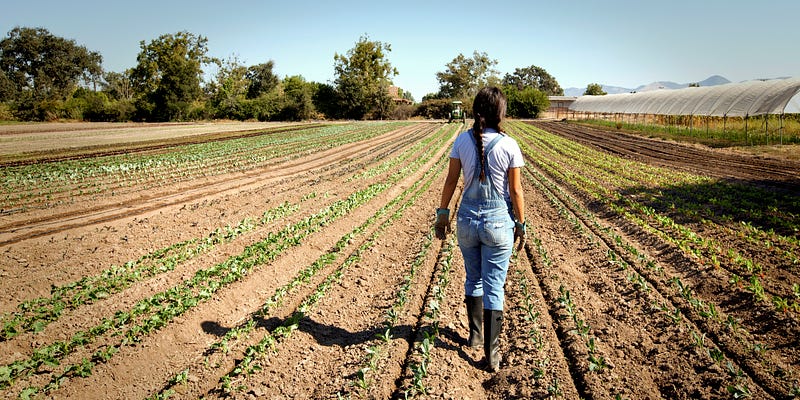
If another me exists in another universe, I picture her clad in a red gingham dress or blue denim overalls. She toils on a farm surrounded by corn and cows. This is the life I might have lived, had I followed the advice of a career aptitude test from my high school days. My life’s work decided by the 17-year-old me, while I sat hunched in a high school auditorium coloring in ovals on a Scantron sheet.
The test, sponsored by a branch of the armed services, revealed I should go into agriculture. Growing up in town, pulling weeds in our family garden was the closest I came to life on a farm. I imagined the work would be the same, only on a much larger scale. Mechanical aptitude came in second place, suggesting the possibility of a career in helicopter repair. I am certain my doppelgänger can both plow a field and fix a broken tractor.
They taught neither farming nor tractor repair at the school I attended. Girls were shuffled into Home Economics and handed a spatula while boys were enrolled in carpentry courses and awarded a hammer. Young ladies learned to bake a cake, sew a skirt, and type a note — all the useful skills we needed in the 1970s. What would I be when I grew up? I wanted to be a doctor, an author, an actress, a missionary, a teacher, or a scientist. Not a farmer.
I fumbled along as a waitress, telemarketer, stay-at-home-mom, carpenter, bookkeeper, and accountant — as though I were working my way backward through the alphabet. The alternate-universe me took the advice from the aptitude test and ran with it. She moved to sunny California and joined a commune. Far from the capitalist demands of a 9-to-5 job, she rises with the sun and feeds the chickens. She bakes her bread, sews her clothes, and types poetry on her Royal typewriter.
This woman exists on a different plane from me, but the older I grow the closer I feel to her. As my husband and I look at houses we might buy and towns where we might retire, I judge each option on whether there might be a spot for a garden. The places earn bonus points if there’s room for a small shed where I can set up a typewriter. Multiverse me would approve, I’m certain. Like parallel lines in a drawing, we’ll meet at the vanishing point.
This story was published in response to Human Parts’ Weekend Writing Prompt, “Give us a snapshot, a moment, an experience from a life you could’ve had. What are you up to out there in the multiverse? What would Multiverse You think of the life you have right now?” To receive prompts like this one every weekend, subscribe to our newsletter by following Human Parts.
“We should visit Enchanted Rock,” Andrew suggested one evening, not long after we started dating.
I pictured a place shrouded in a sparkling mist and peopled with tiny fairies peeking from behind evergreens. I worried whether the rock, enchanted or not, would provide shade. I’m a great fan of shade, especially when the temperature gets above eighty degrees. When I hike in the summer, I stuff my hydration pack full of ice. I’d carry an electric fan if I could, and string out a bright orange extension cord behind me as I tramp along the trail. Our visit to the Enchanted Rock Natural Area in the Hill Country of Texas was to take place in the unseasonably warm month of May.
I had discovered that Andrew got along quite well outdoors. He always carried one of those multi-function pocketknives and a small, intense flashlight, in case he needed to defend himself against orcs or cut up an apple in the dark.
“What’s enchanted about the rock? Are there trees?” I asked.
“The rock makes noise at night, as the granite cools off, and there are a few trees,” Andrew assured me. “We can climb to the top!”
“Climb?”
I wondered about those rock noises. I pictured myself strapped into a leather harness and dangling from the side of a cliff. I was willing to explore exciting experiences with Andrew, but I didn’t think plunging to my death would make a good impression.
“Oh, it’s really more like hiking. It’s not that steep.”
I was not reassured. Andrew’s legs were shorter than mine, so his center of gravity was closer to the ground. His sturdy legs were built for inclines.
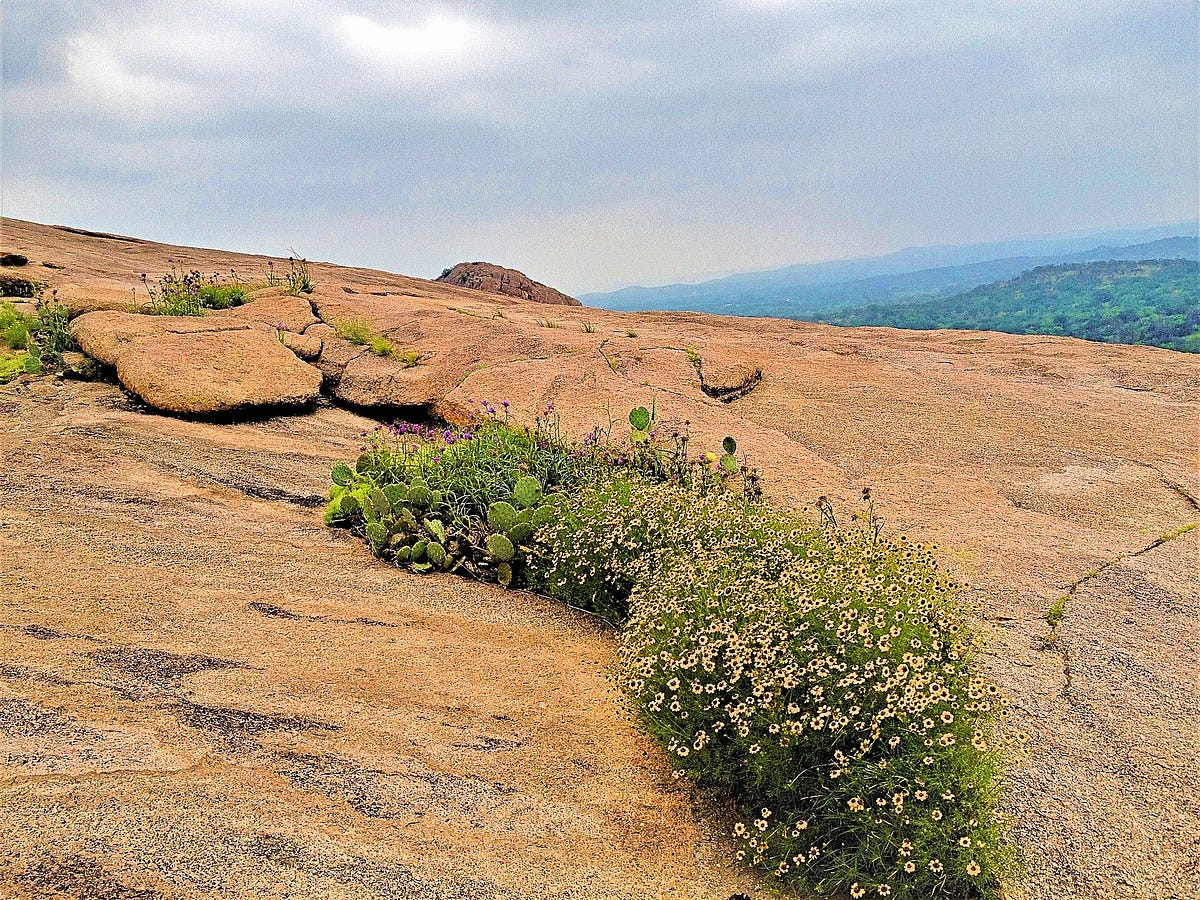
I searched the internet for a picture of the place and found an image on the state park website. It showed a dull pinkish grey, rounded hill of granite set against a backdrop of bright blue sky. Stunted mesquite trees in sparse blotches of green dotted the bottom of the hill. The sides and top of the rock, however, resembled the balding head of a middle-aged man who declined the comb over but wasn’t ready to give up all his hair. Another website suggested the area might once have been the location for human sacrifices. As I wondered aloud if we might still see bloodstains on the granite, Andrew made our camping reservations.
When arrived at the Enchanted Rock Natural Area, we stopped to check in at the ranger station and pick up a map of the area. The helpful ranger, a rosy complexioned, blond young man in a pressed tan uniform shirt and a hat like Smoky the Bear might wear, pointed out the camping spots on the map. Off we went to explore before hiking to our campground. Beyond the parking area the focus of the state park, the Enchanted Rock itself, rose into the sky. Clouds hovered some distance above the summit of the hill, and the pink granite sides shimmered in the afternoon sun. Boulders the size of small sheds clung to the surface. I didn’t see many trees on the slope, or places that looked to afford either shade or an easy stroll to the top.
“We could hike up the Little Hill this afternoon and save the larger one for tomorrow.”
Andrew pointed across from the Enchanted Rock. The Little Hill was shorter than the larger granite hill that gave the park its name. There were however, a few small trees clinging to the granite slopes. The guidebook, “On Your Way Up, a Guide to the Top of Enchanted Rock” cautioned “if you are unsteady on your feet or have trouble with your footing, please consider your physical condition before attempting the climb.” I have trouble keeping my footing when I step in and out of my bathtub, so I agreed with Andrew that we should postpone our adventure on the Enchanted Rock, and warm up with a climb up the Little Hill.
We walked past the brave hikers headed up the main path toward the Enchanted Rock. They were an interesting assortment of age and ability. Many of them had on sneakers instead of hiking boots. I noticed several people leading dogs. A tiny brown Chihuahua scrambled alongside an older woman with white hair held back in a visor. When I pointed out the little dog to Andrew, he reminded me he had once climbed to the summit while accompanied by a Chihuahua. The dog belonged to an old friend, a girl he knew before we met. I had seen a photo of Andrew posed on a barren, rocky, landscape, holding a tiny tan and white dog with a pink jeweled collar, but I hadn’t realized the picture captured the top of the granite mountain.
“Did the dog enjoy the climb?” I wanted to know.
“Yes, she did!” Andrew replied as we started up the side of the Little Hill.
As I shuffled over piles of loose pebbles and searched for the path with the least slope, I thought about that picture of Andrew and the little dog. He posted it on his online dating profile, where I saw it when we first chatted. The dog’s owner was absent from the picture, but in my imagination, she looked something like Scarlett Johansen, Andrew’s favorite movie star.
We had trudged about halfway up the incline when I realized the slope was getting steeper. The outcroppings where I might gain a handhold were getting further apart. I squinted into the sun and wiped the sweat from my face, trying to gauge how much farther along we had to go. I regretted leaving my ice filled water bottle behind in the car.
“Let’s stop here for a minute.” I panted and clung to a large rock the size of a Volkswagen, poised to slide down the side of the granite slope, with or without me still clinging to it.
“Are you tired?” Andrew asked as he stepped closer to the edge of an outcropping, where he would have a good view of my body as it tumbled unhindered down the hard, rocky ground.
I thought Andrew and I had reached the point in our relationship where I should disclose one of my shortcomings.
“No,” I replied. “I’m afraid of heights.”
“Oh! Are you okay? Should we go back down?”
Andrew walked toward me, sending a shower of loose rocks cascading past my feet and bouncing along to the concrete parking lot below. I risked a glance behind. The gentle incline we had traveled transformed into a forty-five-degree slant covered with sharp bits of gravel.
“No, let’s keep moving.” As I said this, a dark shadow floated across the rock. I glanced up to spot a turkey buzzard, circling in for a closer view.
“How about we aim for that rock up there?” Andrew gestured up the hill, toward a grouping of boulders the size of cattle cars. They did not appear to have anything holding them onto the side of the mountain.
“There are a lot of rocks up there, which one are you talking about?” I leaned out past the boulder to get a better glimpse up the hill.
“The penis shaped one,” Andrew answered.
“That doesn’t look like a penis.”
No matter how much I squinted the rock did not seem the least bit phallic shaped. Maybe he meant a different rock, and I had a moment of panic, picturing Andrew wandering up and out of view while I trekked from one tall pointy rock to another.
“You can do it! Let’s get a little closer.” Andrew marched up toward the summit, and out of view around yet another large boulder.
I realized the mysterious noises heard at night were most likely not ghosts, or some reasonably explained natural phenomenon. They must be instead the cries of abandoned hikers, afraid to venture away from the rocks they anchored behind.
We worked our way to the top, with Andrew stopping now and then to wait for me to scrabble along behind. We made our way from one vaguely penile column of granite to the next. I resisted the urge to crawl, afraid even that might prove too frightening, and I would be forced to push myself up the slope on my belly like a snake.
When we reached the top of the hill, I found a patch of green moss growing in a weathered depression in the rock. This was not the Enchanted Rock, but it looked as though we might find fairies. Birds chirped and flitted about a stunted oak tree as though they were down at ground level. I hurried over to the tree, eager to take hold in case it was a heat induced mirage. If I clung to the tree, I hoped I could convince myself I wasn’t on top of a hill I would have to climb back down. I should plant a flag, if only the surface beneath me weren’t solid granite.
I posed on the summit of the Little Hill and loosened my hold on the scrubby tree. To a casual observer, including the boyfriend I wanted to impress, I would appear to be leaning my hand against the bark, and not clinging for dear life to the nearest object that didn’t move when I touched it.
Andrew positioned himself at the edge of a drop-off and gazed off toward the Main Dome next to us while he snapped pictures with his camera. The pink granite of the Enchanted Rock glowed in the late afternoon sun. If I squinted a little, I might make out a small, determined form on the top of that neighboring rock. I closed my eyes and I could see her clearly, her little snout raised up to smell the fresh wind off the moss, and her four feet planted firmly in triumph on that solid ground.
We arrived at the zoo in a car loaded with boxes of books and mismatched towels, two tennis rackets, and some stereo equipment. I’d been lured into the trip by Andrew, my boyfriend back then. I love the opportunity to view any animal secured behind a fence where there is little chance of it being able to bite me, sting me, or pee on my leg. When Andrew mentioned an overnight trip to Waco to the Cameron Park Zoo, I packed my toothbrush.
“We’ll stop by the zoo on our way home, after we pick up things I have stored in Austin,” he said.
“Wait, there’s labor involved?”
“The zoo has an entire exhibit devoted to lemurs,” he said. “You won’t want to miss that.”
I agreed to a couple of hours rummaging through the boxes stashed in Andrew’s storage unit. We had been dating awhile by then, and there’s no better way to get to know someone than snooping among their possessions.
When we arrived at the zoo, I wanted to go see the lemurs right off, but Andrew suggested we save them for last.
“We’ll walk a big circle through the park, and end up at Lemur Island,” he promised.
After we meandered past the sloths hanging like hammocks in their enclosure, somewhere around the middle of the zoo, we came across a playground. It had a slide, a climbing wall, and a giant concrete snake painted in bright stripes of black, red, and yellow.
“Oh! A snake!” Andrew took out his camera. “We need to get a picture of you with that snake.”
I agreed immediately. Before my divorce I rarely posed for photographs. There are hundreds of pictures of my children growing up. They are almost always alone in the portraits, as though they had no parents and were raised by wolves. I remember a time before the invention of smart phones, when all you had to do to prevent your own picture being snapped was to keep a firm grip on the camera.
Things changed the year after my divorce. I signed up for an account with OK Cupid and realized I’d need to post photos of myself. The pictures I selected tended toward the silly side. For Halloween, I posed in front of a Christmas tree decorated with plastic bats and skulls. I’d rather be judged for my sense of humor than my appearance, plus I reasoned — who doesn’t love a clown?
When I spotted the shot of Andrew wearing a giant mushroom hat, I knew we would be a good match. It turned out he loved taking silly photographs as much as I loved posing for them. If a compromising picture of me ever surfaces, it will be one in which I am clothed, wearing a funny hat or a tiara, and posed on top of a mechanical bull.
On the playground, I looked at the snake and tried to imagine the best angle.
“What if I climb on top?” I offered.
“No, no — you should get inside, in his mouth, like he’s swallowing you.”
I weaved through the noisy children running around on the playground as though this site belonged to them alone. Eventually, enough tired of this exercise I had a clear path to the snake, and I rushed over and ducked into the mouth. The snake was constructed to accommodate a small to medium sized child, and not a grown, inflexible woman.
“No, turn around.” Andrew motioned circles with his hand.
He lowered the camera as I tried to swing my feet over and onto the slick painted surface of the snake’s mouth. I slid around face down, with most of my body hanging out as I tried to get some purchase on the slippery concrete.
“No! No! The other way!”
Andrew continued to wave his hands about, while I ignored the toddler standing in front of me with a puzzled look on his face. The child, a little boy, frowned and stuck a grimy finger in his mouth. A line of sticky purple that looked like grape jelly trailed down the front of his t-shirt.
“Lay down,” Andrew directed.
I dropped my face toward the mulch cushioning the playground and tried not to think about germs in the wood chips.
“No! Not that way!” Andrew motioned again with his arm, waving it in a helicopter pattern over his head.
Several sets of parents shuffled their children away from the crazy lady rolling around inside the giant cement cobra.
“Lie down on your back and throw your arms out. He’s eating you alive!”
The toddler who had been watching me burst into tears and ran over to hide behind his mother. I flipped over and stuck my arms out past the snake’s mouth, banging my elbow in the maneuver. I hoped the resulting pained expression on my face would add a touch of realism to the photo.
Later, while we were snapping pictures of a giraffe, Andrew discovered the exposure on the camera was set a little too light for his taste. He fussed with the adjustments and then announced, “I’m afraid we’ll have to go back and take that snake picture again.”
“Can we see the lemurs first?”
Maybe on the way over to Lemur Island Andrew would find something more promising than a large cement snake for me to pose on- hopefully a big, soft, stuffed bear.
“It won’t take but a minute, it’s not like the lemurs are taking appointments.”
When we arrived back at the playground, we discovered it covered with children. There were at least five or six of them claiming the snake as a good place to stand and shout out to their parents. I passed the time while we waited staring longingly at the icon for Lemur Island on the zoo map.
The last child left her perch on the snake for the chance to go push her brother off the climbing wall, and I seized the opportunity to dash over and slide myself feet first into the snake. I bumped my elbow again. Andrew snapped off a couple of quick pictures and we left to make our way at last to Lemur Island.
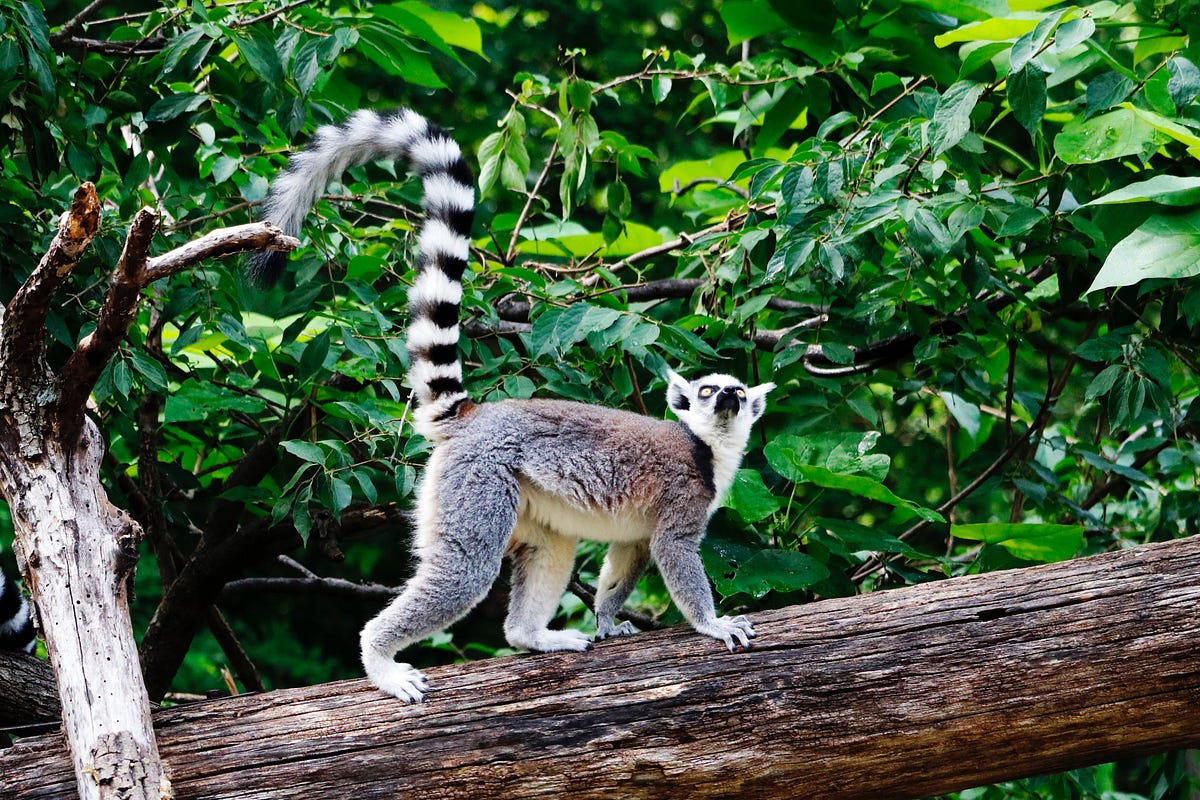
When we got to the habitat, I discovered the exhibit was a lovely place, complete with artfully constructed cliffs and ledges, tall trees, and a thirty-foot moat encircling the land area. The only thing lacking, as far as I could tell, was lemurs. I made out a lone greyish-brown animal sunning on a ledge fifty feet away. Andrew offered me his binoculars, and I watched the lemur scratch behind his ear and then lumber over to another section of the cliff to settle in for a good nap.
“Where are all the lemurs?” I asked.
“I don’t know, maybe they’re sleeping.”
Andrew took out his camera and zoomed in for a photo. We sat at a table at the observation area across from Lemur Island and took turns looking through the binoculars until it was time to leave.
The next day Andrew emailed the pictures he took at the zoo, including the photo of me and the snake. It was the first one, the overexposed photo. Andrew sent it with a little note — “Turns out I liked this photo better.”
As I read the email, I had to admit the picture was a good one, and worth the trouble it took staging it. There I was, arms flung out, the map of the zoo and other assorted brochures tossed just out of reach of my hands. I had a terrified look on my face, as though I knew we would have to stage the whole thing again.
The photo of Lemur Island showed the beautiful landscape and a small dot amongst the rocks. If I squinted just right and put my nose on the computer screen, I might imagine the dot was a lemur. There he was, snoozing alone on the rock ledge. He might not have been lonely, but I couldn’t help feeling sorry for him, with no one to snap his picture should he have the urge to put on a funny hat and dance along the edge of the cliff.
Lemur Island at the Cameron Park Zoo in Waco, Texas — Photo by Terrye Turpin
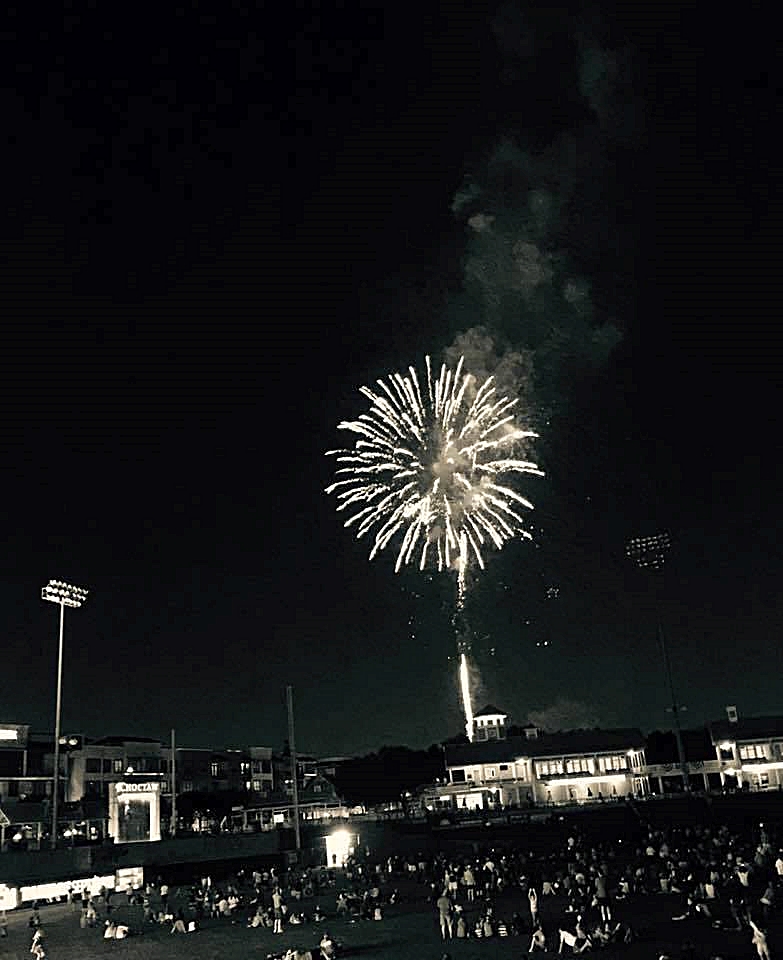
The view from 2016 when we were on the other side of the stadium.
I am not especially patriotic, but I love a good fireworks display. I’m not sure how I came to this attraction to all things bright and sparkly. It isn’t nostalgia. The only fireworks I remember in my childhood involved a car trip with my parents down a deserted country road. We stopped outside the city limits and my dad unloaded a paper sack of bottle rockets that we carried past a herd of curious cattle to the edge of a pond on some stranger’s land. It wasn’t exactly the type of memory I’m anxious to recreate.
The other day was July 4th, the day we Americans celebrate our independence by setting off grass fires and frightening the neighborhood dogs. My fiancé Andrew and I set aside this date every year for our annual disagreement about fireworks. He prefers to ignore them and hide inside in the air conditioning (I think he must have been a Labrador retriever in a past life) while I insist that the holiday won’t be complete unless I watch something explode.
“I could always stick a sparkler up my butt and run around,” Andrew said.
“Not spectacular enough,” I said, after considering his offer.
This year we compromised with an outing on July 3rd to the ballpark near our home to watch the Frisco RoughRiders play baseball. The schedule stated there would be fireworks following the game. We arrived at the stadium after the first inning and settled into our seats behind first base. I counted off the innings and willed the sun to set while we ducked at the occasional foul ball flying overhead. The ice in my soda melted and my thighs stuck to the plastic seat. The air filled with what was either the aroma of grilled hot dogs or my fellow spectators roasting in the summer heat. Around the 7th inning we rallied enough to stand and sing along with “God Bless America.”
As soon as the game ended I noticed a stream of people heading down from the stands.
“Should we follow them?” I asked.
The loudspeaker cut in, announcing that the fireworks would soon start. “They’ll be visible behind the first base section of the stands, fans will have a good view from the field,” the announcer said.
“That’s right over us,” Andrew pointed out. “I don’t think we’ll be able to see from here.” We leaned back in our seats, trying to judge the line of sight.
“We should move,” I agreed.
We hopped over rows of plastic folding seats and fought like salmon headed upstream against the crowd tromping down the aisles. The announcer warned “The fireworks will start in one minute” just as we reached the top of the stadium. I hummed the theme from Mission Impossible as we dodged a stadium attendant.
“Go! Go!” I urged Andrew as we weaved past shuttered food stands and splashed through puddles alongside the Lazy River pool. The first boom sounded as we fled through a gate and into the street beside the ballpark. I stood on the curb and leaned out into traffic so I could watch the pyrotechnics bursting in flashes of brilliant red, white, and blue. Their splendor was slightly blocked by the leaves on the tree I stood under. The display ended while I was still deciding on the best place to stand. It was like someone offered me a cookie and then broke it in half and gave me the smaller bit.
The following evening, the proper Independence Day, we celebrated with an after dark bike ride through our neighborhood. We ride at night because I will only put on bicycle shorts when there is no danger of anyone seeing me. The subdivision across from our home features roads with challenging hills. I usually complain and grumble as I downshift and pedal along. This night, as I struggled up the fourth or fifth incline, I heard the distinctive boom that meant somewhere people were celebrating.
“Can you see any fireworks at the top?” I called as Andrew cycled past me.
When we got to the peak we could hear a barrage of blasts from every direction. But we couldn’t see any fireworks. It was as though we had arrived at a free fire zone in the midst of an invisible military occupation.
We biked on through the subdivision. I struggled along hopefully at every rise in elevation while Andrew shot past me. At last we arrived at the outside edge of the subdivision, and Andrew coasted up to the stop sign at the intersection with the main road. An older man and his barefoot son stood in their front yard, watching the horizon.
“Look there.” Andrew pointed toward the east. A sound like far off thunder rolled toward us and I saw a burst of red and gold light up the sky miles away.
“I think that’s Arlington, it’s been going on almost an hour,” our neighbor told us.
We had a good view, although from our remote vantage point the fireworks resembled glittery dandelions gone to seed. As the booms faded Andrew turned to me. “If we listen carefully we might hear the people cheering.”
“Maybe,” I replied. I envied that distant crowd. I imagined the fireworks bursting in the air and showering their magic light on those below. I hoped they clapped. I hoped they cheered. I hoped they sang.
God bless America, land that I love
Stand beside her and guide her
Through the night with a light from above
From the mountains to the prairies
To the oceans white with foam
God bless America, my home sweet home
God bless America, my home sweet home






 Let's Get Out of Here