Tonight I cancelled my membership to Medium, the home for much of my very short fiction, short stories, and essays. Most are still posted there, but I don’t write there often enough now to justify the cost of membership. Many of the short stories I wrote over the years I compiled in my first book of short stories and I will need to comb through the rest to see if I want to put them in a second book.
For now I’ll share a selection of my micro-fiction. I love the challenge of micro-fiction, taking a story and condensing it down to just enough words to carry the scene. They’re satisfying to write and I hope you like them also.
Escape Velocity
She left behind what held her down
Freed from the tyranny of Earth’s gravity, she floated past the cryo-pods where crewmates rested in dreamless slumber. Machinery hummed like human breath. How far they’ll travel, pioneers.
She remembered another traveler, sent from a dying planet. A child, falling from the sky. Saved, he grew into secret powers. How odd the only things that hurt him were fragments from his lost home.
She wiped frost from the viewport and bid goodbye to Earth before her own cold rest. A beginning, without prejudices and limitations. She wonders — when they reach that distant place, will she be able to fly?
Photo by the author
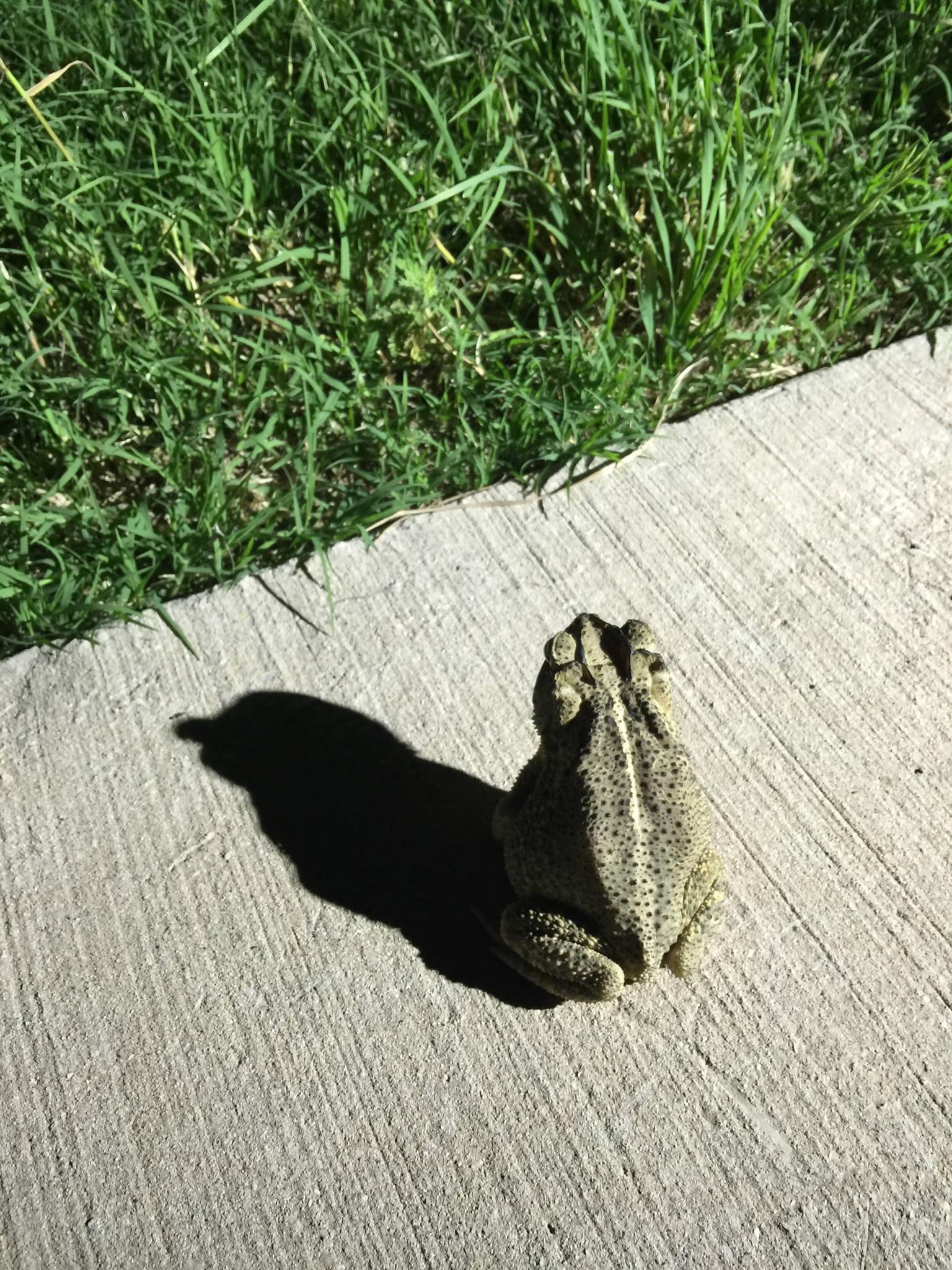
Frog Looks Back
He had lived there so long, in his forest of grass, that he only remembered flashes of his former life. Like the pop of the paparazzi’s cameras — quick frames of hangover mornings, thin false smiles, fake friends who would run at the drop of a dollar.
What had he done to earn the reward of solitude? Jilted a witch? Spurned a wizard? His royal world brought down to a muddy pond littered with flies.
Even so, when she stooped to offer a kiss, he turned from the lipstick smear of her lips. Regretting nothing, he’d choose to stay a frog.
Remote Recollections
The eve of her sixty-ninth birthday Vera Holloway clicked the remote control and turned on her television to a scene from her sixth birthday.
“That’s odd,” she said. Vera the child huffed at blazing candles.
Tapping through channels she discovered every program starred her, Vera from Uncertain, Texas. Channel eight featured a high school football game, marching band all brass and drums while she kissed David Keller goodbye to Vietnam.
Memories hazy and half-forgotten-crunch of autumn leaves, sweet bite of strawberry snow-cone, skip and scratch of vinyl records. Last click. Who was that old woman, staring from the blank screen?
Photo by the author
The Lighthouse
Byrne Macleod lived alone at the lighthouse for forty years. Every night he lit the torch and watched the dark ocean for ships that never passed the rocky shore.
“Why stay, Grand Da?” His great-grandson, fisherman’s heir to seas stripped bare, asked each time he rowed over to the island.
“Someone must wait for them.”
Great waters rose and receded, wars raged and cities burned with plague while Byrne kept vigil. Through eyes dimmed by salt spray he searched the waves.
At last they came, the voyagers. The celestial ships hovered overhead, their journey not by sea but by stars.
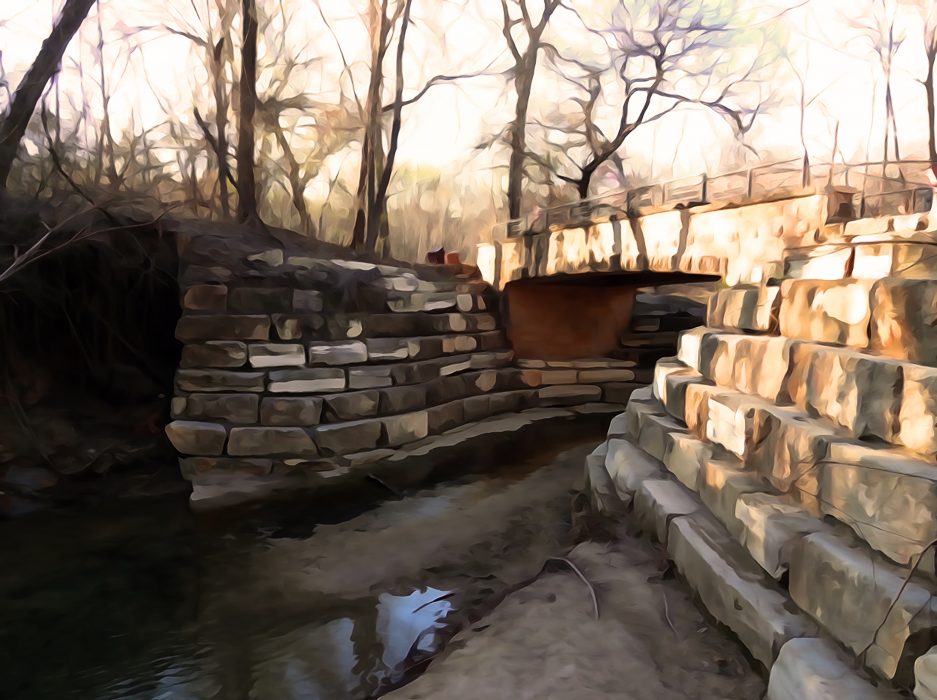
Photo by the author – edited with the Waterlogue app
The Secrets the Moon Holds
She ran along the path, a shortcut through the park near her home. The blue-white glow from the full moon the only illumination as she dodged through trees as familiar to her as the furniture in her living room.
She emerged from the woods onto the concrete sidewalk, a thirty-three year old woman still able, she felt, to pass as one much younger. Still happy for the inconvenience of being carded when she ordered wine, her mock indignation hiding her false pleasure.
The moon her only observer, she fussed with the zipper on her jacket and reached up to pull loose a strand from her ponytail. Messy enough to give the patina of truth to her exercise, the flushed cheeks and high color on her chest.
Home at last, she paused before she turned the knob and pushed open the door. If he greets her with a kiss, she wonders, will he taste him on her lips?
En Passant
She sets the board as they always have. The black is hers, to match the color of her hair — once dark as coal, now grey as ash.
Brew the tea, light the candles, draw the curtains, pull out the chair on his side of the table.
Fifteen years she’s waited for the match, her opponent forfeited much too soon. The hard pain in her chest, sharper than fear, tells her this may be the night she joins the game.
She would sacrifice her pawn but she plays by the rules. As any good player knows, white always goes first.
The Serving Girl’s Legacy
A drabble in 50 words
The barista, the rumor, the hundred-dollar tip. Co-workers congratulated her, her manager promoted her, her boyfriend doubted her.
“How did you earn that?” He frowns, cold as cream on a Frappuccino.
“It was really just a ten,” she says, but he’s gone.
Two lies and one truth — She’ll miss him.
Photo by the author
The Children’s Garden
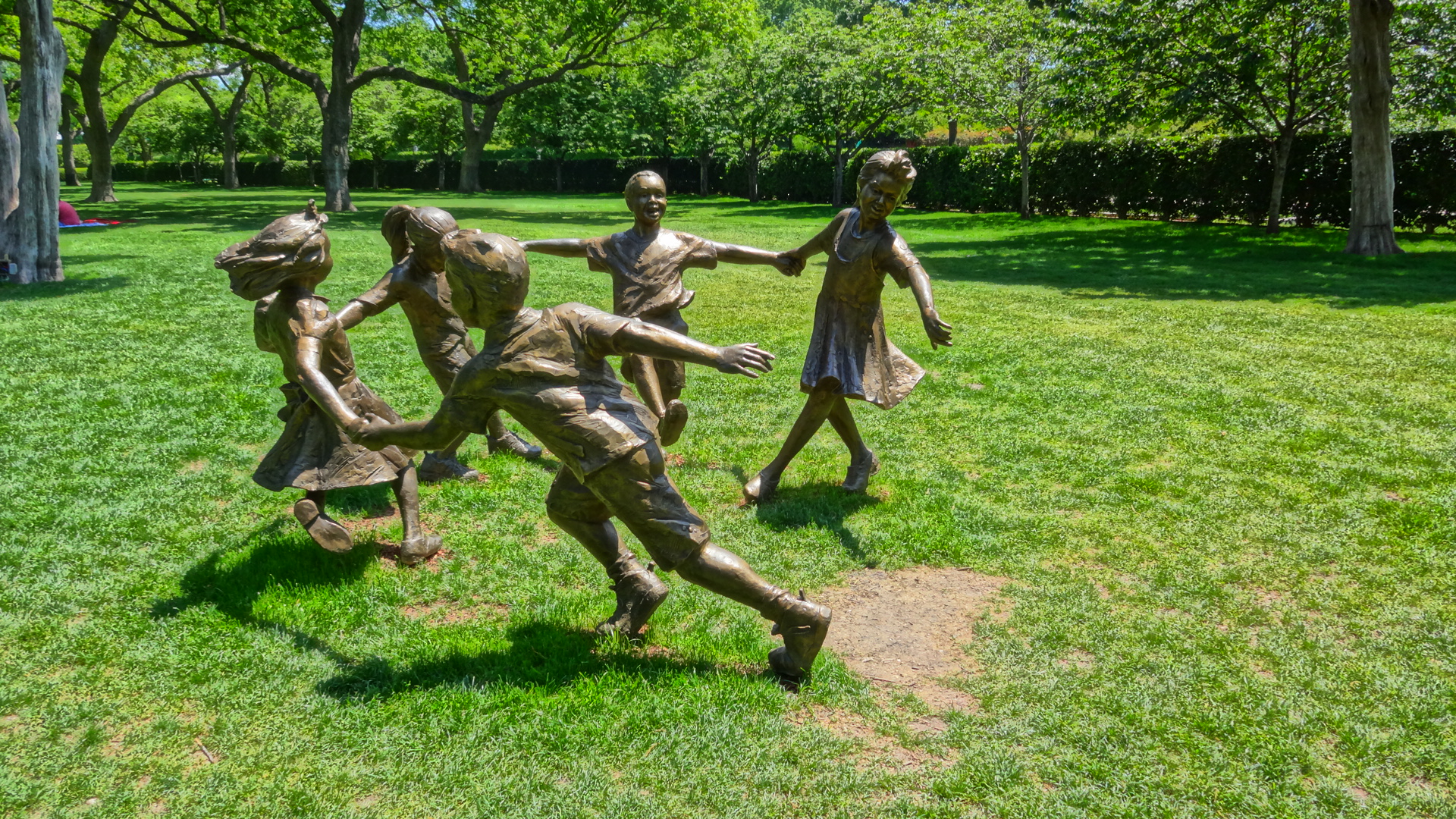
“Go ahead. I’ll rest.” Rose Watson’s grandmother sank onto the park bench. “They’ll keep me company.” The grandmother waved at a circle of sculptures — children, bronze figures cavorting in the grass.
“Okay. You sure you don’t need…”
“I’m old, not incontinent.” The grandmother laughed. “Better scoot, the garden’s closing.”
Rose hurried to the restroom, casting a glance at her grandmother. Had she ever played like those statues? She’d worked years in a factory, supporting her family.
Rose returned to an empty bench. “Grandmother?” Childish laugher answered her. In the dusk she searched, never noticing the extra figure in the circle.
Photo by the author
A Closed Path has no End
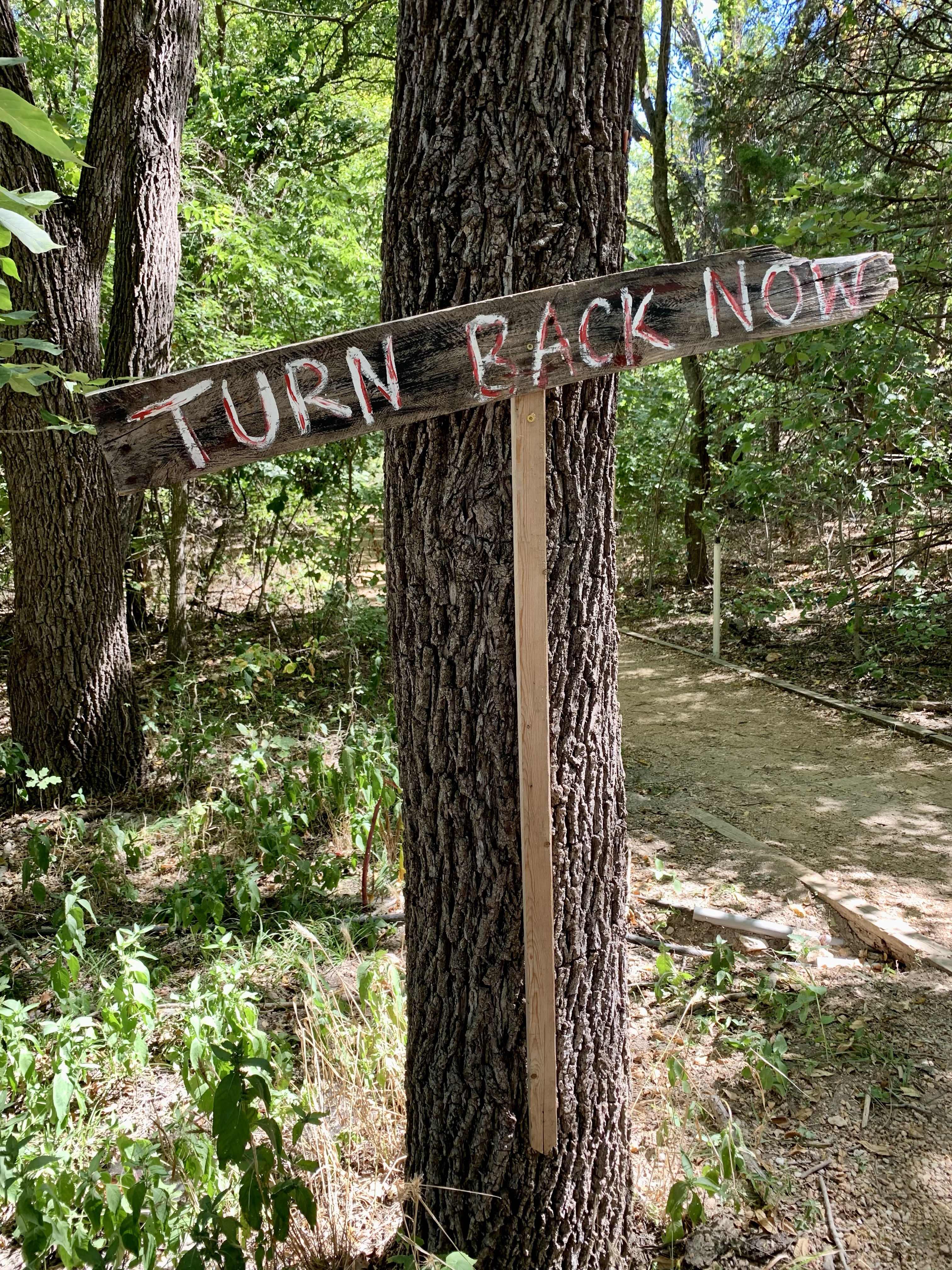
She followed the ghost girl past the warning sign, along the sun dappled path into the dark woods. The trees parted, branches bowing to lead her through the forest until at last the girl turned.
“Here.” She pointed, her spectral arm sweeping across a mulch of sweet pine needles.
The hiker knelt — her knees pressed into soft soil. With trembling fingers, she brushed the dirt from the white, rounded dome, so like a bulb planted in shallow earth.
“Your grave?” she asked. How sad to spend eternal rest not blessed in consecrated ground.
This week’s story comes from an NYC Midnight contest. I had the questionable luck of drawing romantic comedy as my assigned genre, and I had to include a gymnast and the action of being “tech-savvy.” This was part of the short story challenge, and I wrote this one for the third round of the competition. I’ll give myself kudos for making it through the first two rounds, even though I didn’t advance past this one. I did have fun though, and that counts for something.
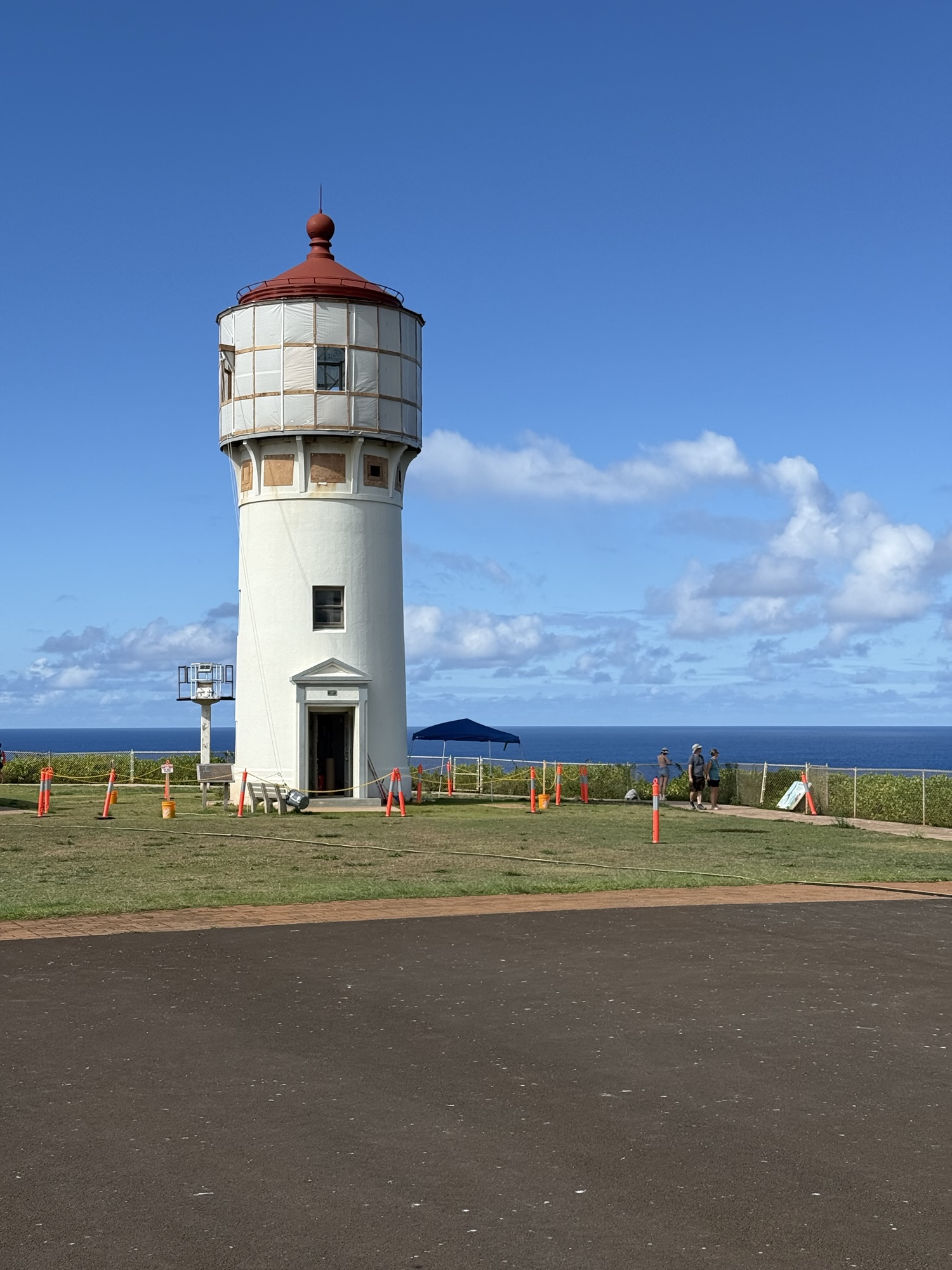
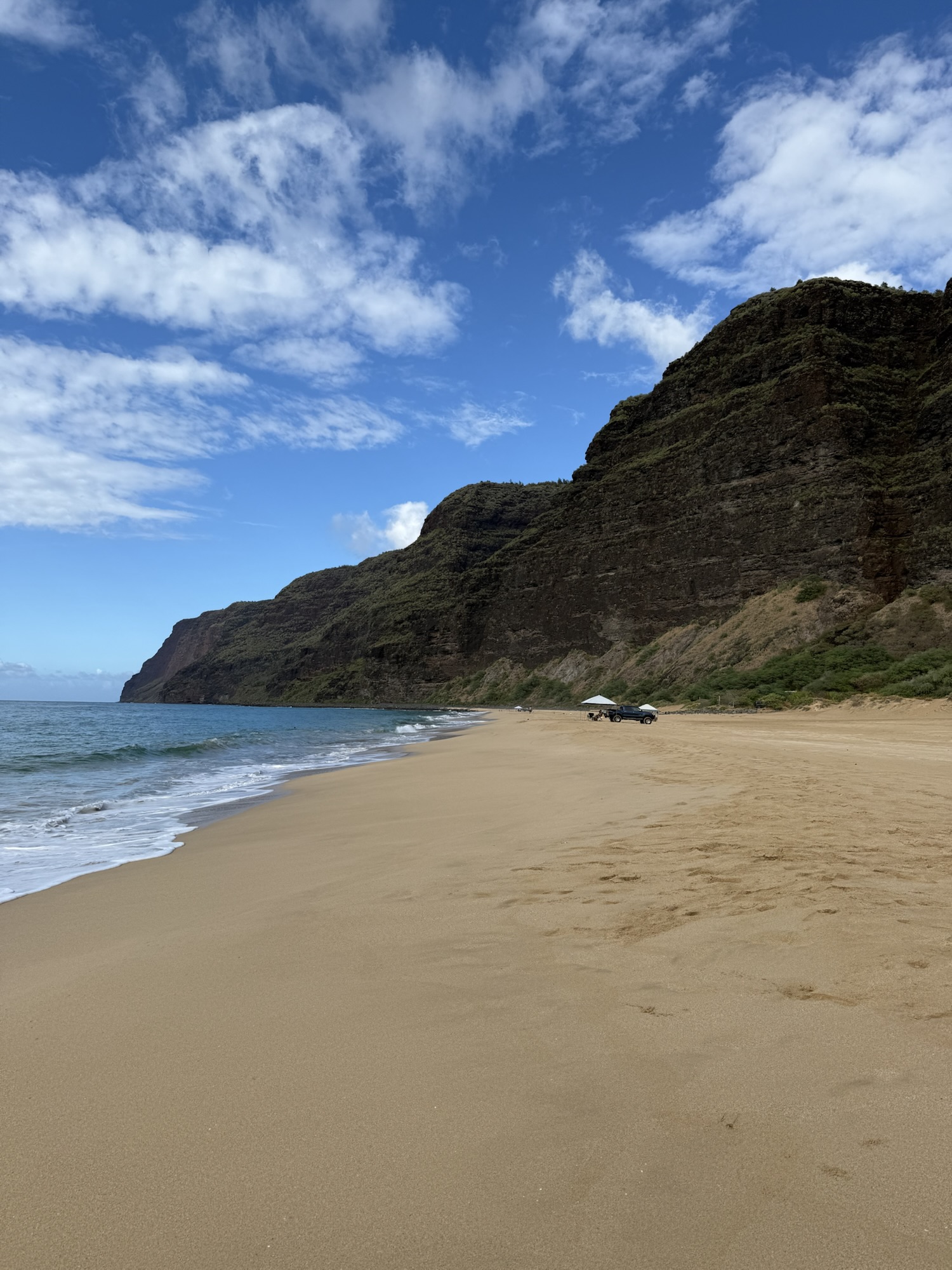
By the way, the photo I’m using to illustrate this week’s story is from our visit to Kauai this year. We stayed at a condo with an ocean view. It was a lovely trip with family and I will share more about that trip soon. For now, please enjoy my venture into the romance genre.
An Unexpected View
Kate Aldridge finally departed (for Florida, not heaven) from her two-bedroom condo in the Park Haven retirement community. Lena Stafford had long coveted Kate’s balcony. The second-floor view of the neighboring nature preserve was perfect for capturing images of migrating birds she could post to her Facebook group.
Lena’s apartment faced the parking lot. From her balcony she watched ambulances ferrying residents off to the hospital or to another permanent destination.
When the condo sale was posted, Lena would be ready. She had her real estate agent on speed dial, her earnest money in hand, and her moving boxes ordered. There were few interested in the condo, as most Park Haven residents were satisfied with smaller places. She could out bid every buyer except one—Arthur McCay.
The week after Kate moved out, Lena met her best friend, Miriam, in the community common room. They sipped wine from matching mugs and worked on a puzzle. Lena wore her usual outfit of neutral colors, blending into the background. A tan canvas fanny pack held her iPhone.
Miriam wore a Hawaiian shirt with pink and orange flowers and a matching headband.
“Here he comes,” Lena said. They had been discussing Lena’s upcoming bid on the condo. She had instructed her realtor to send it over the minute the home listed. One mention of Arthur’s name and the man himself appeared as though summoned.
Miriam tried forcing a puzzle piece into the wrong place. “You’re obsessed with him.”
Arthur, an ex-Olympic gymnast, was a hot catch in the community. Six feet tall, he had silver hair and blue eyes a shade darker than his locks. Lena told herself her interest extended solely to how much money he had on hand. Arthur McCay had founded a lucrative nutritional supplement company, and rumor had it that he had sold it for millions. Lena, a retired software engineer, had considerably less than that in the bank.
“Afternoon, ladies.” Arthur stopped at their table. “Have you seen the cork board?” He held up a hand printed yellow flyer. “I need to post the sign-up sheet for my yoga class.”
“They moved it by the restrooms,” Lena said. “We use a digital bulletin board now. I added it to the Parkview Haven website.”
“I don’t get online much,” Arthur said.
Lena held out her hand. “I can post a sign-up link. What’s your email address?”
“Thanks, but I don’t check it often. You can use my phone number. It’s on the flyer.” He gave Lena the paper and winked at Miriam. “I’ll tack a copy to the cork board, in case there are old-timers like me around.”
“I teach a free internet class—Surfing for Seniors.” Lena tucked the flyer into her fanny pack.
“Oh!” Miriam tugged Lena’s arm. “You could trade – internet for yoga.”
“Sure thing.” Arthur smiled. “There’s a chair yoga class, too. If you want to start with something easier.”
“I’ll keep that in mind.” Lena stuck out her tongue at his departing back. “Start easier. Ha! He should learn something himself.” Why was she so angry? She supposed it was the competition for the condo. It wasn’t fair. Arthur lived in a top floor apartment that already had a view of the woods next door. He didn’t need another place. Lena gulped the last of her wine, then slammed the mug onto the table. “He probably still has the first computer he bought at Radio Shack.”
Miriam leaned forward and cupped a hand next to her mouth to whisper, “I heard he owns a flip phone.”
That Friday, Lena agreed to go with Miriam to the yoga class. She dug from her closet the foam mat she purchased when she signed up for an exercise class on Zoom. That effort failed during the first session, when Lena turned off her camera and took a nap on the mat.
When they arrived at yoga, Arthur was setting up a large boom box. He was dressed exactly like Lena in loose gray sweats and a white t-shirt. Good lord, they could be one of those couples who wore matching outfits.
“I didn’t know there was a uniform,” Miriam said as she rolled out her mat. Miriam wore fluorescent green tights, pink leg warmers and a sweatshirt with the words “Let’s Get Physical” emblazoned across the front.
Arthur popped a cassette tape into the player, and a wave of soft notes and chimes filled the room. “Good morning and welcome.” He turned his blue-eyed gaze to Lena. “We will start with stretching.”
As they worked their way through the poses, Lena relaxed. This wasn’t so hard, and Arthur demonstrated variations of the forms for those who had physical limitations. Toward the end of class, she wobbled getting into Warrior I.
“Try to keep your hips square with the front of the mat.” Arthur padded over to her.
Frustrated, Lena glanced around the room. At least no one was watching her performance.
“Is it okay if I touch you?” Arthur held his hands out, palms up.
Lena nodded yes. His fingers brushed her waist, moving her hips forward. “Drop your shoulders and relax.” With the lightest touch, he started at her neck, and ran his hands to rest lightly on her shoulders.
She exhaled and lifted her hands higher, ignoring the blush heating up her face.
Three days later, Lena rose early, before the heat set in, packed a bottle of cold water in her fanny pack, and headed to the nature preserve. At the entrance, she downloaded a trail map onto her phone. The yoga workout had made Lena realize she spent too much time sitting at her laptop, waiting to hear from her agent. She’d sent over her offer the day before.
Hearing an unfamiliar bird call, she weaved through the brush trying to find the source. Instead, she located a path that wasn’t marked. This track led to a ridge above the creek winding through the park. Where was that bird? She lifted her phone to at least capture the sound on video. Two steps closer to the edge of the drop off, her foot slid in loose dirt and she tumbled, ass over teakettle, down the ridge and into the shallow creek.
“Oh!” Lena cried out, managing a weak “Help.” Her hip ached and her foot was bent underneath her. Whimpering, she untangled her limbs. Ten feet away, her phone buzzed. Moments later, she realized her watch, registering her fall, had called 911. “Oh no.” Lena tried and failed to reach the phone and cancel the call, more humiliated than injured. She crawled out of the creek right before the ambulance arrived and the EMTs insisted on taking her to the hospital.
Four hours of prodding and two x-rays later, Lena was cleared to leave the emergency room. They had rescued her phone also, and Lena tried calling Miriam for a ride. No answer. She could call an Uber, but hated to add the expense. Then she remembered the flyer with Arthur’s phone number. It was still in her fanny pack, where she’d stashed it after posting the sign-up info. She took it out and called him.
Once they arrive back at Park Haven, he insisted on helping her get settled in her apartment. “Is there anything else you need?” he asked.
“I’m okay. No broken bones, but I have a bruise shaped like Texas on my hip.”
“I bet that’s a sight.” Arthur stuttered, “I mean…”
“No offense, it really is something. At least now I know my watch and phone will look out for me if I have another hard fall.”
Arthur gave her a confused look, so Lena explained about the automatic call for help. “That’s interesting,” he said. “Something to think about.”
The next morning, Lena was propped up in bed, resting her hip, when she got the call from her realtor, telling her the condo had sold to someone else. Right after that, her Ring camera alerted her to a visitor. Arthur.
Why was he here? He held a shopping bag. Had he brought her a consolation present? She considered ignoring him, but finally pushed herself out of bed and answered the door.
“Congratulations,” she said. “The condo. You were the winning bid, right?”
“I didn’t buy it. I’m happy where I am.” He shook his head. “Were you bidding on it?”
“I wanted that park view.”
“Oh.” Arthur held up the shopping bag. “I need some help if you have time.”
“Sure. I owe you for the ride home. What do you need?”
He opened the bag and pulled out a new iPhone and an Apple watch. “It’s time to join the twentieth century.”
“It’s the twenty-first, Arthur.”
“Let’s take it one century at a time. I’ve got a good view of the park. Come over and help set up this stuff. We can have coffee on my balcony. Watch the birds.”
Lena nodded. “That’s a good trade.” And maybe a good start for something more.
This week’s story was my first entry into the Not Quite Write flash fiction contest. The challenge includes three prompts. One of the three is what they called an “anti-prompt” where the requirement is to break a named writing rule. For the round that I entered, the rule to break was “use active voice.” The other two prompts were: include the word “crane” and include the action of burning something.
I enjoyed writing the story, even if I didn’t place in the contest I still ended up with a nice little story to post here.
The Magic of Crane Flies
Erin Welch dropped the match onto the brush pile, and with a crackle, the dry tinder ignited. The leaves were burned in the evening, because that’s the way it was always done, as her grandmother had taught her. Leaning against her rake, Erin studied the sparks rising into the dark–orange blooms against the purple dusk. The autumn scent of wood smoke filled the air. Soon, they would be drawn to the light.
Minutes later, when the glow lit up the trees, the first crane fly brushed against her cheek. She captured it in her cupped hands, and its six spindly legs tap, tap, tapped against her palms. Others arrived, drunkenly flying above the flames, their wings reflecting amber light. Easy to believe they were faeries, with their long bodies and large eyes.
Erin’s grandmother, Dinky, had always said that crane flies were made for magic. During their short lives, they never ate. Instead, they spent their time reproducing for their next cycle stage. Such determination to foil death had led to their kind surviving for millions of years. Across the yard, inside Dinky’s cabin on the fireplace mantel, was proof–a fossilized crane fly, stamped on a chunk of shale.
“Capture one and it’ll grant a wish,” Dinky had said.
Adulthood cares banished belief in enchantments. Until now, the week after her grandmother’s death. Careful not to damage the trapped insect, Erin whispered her request and released the crane fly.
It joined its mates above the flames, as sparks swirled and joined to form a familiar figure. Before Erin could blink away the apparition, her dead grandmother stepped beside her.
“Nothing like a good fire.” Dinky held her hands out to the flames, as though to warm them. Her body flickered like a pixelated image. As in life, her ghost stood barely over four feet tall, her short stature the inspiration for her nickname.
“Grandma?” Erin’s breath hung in a cloud. The night air turned winter cold. She edged closer to the fire for warmth.
“I’m here.” There were so many things she wanted to ask her grandmother. She tried to touch the ghost, but her hand passed through.
Gusts of frigid wind scattered the burning leaves. Erin rushed, stamping out pockets of flames. When she finished, Dinky’s ghost had vanished.
“No!” Frantic, Erin tossed handfuls of dried leaves onto what remained of the fire. Despite her efforts, only sparks floated above. The ground circling the fire held dozens of the crane flies, their stick bodies motionless. She dropped to her knees, the cold soaking through her jeans as she scrambled, hoping to find one alive.
She wanted more time. So many things left unsaid. She strode to the cabin and went inside. The wish had only lasted for as long as the crane flies lived, so what better magic than something captured forever? Erin picked up the fossilized crane fly and made her wish.
The third time I entered the Writers’ Playground short story contest, I actually managed to finish and submit something. I like this contest because the genre is open, and they offer a good mix of prompts so you’re not tied to something crazy. Despite the opportunity to go all out in horror, I went with the story below as my entry. The prompts were: one of the characters had to be a carpenter, the setting must be mostly in a rehabilitation center, and the story must include a piece of amber with something living preserved inside.
One of the best things about entering the Writers’ Playground contests is they send you feedback on your entry, even if you don’t place in the contest. For this story the judges had some nice praise but they pointed out that the story didn’t seem to have any conflict. Everything flowed a little too smoothly for the main character.
I liked the story, but I don’t think I’ll be revising it, so here it is, in all its unedited glory. Enjoy (or not)
Bird, Stone, Pen, Ring, Sand
Cole Miller lost his wife, Kira, on a rain-slick county road. Not to death. Thank God she wasn’t with him the night a drunk driver plowed into his pickup, but the accident wiped all memory of her from him as smoothly as wiping crumbs from a counter.
Since that night, he had spent forty-two long days in the hospital before transferring to the rehabilitation facility that had been his home for the past three weeks. Days, he shuffled along the smooth vinyl floors, down hallways painted a calming robin’s egg blue, to appointments with the therapists entrusted with his care. His recovery advanced in painful bits both physical and mental. Cole wondered if he would ever regain what he had lost.
On his left hand, he wore a simple platinum wedding band and around his neck hung an amber pendant on a gold chain. His wife had brought the necklace to him when he first entered rehab. “Amber is for courage and healing,” she said. A butterfly lay captured inside the resin, its delicate wings folded closed. Fragile, yet protected by the substance that had trapped it.
The pocket of his fleece hoodie sagged with a stack of notecards, a felt-tip pen, and five creased photographs. These were the tools he had been given to recapture his life. Cole would try to be brave, while he struggled to recover the bits of his past he had lost.
He had traded his walker for a cane the week before and he was still working out the use of it, stumbling now and then when his feet refused the rhythm of walking. With each falter, he peeked around him, to make sure no one saw his weakness. Before the accident, he had been able to stroll along the top plate of a four-story apartment construction, balancing on the 2×4 frame as though it were the width of a sidewalk. Stopping at an open door, he peered inside to reassure himself he had arrived at the psychologist’s office at the right time.
“Good morning, Cole. Come in.” The woman greeting him had long, dark hair, pulled back in a loose bun, wispy tendrils draping to frame her face. A pair of reading glasses perched on her forehead.
After a moment, like the answer from a Magic Eight Ball, her name floated into his consciousness. “Doctor Foster.”
“That’s right. But you can call me Ellen.” Tapping her desk, she motioned to the seat across from her. “How are the cards going?”
Shrugging, Cole pulled the note cards and photos from his pocket. “Not much new, I’m afraid.” He covered the lot with his hand, embarrassed by how few lines he had written in the two days since they had last met.
“Okay. Let’s get started and we’ll go over the changes. Your memories are still there. They’re filed away, and we just need to teach your brain how to reach them again.” She leaned toward him, as though about to impart a secret. “First, I’m going to say five words. Listen carefully and try to remember as many of them as you can. I’ll ask you for the words in a few minutes.” When Cole nodded, she said, “Bird, Stone, Pen, Ring, Sand.”
Silently, Cole repeated the words. He met with Ellen twice a week, and he had failed this test each time. The random words together made no sense to him, which he supposed was part of the test. Instead of a filing cabinet, his memories were like the butterfly in the amber. Encased in resin and like the delicate wings of the insect, he feared they would be damaged as he tried to free them.
Why couldn’t Ellen use things he could recall easily—hammer and nail, saw and plane? Vivid as a movie, he replayed days on job sites. The sun warming the back of his neck as he bent to cut a sheet of plywood, and the burned wood scent of sawdust as it drifted into piles at his feet.
“Let’s go over your notes.” Ellen interrupted his recollection.
Cole sorted the cards into piles next to the photos. He picked up the first card and the picture that went with it. It was a studio portrait of an older couple, posed in front of a fake background of tropical flowers. “My parents,” Cole said, “taken a couple of years ago when they were on a cruise.” He smiled and pointed to his notes. “It was their anniversary.”
As he nudged a faded polaroid of a small dog with a wiry, black and white coat, Cole said, “My dog. But I think it was a long time ago.” He frowned with the strain of reaching for the dog’s name. Was it Topper? Tipper?
“Good. And the other photographs? Anything you remember?”
Arranged in a triangle, the last three photos were still somewhat of a mystery to Cole. The first was of waves rolling onto a beach, an orange sun either setting or rising across the horizon. A man stood knee deep in the surf, his back to the camera. Someone had captured a one story, red-brick house in the second photo. This was where he and Kira lived. The house felt comforting, in the way the set of a favorite movie or television show would be familiar.
In the last picture, he sat at a restaurant table next to a woman in a denim jacket. His wife. With one of her hands, she lifted a margarita glass. The other hand rested on Cole’s arm. Her head flung back, a wide smile stretched her lips. The flat, one-dimensional photograph did not hide the spark in her eyes. “Kira,” he said.
Cole picked up the photo and turned over the note card that went with it. The card held the details he had been able to recall so far. She was a teacher. They met in high school and married ten years ago, soon after graduation. No children.
Cole scooted forward in his chair. “No children. Not yet,” he said, and something in those words brought a wave of sadness. He touched the photo, where a matching pendant to his could be seen tucked halfway hidden by the fabric of his wife’s shirt. Was this a different necklace, or had Kira given him hers? Did this one also have a butterfly captured inside? As he studied the photograph, his wife’s face shifted, replaced by a younger version of herself, then back to the familiar image in the picture. Cole rubbed his eyes. “We don’t have kids, but we want them.” At least, this was what he thought now. Had they really been trying for a baby, or had he recreated an alternate reality to fill in the gaps in his memory? And which option was the better one?
“That’s good,” Ellen said. “Put it on your card.” When he finished writing, she asked, “Now, how many of the five words can you name?”
Cole froze. He blinked and flinched at a flash of pain behind his eyes. Trying to recall the words, he shook his head, then glanced at the spread of photos and the card he had written on. “Pen!” Picking up the photo of the beach, he added, “Sand.” It was cheating, using these things to trigger the words, but he allowed himself a deep breath and a moment of satisfaction.
“Anything else?” Ellen asked. “Take your time.”
Cole gripped the side of his head as though he could pull the remaining three words from his brain. He slapped the table, frustrated. “No, they’re gone.” His voice rose. “I can’t do this.”
“It’s okay. Two is a good start.” Ellen gripped his hand. “We’ll try again.” She pointed to the cards. “You’re making progress and I expect you’ll be able to recover your past, up to the accident. Forgetting that is the mind’s way of protecting you.”
Protection? Did that mean he would only recapture the good things from his past, and not the bad? He grasped the amber pendant, rubbing the smooth surface across the calluses on his fingers. The motion relaxed him.
Ellen flipped through the folder on her desk. “You’re scheduled for discharge tomorrow, but we will continue therapy on an outpatient basis. Are you ready for that?”
“I guess.” He tried for a hopeful tone. “Yes, it’ll be good to be home.” As he scooped up his things, Cole asked, “Hey. Can you tell me those words again?”
“You know they change each time, right? We’ll keep working, don’t worry. Let everything come back naturally. Once you’re home in familiar surroundings, that will help.”
“I just want to write them down.” Even though he knew the next test would have new ones, this group was special, because for the first time he had been able to recall two of them. He wanted to hold on to all of them, as though they were magic words that would unlock everything.
Ellen nodded. “I guess it doesn’t matter. Here they are – Bird, stone, pen, ring, sand.”
During the drive home the next afternoon, Cole stared out the car’s window, studying the houses and businesses flashing past. His shoulders relaxed as he settled back against the car’s vinyl seat.
“Some music?” Kira asked.
“Sure.” Cole adjusted the oversized sunglasses that covered his eyes. They helped block the light that triggered migraines and wearing them, he could hide the crimson scar that ran from his temple to his cheek. “Oh. I wanted to ask you about this.” He held out the amber pendant. “Where did I get it? Was it a present?”
Kira glanced at him, then looked back to the road. “It was a present, yes. You gave it to me. When we traveled to the coast last year. There was a gift shop near the beach.”
Cole closed his eyes, still holding the pendant. When he breathed in, he swore he could smell salt in the air. “The photograph—that trip?”
“That’s it, yes. It was after…” She shook her head. “You told me amber was for healing.”
“And courage,” Cole added. “Sometimes, I think my memory is like this butterfly. Trapped in here.”
“Not trapped,” Kira said, “preserved.”
He closed his eyes. Preserved meant kept safe. The night before, he had had trouble falling asleep. Finally, he had taken out the card where he wrote the words from his therapy session. He had read them, then tucked away the paper and repeated the words from memory.
Kira turned on the radio, and his eyelids heavy, Cole surrendered to sleep. He woke as the car pulled into their driveway. For a moment, he expected to see his Ford parked there, but no—it would have been totaled in the wreck, towed away to a scrapyard.
Stepping into the house, Cole slipped his sunglasses into his pocket and paused on the threshold. He leaned on his cane and exhaled, reassured by the sight of things he knew. The couch with its sagging cushions covered by a green and yellow blanket, the braided rug before the fireplace, and the photograph over the mantel—Kira and him on their wedding day. A faint scent of vanilla hung in the air from the candles arranged on the coffee table.
“Welcome home.” Kira took his arm. “Do you need a tour?”
“That depends. Do I need a ticket?” He started down the hall, toward the master bedroom.
“I think we can let you slide this time.”
When he stopped in front of a closed door, Kira stepped beside him and blocked his path. He put a palm against the door. What was inside this room? He grasped the handle and pushed open the door. Kira followed him inside.
The walls were painted sky blue, a color that reminded him of the rehab center. A dozen boxes were stacked in a corner, opposite a piece of furniture covered by a sheet.
“We don’t have to go through this now,” Kira said. She tugged his arm. “Come on, let’s get you settled.”
Cole shook his head. It was there, teased at the corner of his memory. He clutched a handful of cloth and pulled it away, revealing the object underneath. A cradle. He ran a hand across the side. “I made this.”
“Yes.” Kira wrapped her hands around his waist and buried her face against his shoulder. “After we lost the baby, we packed everything away. And then, when you got hurt in the accident I didn’t know when the time might be right again.”
Not all memories were good, but they were all a part of what made him who he was. What they were, him and Kira. “We’ll get there.” He kissed her brow, then took off the pendant to clasp it around her neck as he whispered, “Bird, stone, pen, ring, sand.”
I don’t remember the prompts for this one. I think the genre must have been Adventure or something like that. I do remember thinking this ended up a hot mess, and looking back at the feedback I received the judges agreed. It didn’t advance, and it has languished in my files since February 2023. Here it is now, for you to enjoy. (Or not)
The Shy Lady’s Treasure
In the boat’s prow, Jenny Simon leaned into the salt spray. A glance behind revealed the mainland’s shrinking, mangrove lined shore, while ahead Shy Lady Island’s rocky outline grew from the sea. The island’s most famous structure, a historic lighthouse, stood outlined in the sun. The lighthouse had been in operation until the 1920s, when a newer structure was built on the larger island to the south.
She curled her fingers around her heavy packs’ strap and tugged it closer, imagining the slip of paper tucked inside—the permit that gave her permission to explore for the next twenty-four hours. Precious little time, but she planned to find what she’d come for and be gone before it expired. In two days, the land’s title would revert to the state and Shy Lady would be closed to visitors. Now, access to the island was difficult and overnight stays were not allowed. You had to have the right credentials even for a day trip.
One of her fellow passengers—a middle-aged woman wearing a fluorescent yellow life vest stood gripping the rail at the stern. A large canvas backpack rested at her feet. She wore khaki trousers and brown, thick-soled hiking boots. The woman turned and met Jenny’s gaze. Purple shadows like inky fingerprints underlined the woman’s eyes. A gust of wind caused her jacket to flap open, revealing a holstered pistol at her waist.
The boat rose in the water, then slapped in the trough of a large wave. “Sorry!” The captain smiled as he called over the growl of the engine.
Jenny fumbled with her phone. Soon she would have no signal. The last text from the previous night was displayed on the screen.
where r u?
She turned off the phone and returned it to the pack. By the time Claire found the note she’d left, it would be too late to stop her. It would be easier to ask Claire to forgive her once she had the treasure in hand. Selling the copper scroll would solve so many problems for them. They could pay off Claire’s graduate student loans and have money to buy a house. There might even be enough for Jenny to finish her degree. She loved Claire, but her girlfriend had grown up comfortably upper middle class. Jenny couldn’t help but imagine the wealth ancient artifacts might bring. For Claire, it was all about history and knowledge.
At last, they reached the pier. She gathered her things and made to depart. The woman strode past, followed by the other two passengers, a pair of young men. The men carried heavy packs with shovels and picks strapped to the outside.
“I’ll be back this evening at six, before sundown,” the boat’s captain told them. “There’s a storm coming in, so don’t be late.”
She followed the others off the boat and before they left the dock, the woman turned to her and held out her hand. “Hello. I’m Peggy Horton. I was glad to see your name on the roster,” she said. “I knew your father. I was in his antiquities class when he taught at Central Tech.” Her smile faded,, and she pulled Jenny closer. “I’m sorry for your loss. But it’s good to see you following in his footsteps.” The woman cocked her head and her lips curled in a smile that didn’t reach her eyes.
Jenny nodded and mumbled, “Thanks.” She pushed past the woman without another word. Better that she think her rude than risk further conversation.
“We’ll see you at the midden tomorrow,” Peggy called after her.
“Sure.” Let them wait for her to show up. She had better things in mind than digging through an archaeological garbage dump. That was the sort of thing Claire would love, and any other time, so would she, even if she always had to go as an unpaid volunteer. Despite Shy Island being less than an eight-hour drive from their home, they’d talked about it but never ventured here. Jenny marched toward the lighthouse.
Lit by the sun, the structure towered before her, perched on a rise overlooking the beach. Broken stones from the façade littered the ground below it. From the top of the building, she would have a good view of the area. Also, the delay would allow the others to wander out of sight. She squeezed through the arched opening and into what had been the lightkeeper’s quarters. Cracked masonry covered the walls. Shadows darkened the space, and it smelled of mold and damp. A small room to the side must have held his sleeping space. Jenny peered into that room, noting a square of metal bolted to the wall. The surface, once polished, now spotted with age, had probably been used as a mirror. Bits of a wooden frame enclosed the square. The wood was carved to resemble tree bark wrapped in vines. The frame had rotted away except for two sides.
Jenny slipped past the yellow caution tape to climb the stairs. At the top, she eased past the giant glass lens in the center of the floor to look out the opening. She spotted Peggy and the two men hiking into a stand of trees before the woman split off from the pair. The men must be heading to the dig site, a trash pit dating back to the 1600s, when Spanish pirates had used the island as an outpost. It was in a clearing in the middle of the grove. Over the past ten years, portions of the midden had been excavated.
She knelt on the floor and pulled from her pack a small leather journal. It was wrapped in cloth, then zipped into a plastic bag to guard against moisture. Carefully, she turned the pages to the section she had memorized. Here, in the lightkeeper’s tidy hand, he described finding the relic—a copper scroll. He must have known it was valuable, but he couldn’t read the Spanish words printed on the scroll. Alone on the island for so many years, it must have been a precious possession. He’d hidden it during the Civil War. Almost two hundred years had passed since he’d written those words, but no one after had found the scroll, although many had speculated about its existence.
Turning to the journal’s last words, Jenny read the lightkeeper’s clue to where the scroll had been hidden.
I will rise and face my treasure each morning. Clasped in the embrace of her roots, she will keep it safe until this danger has passed.
Standing, she gripped the binoculars she’d brought and studied the landscape, searching for the highest point on the land. He would have wanted a place far from shore, where the rising tide would never reach. Some place he would see from the lighthouse and reassure himself the scroll was safe. There, at the edge of the horizon, stood an oak tree. It towered over the canopy by at least twenty feet.
It took Jenny an hour to wend her way through brush and over rocky outcroppings to reach the hill that held the oak. Whenever she’d caught her breath and unwind the brambles that clung to her clothes, she swore she heard the echo of footsteps behind her. Now she stared at the ledge thirty feet above. The base of the hill held a dry creek bed. Run-off from heavy rains had carved the soil, leaving a shelf of dirt less than a yard deep and extending out six feet overhead. Halfway down, the side roots poked like fingers from a shallow grave. She trod the creek bed until she found a spot that sloped more gently and would be easier to climb.
At the top, she kneeled beside the tree and brushed at the dirt. She would dig here, on the side opposite the drop-off. If her luck held, she’d find the scroll without having to risk the ground collapsing under her. She began lifting clumps of soil with her folding shovel, scraping off the clay-like dirt into a pile next to the hole. Sweat ran from her brow and she had to pause every few minutes to wipe it away. When the rain began, she was at first grateful for the cool drops. The wind rattled the branches and leaves overhead, and combined with the patter of raindrops, it hid the crunch of footsteps until the woman spoke.
“Who are you?”
Jenny flinched and rose, clutching the short-handled shovel. She faced the woman from the boat, Peggy Horton. She held a dull black pistol, aimed at Jenny.
“What do you want?” Jenny stepped back against the oak.
“You are not Claire Emerson.” The woman lifted the gun. “I saw her at a conference six months ago. Her and her father, Dr. Emerson, right before he died.”
Jenny’s mouth went dry, and she trembled. She didn’t think Peggy would shoot her if she stayed silent, and she didn’t want to speak the truth. Her face flushed with heat, remembering how she’d applied for the permit using Claire’s name and her credentials. They had found the journal boxed with her father’s papers. Based on ship’s logs he’d discovered and antique correspondence between Spanish explorers, Dr. Emerson had proposed that the missing copper scroll describing the location of Ponce de Leon’s fountain of youth had been stashed somewhere on Shy Lady Island. How they had fought over that journal! Jenny wanted to travel immediately to the island and look for the scroll. Claire, too distraught over her father’s death, didn’t want to even discuss it.
Jenny shifted her weight, preparing to swing the shovel and jump behind the oak.
“Stay still!” Peggy lifted the gun until it was pointed at Jenny’s head. Lightning zipped in a jagged white line, followed by a drum beat of thunder. The gun never wavered. Peggy smirked. “I know why you’re here. If you’re pretending to be Dr. Emerson’s daughter, you must be searching for the lost scroll.” She motioned with the pistol. “Go ahead. Keep digging.”
Jenny scraped at the soil until blisters rose on her hands. Cold rain continued to fall. The sky grew darker by the minute and below, water ran through the creek bed. At last, the only place left to dig was the ledge.
“Go ahead. Don’t stop.” Peggy nudged Jenny with her foot.
Carefully, Jenny scooted to the far side of the tree and dug. Rainwater filled each divot she removed. Finally, her shovel clinked against something hard. She brushed at the dirt, but mud kept sliding into the hole.
“What is it?” Peggy stepped beside Jenny.
Another crash of lightning and clap of thunder sounded. Rain pelted Jenny’s skin and the earth beneath her shuddered. She looked up. Peggy held the gun at her side, pointed toward the ground. If Jenny gave her a shove, the woman would tumble off the edge into the stream below.
Before she could act, the earth shifted again. Peggy cried out and waved her arms, trying to grab hold of the oak. Jenny flung herself past the tree to the solid ground behind. With a wail, Peggy fell.
Lying flat, Jenny held onto the oak’s roots and peered over the outcrop. Peggy lay half-submerged in the rushing water. Her eyes were closed. One leg was bent at an odd angle. A line of blood oozed from her scalp. Jenny backed away. If she left her there… but no, she couldn’t do that.
Later, she would remember the next few hours as a series of scenes, like slides in a presentation. The first one showed Jenny pulling Peggy from the creek and securing her high on the opposite bank. She found the men at the midden site. Together, they used the tarp that had been strung over the dig to carry Peggy to the lighthouse. None of them had phone service on the island, so they would have to wait for the boat to return that evening. One man had a first aid kit, and they cleaned Peggy’s wounds and stabilized her broken leg.
From her perch at the top of the lighthouse, Jenny was the first to spy the boat arriving. She hurried to the dock and waved as though she would speed the arrival. As soon as it landed, a familiar figure stepped from the boat. Claire.
Jenny longed to rush forward, into her arms, but she hung back. Her fears were soothed when Claire pulled her into her embrace. “What the hell, Jen. What were you thinking?”
Jenny shook her head. “It was stupid and I’m sorry.”
“Why would you risk this?”
The words spilled out, how she searched for the scroll, how finding it would have changed their lives for the better. “But it’s too late now,” Jenny said. “I didn’t find it.”
The boat captain radioed for a helicopter to take Peggy to the hospital. Shock and pain had turned her skin pale and clammy, but she would survive. After it left, Claire, Jenny, and the men prepared to leave with the boat.
“Where did you think you’d find the scroll?” Claire asked.
Jenny described the words in the journal, and how she’d searched for the tree from the lighthouse. “He would face it every morning and…” Jenny froze. She grabbed Claire’s hand and swung her pack onto her back. “Please wait a few more minutes,” she called to the captain.
Together, Jenny and Claire jogged to the lighthouse. “He must have spent so much time here.” Jenny crossed into the small room and stood before the metal square. “This,” she said, “is what he faced each morning. A mirror. Not a tree, but made to look like a tree.”
“You think it’s behind there?” Claire ran her fingers across the rotted wood frame.
“Only one way to know.” Jenny pulled a pry bar from her pack and bent one section of the metal away from the wall, revealing a flat, faded, muslin covered object. Jenny sucked in a breath. “I don’t want to damage it.”
Claire tugged at a corner of the cloth until a section of a rust-colored tablet appeared. Jenny made to pry the rest free, but Claire grabbed her hand. “No. We should have witnesses and document the find.”
“It’s ours, isn’t it? Finders keepers? The land doesn’t belong to the state until tomorrow.
Claire shook her head. “No. They’ll close the island tomorrow, but the title passed last month. We can’t claim it, Jenny.”
Jenny dropped her hand. “You should be the one to find it, Claire. The discovery belongs to you, even if the money doesn’t.”
“But I’m not here on a permit. I begged the boat captain to let me ride out here and back to find you.”
“You’ve been here with me all along. It’s your name on the permit, not mine.” Jenny strolled outside to ask the captain to hold the boat a little longer, as they had something amazing to share.
I wrote this story for the NYC Midnight Fiction Contest way back in 2021. The genre had to be “Ghost Story” and I decided to set it at the Excelsior Hotel in Jefferson, Texas – rumored to be haunted. I published a copy of the story on the Medium site but it didn’t get many views, so here it is again, for anyone who didn’t read it back then.
The Message
The day before her twentieth wedding anniversary, Doreen Clark traveled alone to the Excelsior Hotel, where ghosts were rumored to roam the halls. The hotel, built in the late 1800s, had wood floors that creaked and moaned at night, as though the place were filled with spirits burdened by ghostly pains.
“Welcome,” the chipper clerk greeted her. “Have you stayed with us before?” The woman wore black cat-eyed glasses around her neck, suspended on a rhinestone studded cord.
“Years ago.” As the clerk confirmed her reservation, Doreen stepped over to study the photographs arranged on the lobby wall.
“Fascinating, aren’t they?” The clerk gestured to a gilt-framed photo of a seated woman garbed in old-fashioned, dark, mourning clothes. A translucent figure, a man with a drooping mustache, hovered behind the woman, one hand resting on the carved wooden back of her chair. “Are you familiar with the history of spirit photography?”
“Oh yes,” Doreen replied, “my husband was an amateur photographer. He loved the stories behind the photos.” Spirit photography dated back to the late 1800s, when enterprising photographers used long exposure to create ghostly images transposed onto the pictures they captured. The enterprise proved profitable, as grieving relatives longed to see their beloved again.
“They’re interesting, but I feel sorry for the folks who believed they could connect with their dead loved ones.”
Doreen smiled and shrugged. “I’m sure they got some comfort at least, the true believers.” If she told this woman the real reason she’d journeyed back to this particular hotel, on this date, Doreen wondered if the clerk would pity her or think her crazy.
After she dropped her bags in her room, Doreen texted her daughter, then carried a book to the courtyard, to warm herself in the late October sunshine. Fragrant crimson roses climbed the brick walls. Had there been roses back then? The novel, a gaudy romance, couldn’t hold her. A nap would suit her better.
She woke at dusk and rose, wishing for a candle. Houdini’s widow, she’d read, kept a candle burning for him every night for years. Doreen placed her palm on the frosty glass of the French doors, looking over the courtyard. Something moved outside, a wisp of white that could have been a bit of gauzy cloth batted in the wind.
She remembered her wedding day, so many years ago. They had danced in this courtyard, Doreen’s white lace dress sweeping the cobblestones. What are ghosts? Doreen believed them to be the echo of memory, suspended in air like motes of dust. When Houdini died, he promised to contact his beloved. His widow waited years for that signal.
Her fingers clutched her phone as she unlatched the door leading into the courtyard. The modern equipment lacked the romance of the long exposure on glass photographic plates, but maybe it would do. Lifting the phone, she centered her image in the screen and focused on the wall of roses behind her. She snapped a shot, then another, and another, turning to capture all of the courtyard until she felt faint and dizzy.
Back in the room, Doreen scrolled through the digital images. The phone’s camera had done a fine job of capturing the splash of red roses and the moss-dotted stone of the courtyard, even in the fading light. Nothing else. No outline or familiar face, no time-worn hands resting on her shoulders.
Leaning forward, her lips a finger’s width from the panes, Doreen breathed on the cold glass of the French door. “Oh Bill, I miss you so.” The pane fogged, and she lifted a finger to scrawl a heart. She turned her back to drop the phone on the bed’s quilted coverlet. All those photographs -they couldn’t all be fake, could they? She vowed to return next year, and every year after that, as long as it took.
On the courtyard side, a shape appeared on the pane then quickly faded—the imprint of a kiss, as though tenderly etched on a photographic plate.
Last week, my friend Cathy and I drove up to Denison, Texas intent on finding a new bookstore I’d seen on TikTok. Despite the downtown construction that blocked a large portion of Main Street, we had no trouble locating our destination – Sundrop Books.
Sundrop Books – photo by the author
Inside we each found an armful of novels we couldn’t live without. The store sells both used and new books, plus there is a table filled with one of my personal favorites – the brown paper wrapped “blind date with a book.”
Interior of Sundrop Books – photo by the author
As we were leaving, the owner told us about another bookstore just down the street. A bonus store!
Pen and Page Weathered Books – photo by the author
Inside we each found more books that had to come home with us. Pen and Page stocks both nearly new and used books, plus original artwork by the owner.
Interior of Pen and Page Weathered Books – photo by the author
It was great to find not one, but two bookstores to add to my list of nearby places to visit. The City of Denison is remodeling the park in the middle of downtown, and when that is finished I will certainly need to visit again!
If you’ve made it this far in the post I hope you’ll stick around a bit longer and read the short story below. This one is posted in all its unedited, ugly glory, having been cobbled together over 48 hours for the second round in the NYC Midnight Flash Fiction contest this year. I was not surprised to find out I hadn’t made it to the final round. Writing this one was actually painful. My assigned genre was suspense, and the required setting was a martial arts studio. The final indignity came with the last prompt. Somehow, I had to include CAT FOOD in the story.
Gentlefolk, I present to you:
The Shadow Way
With each step, Mia Dalton tightened her grip on her umbrella, weighing the possibility of using it as a weapon. Had the strange man following her been on the bus? Impossible to tell in the dark and the rain. She hated winter, when night fell by five o’clock. It meant trudging the three blocks from the bus stop to her apartment while imagining danger behind every doorway. Despite what her therapist said, it wasn’t that unreal a fear. Mia had the scars to prove it.
The rain fell harder. As she quickened her steps, the stranger did the same. Was she leading him to her home? Then, twenty feet in front of her, a black cat appeared on the sidewalk. It pivoted to face her, yellow eyes reflecting the streetlights, then scampered across the street.
Mia groaned. A black cat crossing your path was the worst of luck, but maybe this time it was a warning. The animal sat under the awning of the convenience store on the other side, as though waiting for her. Weighing her decision, Mia changed direction, jogging toward the lighted store. If the man did the same, she could duck into the shop.
Once she made it to the storefront, Mia steeled herself and turned to look back. The stranger faced her. He waited outside the circle of light from the streetlamp, his features in shadow. Was this the man from the robbery? It had been almost a year. If he meant to track down the only witness to the murder, he would have done it sooner.
“Go away,” Mia whispered. As though he heard her, the man strode off, vanishing out of sight at the next corner. Beside her, the black cat rose and sauntered away. On impulse, Mia followed. She would circle back to her apartment complex after she was certain the man was gone.
They traveled toward the bus stop, and then turned down a side street lined with quaint, older houses. The rain stopped, and drawn by the warm light spilling from the homes, Mia tagged after the cat until it ran up onto the porch of a pale blue, two-story, Victorian-style house. She paused on the steps. Stained glass windows framed the doorway, and a sign over the entrance read “The Shadow Way: Aikido.”
The door opened, and a woman with hair the color of iron filings greeted Mia. “Hello.”
“I’m sorry.” Mia retreated. “I didn’t mean to disturb you. Is this your cat?” She pointed to where the cat had curled up on a corner of the porch.
The woman smiled. “He’s a stray, but we welcome all kinds here.” She held the door wider and motioned to Mia. “I’m Yuna. Please come in.”
“I’m Mia.” Noticing her host’s bare feet, Mia slipped off her shoes and socks and stashed them in a cubby in the entry. Inside, candles in glass jars lit every corner. A royal-blue mat covered the floor. Yuna wore a white wrap-around jacket and loose wide-legged black cotton pants.
“We don’t practice with the katana.” Yuna pointed overhead, to a polished sword hanging on the wall. “Instead, we use the wooden practice weapons. But they are just as useful when learning.” She took Mia’s arm and led her to a rack of wooden rods.
“I didn’t come for lessons. I should leave.”
Yuna tilted her head, studying Mia. “Chance brought you to me, a teacher without a student.” She handed Mia a short wooden stick from the rack.
“I’m not a fighter.” Mia hefted the rod. The weight of it felt good in her hand.
“Aikido is not about fighting, but about overcoming your fears and confronting your shadows.”
Mia nodded, thinking of the night of the robbery. She had stopped at the liquor store to grab a bottle of wine. While waiting behind one other customer, a masked man had entered. Shouts, cries, and gunfire had blended into an awful cacophony. The robber shot the cashier, the other customer, and Mia. Pain had flared in her shoulder, where the bullet had entered. She had fallen forward, as though to embrace her attacker. Her hand, scrambling for hold, had yanked away his mask. For an awful moment, he had stared into her eyes. Certain she would die, Mia had closed her eyes, but the man had left her there, with only the dead for company.
Now, Mia handed Yuna back the practice rod. “Okay. I’ll learn.”
“Good. Come back tomorrow night.”
Over the next three months, Mia visited the dojo every night. She brought expensive gourmet food for the cat until he trusted her enough to roll over at her feet. She named him Chance, and with Yuna’s blessing took him home with her.
The lessons progressed. Mia practiced with the short staff, the jo, and then with the longer bokken. The movements soothed her. Inside the dojo, she could leave her fear behind. Winter thawed, and the days grew longer until the evening of the first day of spring, when Mia saw the masked man again.
He followed her from the bus. This time, she spotted him right away, remembering the angle of his jaw and his gray eyes. At first, she thought to lead him to The Shadow Way, and Yuna’s help. That felt wrong, to bring violence to a place that had brought her peace. Instead, she marched down the sidewalk, one hand inside the tote at her side.
The streetlights flickered on when he grabbed her arm. She spun, clubbing him with the jo she had hidden in the tote. With a practiced move, she swept his feet. He fell.
The clerk at the convenience store across the street raced over. “I called 911,” he said.
Later, after she gave her statement at the police station, Mia decided to stop by the dojo and tell Yuna what had happened. But when she walked down the street, she couldn’t find the blue house. Like her fear, it was gone.
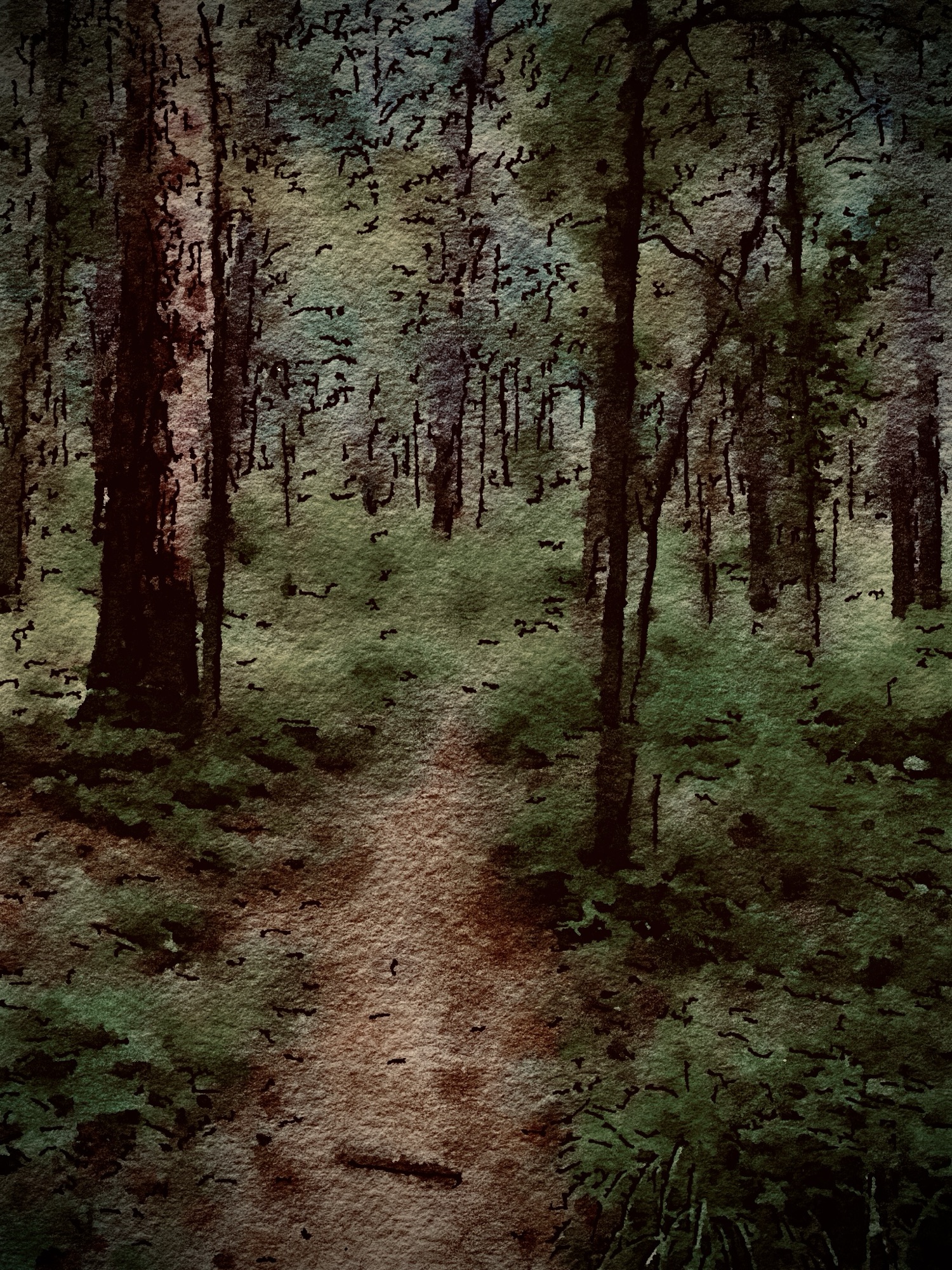
A short story from the 2022 NYC Midnight Flash Fiction Contest
Photograph by the author
In November 2022 I made it all the way to the final round of the NYC Midnight Flash Fiction Challenge. The story I submitted didn’t land on any of the prize levels, and I filed it away until in 2024 when I reworked it into a tale that was accepted and produced for the Drew Blood’s Dark Tales podcast. Writing is often like that, we take scraps of ideas and piece them together like a quilt. This story changed quite a bit from the original, but one thing that stayed was the object that had been one of the NYC Midnight prompts – a cloche.
Here is the original story, in its unedited glory. Once again, I hope you like it, but if you don’t – don’t tell me.
The Price of Guilt
Beth pulled up the email with the instructions for the rental cottage’s lock. Assured a late arrival would be okay, she grabbed her bag and the half-empty wine bottle from the passenger seat. A single yellow bulb illuminated the porch. In its glow, she studied the damage to her car. A crack zigzagged down the front bumper. Clots of dark red liquid were smeared across the damaged running light.
Hurrying to the front door, she imagined the crunch of steps behind. Inside the house, a tiny fireplace took up one wall, bookcases on either side. Scattered among the dusty books were dozens of cloches. The bell-shaped covers reflected the light, concealing their contents until Beth stood close enough for her breath to fog the glass.
Each cloche held a tiny woodland tableau, filled with moss, twigs, and stone chips—scenes from fairy tales. The old stories, where starving children wandered lost in the woods and maidens had their hearts carved out by jealous witches. Desiccated butterflies, with their tattered wings, clung like fairies to miniature branches. Scattered within the greenery of one were the delicate, yellowed bones of a small animal.
She found the bedroom at the end of a short hall, across from a bathroom no larger than a closet. The antique door knob turned with a squeal as the door opened on rusted hinges. Beth dropped her bag on the bed and gazed at the four walls. There were no windows in the room.
The metal framed bed took up one wall, and a scarred oak dresser rested across from it. Another cloche sat atop the dresser. This one held a miniature replica of the cottage, and a screen of tiny trees. Minuscule bits of rock trailed along the inside front of the glass, circling to the tree line.
She pressed her palm to the rough texture on the blank wall, then tapped across the area with her knuckles, expecting to hear a hollow sound. When she realized the missing window would have faced the edge of the forest outside, she shivered, grateful to have missed that view.
The pipes in the bathroom groaned and rusty liquid spun down the drain, the color like bloody water. Gagging, she retreated to the bedroom to undress and snuggle under the heavy patchwork quilt. She took one last check of her phone. No messages.
She woke from a dream that drifted from her memory like smoke. Cavernous darkness surrounded her. Beth fumbled for the bedside table and her phone. Her hands met open air. She stood. Sweeping her arms out, her fingers brushed across the textured wall. She traced her steps back to the bed, but somehow missed it. Her back thumped the far wall.
Her heart thudded. The taste of sour wine rose in her throat. She scooted sideways to the next corner, then to the next, and the next. Finally, her hip bumped against the dresser. She brushed her fingertips over the cloche’s cool, rounded glass. For a second, she closed her eyes and when she opened them, a window appeared in the wall.
The moonlight streaming through the opening revealed the dresser as the only furniture remaining. No door, no bed, no table, no purse, no luggage, no phone. A sound escaped her, half-gasp, half-laugh. Taking a breath, she shook her head. Cool air brought the clean scent of pine and juniper. The walls and ceiling of the room pressed upon her, as though they shrank with each breath she drew. Outside, the open expanse called to her. She climbed through the window.
Ahead, the tree branches dipped in the wind, waving her forward. When she came to the road, she strolled on, despite the bite of gravel under her bare feet. Tire marks dug into the soft earth of the shoulder. The accident had been miles back, but here, dark blotches dotted the grass. A path of flattened weeds led into the brush, as though something large had dragged itself from the road. The tree trunks at the edge of the forest held strange symbols carved into their bark. Runes, scratched into the pale inner wood. The hair rose on her arms.
“An animal,” Beth chanted. “It was an animal.” Her mind recalled the stooped figure rising in her headlights, two black shapes like horns sprouting from its head. A deer. Wouldn’t a person have cried out? It happened so fast – in the time it took for her to glance at the phone in her hand.
A strangled cry sounded, half moan, half growl, like no animal she had ever heard. Beth jumped and raced back to the cottage. If she didn’t look, she wouldn’t know.
The space was back to how she’d found it. Door straight ahead, bed to her right, with the covers thrown off as she’d left them. When she glanced behind her, the wall had closed. No more window. Rushing to the door, she jerked it open. Down the hallway, through the living area, to the front door and then outside again. She didn’t stop until she crashed into a solid barrier. Knocked off her feet, she moaned and crawled forward, one hand held out. Stumbling upright, she banged her fist against the hard, clear surface. Glass.
“No!” She crawled to the cottage and inside to the windowless room. The dresser top sat empty—the cloche gone. Her world tilted, the floor beneath her swaying like the deck of a ship. She fell. Scrambling to her feet, she spilled from the room, rushed down the hall and out the front door. A huge red eye stared at her, distorted by the curve in the glass. It placed the cloche, her world now, on the shelf, then left. At the doorway, the thing crouched and lifted its horned head. The silhouette was exactly how it had appeared in her headlights. Beth stumbled backwards into the cottage. She stretched out on the bed in the windowless room and closed her eyes at last.
The End
If you’d like to hear the story inspired by this one you can listen to Drew Blood’s podcast on YouTube here.
This week I have a treat of a tale from one of my entries in the NYC Midnight Flash Fiction contest. For this unfortunate assignment, I received the challenge of writing a spy thriller story in 1,000 words or less. To top that off, the story had to include a flamethrower. I have forgotten what the third prompt was – just reading the story again brought flashbacks of the trauma induced by having only 48 hours to churn out something resembling a thriller. With a flamethrower.
I did not advance in that round, and the story stayed buried deep in my electronic files until now, when I have recovered enough from the embarrassment of writing it to allow it loose upon the world.
Ladies and Gentlefolk, I present to you:
Facing Fire: An undercover agent accepts a dangerous assignment to prove herself. When an unexpected threat occurs, she must face her fears in order to survive.
When I left the Navy, I swore the next time I set foot on a ship, it would be to cruise to some exotic location. I got the exotic part, but there’d be no poolside margaritas. Three weeks until Christmas, I stood on the dock in the Port of Santos, Brazil, and stared up at the 40,000 deadweight ton freighter that would be my home for the next twenty-six days.
The ship carried a crew of 25. In the time we would travel from Brazil to Baltimore, I had to determine which of them had ties to a terrorist organization, and which of the 9,000 containers on board held ten tons of cocaine they would sell to finance their operations. I would share a bunk with the only other woman on board—the medical purser, a petite black woman who spent her free time cross-stitching flowers and Bible verses on tea towels. She was either the most unlikely suspect or the one with the best cover.
I met Captain Burke my first day aboard. He was the only person who knew I belonged with the organization with three initials and not the merchant marine union.
“You’re here against my will, Miss Leary. I can’t afford an untested officer.”
I pulled at my sleeve to better hide the burn scars on my arm. “With all due respect, sir—for my last four years in the Navy, I served as Navigator. I can do the job.”
“Fine. As Third Mate, you’ll have the 4-8 watch when you’re not in the control room.”
Night watch meant 4:00 am. Not a problem—I hadn’t slept all night since before the accident that landed me at a desk. I’d fought for this job to prove myself capable of active duty again. I owed it to the ones who hadn’t survived that day.
A week passed, and I didn’t get any closer to identifying the terrorist or finding the drugs. Only one in ten of the huge metal boxes was searched in port, so the chances of its being picked at random were low. International maritime law ruled at sea. Domestic law enforcement had their hands tied until the ship docked. Not so for my group.
Halfway to Baltimore, I stood alone in the pitch-black early morning. Bundled against the cold, I shivered as the frigid salt spray hit my face. I gripped the handrail on the bridge and let my gaze roam over the white-tipped waves below. The stink of diesel didn’t cover the ocean’s saltwater scent. I turned at the sound of footsteps. The Chief Mate, Mark Simms, stopped beside me.
“Quiet night?” He tapped a cigarette from his pack and lit it.
“So far. I thought you weren’t on nights. Why the early stroll?”
“Couldn’t sleep. Thought I’d check, see if you needed help.”
I opened my mouth to ask why I’d need help when a noise sputtered through the silence. An outboard motor. Spotlights lit the gray water, illuminating a tiny craft zipping alongside the ship.
“Pirates!” Simms flipped his cigarette over the rail and took off. I thumbed my walkie-talkie and radioed the bridge. A klaxon alarm blasted. I imagined the crew stumbling like ants whose nest someone had kicked.
I jogged toward the stairs. Unarmed, I hoped I wouldn’t encounter any of the pirates. Halfway to safety, the ship went dark. Protocol— something we’d drilled on just the week before. The alarm died with a moan.
Footsteps pounded behind me. I spun to face a pack of men. One of them held a machete. These weren’t my fellow crew members. The lead guy had something strapped to his back, and the long, stick-like contraption he pointed at me wasn’t a rifle. I dived behind the nearest container. The night exploded in heat and orange light. The pirates were armed with flamethrowers.
With my back pressed against frost-covered metal, I shivered and let out a fog of breath. The cold reassured me I wasn’t on fire.
The pop of gunfire sounded. Someone screamed. I eased out from behind my cover. Five feet away, a body lay stretched on the deck in a pool of dark blood, flamethrower still strapped to his back. Ahead, the pirates had taken cover behind a stack of metal drums. Bullets pinged past. At any moment, the bad guys might turn and run for the stairs and the control room. I reached a hand to grasp the flamethrower and slip it from the body.
Motion in the cargo stacks drew my eye. Captain Burke crouched beside one container. He tugged on the straps holding the box, then startled when he noticed me. He should have been locked down in the control room.
Burke crept over to whisper, “What are you doing?” He reached to his side and drew out a pistol.
I shouldered the flamethrower, and before the pirates could charge, I aimed a burst of flame at the metal straps holding the nearest stack of containers. The straps glowed white hot, then snapped as the boxes tilted. They tumbled onto the deck, blocking the pirate’s escape.
With no way out, the bad guys surrendered. Captain Burke appeared at my side. He studied the collapsed containers with a look of relief. Once we secured the pirates in the freighter’s brig, I used my satellite phone to call in my suspicions.
Homeland Security and the DEA met the ship in Baltimore and arrested Burke. His first duty should have been to the crew. Instead, he fled to check on the cargo. One stack of containers in particular, and his look of relief when that load wasn’t the one that fell, gave me the idea that the drugs would be in the one he’d checked. Turns out I was right, and he was glad to exchange his testimony for immunity. He’d only been in it for the money.
Me, I’m booked on another ship. This one sails from Galveston to Cozumel. Warm sand, cold margaritas, and not a flamethrower in sight.
I submitted the story below to a contest recently. It didn’t place so I’m sharing it now. In this one the genre was open and I was assigned two prompts that had to be included: career advisor and mosaic. I went with fantasy/magical realism with a humorous touch. I hope you like it, but if you don’t, please don’t tell me.
Afterlife Positions Available
An hour and ten minutes after Ellen Tyler collapsed into the koi pond at the Dallas Arboretum, she woke in a sterile white room. A fluorescent light buzzed overhead. Was this a waiting room, in a clinic or hospital? She hoped they took Medicare. Puzzled, she patted her chest. Her clothes – the same cargo pants and matching shirt she had dressed in that morning – were dry and clean.
Right before splashing in the pond, she had felt nauseous and dizzy. She had leaned over, snapping a photo of an orange carp, until a sharp pain in her arm made her drop her iPhone into the water. When she reached to retrieve it, she blacked out. Afterwards, blue and red flashing lights, shouting, and her sister Trina’s shocked face filled some of the blank spots in her memory.
The door on the other side of the room swung open and a tall, wide man filled the doorway. He wore a wrinkled gray suit and had the pleasant, smiling expression of a television weatherman predicting sunny weather.
“Hello! Sorry about the wait. We weren’t sure when you would arrive.” He stuck out his hand. “You must be Ellen. I’m Milton.”
Ellen squeezed the man’s hand. Then, not knowing what else to do, she followed him into his office. A dull metal desk filled one half of the room. Files, folders, and yellowed paper covered the desktop and overflowed onto the floor. Milton stooped and removed a cardboard box from his chair, then pulled over a wooden chair for Ellen.
The white walls held two posters—one had a photo of a kitten clinging to a clothesline and the words “Hang in There” scrolled across the top. The other sign featured a montage of at least thirty images. A sheet-covered cartoon ghost held the center square, surrounded by several other pictures that looked like they belonged on the covers of horror novels. There was a gnarled being with knife-sharp nails, a thin man with solid black eyes, and a transparent, shrouded figure. As she stared at the poster, one of the images, a woman clothed in a long black dress, waved at Ellen.
“Where the hell am I?” she asked.
Milton’s face turned red. “You’re not in…” He coughed, “…that other place.” He shuffled a stack of papers and pulled out a glossy brochure. Handing it to Ellen, he said, “This is the Career Placement Agency for the Afterlife.”
“Wait.” Ellen fanned herself with the flyer. “I’m dead?” How could this be? She had celebrated her 71st birthday last month, but she had also received a perfect checkup from her doctor.
“You expired this afternoon.” Milton laced his fingers together. “Heart attack and drowning.”
How embarrassing. Ellen always assumed she would pass quietly in her sleep at age 101. What a ruckus she must have caused. Trina would never forgive her for insisting on tromping around in the summer heat instead of enjoying an afternoon matinee in an air-conditioned movie theater. Her sister loved the movies. Trina would have to find someone else to share her senior discount pass at Movie Plex.
“I thought the afterlife was filled with harps and angels, not work.” Ellen held up the brochure. The cartoon ghost from the wall poster graced the cover. The title, written in Comic Sans font, read “Guiding Your Choice for Eternity—A Mosaic of Diverse Opportunities.”
“These experiences are designed to bring purpose to your life after death. I’m here to guide you in choosing which form your spirit will take.” Milton pointed behind him, to the collage of images. “Each afterlife represents at least one of our six core skills—comfort, entertainment, education, inspiration, caution, and remembrance. For example, you could choose Lady of the Lake or ectoplasm entity.”
“I drowned in the damn koi pond, Milton. I can’t imagine haunting knee-deep water for the rest of my time. And that ecto thing just looks like a blob of green goo.”
“You have leftover anger issues. Maybe a spot as a poltergeist?”
Ellen huffed. “Spend eternity chunking pots and pans in someone’s kitchen?”
“It’s not just pan chunking.” Milton sat up straight. “It’s entertainment.” When Ellen didn’t respond, he continued. “Do you like travel? I have an opening for a Vanishing Hitchhiker.”
“Can I give it a trial run?”
Milton clapped his hands. “Of course! I’ll see you back in a week.”
After the first three nights of waiting on a desolate country road for a car to pass by, Ellen wished that time would pass more quickly in the afterlife. The fourth night, a farmer in a rusted pickup with bad shocks gave her a ride. Grateful for the company, she forgot to vanish, and rode with him into town. She had to walk the six miles back to her post.
When the week was up, she met with Milton again. Her past wasn’t dark enough to qualify her as a revenant. She wasn’t deeply melancholic, so wraith would not be a good fit. She would end up a ghost orb, floating over a swamp and being mistaken for a ball of gas.
“What else is there?” Ellen pointed to the cartoon ghost in the collage. “How about that one, but without the sheet?”
Milton sighed. “I hoped to place you in an entertainment or inspiration position. Most of the other careers require a commitment to a static location.”
“That’s fine. And I know a perfect place.”
Ellen floated along at Movie Plex, creating cold spots in the ladies’ restroom and leaving the scent of popcorn in newly cleaned theaters. Her sister bought a ticket the second week, for the new Tom Cruise flick. Ellen settled in the empty seat next to her and whispered, “Hello.” When Trina turned her head to peer at the vacant spot, Ellen waited until the air conditioning kicked on with a burst of cold, then brushed a strand of hair from her sister’s face.




 Let's Get Out of Here