
Cold Feet Warm Socks

A trail suitable for walking — Photo by Terrye Turpin

Until I met Andrew, the man who would eventually become my husband, I was blissfully unaware that there were socks designed for specific activities. I purchased my socks in bulk and in solid colors that eliminated the need to make sure I had on a matching pair.

When I started dating Andrew, we spent weekends hiking along the shady trails near our home. I used to call this activity ‘taking a walk’ and it didn’t require specialized equipment. Andrew suggested that my feet would feel better if I were wearing a pair of socks with extra cushioning, and I agreed while we were limping to the car after a five-mile hike over terrain so scattered with sharp rocks and tree roots it resembled a trek through Mordor.

I didn’t realize that there were special socks for hiking, but a trip to REI (Recreational Equipment Insanity) set me straight on that right away. While I puzzled over the price tag on a pair woven from tan and green striped wool, Andrew handed me a flimsy bit of white cloth I held up and realized was actually a pair of socks.

“You should get liners. They’ll help to prevent blisters,” he said.

“You’re telling me my socks need socks?”

I left the store without purchasing anything when Andrew mentioned that REI had an outlet and if I weren’t picky on style, I could find suitable socks at a discount online. I ordered one set in a lovely shade of hot pink, just shy of rose and a little darker than blush, and I figured the color must be what landed them on the clearance section. Surely hiking socks would tend toward more solid, understated colors, like beige or olive green. I imagined that in a pinch I could take them off and use them as an emergency signal since the color could be seen by passing planes.

When the socks arrived, I opened the package to discover they came with instructions in five different languages and a 30 day no risk trial. They were made from a material called Thorlon, which sounded like a character from a fantasy novel.

“By the shield of Thorlon I command you!” I told Andrew.

The packaging described how this material magically prevented blisters. No liners required. A disclaimer on the tag mentioned the socks should not be ironed or dry-cleaned. While I pondered the type of person who would iron their socks and wondered just how this could be accomplished, I was relieved to notice the instructions included illustrations, captioned in English, of how the socks were fitted and cushioned. I worried I would have to learn German to get dressed for hiking.

The colorful tag also mentioned the socks protected against shock, impact, and shear. For a moment I thought I had mistakenly ordered a parachute. I reassured myself by trying them on and walking around my apartment. Although they seemed to have a nice amount of cushioning I didn’t think I would jump out of an airplane wearing them.

I wore the socks the next evening to walk down to the local library with Andrew to return some books. It was a chilly evening, so I put on the bright pink socks with a pair of matronly sandals that had elastic bands at the back, to hold them on my feet.

“My feet are cold,” I explained as I put on the socks and slipped into my sandals.

“Those socks should help.”

“If we get separated, just look for the pink glow,” I told him.

We made our way to and from the library, and Andrew not only walked beside me he carried my books and held my hand for most of the trip. It was dark out, which made it difficult for anyone to spot us I suppose, but the Thorlon material seemed to reflect the streetlights in a rosy glow around my feet. It occurred to me the packaging for these socks ought to include the disclaimer you shouldn’t judge someone until you had walked a mile in their socks. And while they are often found together, a warm heart doesn’t have to be accompanied by cold feet.
The Care of Cast Iron

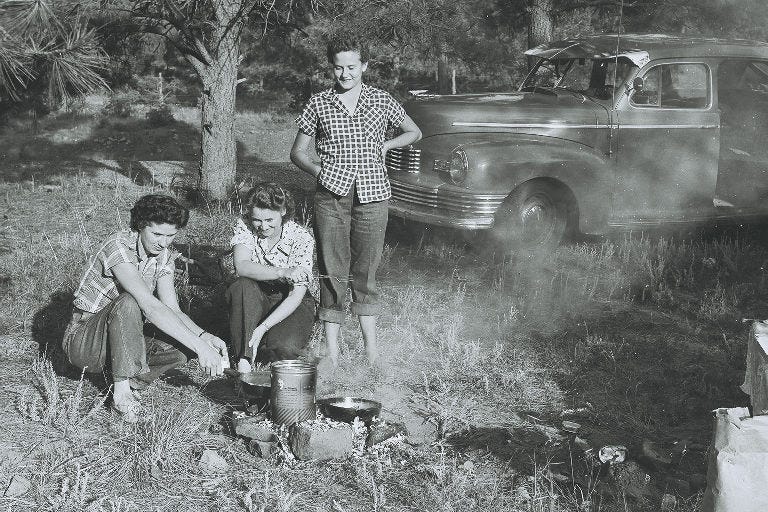
My mother on the far left, cooking over an open fire.

I cannot find my mother’s frying pan. The one she gave me before she moved into the nursing home, before she died, and after she stopped cooking for herself.

Her hands were rough, large and knotted with arthritis. They shook as she held out the frying pan. “You want this?” she asked as she picked up the heavy skillet from the inside of the oven where she stored her pots and pans. I took it because it was one of the few things in her apartment that didn’t smell like pine cleaner.

Other people hold on to things. They remember birthdays and anniversaries, and know exactly who inherited their grandmother’s silver. I misplace my scissors and the remote to the television but you would think something large and useful like a frying pan wouldn’t just float off out of sight.

My parents started their married life as farmworkers. My father drove a combine, and my mother cooked for the field hands in the 1930’s. She didn’t speak of it much. I am left to picture her aproned and bending to tend to a wood fired stove and stooping to wipe the sweat from her forehead with the back of her hand. After the farm job she cooked for her husband and children and then just for herself and me, the last in the line of seven offspring.

Her cast iron skillet had a surface polished mirror smooth and jet black from years of fried potatoes, scrambled eggs, pork chops, and scratch made pancakes with golden brown circles dotted with pale spots where the butter melted. I was in high school when my parents divorced and our meals changed to things barely recognizable as food.

My mom, with her eighth grade education, found work as a housekeeper. She spent long days cleaning and cooking for other people, so at home we had frozen pizzas, chili and soup from a can. Evenings we settled in front of the television and suffered through boil-in-bag meals, little plastic packets pulled from the freezer and dunked into boiling water to cook. We dumped the contents out and spooned up Chicken a la King or Salisbury steak over instant potatoes. The boil-in-bag meals had an unpleasant aftertaste, like you had licked a plastic bucket and decided to melt it and serve it for dinner.

Married with two children, I had a frying pan when my mother gave me hers. My cast iron skillet was new and not well seasoned, the surface still pitted with small imperfections.

I didn’t notice when my mother stopped eating. She didn’t trust food prepared by others. She quit attending holiday meals, refusing even the plates brought to her by family. She liked hamburgers from Wendy’s so I often picked up a burger and fries to drop off on my way home. I have worked in fast food restaurants, but I never mentioned that her meal had most likely been prepared by someone with tattoos and a nose ring.

The microwave confused her, and she never learned how to use the one in her apartment. On our weekly trips to the grocery store she bought whatever frozen meal she could cook in her toaster oven. I carried her groceries in and stood in the entryway while she took off her shoes. One by one she ferried the items to the kitchen counter where she washed each box and bottle in harsh cleaner before putting them away.

My mother’s mental illness went untreated for most of her life. The obsessive compulsive disorder that locked her into rituals of cleaning didn’t appear until most of my brothers and sisters had grown up and left her house. I guess it might have been worse for me, growing up in a home with easy to mop vinyl floors in every room. At least she wasn’t a hoarder. I had to strip my clothes off and toss them into the washer before I walked through the living room but I didn’t have to wonder if there was a dead cat hidden under the couch.

She lived alone, in an apartment complex for senior citizens. They had a concierge to carry off the trash, so I didn’t notice the empty peanut butter jars that stuffed the bags of garbage while unused dinners filled the freezer. She began phoning 911, certain she was having a heart attack. I made the twenty minute drive from my house, arriving in time to find her sitting up and flirting with the young, attractive emergency medical technicians. When I mentioned the dizziness and confusion to her doctor, he suggested that it might be caused by malnutrition.

My mother’s frying pan stayed stashed in the cupboard. I don’t remember packing it up when I moved out of our house after my divorce, but I must have. There’s a vague memory of giving it to one of my grown children, but when I asked they both could not remember anything about it.

“I have a skillet, but it’s not that old,” said one.

“I think I got mine at Goodwill,” the other replied to my text.

To properly season a new cast iron skillet you must first scrub it with hot, soapy water to remove the grime from manufacturing. You dry the pan, rub the surface with oil and bake it for one hour at 375 degrees. I wish I remembered what I did with my mother’s frying pan. If I made a gift of it, I wish I had given it with the ceremony and pomp it deserved. Perhaps then one of us would recollect where they’d last seen it. A seasoned cast iron skillet will last a lifetime, and heat and use will wear the surface smooth and brilliant and precious.

The Glue That Binds Us


When my boyfriend, Andrew, told me he had ordered something special for my birthday, I didn’t know what to expect. We started dating in October, and for Christmas he gave me a television. He won it in a drawing at his company holiday party so it didn’t cost him anything, but still, it was a brand new flat screen TV.

My birthday was in February, just before Valentine’s Day, and after intense questioning Andrew finally admitted that he purchased my gift on eBay. This didn’t narrow the field much, but at least gave me comfort that the gift was not a puppy.

“Is it bigger than a breadbox?” I asked Andrew.

“That depends,” he answered, “how much bread are you planning on storing?”

The box arrived just before my birthday, and it was slightly larger than a box that might hold a loaf of bread. We sliced open the tape that held it together and looked inside. I pulled back the wrapping paper that cushioned the object and saw a flash of bright yellow and orange. Looking up at me from the box was a duck’s head.

“It’s a cookie jar,” Andrew said.

“Oh,” I said, as I looked the ceramic duck in its beady little eyes. Whoever painted this duck had an unsteady hand. The eyes were wide and startled but the orange bill appeared expressionless, giving the impression that this particular duck didn’t care much about anything. I reached into the box to pick up the lid of the cookie jar, and discovered that the head was detached. Tiny shards of ceramic littered the inside of the box.

“What a shame, it’s broken,” I said with what I hoped was a proper amount of sadness.

“Oh no! We’ll have to fix it!”

I got up and stepped into the kitchen to rummage around in the drawer where I kept spare packets of ketchup, loose toothpicks, and those little twist tie things.

“I’ve got some super glue in here somewhere,” I said.

“That won’t do. We’ve got to pick up some epoxy,” Andrew replied. He went on to explain in detail the importance of bonding strength and application style. “Epoxy will fill in the small cracks and create a smooth surface. It will bond better with the ceramic surface.” A trip to the home improvement store was required, to get the special two part epoxy that would mend the duck.

Andrew and I met online. I marked the days off on the calendar until we could meet in person, thinking all the time that I wasn’t getting any younger. Starting over after a divorce in my 50’s was challenging and I never expected that I would find anyone I could tolerate for more than a few hours. I liked Andrew well enough to step up and give him a kiss at the start of our second date. And now we had progressed to shopping together for hardware.

We purchased the epoxy and Andrew spent nights at the kitchen table with newspaper spread out under the broken cookie jar. He picked up bits of ceramic duck with tweezers and slowly fit the pieces together. He mixed epoxy until we were giddy with the fumes, and filled in the cracks on the surface.

When Andrew finished the mending I announced that the duck should retire to a life of leisure and give up the work of holding cookies. There was a brownish faded photograph included in the package with the cookie jar. The snapshot shows the jar cradled by slender feminine hands, the woman’s face cut off from the frame. The date 1977 is printed in ink on the back of the picture. I wondered how the duck wound up at auction, bought and shipped to end up shattered but then restored.

“Well, it’s not perfect but I guess it’s okay,” Andrew said. We placed the duck on a shelf and we were pleased with the repair. The cracks were noticeable only if you peered closely, and even the original owners might overlook the imperfections.

“It’s wonderful,” I said, “just the right birthday present.”

If love is the glue that binds us, then patience is what sets the bound and fills the missing bits from our damage, smoothing the surface to make us good as new.