
The Things I Kept

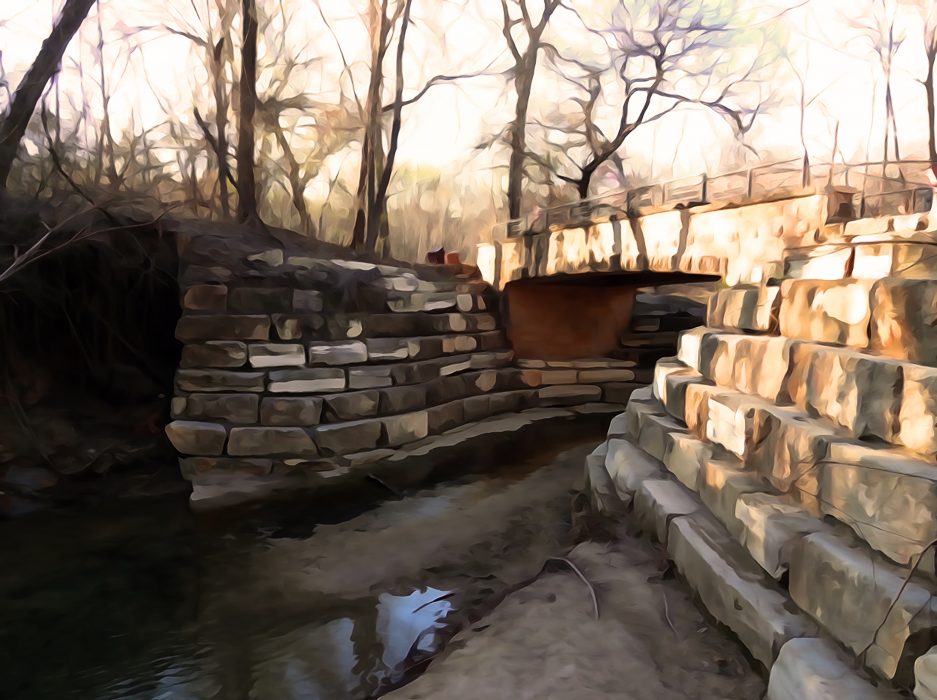
Photo by Don Agnello on Unsplash

I packed up my apartment in one afternoon, amazed at the amount and the variety of useless stuff I collected in fourteen months. Some of it I had when I moved in, but not the one hundred plus ketchup packets or the fifty little plastic sleeves of soy sauce. I certainly didn’t remember owning hundreds of clothes hangers. It’s funny the items you consider worthwhile when you are choosing which to leave and which to take. Two of my possessions I consider valuable enough to be the first on the “keep” list — a small statuette of a sad dog in a Boy Scout uniform, and my 1958 Barbie doll.

Photo by Terrye Turpin

The ceramic dog was a present from my father. By the time I came along he no longer led a scout troop, but I liked the little statue and asked him for it. The Barbie doll might be worth some money if her feet weren’t marked with the imprint of my childish teeth. Barbie and the little dog were among the first things I took out of the home I left to my ex-husband.

The more stuff you own the more dusting you need to do. If I could, I would reduce all my possessions down to what would fit into a backpack. I could make do with a travois I guess and drag the lot along behind me. I fled a twenty-five-year marriage with just what fit into my car, plus a futon. A small price to pay for a quick retreat.

Three months after I appeared alone in court to finalize the divorce, my ex-husband’s sister asked if I wanted anything from the house. They were selling it in a last gasp effort to avoid foreclosure. I brought friends, boxes, and a pickup and arrived to find the front door of the house covered in plywood. Law enforcement had kicked in the door, looking for a man my ex had let stay at the house. We loaded up photo albums, dishes, books, odds and ends I thought I might want.

I wound up with a collection of novelty coffee mugs, a flock of ceramic roosters and chickens, battered pots and pans with loose handles, puzzles, games, blankets, paperback books and bookcases–it grew exhausting dragging it all along behind me. I decided to hold a garage sale. I convinced my son, Andy, that he should let me hold the sale at his house by offering to split the proceeds with him.

I’ve lived long enough to have suffered through several garage sales, they seem to come in ten-year cycles, like a plague of locusts. The day of the big event I set up in Andy’s driveway with a cup of coffee and watched the sun rise while our first customer arrived. The woman struggled out of the passenger seat of an older model pickup truck with a bed piled high with used furniture. She ambled toward me and asked “Is your lawnmower for sale?”

I explained that we didn’t own a lawnmower, let alone have one for sale, and she huffed, turned around, and walked swaying back to the truck. The treasure hunters appeared. They rummaged through the mismatched coffee mugs, torn sheets and worn out bath towels, boxes of puzzles with just one piece missing, and clocks that no longer worked. They turned to ask, “You got any gold or silver jewelry?”

I had my wedding ring, but I didn’t sell it. Not then. I kept it stashed in a wooden jewelry box for a year after the divorce. I sold it at a store front with a large black and yellow banner proclaiming “We Buy Gold! Silver! Top Dollar!”

Each item that sold meant one less thing to pack up and move. I felt lighter as the boxes of knick-knacks, throw rugs, and collections of paperback books left with each buyer. I had been carrying the weight of these things for years. By ten o’clock on the second day of the sale I was down to several dozen coffee mugs, some pots and pans, a used television antennae, and a warped dresser with loose knobs and sticky drawers.

Andy joined me on the driveway as we watched people cruise by, checking out the remnants from the safety and air conditioning of their cars. Our last customers were a pair of older Hispanic men who paid two dollars for a dozen coffee mugs. Before they left, they asked if we would like to buy some tamales. The men led us to their car, parked at the curb in front of the house. They popped the trunk and lifted a foil wrapped bundle from a red plastic cooler. The tamales were warm, fragrant with chili and garlic. My son and I closed our enterprise. We packed up the left-over goods to donate to charity and placed the bulkier stuff out by the curb with a sign that read “Free.”

I still have the Barbie doll and the ceramic dog. The other things I own do not all fit in a backpack and I doubt I could get it all into my SUV. The possessions we own and the memories they contain can weight us down and bind us in one place like anchors, keeping us from moving on toward a better destination. And sometimes our things act as ballast, giving our life balance, reminding us of where we came from and holding us steady on our course.
The Care of Cast Iron

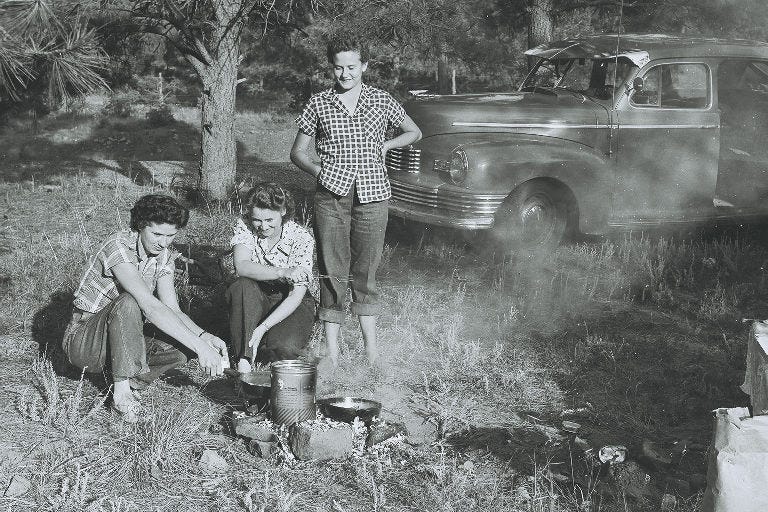
My mother on the far left, cooking over an open fire.

I cannot find my mother’s frying pan. The one she gave me before she moved into the nursing home, before she died, and after she stopped cooking for herself.

Her hands were rough, large and knotted with arthritis. They shook as she held out the frying pan. “You want this?” she asked as she picked up the heavy skillet from the inside of the oven where she stored her pots and pans. I took it because it was one of the few things in her apartment that didn’t smell like pine cleaner.

Other people hold on to things. They remember birthdays and anniversaries, and know exactly who inherited their grandmother’s silver. I misplace my scissors and the remote to the television but you would think something large and useful like a frying pan wouldn’t just float off out of sight.

My parents started their married life as farmworkers. My father drove a combine, and my mother cooked for the field hands in the 1930’s. She didn’t speak of it much. I am left to picture her aproned and bending to tend to a wood fired stove and stooping to wipe the sweat from her forehead with the back of her hand. After the farm job she cooked for her husband and children and then just for herself and me, the last in the line of seven offspring.

Her cast iron skillet had a surface polished mirror smooth and jet black from years of fried potatoes, scrambled eggs, pork chops, and scratch made pancakes with golden brown circles dotted with pale spots where the butter melted. I was in high school when my parents divorced and our meals changed to things barely recognizable as food.

My mom, with her eighth grade education, found work as a housekeeper. She spent long days cleaning and cooking for other people, so at home we had frozen pizzas, chili and soup from a can. Evenings we settled in front of the television and suffered through boil-in-bag meals, little plastic packets pulled from the freezer and dunked into boiling water to cook. We dumped the contents out and spooned up Chicken a la King or Salisbury steak over instant potatoes. The boil-in-bag meals had an unpleasant aftertaste, like you had licked a plastic bucket and decided to melt it and serve it for dinner.

Married with two children, I had a frying pan when my mother gave me hers. My cast iron skillet was new and not well seasoned, the surface still pitted with small imperfections.

I didn’t notice when my mother stopped eating. She didn’t trust food prepared by others. She quit attending holiday meals, refusing even the plates brought to her by family. She liked hamburgers from Wendy’s so I often picked up a burger and fries to drop off on my way home. I have worked in fast food restaurants, but I never mentioned that her meal had most likely been prepared by someone with tattoos and a nose ring.

The microwave confused her, and she never learned how to use the one in her apartment. On our weekly trips to the grocery store she bought whatever frozen meal she could cook in her toaster oven. I carried her groceries in and stood in the entryway while she took off her shoes. One by one she ferried the items to the kitchen counter where she washed each box and bottle in harsh cleaner before putting them away.

My mother’s mental illness went untreated for most of her life. The obsessive compulsive disorder that locked her into rituals of cleaning didn’t appear until most of my brothers and sisters had grown up and left her house. I guess it might have been worse for me, growing up in a home with easy to mop vinyl floors in every room. At least she wasn’t a hoarder. I had to strip my clothes off and toss them into the washer before I walked through the living room but I didn’t have to wonder if there was a dead cat hidden under the couch.

She lived alone, in an apartment complex for senior citizens. They had a concierge to carry off the trash, so I didn’t notice the empty peanut butter jars that stuffed the bags of garbage while unused dinners filled the freezer. She began phoning 911, certain she was having a heart attack. I made the twenty minute drive from my house, arriving in time to find her sitting up and flirting with the young, attractive emergency medical technicians. When I mentioned the dizziness and confusion to her doctor, he suggested that it might be caused by malnutrition.

My mother’s frying pan stayed stashed in the cupboard. I don’t remember packing it up when I moved out of our house after my divorce, but I must have. There’s a vague memory of giving it to one of my grown children, but when I asked they both could not remember anything about it.

“I have a skillet, but it’s not that old,” said one.

“I think I got mine at Goodwill,” the other replied to my text.

To properly season a new cast iron skillet you must first scrub it with hot, soapy water to remove the grime from manufacturing. You dry the pan, rub the surface with oil and bake it for one hour at 375 degrees. I wish I remembered what I did with my mother’s frying pan. If I made a gift of it, I wish I had given it with the ceremony and pomp it deserved. Perhaps then one of us would recollect where they’d last seen it. A seasoned cast iron skillet will last a lifetime, and heat and use will wear the surface smooth and brilliant and precious.