All the Beautiful Girls

A short story

Photo by the author

The story I’m sharing tonight is one I submitted to an NYC Midnight Contest. I don’t remember the prompts or the word count length. I revised it and then submitted it to a contest on the Vocal website. It didn’t win anything there either.

I removed it from the Vocal website when I cancelled my membership there and held onto the piece, thinking I’d include it in another book of short stories one day. Since then I’ve started working on a novel and the short stories have been put on hold.

Writing a novel is a long slog compared to churning out short fiction. The reward, I think, comes when you finally finish the thing and can put “THE END” to the last page. Completing a short story, the reward comes much faster. I did, however, received a boost in motivation last month when I entered the Novel Beginnings contest held by the ProWritingAid software app. My first 5,000 words was selected for the long list of 183 writers out of over 14,000 entries. I didn’t make the next round, the short list, but I’ll rest on that first win as it has inspired me to keep going and keep writing until I reach that last page of my novel. For now, I hope you enjoy this short story, but be warned – it’s horror and a bit dark.

All the Beautiful Girls

The first girl disappeared on a cold fall evening. Wet, gray leaves cloaked the ground, robbed of their color by the low-lying fog. Claire Avery knew the missing woman, not by sight, but by reputation. The sort of blonde, fizzy girl whose smiling photo had graced the pages of her high school yearbook. Claire would never be that girl. Her jaw was too sharp, her teeth too crooked, her nose too large—no one ever sought her out. The university put up notices, warnings to the students—do not walk alone at night, do not let anyone follow you into the dorms.

The school, a small midwestern college, had only recently begun admitting male students. After the second missing girl, those few young men scurried across campus with downcast eyes, as though the fact of their gender showed their guilt.

Claire’s roommate, a timid student majoring in music history, fled from the school and returned to her hometown. She left behind a wooden cross nailed to the wall. Left to herself, Claire filled the room with empty food containers, discarded notebook papers, and stacks of textbooks. She pushed her dirty laundry under the empty bed, where it filled the space with the stink of acetone and alcohol from her chemistry labs.

The morning after the second disappearance, Claire was showering in the communal bathroom when she heard one of the resident advisors call out, “Man on the floor!” Claire snatched her robe and towel and twisted the handle to cut off the water. The pipes clanged a protest as she hurried into the hall.

One of the maintenance workers, a tall man with long arms that reached almost to his knees, passed by her. Jerry. He had helped Claire carry supplies to and from the chemistry lab. They’d chatted about movies and a mutual interest in old black and white films. More conversation than she had ever had with her fellow students. He strolled past, his flat gray eyes focused down the hall, not seeing her. He held a heavy wrench in one fist. The tool bag around his waist clinked with each step.

A week passed with no sign of the missing women. Were they resting in some weed-filled field, discarded like litter? Campus security tacked up flyers with photos of the girls. At first glance, they appeared to be the same person, so alike they could be twins. People left flowers, candles, toys under each poster—offerings at an altar. More gifts than Claire had ever been given. She stole a tiny purple unicorn from the pile. The dead did not need presents.

November blew in with frost and the hint of snow. While most of her dorm mates left for home and Thanksgiving food, Claire opted to stay at the university. She and a graduate student, a woman whose eyes were always red and swollen with allergies, would be the only people in the dorm. The grad student warned her, “They’re going to do some plumbing repairs this week. We’ll have to shut off the water.”

“No problem,” Claire assured her. Lately, she hadn’t the energy to bathe. Her hair hung in greasy strands. She dressed in layers to hide the stink of her unwashed body.

Monday of Thanksgiving week, Claire woke to a rhythmic, pounding thud. It came from the basement, as though the building had gained a heartbeat. The door to the cellar stairs, usually locked and bolted, stood open. She clung to the rail and made her way down the steps.

Dust, carried on the moist heat from the boilers, wafted up to greet her. The flickering fluorescent light revealed a shirtless man in the center of the basement floor. Sweat streaked his back. He raised a massive sledge hammer and slammed it down on the concrete. The blow echoed in the space. Claire felt it travel up the soles of her feet, shuddering across her legs and thighs. 

As though he felt her watching, the man turned. Safety glasses covered his eyes, making his face resemble some alien creature. It was Jerry. Claire lifted her hand, about to wave. “What are you doing here? Get out!” He waved a gloved hand, shooing her away.

“I’m sorry.” Claire backed away, stung that he hadn’t recognized her. She swiped at her eyes and rushed back up the stairs to her room.  

“Slab leak,” the grad student explained later. “He’ll fix it, then pour new cement. Water should be off about an hour tonight.”

That night, Claire wandered the dim hallway. Barefoot, she descended the stairs to the basement and shone a flashlight across the broken floor. Dirt and broken concrete lay piled in one corner. A hole in the center revealed a crisscross of copper pipes. The gap in the earth below them was as deep as a grave.

Back in her room, Claire watched from the window as Jerry hauled bundles wrapped in black plastic across the lawn and through the side entrance. She imagined him bent under the burden as he descended the basement stairs. Bags of concrete, or something else?

Hours later, when Claire figured the job was done, she went downstairs. He’d left the basement door padlocked, but when Claire tugged at the rusty lock, it sprang open. She lit her way into the basement with the light from her phone, then clicked on the dim fluorescent fixtures.

The overhead lights revealed the slick wet surface of new concrete, a sheen of water shining on top. Claire knelt next to the dark gray square. She breathed in the sweet, musty odor of the cement. Another smell lurked underneath, rotten and foul. Leaning forward, Claire pressed her hand into the soft mass. She put her weight full on her palm, leaving a deep imprint on the cement.

A shadow fell across the stairway. Claire’s breath caught in her throat. Steps thumped across the wood. She scrambled back until the cold cinderblock wall pressed against her. The shadow crept forward until finally, he stood revealed. Jerry. He must have seen the glow from the basement lights. A glint of silver flashed at his side. A knife.

Claire held out her arms, smiling against her fear as he lifted the blade. Did he see her at last? She hoped it would be quick, she hoped they would put her picture beside theirs—all the beautiful girls.

THE END

The Cry at Cliff’s Edge

A short story

Photo by Terrye Turpin

Some of my first short stories were ones I wrote for the Medium website. One of the publications there was called The Weekly Knob. The editors posted a writing prompt, usually an object, that had to be included in the story. You had a week to come up with something. There was no word limit or specific genre, so this was perfect inspiration for me. In 2020 I compiled many of those stories into a book and published it on Amazon.

I continued writing short stories and submitting them to different publications on Medium. The Weekly Knob changed their name to Hinged. Sometime in 2022 I stopped writing unique stories for Medium and I just reposted from my website over there.

My most prolific writing years were the ones I spent writing for The Weekly Knob. I loved getting the prompts every week and I interacted with so many lovely writers who were also posting on Medium. The practice and encouragement I got on Medium helped me to become the writer I am today.

Change comes to us all. Websites come and go, publications fold and so do publishers. I will be sharing here some of the stories I posted on Medium, just to make sure they have a permanent home. I had thought about gathering them for a another book of short stories, but I tell myself I have enough work to do just finishing the novel I’m working on. And the overall goal is to share the tales, so here’s the first one, originally published in August, 2021. I think the prompt was “hinge.”

(If you are one of the people who read this story back when it was first published, I apologize, but perhaps you’ll enjoy it a second time.)

The Cry at Cliff’s Edge

On the first anniversary of her daughter’s death, Ginny Stroud drove to the sea. In her late thirties, Ginny had dark brown hair that she kept clipped close to her scalp, like a young boy’s. A thick scar, twisted and rose-pink, traced from her scalp down the side of her face. Another scar, hidden beneath her jeans, traveled from her hip to just above her knee. Beside her, on the passenger seat of the car, lay a stack of paperback books, her leather purse, and a silver handled cane.

Her little red car, so nimble and reliable when navigating crowded parking lots and slick city streets, chugged up the winding road that led to the Inn at Cliff’s Edge. She had found the hotel on a blog devoted to quiet, less-traveled vacation spots. The place didn’t even have a website. Ginny looked forward to the isolation of being surrounded by people who did not know the tragedy that had shattered her family the year before.

The road, a narrow, one lane asphalt drive, appeared chiseled from the cliff face. A low guardrail stood between her car and the drop to the white-capped grey ocean below. With one hand on the gearshift, Ginny pressed as close as she dared to the towering rock on the passenger side of the car. A large white bird swooped across the road at a curve, and Ginny, distracted, allowed the car to drift onto the loose gravel at the edge.

“Oh!” The involuntary cry escaped her as she steered back into her lane. Her heart drummed in her ears and she shook her head at the near accident. Would it have been so bad after all, if she’d broken through the guardrail and plunged into the cold water below?

At the hotel, she tossed her clothes into the antique dresser in her room and kicked off her shoes. Her room, on the second story of the inn, faced the ocean. Opening the French doors that led outside to the iron railed balcony, Ginny leaned out to breathe in the cold, salt scented air. Below, an overgrown trail led to a wooden gate with peeling paint and rusted hardware. Vines twirled through the arch at the top of the gate, and scrubby pine trees obscured the view, but Ginny supposed the path must continue on the other side.

Tired from the drive, she stretched out on top of the quilt covering the bed. She thought to text her sister to tell her she’d arrived safe and sound, but a check of her phone revealed no service. She would use the hotel phone and call that evening, after dinner.

Hours later, she woke to odd shadows cast by moonlight filtering in through the open balcony doors. Disoriented, she sat up, dizzy with the shock of waking up in unfamiliar surroundings. Memory filled in her day — the long drive from her home to the coast, checking into the hotel, and at last — collapsing on the bed. Ginny had swung her feet off the side of the bed when she heard the cry.

It sounded like an animal cry, but the noise fluttered up the scale, then dropped to an unmistakable human sob. Ginny sprung from the bed, wincing at the sharp pain in her hip. She fumbled with the cane propped beside the bed and, grasping it in one hand, limped barefoot to the French doors.

“Hello?” Ginny leaned over the balcony’s rail, peering into the night below. A scant yellow light illuminated the shrubs at the hotel’s foundation, but did little to light the pathway to the gate. The cry echoed again, fading as though the owner were striding away, down the trail on the other side of the gate. It could be a child, Ginny thought, lost out there in the dark. She reached for the inn’s phone beside her bed, then changed her mind and slipped on her shoes.

“Are you sure?” At the hotel’s desk, Ginny questioned the clerk. “It sounded like a child.”

The night clerk, an older woman with gray streaked black hair, shook her head. Deep lines bracketed the woman’s mouth. “There are no children with our guests. You probably heard the hinge on the gate. It’s old and when the wind blows…”

“I suppose that could have been it,” Ginny allowed. Her stomach rumbled, reminding her she hadn’t eaten since breakfast that morning. “I don’t suppose the kitchen is still open?”

“No.” The clerk shook her head. “But I could open the pantry, make you a sandwich if you’re not too particular.”

“A cold sandwich sounds wonderful.” Ginny read the woman’s name from the white plastic badge pinned to her shirt. “Thank you, Marie. I’m in room 215.”

The clerk smiled, the expression softening her face. “You go on back upstairs and I’ll have someone bring it up.”

Back in her room, Ginny phoned her sister. “I’m here. Safe and sound.”

“That’s good, at least. I still don’t think it’s a good idea for you to be alone right now. Have you talked to Dennis?”

Ginny shook her head as she answered. “No.” She’d read somewhere that many marriages didn’t survive the death of a child. Her husband, Dennis, had moved out two months ago. She didn’t expect they would reconcile. She didn’t have the energy to even try.

“Please tell me you won’t hole up in that place alone all weekend. I don’t like to think of you all by yourself tomorrow. Go outside. Is it pretty there at least?”

“It’s lovely, Stef.” Ginny described the inn — the ivy-covered stone walls, the lofty view of the ocean below. She didn’t mention the old wooden gate. “There’s a farmer’s market tomorrow in the town. I saw the sign when I passed through this afternoon. I’ll drive down and check it out.”

“That sounds like a good plan.” Her sister paused. The sound of her breathing filled the phone receiver. “No one ever blamed you, Ginny.”

True, no one had ever assigned fault to her, at least not where she could hear them. Maybe Dennis had doubts, in the nights he had paced sleepless through their home, over whether Ginny could have done anything differently that day. The burden of the accident lay like a slab of stone on Ginny’s heart.

Ginny clutched the phone so tightly her knuckles grew white. She was about to answer her sister when a knock sounded. Her sandwich. “I’ve got to go, my dinner’s here.”

“All right. Remember — we love you.”

“Love you too,” Ginny whispered into the silent phone.

She fetched a couple of dollars and some change from her purse for a tip for whoever had delivered her food. When she opened the door, Ginny spied a tray on the hallway floor, with her sandwich wrapped in paper and resting on a white napkin on its center. A noise at the end of the hall, near the stairs, drew her attention and she glanced that way in time to see a young boy grasp the handrail. He turned toward her before he started down the stairs. Ginny glimpsed dark brown eyes and a shock of black hair that fell across his brow before he fled down the stairs.

“Hey!” Ginny called after him. She waved the money grasped in her fist, but his steps echoed as he disappeared from view.

The next day, at the farmer’s market, Ginny studied the people weaving amongst the booths set up on the town square. The clerk, Marie, had said there were no children staying at the inn, so maybe the boy was local, lived in the town. He looked too young to be working at the inn, but maybe the rules were more relaxed there.

At one booth, Ginny bought a loaf of bread and a jar of local honey. The vendor’s daughter sat on a quilt on the ground playing with dolls. Tears blurred Ginny’s vision — the girl looked so much like Lottie. Sometimes she went weeks glimpsing no one who reminded her of the child she’d lost. And some days she couldn’t even venture out to the grocery store, afraid she might one day lose herself and chase after some stranger’s daughter.

Back at the inn, Ginny felt she needed a distraction. She explored the grounds. In particular, she wanted a closer look at the gate. Brushing aside sticks and tangled weeds with her cane, she ventured along the path. Exercise, her doctor had declared, would do her good.

The gate at close view looked more mundane than mysterious. It might have once been painted white, but now only patches of color remained on the grey wood. There was only one hinge, a large ornate piece of metal with curled emblems stamped on the surface. A shiny brass padlock hung from the hasp on the gate, unusual for its newness. Had someone unlocked the gate the night before? If the padlock had been in place, the wind couldn’t have swung the gate and made the noise that Ginny heard.

The screws holding the hinge in place felt loose when she pushed against them. She ran her fingers across the surface of the hinge and then wiped her hand across the hem of her shirt. Rust, red as blood, stained her clothes.

“You shouldn’t do that.”

Ginny spun to see the source of the warning. The dark-haired boy from the other night stood behind her on the path. As he strolled up to join her at the gate, Ginny saw he was older than she’d first thought, closer to thirteen than the nine years she’d assumed.

“This is not a good place,” the boy said.

“The inn?”

“No.” The boy waved a hand at the gate. “This. The path, the gate. It’s too close to the edge. You should walk on the other side.”

“But there’s no ocean view over there.”

The boy frowned, considering her. “All right, but don’t go past the gate. That’s why it’s locked, you know.” He stepped beside her and placed a hand on the gate, pushing. The hinge creaked, shifting against the wood, but the lock held. Satisfied, the boy stepped aside and turned to leave.

“Wait,” Ginny called after him. “Do you live here? What’s your name? I’m Ginny.”

Walking backward, the boy answered. “Anthony. I live with my grandmother. She works here.”

Something about the boy’s solemn face and dark hair reminded her of the night clerk, Marie. This must be her grandson.

“Marie?” When the boy nodded, Ginny asked, “Where is your mother?”

Anthony stopped and stared past her. “She’s gone,” he said, and then he spun and jogged away.

That evening, Ginny had an early dinner in the inn’s cozy dining room. The place filled with customers, even before sundown. She didn’t think the Inn at Cliff’s Edge had rooms for that many people. It must be the closest restaurant for many of the locals. The clatter of plates and the drone of conversation filled the air. Marie had smiled and waved at her as she walked past the desk to the dining room, and Ginny wondered if Anthony was around.

She lingered over coffee and a slice of apple pie after her meal. The sun dropped low and cast an orange glow on the horizon when she paid her check and limped outside. Her hip ached from too much activity that day, but she felt restless and she wasn’t ready to turn in for the night, wasn’t ready to be alone with her memories of this night the year before.

In the fading light, the gravel path seemed to glow and Ginny picked her way along, tapping at the ground with her cane to make sure she didn’t encounter any unexpected obstacles. When she reached the gate, she noticed the hinge had come loose from the screws holding it in place on the post beside the gate. The padlock still hung from the hasp, but without the hinge, the gate leaned open, revealing the white rocks of the path beyond. Ginny stepped through the opening.

Brush and vines crowded against her, but the trail itself was oddly clear and level, as though someone had swept away the sticks and larger rocks. Pine and salt spray scented the air, and Ginny heard the faint sound of waves breaking against the cliff face below. She couldn’t see the end of the path, and she wondered if it led down to the shore or if it broke off at the edge of the cliff. The further she walked, the darker it grew and just as she felt she should turn back, she heard the cry from the night before. This time it ended, not with a sob, but with a tiny voice calling, “Momma!”

Ginny shook her head to clear it. How many times over the past year had she spun at that cry? Knowing it couldn’t be her daughter, but unable to resist the call of a child.

“Hello?” Not Lottie, Ginny scolded herself, but some other child in need. “Where are you? I’m coming.” She pushed along the trail, toward the voice.

Turning a corner, the path emerged into a clearing. A small figure stood at the center of the space with her arms held out toward Ginny. A girl child. And if the girl’s face wavered, the bones shifting and reassembling, Ginny didn’t care.

“Lottie?”

The child motioned her closer. Behind her, the trail disappeared at a drop-off. Ginny hobbled forward. Tears blurred her vision, but she kept going, toward the girl, toward the end of the path.

“No!” Small hands clutched at Ginny’s back. She whirled around to see Anthony. He grabbed hold of her cane. “Come back. She’s not real!”

“I don’t care.” Ginny shook her head. But before she could turn back around, an angry growl sounded.

“Run!” Anthony pulled her along.

Ginny stumbled after him. She dared a glance over her shoulder at the thing pursuing them. It grew and shrank, warping from the blond daughter Ginny had lost to the stocky figure of an older man, then to a slim, black-haired woman. The thing’s skin melted and stretched, like putty over a frame of wire and bone. Its mouth dripped a thick, tar-like substance over shark-sharp teeth. The transformations slowed its progress to a shuffling crawl, but Ginny feared they wouldn’t reach the gate before the creature caught them.

“Go on!” She pushed Anthony away, and he ran up to the gate, prying it open further so Ginny could stagger through.

“Help me.” He pulled the gate closed and held it while Ginny fumbled with the screws on the hinge.

“They’re too loose!” The hinge wobbled. The drilled holes were too worn for the screws to hold.

“Just close it. As long as the hinge is on the gate it can’t get through.”

Ginny slammed the last screw into place. Something large and heavy brushed against the wood on the other side. It snuffled and scraped at the gate, but the portal held. At last, it fell silent.

“It looked like my daughter.” Ginny’s legs trembled, and she sank to the ground.

Anthony nodded. “It’s different for everyone.”

“Who do you see?”

“My mother.”

“What is it?”

Anthony shrugged. “I don’t know. It lives there, on the edge.”

There were so many questions Ginny wanted to ask. Why did the hinge keep it from coming through the gate? And why hadn’t anyone tried to get close to the portal? They could at least hide the gate and keep curious people from trying to go through.

But she didn’t ask any of these questions. Not because she felt Anthony couldn’t or wouldn’t answer, but because the answer came to her as they walked away from the gate.

The next day, as she packed her things into her car to leave the Inn at Cliff’s Edge, Anthony waved goodbye to her from the front porch of the inn. Ginny remembered the wistful look on his face the evening before, when she asked him who he saw when the creature appeared. She knew that feeling, that desire to glimpse a beloved face just one more time. The answer to why the gate still stood was the trade-off. She’d go to the edge again herself, if she could, to give life to an evil that fed from one’s grief, in order to pretend the lost walked the earth again.

THE END

The Auctioneer’s Song

A short story

Photo by the author

This is one I wrote for an NYC Midnight story and it’s different from my usual horror style. The original version didn’t advance in that contest. I had included an odd bit about Holly’s ex that didn’t fit with the story. I was trying too hard to include a dark moment and it didn’t fit. In revision I dropped the boyfriend and concentrated on the relationship between Holly and her father. Sometimes less works best. I hope you enjoy it.

The Auctioneer’s Song

They made good time getting to the auction house, despite Holly not driving fast enough to suit her dad, Loyd. Mindful of the cargo in the trailer behind them, she had putted along in the slow lane, taking her time braking and turning.

“Sales gonna start before we pull into the lot,” Loyd muttered. One side of his mouth drooped in a scowl—a remnant from the stroke he’d suffered six months ago. His right hand curled inward, the fingers gnarled and twisted like branches on a mesquite tree.

“Won’t do us any good to be early if we don’t have a live, uninjured animal.” Holly pulled up to the auction barn and left Loyd to supervise the unloading while she carried the paperwork to the office. They had sold off the cows last summer, but kept the bull for the stud fees. Now, the sale of Midnight Max, their Grand Champion Black Angus, would mark the end of their cattle days.

After dropping off their papers, Holly wandered through the sale barn. The scent of hay and manure, the noise of slamming gates, lowing cattle, and whinnying horses—brought back memories. As a young girl, she’d march beside her dad, inspecting the animals for sale, and occasionally voicing her childish opinion. Loyd had always listened, as though her eight or ten years of experience back then matched his.

Outside, her father chatted with a group of men standing under an oak tree. Their faces were all similar—tan, weathered, and wrinkled. Dressed in the same uniform of starched Wranglers and denim shirts, half the group wore baseball caps with feed store logos. The other half, including her dad, sported wide-brimmed Western hats. Loyd stood in the middle of the group, his good hand gripping the hickory staff he carried as a cane. He kept his damaged hand tucked in the pocket of his jeans.

As she joined them, Jim Cole, the auctioneer, reached to shake her hand, then dropped his when he spotted the metal hook at the end of her sleeve. Instead, he touched the brim of his Stetson and dipped his head to her. “Glad to see you here. It’s been a hot minute, hasn’t it?”

“It has,” Holly agreed. Jim had been running the auction for as long as Holly’s memory allowed. “I know you’ll get us a good price on our bull.”

She recognized their neighbors, Grady Burton and his wife, Sue. Stepping forward to hug Holly, Sue said, “Thank you for your service. It’s good to have you home again. I know Loyd appreciates having you around to help.”

Beside her, Loyd cleared his throat. “I might be old, but I can still haul my own water. As for my girl, I hope she’s seen enough of the world to realize this is the best place for her.”

This was a discussion Holly had put off. Injured in active duty, her disability payment had been automatically approved by the VA, so money didn’t have to figure in her decision. If she stayed with the ranch, she’d have to find something to keep her busy enough she and Loyd wouldn’t knock heads like a couple of angry bulls. Or, with the right type of prosthesis, she could continue her military service.

Jim Cole spoke up, saving Holly from answering. “I’d better get going. Auction can’t start without me.”

On their way inside, Holly and Loyd passed a large open corral holding dozens of horses. They milled about, snorting and switching their tails. Several of them, including mares with their colts, lay on the ground, unable to dodge the trampling hooves. Three men had cornered a bay gelding against the near rail of the corral. He reared and kicked as a red-faced, blond cowboy cursed and shook a rope halter.

“Hey!” Holly gripped the gate.

The bay lowered his head, bony sides heaving. Holly could count his ribs, and his hip bones stood out. Foamy white sweat covered his coat.

“Lady, you don’t want this one.” The blond cowboy tossed the halter on the ground. “He’s got a mean streak. Probably be sent to slaughter.”

Loyd touched her shoulder. “Whoever owned him didn’t treat him right. He’s got spur marks and tack sores. Starved, too.”

“Those horses will go to the slaughterhouse, won’t they?”

“Can’t save them all, sweetheart.”

The sound of the auctioneer greeting buyers reached them, and reluctantly Holly followed her father to the sale arena. They found seats in the gallery as the ring handlers herded in the first lot, six Hereford cows. The animals circled, lowing. Jim Cole began his call, the words a ringing cadence flowing smoothly as a hymn. When she was a child, Holly had tried to decipher the words in between the bids. “They don’t matter,” Loyd would say, “Listen for the dollars. Everything else is flavor for the flow.”

She learned to pick out the phrases that repeated between the numbers. “I have, would you give me, I am here.” The lyrics to the auctioneer’s song, the siren call that would help determine the animal’s worth.

Midnight Max sold before noon. “I’m sorry to see him go,” Holly said. “I hope…” Her voice trailed off. She knew better than to get attached to the cattle.

“Don’t fret. He’s got good years left.”

Holly expected Loyd to rise, but he waved a hand. “We’ll pick up the check later. Let’s stay and watch the rest.”

Toward the sale’s end, the handlers brought out the bay gelding. The horse limped, its head down.

“I can’t watch, Dad.”

“Hold up. We can’t save them all, but we could save this one.”

Around them, the bidding continued. Holly leaned to whisper to her father. “I suppose if we bought this horse I’d have to stay and help with him?”

“Damn shame if you didn’t.”

At the next call of would you give me? Holly raised her hand to cast the winning bid.

“I am here,” she answered.

THE END

Someday All This Will be Yours

An inheritance of creepy things

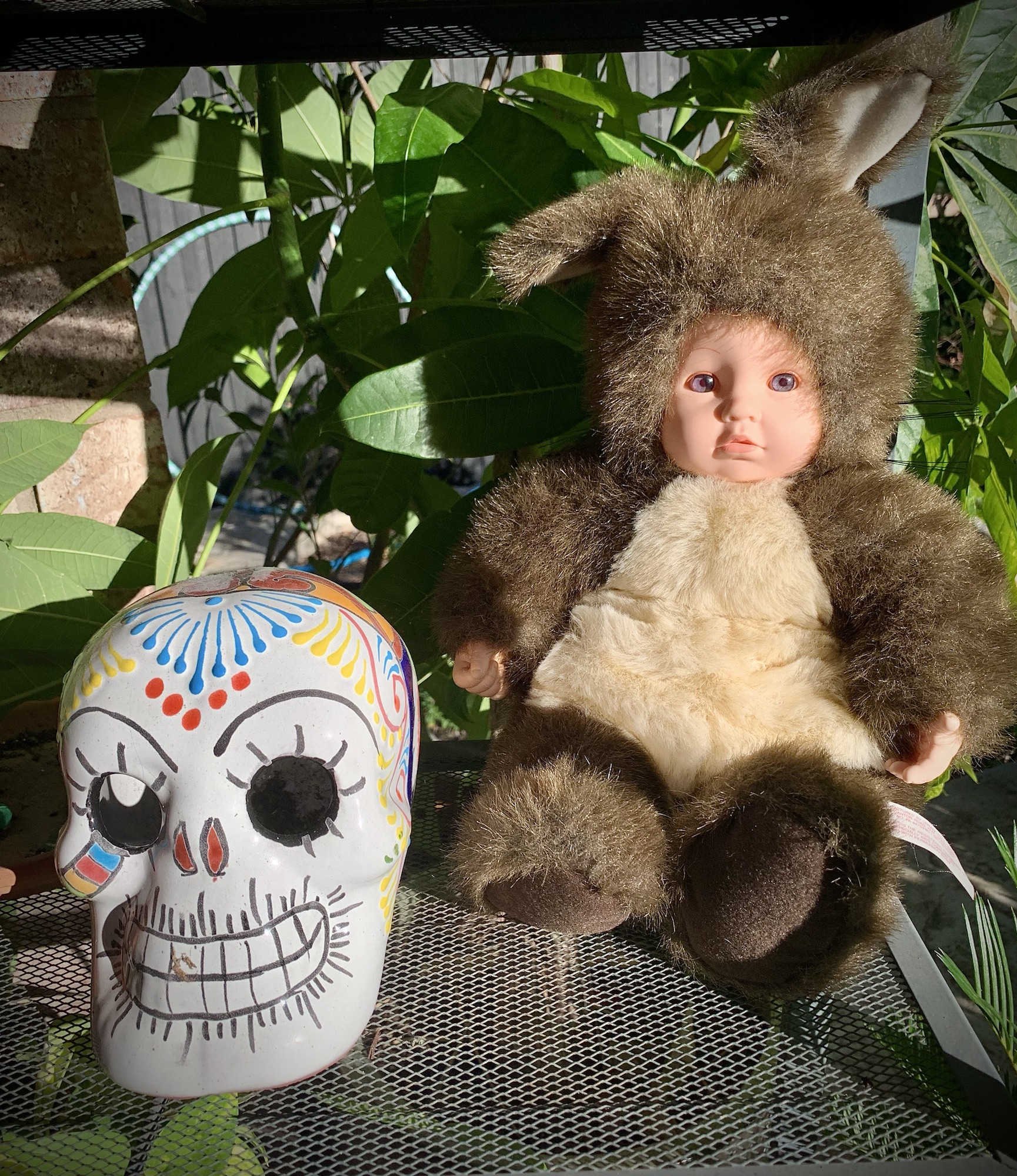
Photo by the author – (Squirrel baby does reside in our home)

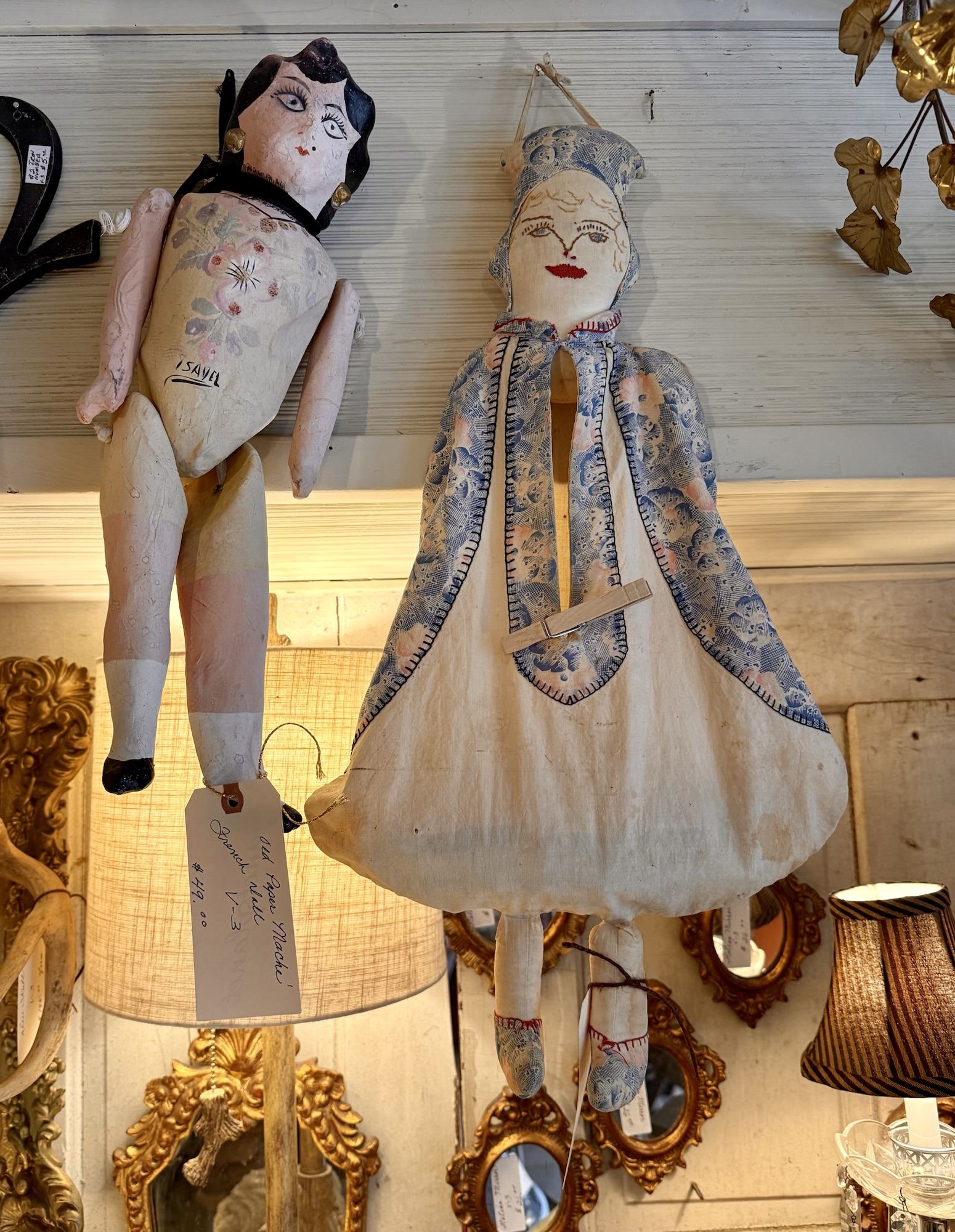
I’ve been listening to the audiobook for Grady Hendrix’s novel How to Sell a Haunted House. I have a signed copy of this book somewhere on my bookcase, but I hadn’t gotten around to reading the physical copy. In order to reduce my To Be Read list, I’ve resorted to audiobooks.

The story is about a brother and sister – Louise and Mark – who have to clear out their parent’s home after their death. “Gee Terrye, that sounds like a depressing read.” Yes, it could be, but the parents were sort of hoarders and the mom left behind a huge collection of dolls and puppets. And the puppets and dolls are haunted.

Somehow Louise and Mark must reconcile their past and clear out the house in order to sell it.

Reading the story I can’t help but picture the hundreds of books and movies my husband and I have accumulated. Add in the puzzles, board games, closets full of clothing, and two china cabinets full of pottery and it will make for a hell of an estate sale when we kick off. I also have dolls, but none of them are haunted. Yet.

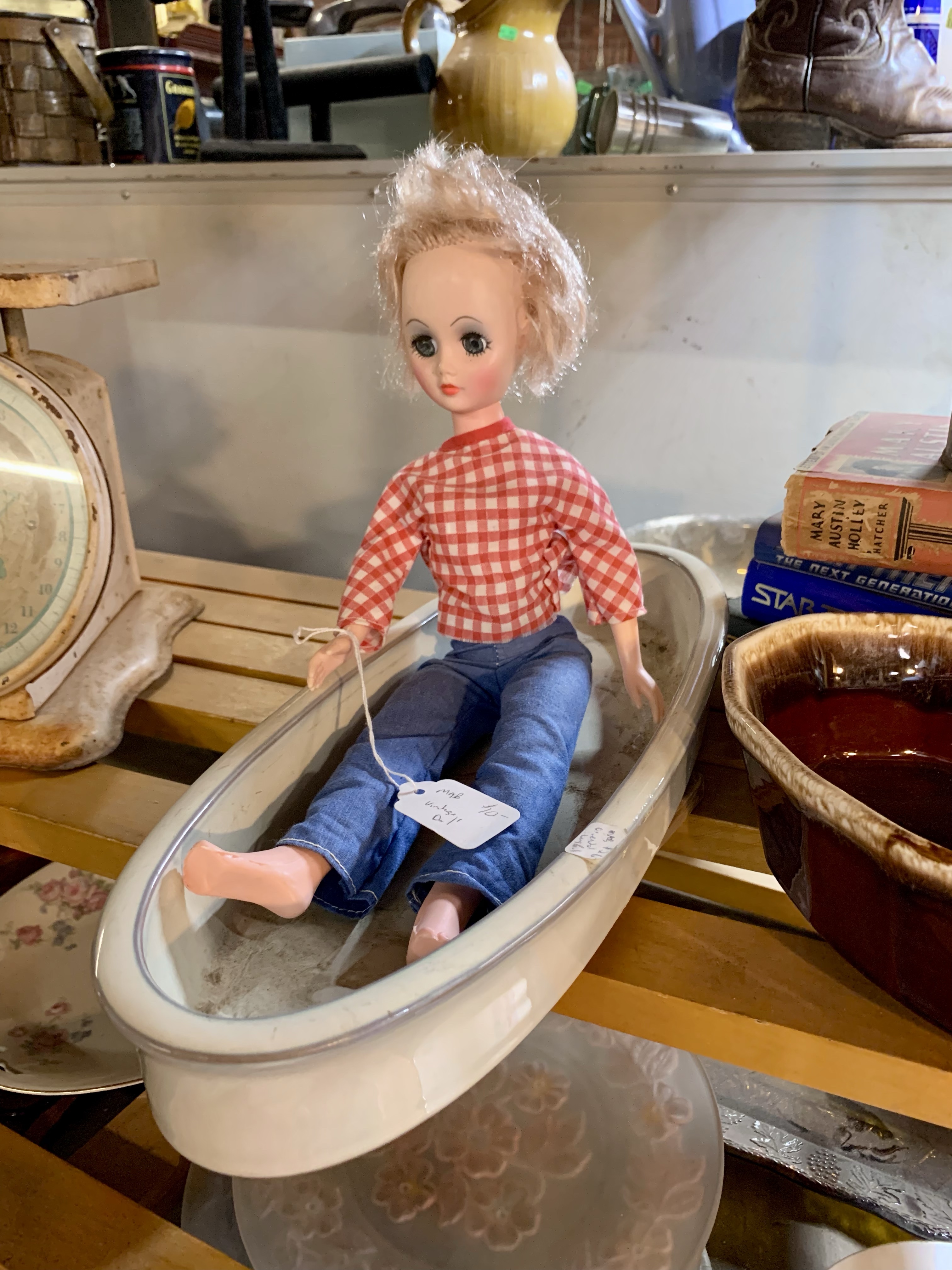
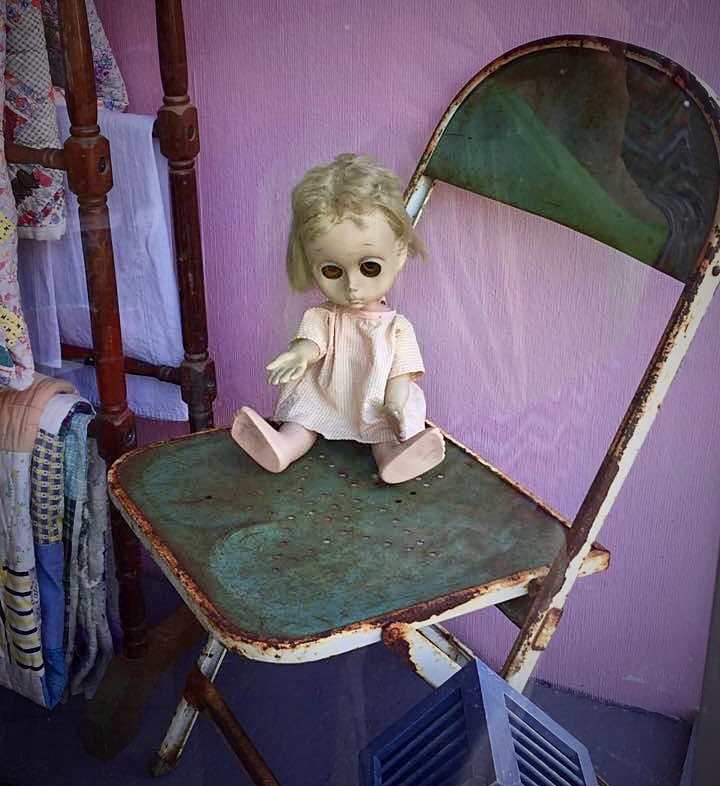
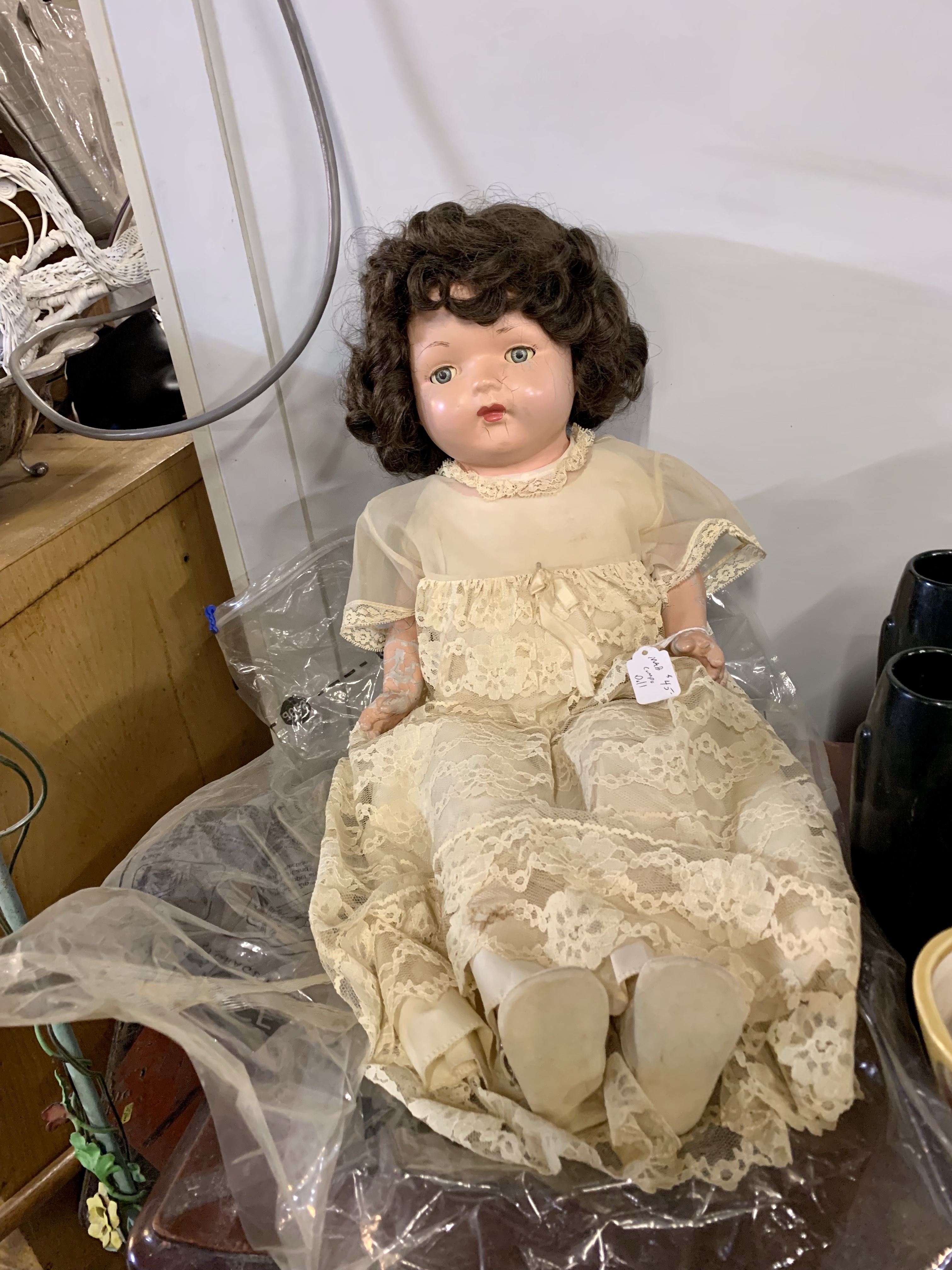
Photo by the author

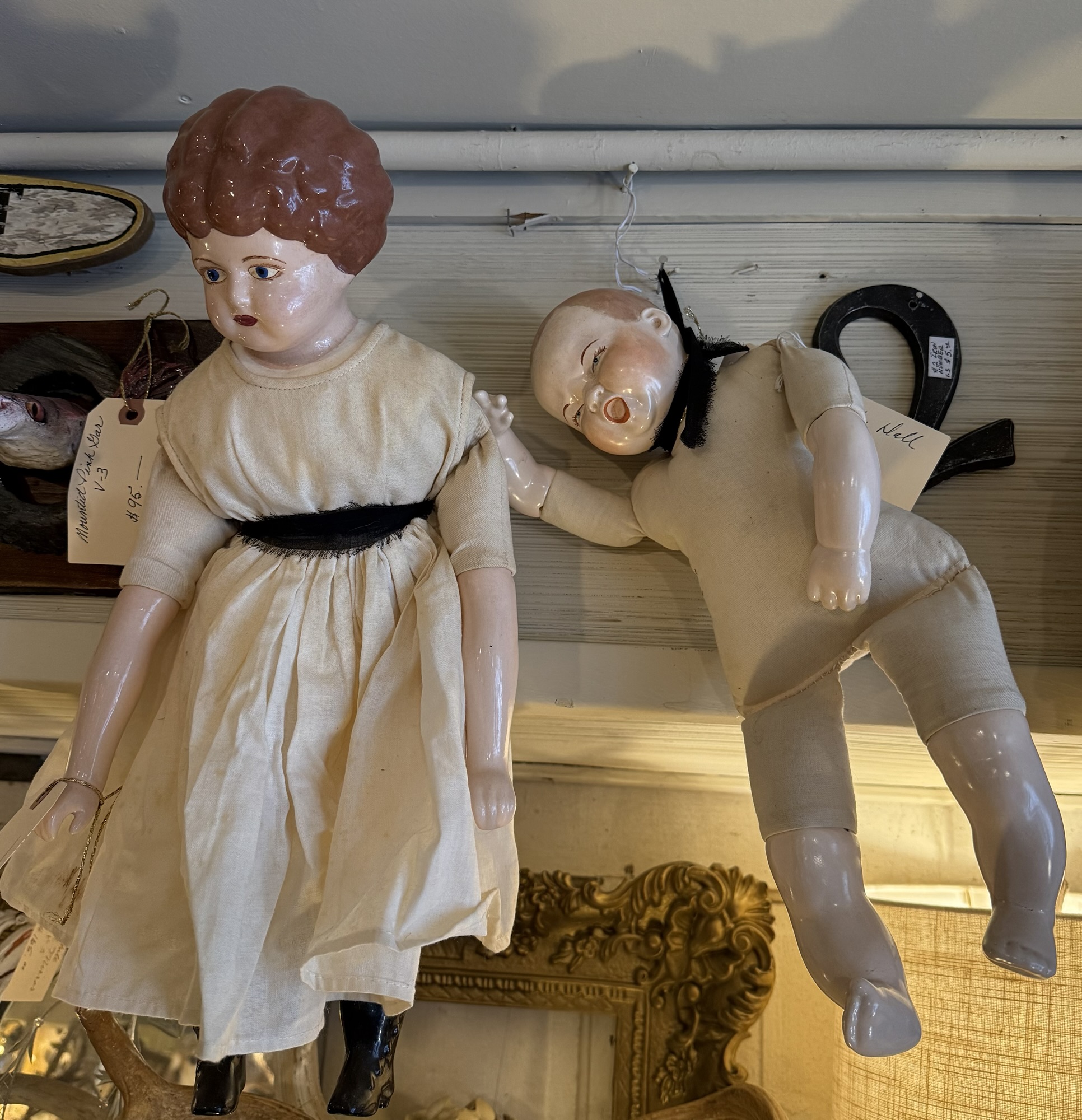
I don’t own the doll above, or any of these pictured below, although there are a couple that I do regret not buying. Can you guess which ones?

I do love encountering these creepy dolls in the stores we visit. Taking their picture is almost as satisfying as buying them and bringing them home.

Photo by the author

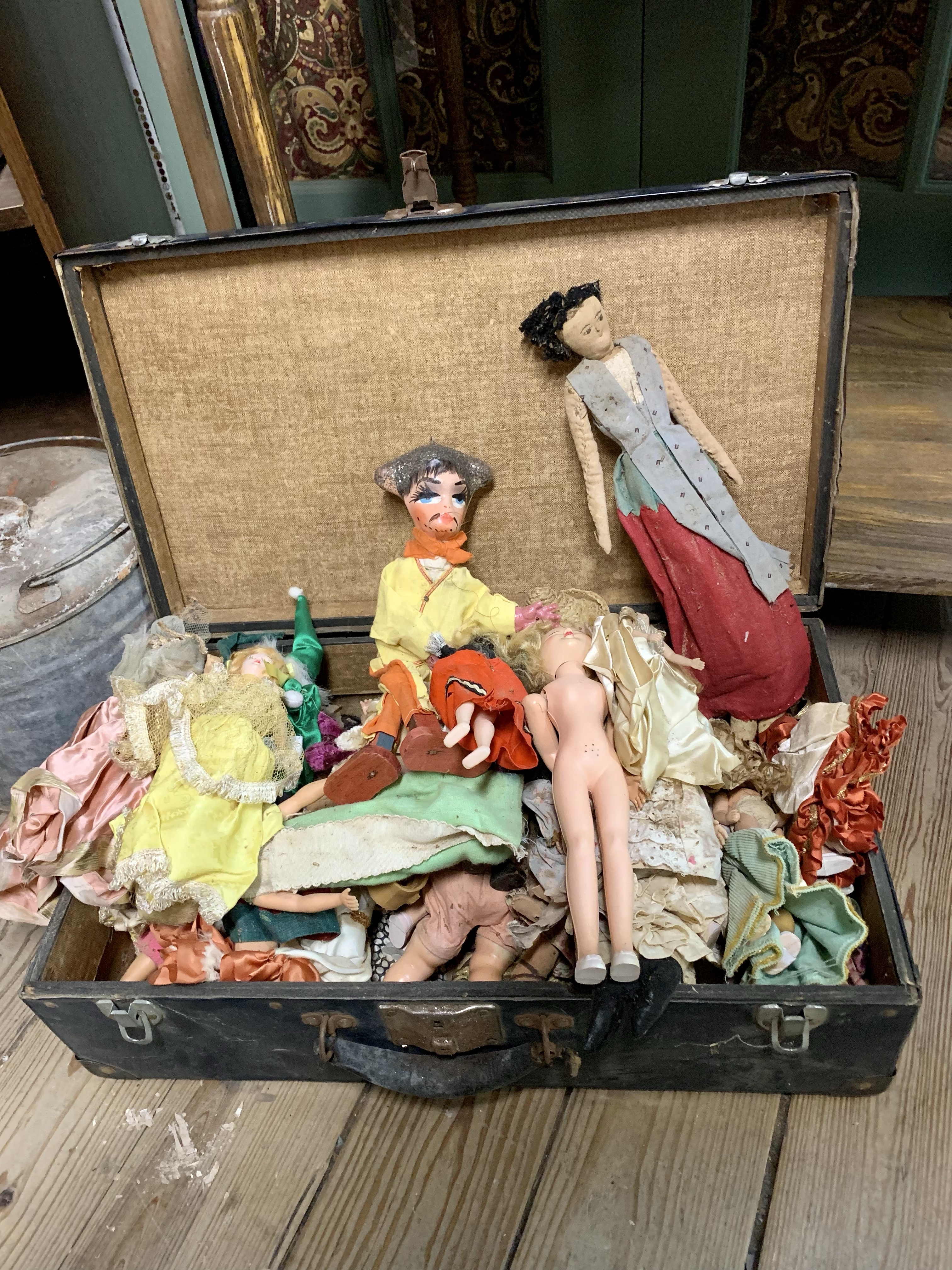
Not just one potentially possessed toy, but a whole suitcase. Who could resist? Me, that’s who.

Photo by the author

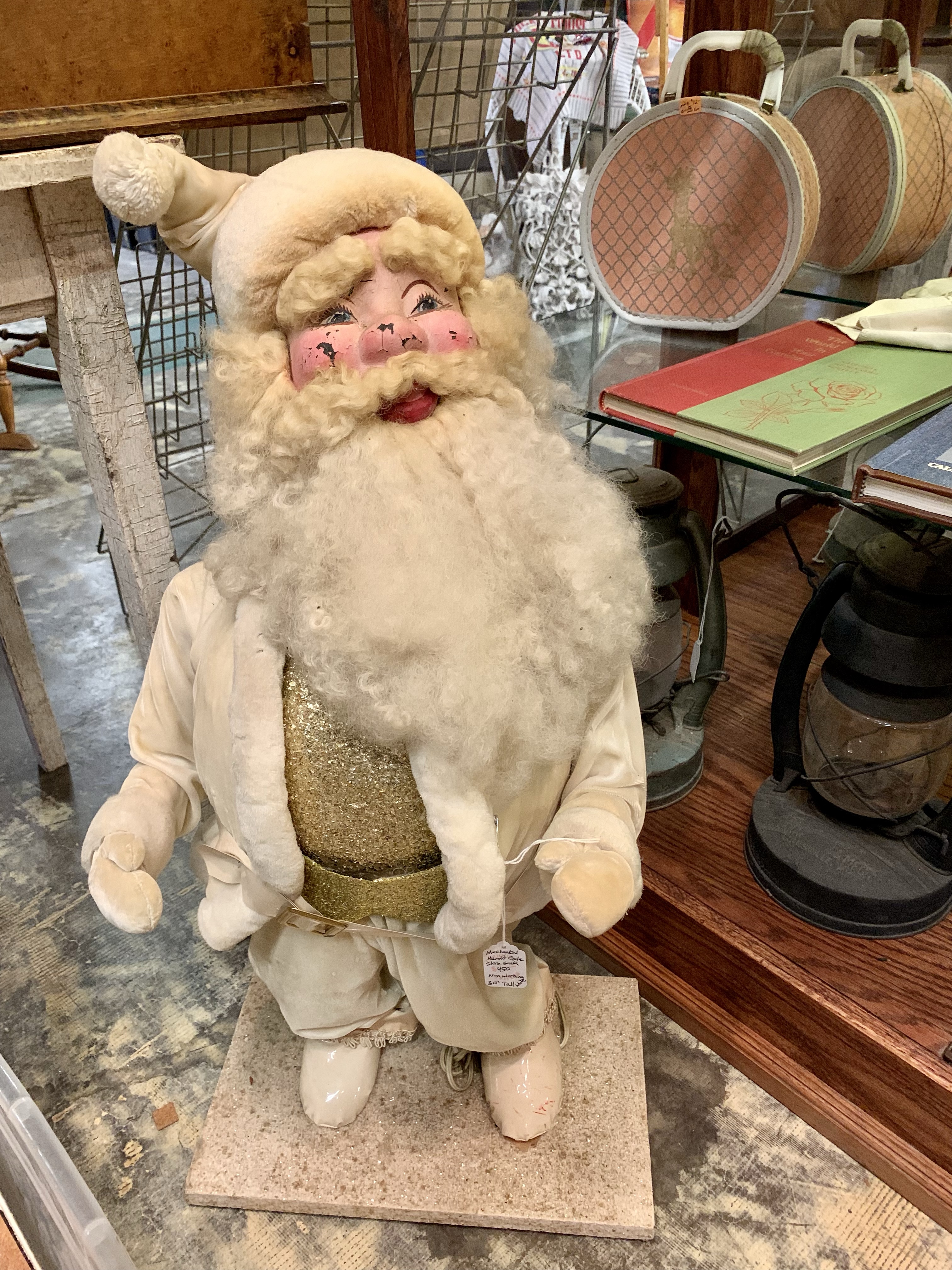
Even Saint Nick has an evil side. Maybe he just needs some love, or someone to murder. Don’t leave out cookies for this guy.

Photo by the author

This fellow looks like he’s climbing over that pile so he can jump right in your arms. He also looks like he’s been to one to many raves.

Photo by the author

No. Just no. I can’t even look at this photo for longer than a minute.

Photo by the author

Here’s a story waiting to be written – revenge of the abandoned bride (doll).

Photo by the author

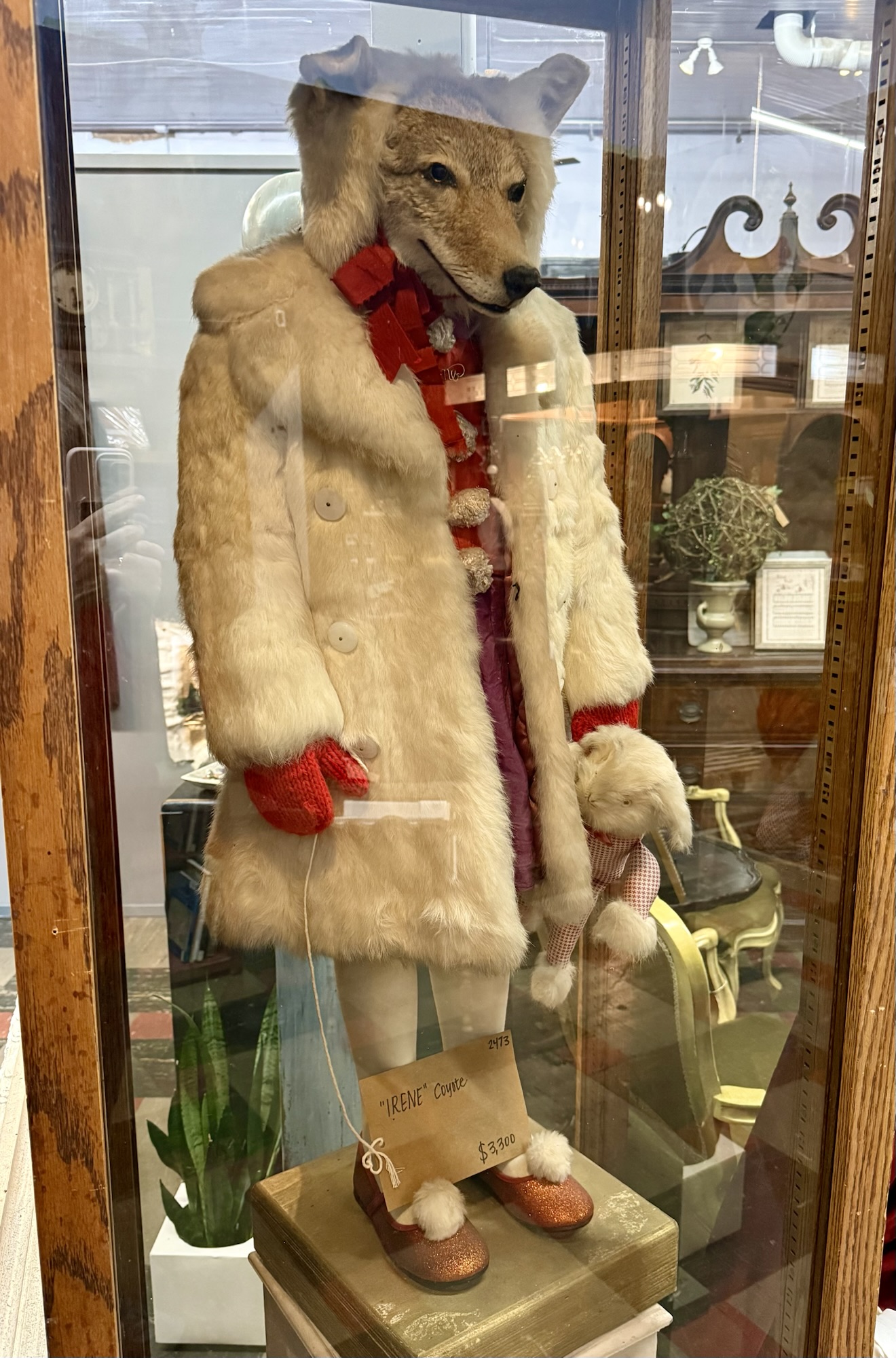
Not a doll but pretty cool. Goodnight Irene.

Photo by the author

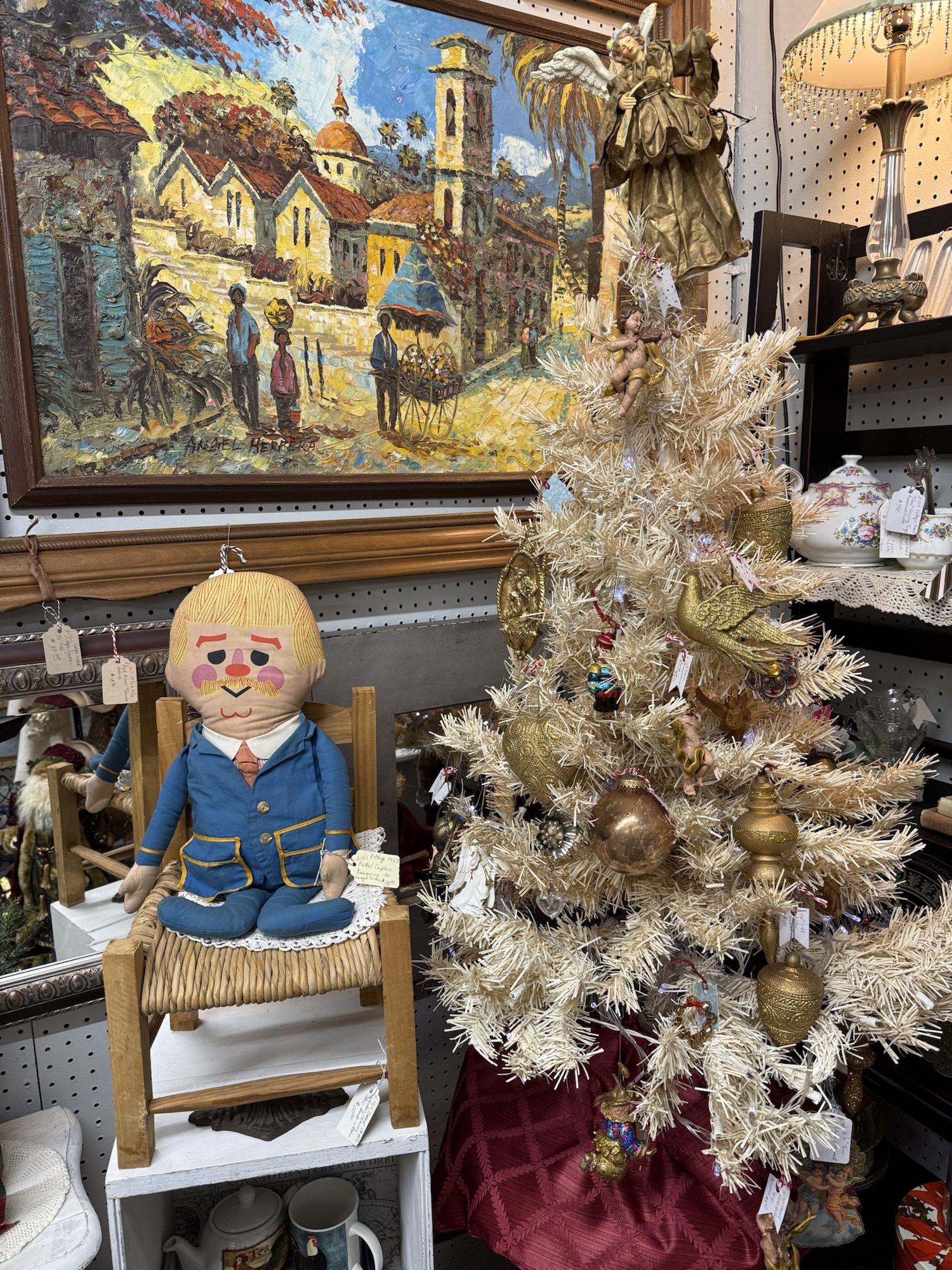
It’s difficult but not impossible to be frightened by Captain Kangaroo.

Photo by the author

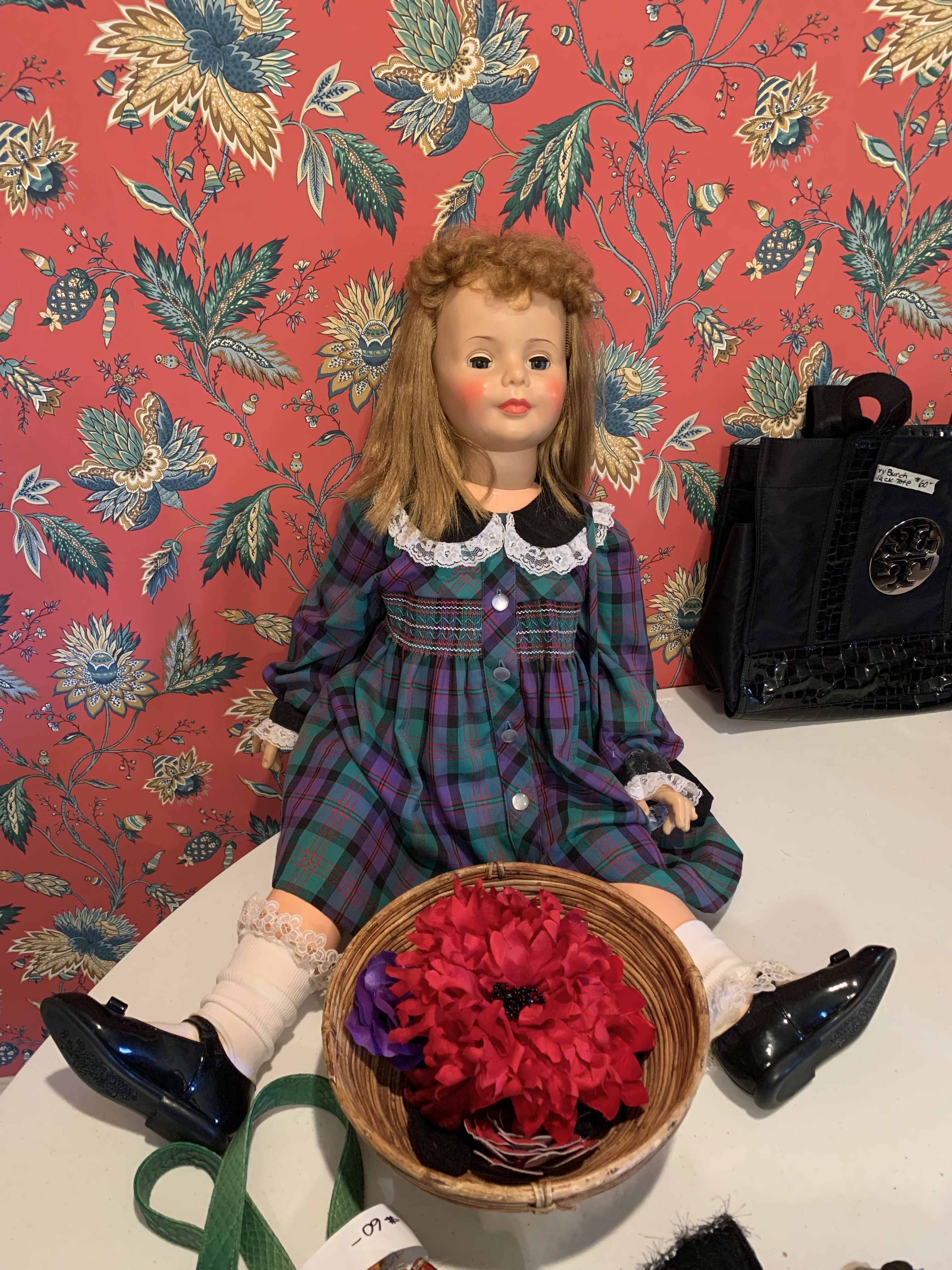
This one is life-sized. Bwa ha ha ha ha.

Photo by the author

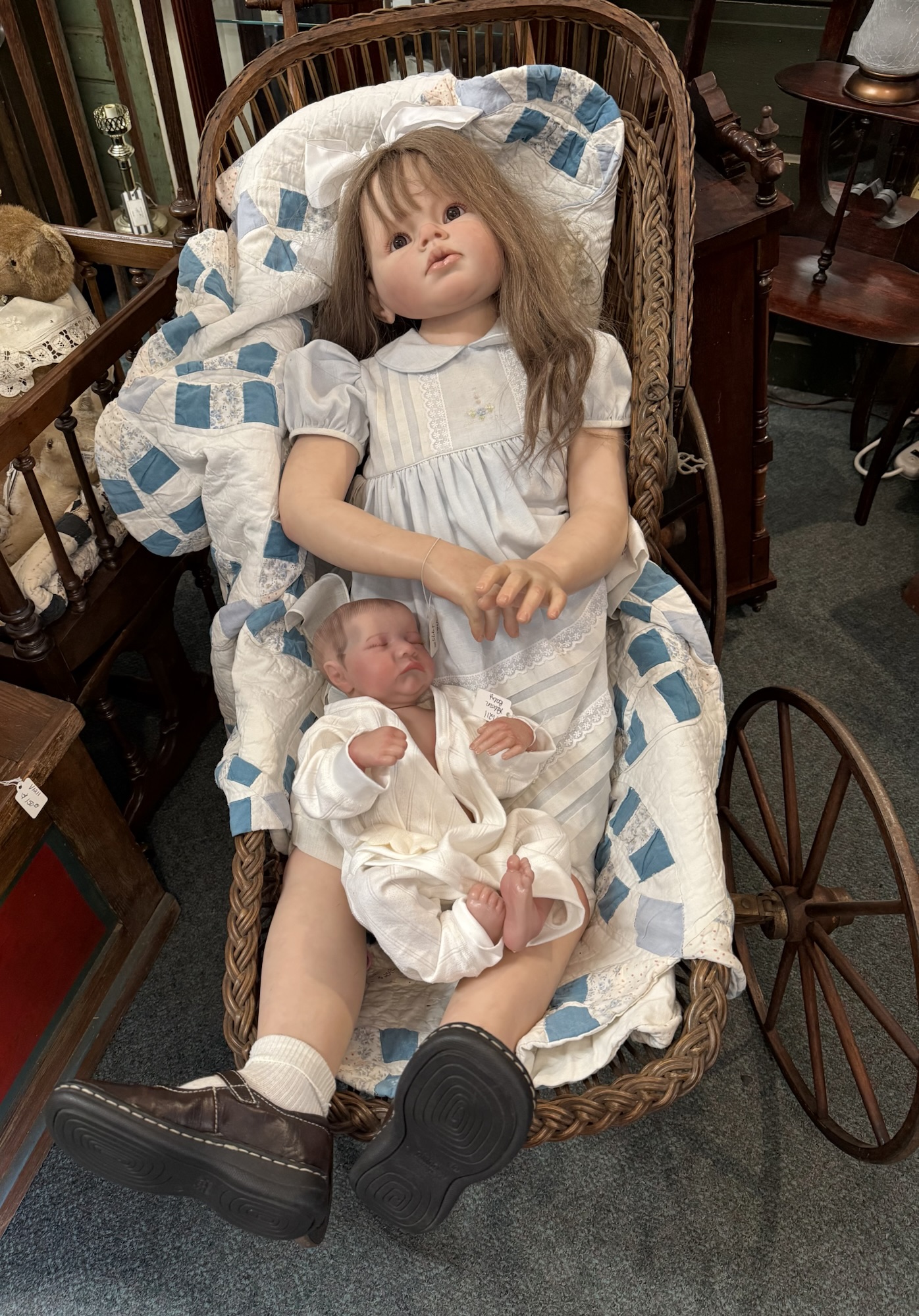
What is going on here? This child-size wheelchair is spooky enough, it reminds me of the 1980 movie The Changeling. Add in this life-sized toddler and her baby brother/sister and there’s a plot twist.

Photo by the author

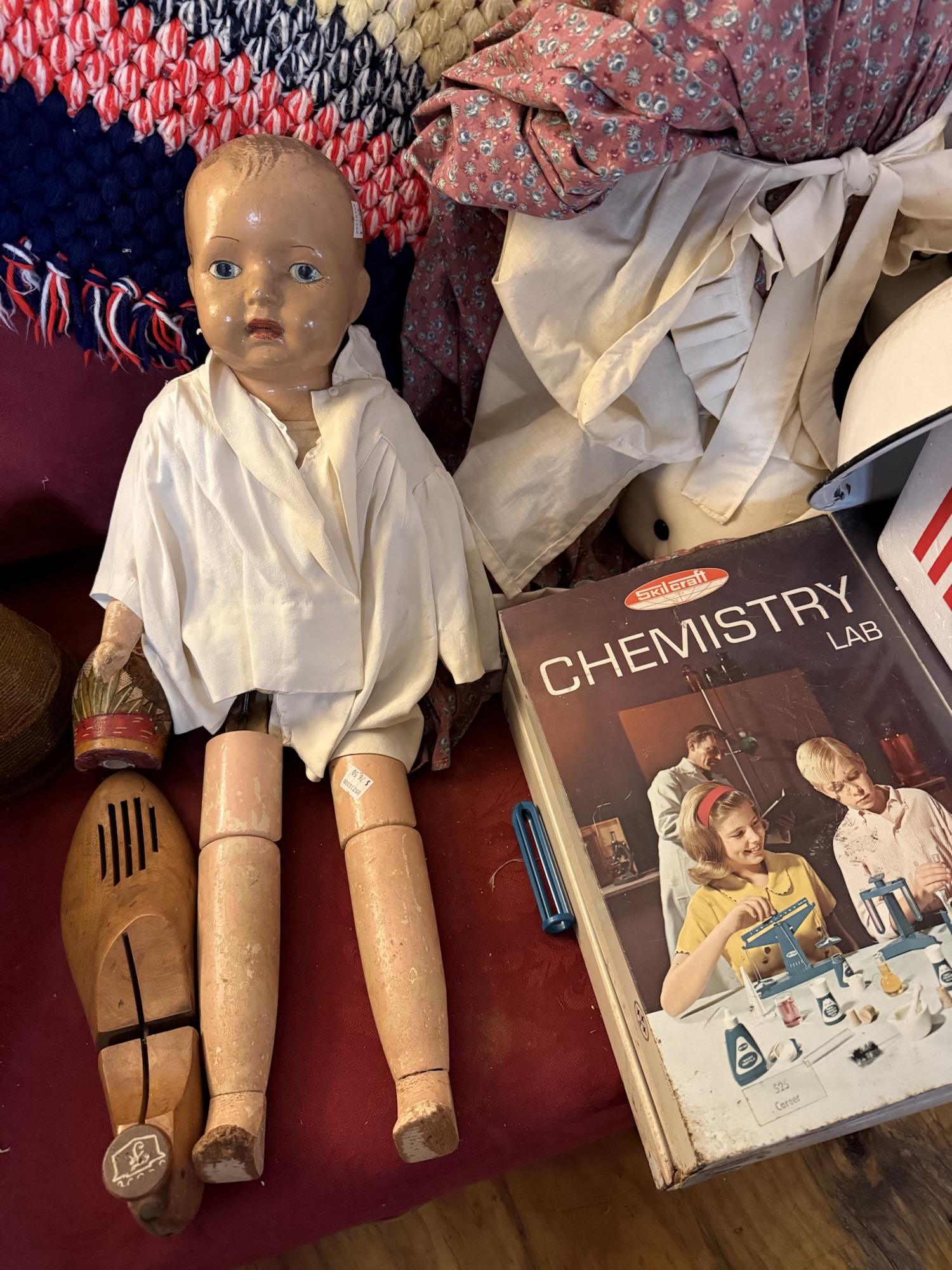
Why did the antique shop pose this guy with the Chemistry Lab? And what is he wearing? Why is his hand so tiny? His expression says he has been disappointed by everything in life.

Photo by the author

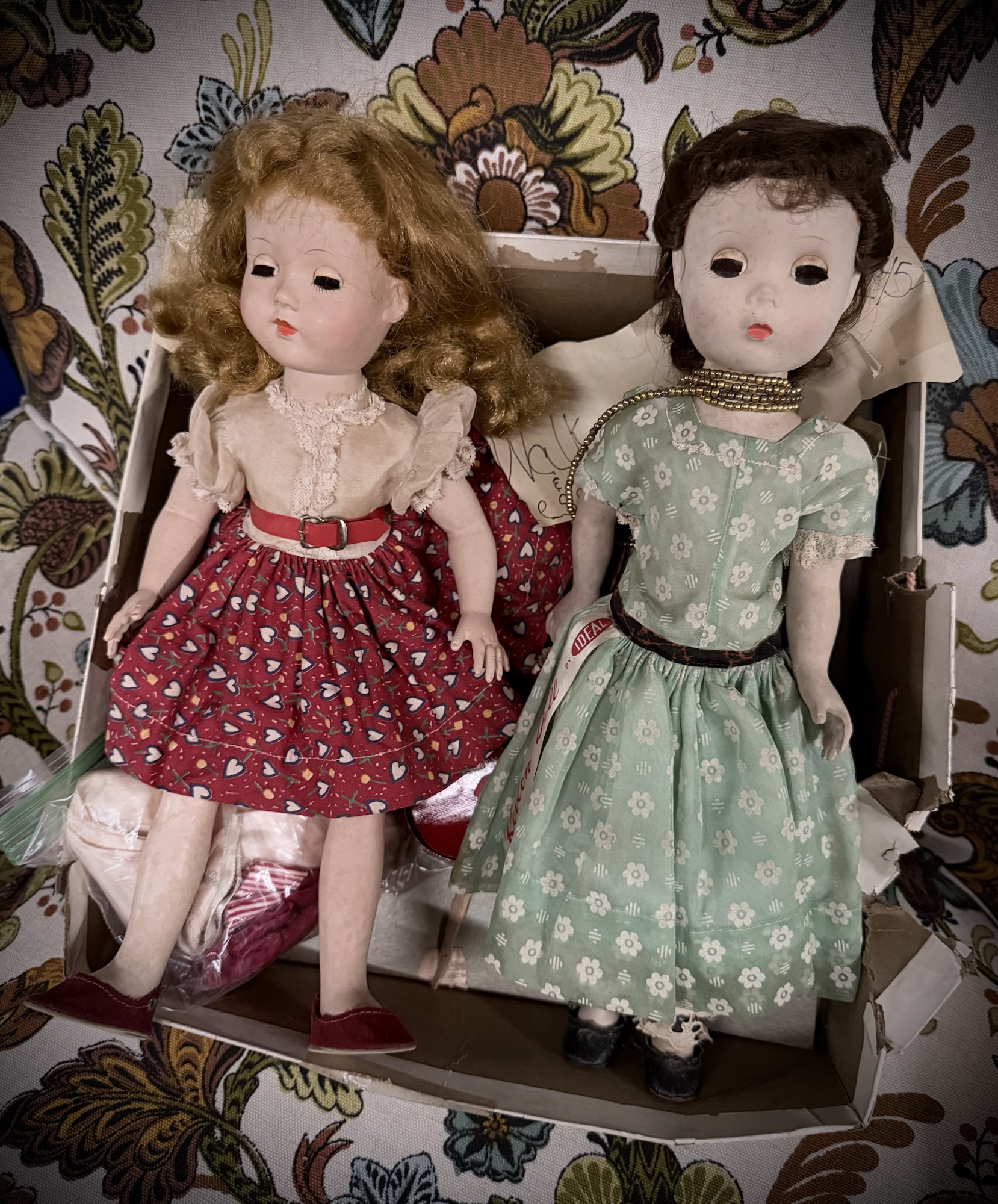
Whoever invented those doll eyes and that open and close, please know you have inspired so many nightmares.

Photo by the author

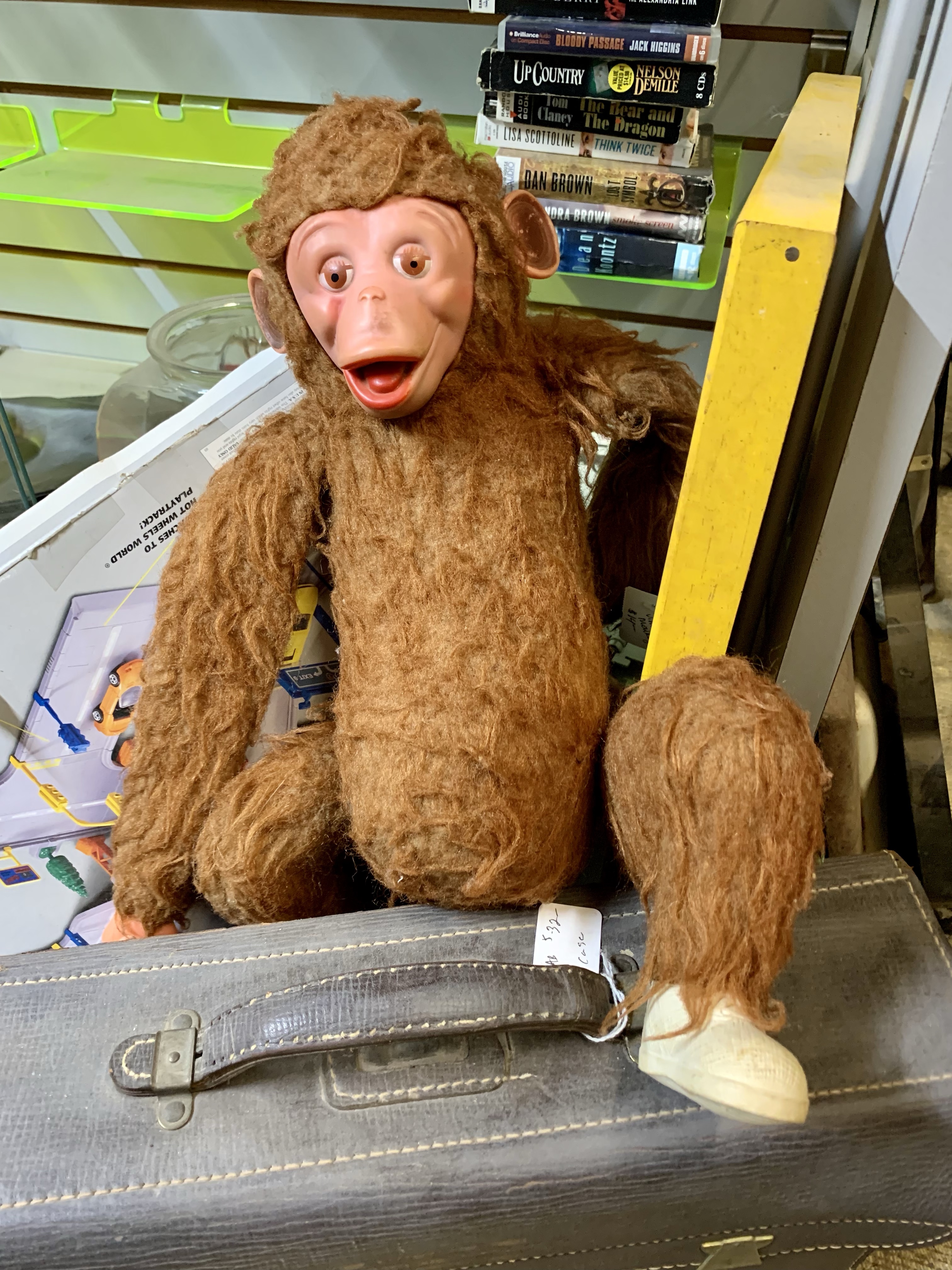
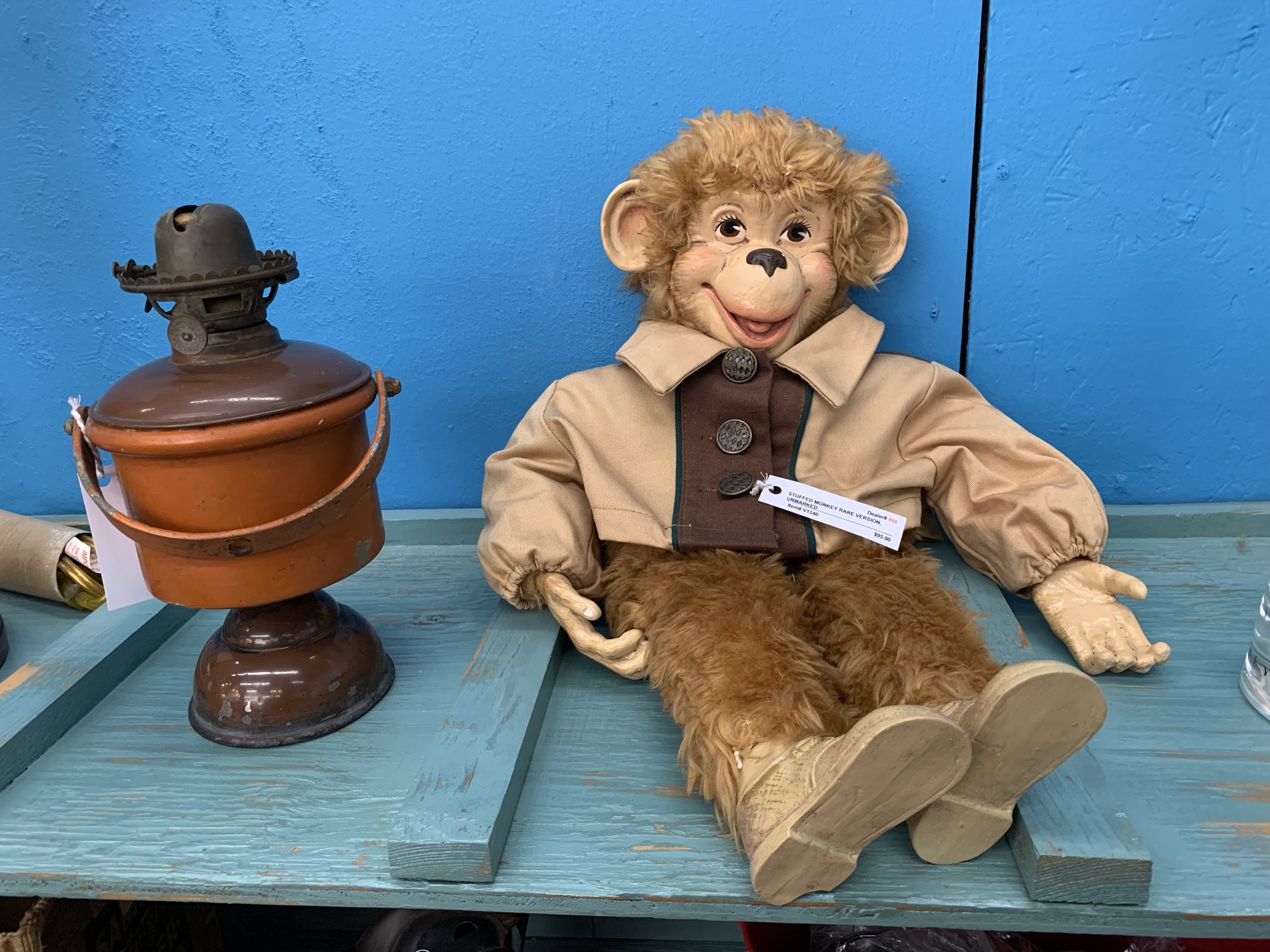
Another monkey. This one has shoes and a shirt but no pants. His half-naked state makes that grin so ominous. Also, why is half-dressed so much weirder than being completely unclothed? Is he naked if he’s covered in fur?

Photo by the author

Here’s some friends just hanging out.

Photo by the author

She looks like she’s rather be anywhere but here, with that screaming baby next to her.

I wonder about the people who owned these things. Did they have a special place in their home? How did they end up in dusty antique stores, next to framed portraits of someone’s grandmother? Were they there at the end, when the people who loved them were no longer around?

Imagine the horror inspired when the relatives gather round the patriarchs and matriarchs and hear them say, “Someday all this will be yours.”

Die Hungry

A flash fiction short story

Photo by the author

The story I’m sharing tonight was my entry for the second round in the NYC Midnight Scary Story contest. I didn’t advance to the finals and I’m a choosing to look on that as okay news as this means I now have the weekend free to work on the novel that I’ve started.

I received some good feedback from the judges, and I considered whether I wanted to go in and re-work the story to submit somewhere. But I then decided that it would just be one way of putting off the hard work of novel writing.

The prompts for this story were: burial, skipping a meal, and a couponer. I do love the prompt based writing contests, as they are always a challenge to creativity. And now, here is the story in all its unedited glory. Enjoy! (or not – this one’s a bit dark)

Die Hungry

The line of people wound through the cemetery. At the edge of the graveyard, a backhoe idled. Hayla shuffled forward, clasping her vouchers. Armed guards strode beside them, like wolves stalking prey.

“It’s fine weather for Parting Day,” the bearded man in front of her said. He grinned, revealing rotten teeth.

Shrinking back, Hayla nodded. Was this his mandatory age of disposition? She had signed up on her fiftieth birthday, five years early, to gift the unused time to her daughter.

The man leaned close enough she could smell the onion stink of his body odor. “I heard they don’t embalm or cremate folks so they can test whether the virus is still around.”

“Don’t care,” Hayla said. “Better to be buried with a full stomach than die hungry and rise as a ghoul.”

“You think this is enough?” The man held a single orange ticket, the color of the free government vouchers. Hayla had five meal coupons, one in each color, collected in preparation for today. A full digestive system halted the disease.

She turned, eager to glimpse the feast table. The scent of roasted chicken drifted through the air. Her stomach rumbled. She shouldn’t have fasted yesterday, but she wanted to gorge today. She swallowed, her mouth slick with saliva.  

“Get back!” One of the armed men shouted. Across from the queue, a dozen people, men and women, fought against the ropes binding them. The unfed. Hayla shivered. Buried under concrete, unable to claw your way out. The group struggled toward the feast line.

“Go!” A guard pushed Hayla into the bearded man.

Screaming, the bound group surged into the queue. Hayla tripped, falling hard on her side. A large man landed on her, crushing her breath. She rolled, pushing the man away.

Gunfire thundered, bullets thudding into victims. Hayla crawled across the grass, shuddering as people fell wailing around her. Within seconds it was over. Hayla staggered to her feet. She ran trembling hands down her body. Her meal coupons were gone.

She grabbed a guard. “I’ve lost my tickets!”

“Sure. And I’m the pope.” He pulled her toward a pile of bodies.

A bulldozer roared, scooping up the fallen. The guard raised his gun.

Hayla woke, lying cold in absolute darkness. Something soft and wet pressed her cheek. Someone moaned. She grasped their arm and pulled it to her mouth. Hungry. She was so hungry.

THE END

Short Story or Vignette?

One needs a plot, the other doesn’t

Moth on Lantana – photo by the author

I’m sharing another piece from a Writing Battle contest. This one had a limit of 250 words. The question I struggle with when writing very short, micro fiction is this: “How do you produce a complete story with characterization, rising and falling action, plot, and resolution when you only have X number of words?” Sometimes I feel like I hit the sweet spot on all those things that make a story a story, and sometimes I just have to be happy writing a vignette.

Vignette: a brief evocative description, account, or episode.

The story below made it to the top 16 in my category, but didn’t win any prizes. My genre was “Summer Fling”, I had to have a character “Bumbling Adventurer” and I had to include the word “Prudent.”

After the contest, I tried to expand the piece and I submitted it to a couple of other contests, only to get it back with the feedback that it wasn’t a complete story. Anyway I like it, so here it is. What do you think? Short story or vignette?

Lantana

Alina rolled through life like a tumbleweed — reckless, never prudent. She wore odd combinations—crimson flowers on an orange shirt and blue striped shorts, as though she dressed in the dark. One summer morning, she braided her sun-gold hair and set off to meet her latest boyfriend, Jay, at the pier. 

She strolled across the sand toward a Ferris wheel outlined against a periwinkle sky. After she lost a shoe in the surf, Alina stopped at the gift shop and bought a pair of rubber sandals.

When she found Jay, he held a paper container of fries. His kiss tasted of salt. Holding hands, they weaved past carnival games and their clanging, ringing, flashing lights. A summer season of popcorn bits and peanut shells crunched underfoot. Alina purchased a souvenir cup topped with a plastic dolphin’s head. They shared a pink puff of cotton candy, the hot-sugar stickiness clinging to their fingers. So sweet, before dissolving to nothing.   

They paused at a giant wooden track. Overhead, cars filled with screaming passengers rattled past. “Last chance, ride it with me?” Alina asked.

“I don’t do roller coasters.”

She thrust the dolphin cup at him and joined the queue for the ride. At the second hill, the coaster froze at the summit. In the moments before the cars resumed their plunge, Alina stretched her arms overhead. The wind carried a hint of coolness, heralding summer’s end. She searched the ground for Jay. Below, he lifted the cup in salute, or farewell.

THE END

Read More Books

“In the end, we’ll all become stories.” Margaret Atwood

Photo by the author

The neon sign on my office wall is a gift from a friend and a subtle reminder that my “to be read” pile is waiting patiently. They don’t really have a choice, unless those books suddenly become sentient. But that’s a whole other story. For now, I’m trying to settle in with a novel instead of doom scrolling through social media. One practice will improve my writing skills, while the other just results in a rise in my blood pressure.

Once I started studying the craft of writing and actually trying to turn out stories of my own, I noticed that my approach to reading shifted. I do read for enjoyment, but it’s hard to turn off that inner editor. Here’s a few of the books I’ve read so far this month and a bit of a review for each, along with what I learned about writing along the way.

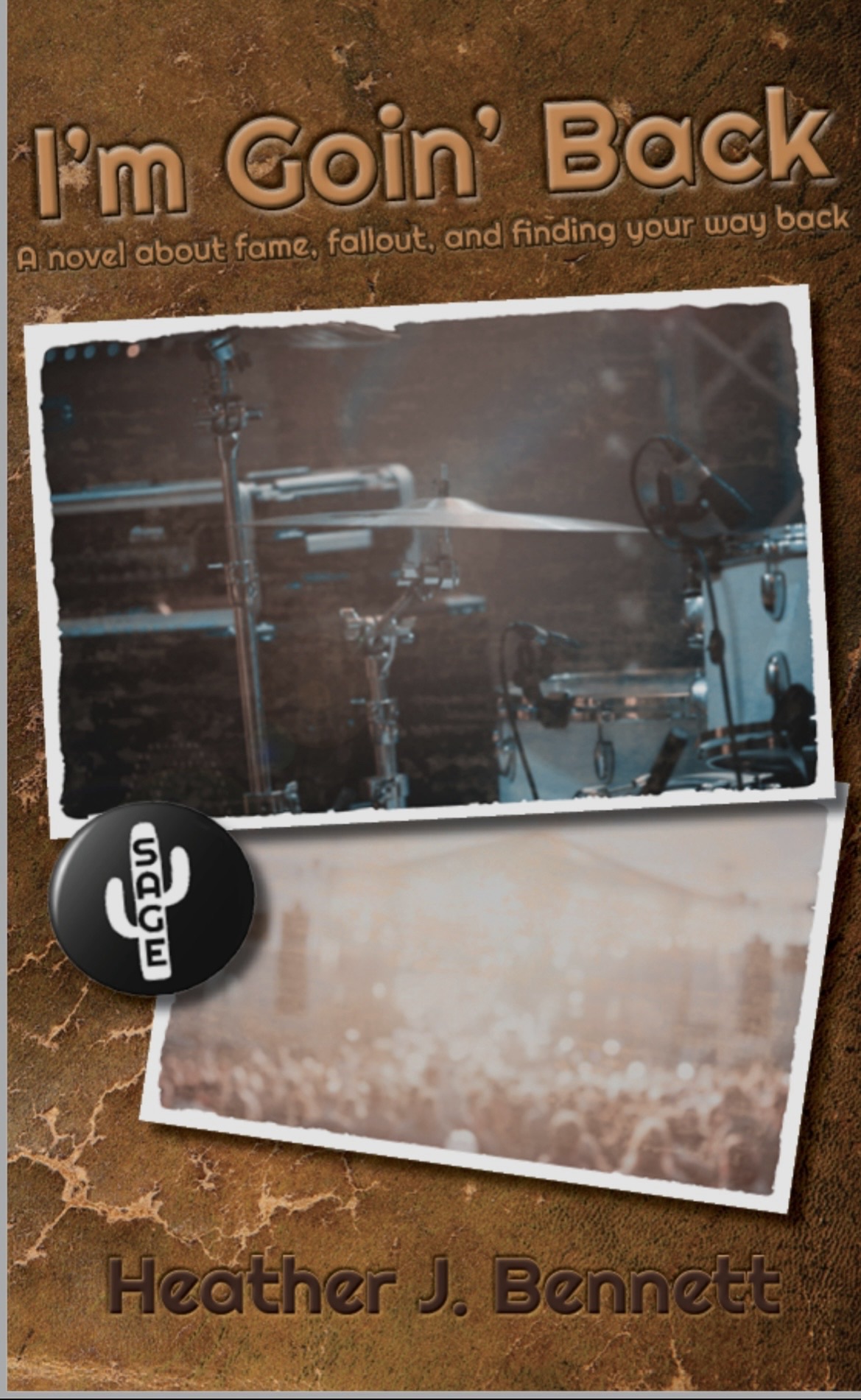
In November I read this novel written by my friend, Heather J. Bennett. She has a way of bringing her characters to life and giving the reader an intimate look at their challenges. Her books capture the 1970s – an era I grew up in – so well that I always feel like I’m settling in with an friend to reminisce about those times. The plots of her novels involve characters in the music industry, most often California rock and roll. Heather brings an authenticity to that setting that brings the reader right along with the characters. Writing wise, it’s good to read and learn from someone with such a good grasp of character development, plot, and setting detail. Plus her books are always a good story!

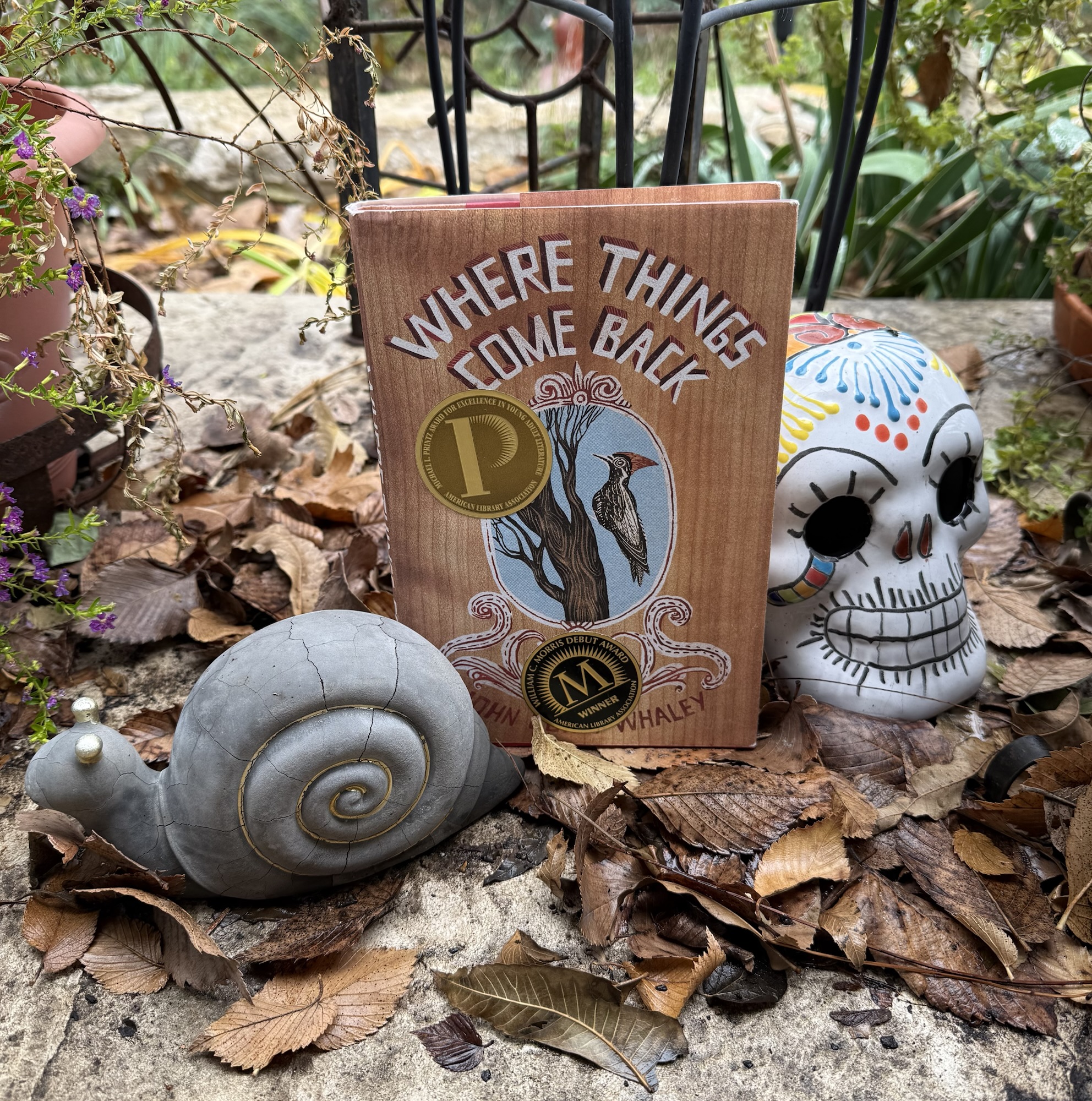
I bought this book at Dollar Tree and it was a $1.25 well spent. The first sentence hooked me in – “I was seventeen years old when I saw my first dead body.” From the title and that sentence, I was expecting something a bit darker from this novel, but I wasn’t disappointed with the story. The main characters are teenagers, so I suppose this would qualify as a “YA” book. There’s a disappearance and dual timelines that eventually converge in an unexpected but satisfying way. I like how the author, John Corey Whaley, tied everything together at the end. There’s a subplot with the town’s reaction to a possible sighting of an extinct woodpecker, and this explains the bird on the cover and also the double meaning of the title. I love it when the writer has a clear picture of how the plot will resolve and doesn’t resort to throwing everything at the conflict in hopes that something will stick. (Riley Sager, stop tossing tropes in the final chapter.)

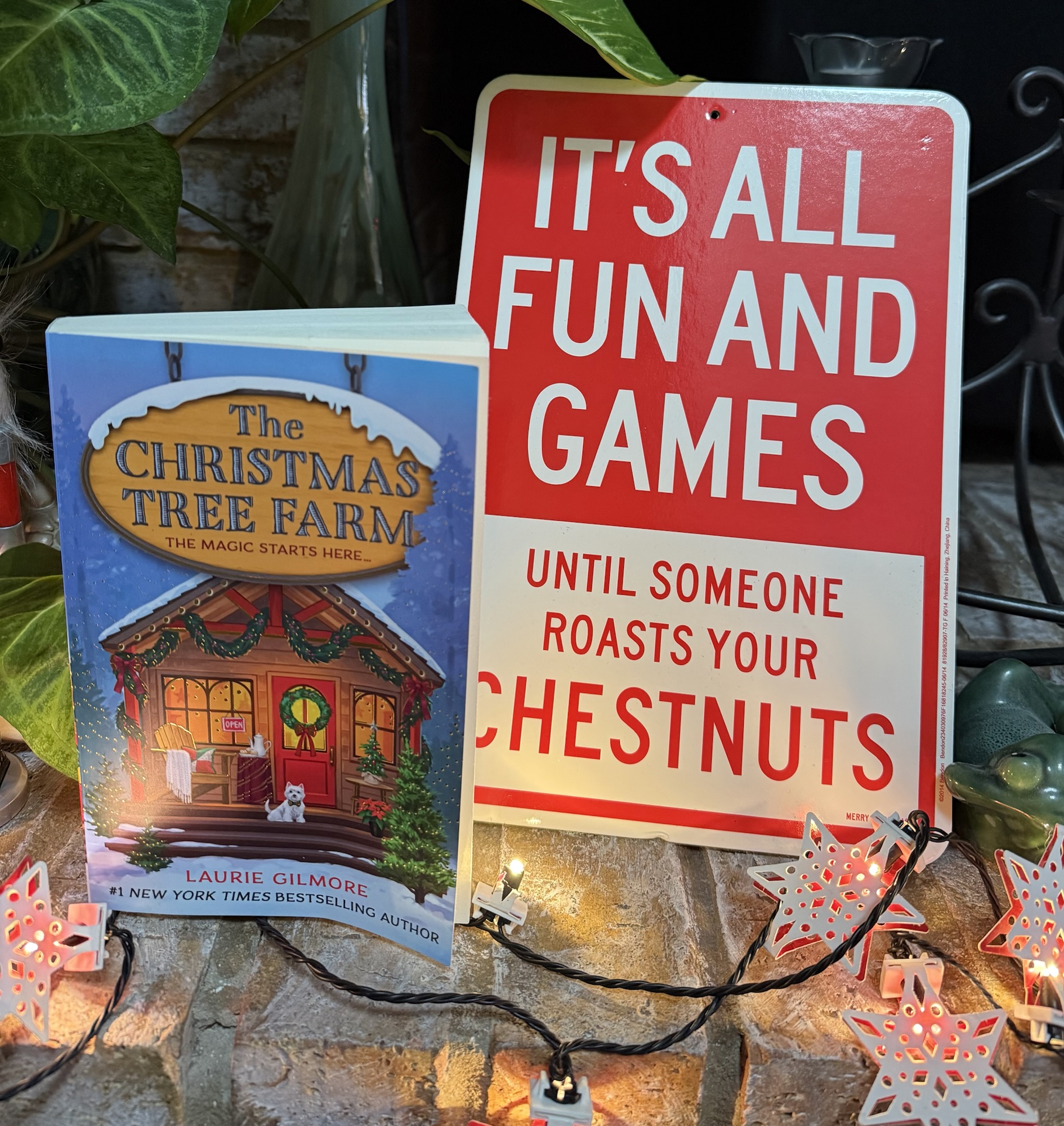
I’ll confess to an occasional binge of romance. I picked up this one based on the cover alone. Plus the author has a whole series set in this town. I loved the Virgin River series, so I thought I’d like these. Going in, I knew there were spicy scenes but I’m an adult, right? How bad could it be? Pretty bad it turns out. I’m not going to smut shame anyone, but if you picked up these books for the sexy parts, be aware the first get together doesn’t happen until about 200 pages in. And then, Kira and Bennett take up almost four pages with dialogue. Enough that I was urging them on to just finish things for heaven’s sake. As for plot, the main character, Kira, buys a Christmas tree farm and meets handsome Bennett. That’s about all that happens, over and over, until they finally hook up during a snowstorm. What I learned from this book – I don’t mind a spicy scene, but I’ve got to care enough about the characters to want them to get busy. I also realized I’ll never write a sex scene. Just coming up with euphemisms for body parts gives me a headache. Unless those parts are being loped off by the grim reaper/slasher who’s been stalking the characters.

Me and Carl

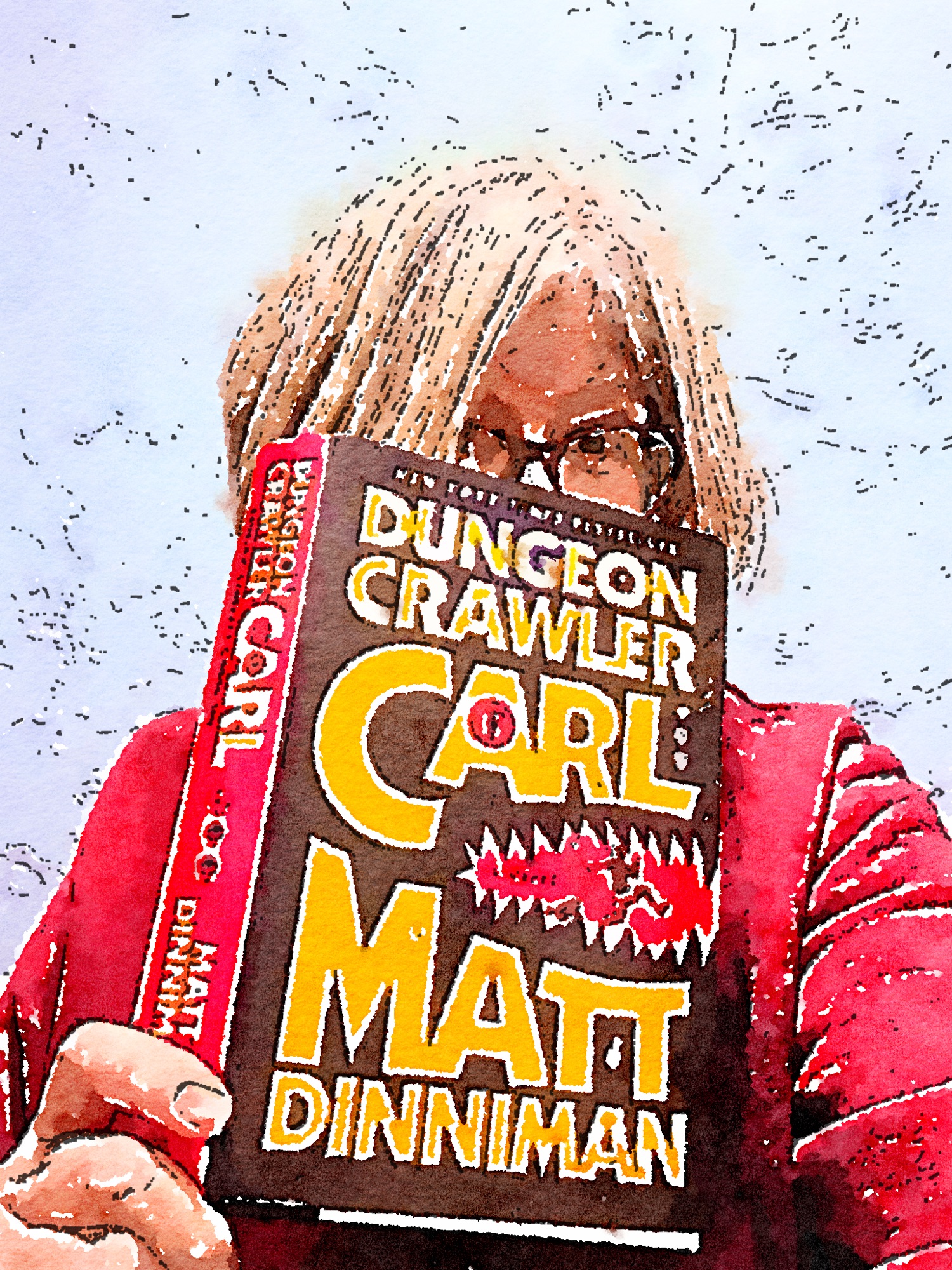
The last book is also my favorite of the month and possibly the entire year. I binged the first few chapters, staying up later than usual with no regrets. This book is a master class on pacing, conflict, hooks, and characterization. The unlikely plot – aliens have destroyed the Earth and the survivors must compete in an intergalactic game show that takes place in a dungeon – makes perfect sense once you get into the story. There’s magic, violence, fantasy, and a talking cat. The cat, Princess Donut the Queen Anne Chonk, is one of my favorite all time characters. By the end of the first chapter, I was rooting for her and Carl and hoping they didn’t get killed by the drug-dealing llamas or exploding goblins. Writing lesson – once the reader loves the main characters they’ll follow them through the story. Another lesson – give a satisfying ending with each conflict but also introduce a new conflict as a result of that ending. I LOVE these books – I bought the rest of the series (what has been published so far, that is) before I made it halfway through the first book. I’ll be reading the second book over the Christmas holiday next week, which will be much better for my blood pressure than doom scrolling Facebook.

The Shy Lady’s Treasure

An NYC Midnight Short Story

Photography by the author

I don’t remember the prompts for this one. I think the genre must have been Adventure or something like that. I do remember thinking this ended up a hot mess, and looking back at the feedback I received the judges agreed. It didn’t advance, and it has languished in my files since February 2023. Here it is now, for you to enjoy. (Or not)

The Shy Lady’s Treasure

In the boat’s prow, Jenny Simon leaned into the salt spray. A glance behind revealed the mainland’s shrinking, mangrove lined shore, while ahead Shy Lady Island’s rocky outline grew from the sea. The island’s most famous structure, a historic lighthouse, stood outlined in the sun. The lighthouse had been in operation until the 1920s, when a newer structure was built on the larger island to the south.

She curled her fingers around her heavy packs’ strap and tugged it closer, imagining the slip of paper tucked inside—the permit that gave her permission to explore for the next twenty-four hours. Precious little time, but she planned to find what she’d come for and be gone before it expired. In two days, the land’s title would revert to the state and Shy Lady would be closed to visitors. Now, access to the island was difficult and overnight stays were not allowed. You had to have the right credentials even for a day trip.  

One of her fellow passengers—a middle-aged woman wearing a fluorescent yellow life vest stood gripping the rail at the stern. A large canvas backpack rested at her feet. She wore khaki trousers and brown, thick-soled hiking boots. The woman turned and met Jenny’s gaze. Purple shadows like inky fingerprints underlined the woman’s eyes. A gust of wind caused her jacket to flap open, revealing a holstered pistol at her waist.  

The boat rose in the water, then slapped in the trough of a large wave. “Sorry!” The captain smiled as he called over the growl of the engine.

Jenny fumbled with her phone. Soon she would have no signal. The last text from the previous night was displayed on the screen.

where r u?

She turned off the phone and returned it to the pack. By the time Claire found the note she’d left, it would be too late to stop her. It would be easier to ask Claire to forgive her once she had the treasure in hand. Selling the copper scroll would solve so many problems for them. They could pay off Claire’s graduate student loans and have money to buy a house. There might even be enough for Jenny to finish her degree. She loved Claire, but her girlfriend had grown up comfortably upper middle class. Jenny couldn’t help but imagine the wealth ancient artifacts might bring. For Claire, it was all about history and knowledge.

At last, they reached the pier. She gathered her things and made to depart. The woman strode past, followed by the other two passengers, a pair of young men. The men carried heavy packs with shovels and picks strapped to the outside.

“I’ll be back this evening at six, before sundown,” the boat’s captain told them. “There’s a storm coming in, so don’t be late.”

She followed the others off the boat and before they left the dock, the woman turned to her and held out her hand. “Hello. I’m Peggy Horton. I was glad to see your name on the roster,” she said. “I knew your father. I was in his antiquities class when he taught at Central Tech.” Her smile faded,, and she pulled Jenny closer. “I’m sorry for your loss. But it’s good to see you following in his footsteps.” The woman cocked her head and her lips curled in a smile that didn’t reach her eyes.

Jenny nodded and mumbled, “Thanks.” She pushed past the woman without another word. Better that she think her rude than risk further conversation.

“We’ll see you at the midden tomorrow,” Peggy called after her.

“Sure.” Let them wait for her to show up. She had better things in mind than digging through an archaeological garbage dump. That was the sort of thing Claire would love, and any other time, so would she, even if she always had to go as an unpaid volunteer. Despite Shy Island being less than an eight-hour drive from their home, they’d talked about it but never ventured here. Jenny marched toward the lighthouse.

Lit by the sun, the structure towered before her, perched on a rise overlooking the beach. Broken stones from the façade littered the ground below it. From the top of the building, she would have a good view of the area. Also, the delay would allow the others to wander out of sight. She squeezed through the arched opening and into what had been the lightkeeper’s quarters. Cracked masonry covered the walls. Shadows darkened the space, and it smelled of mold and damp. A small room to the side must have held his sleeping space. Jenny peered into that room, noting a square of metal bolted to the wall. The surface, once polished, now spotted with age, had probably been used as a mirror. Bits of a wooden frame enclosed the square. The wood was carved to resemble tree bark wrapped in vines. The frame had rotted away except for two sides. 

Jenny slipped past the yellow caution tape to climb the stairs. At the top, she eased past the giant glass lens in the center of the floor to look out the opening. She spotted Peggy and the two men hiking into a stand of trees before the woman split off from the pair. The men must be heading to the dig site, a trash pit dating back to the 1600s, when Spanish pirates had used the island as an outpost. It was in a clearing in the middle of the grove. Over the past ten years, portions of the midden had been excavated.

She knelt on the floor and pulled from her pack a small leather journal. It was wrapped in cloth, then zipped into a plastic bag to guard against moisture. Carefully, she turned the pages to the section she had memorized. Here, in the lightkeeper’s tidy hand, he described finding the relic—a copper scroll. He must have known it was valuable, but he couldn’t read the Spanish words printed on the scroll. Alone on the island for so many years, it must have been a precious possession. He’d hidden it during the Civil War. Almost two hundred years had passed since he’d written those words, but no one after had found the scroll, although many had speculated about its existence.

Turning to the journal’s last words, Jenny read the lightkeeper’s clue to where the scroll had been hidden.

I will rise and face my treasure each morning. Clasped in the embrace of her roots, she will keep it safe until this danger has passed.

Standing, she gripped the binoculars she’d brought and studied the landscape, searching for the highest point on the land. He would have wanted a place far from shore, where the rising tide would never reach. Some place he would see from the lighthouse and reassure himself the scroll was safe. There, at the edge of the horizon, stood an oak tree. It towered over the canopy by at least twenty feet.

It took Jenny an hour to wend her way through brush and over rocky outcroppings to reach the hill that held the oak. Whenever she’d caught her breath and unwind the brambles that clung to her clothes, she swore she heard the echo of footsteps behind her. Now she stared at the ledge thirty feet above. The base of the hill held a dry creek bed. Run-off from heavy rains had carved the soil, leaving a shelf of dirt less than a yard deep and extending out six feet overhead. Halfway down, the side roots poked like fingers from a shallow grave. She trod the creek bed until she found a spot that sloped more gently and would be easier to climb.

At the top, she kneeled beside the tree and brushed at the dirt. She would dig here, on the side opposite the drop-off. If her luck held, she’d find the scroll without having to risk the ground collapsing under her. She began lifting clumps of soil with her folding shovel, scraping off the clay-like dirt into a pile next to the hole. Sweat ran from her brow and she had to pause every few minutes to wipe it away. When the rain began, she was at first grateful for the cool drops. The wind rattled the branches and leaves overhead, and combined with the patter of raindrops, it hid the crunch of footsteps until the woman spoke.

“Who are you?”

Jenny flinched and rose, clutching the short-handled shovel. She faced the woman from the boat, Peggy Horton. She held a dull black pistol, aimed at Jenny. 

“What do you want?” Jenny stepped back against the oak.

“You are not Claire Emerson.” The woman lifted the gun. “I saw her at a conference six months ago. Her and her father, Dr. Emerson, right before he died.”

Jenny’s mouth went dry, and she trembled. She didn’t think Peggy would shoot her if she stayed silent, and she didn’t want to speak the truth. Her face flushed with heat, remembering how she’d applied for the permit using Claire’s name and her credentials. They had found the journal boxed with her father’s papers. Based on ship’s logs he’d discovered and antique correspondence between Spanish explorers, Dr. Emerson had proposed that the missing copper scroll describing the location of Ponce de Leon’s fountain of youth had been stashed somewhere on Shy Lady Island. How they had fought over that journal! Jenny wanted to travel immediately to the island and look for the scroll. Claire, too distraught over her father’s death, didn’t want to even discuss it.

Jenny shifted her weight, preparing to swing the shovel and jump behind the oak.

“Stay still!” Peggy lifted the gun until it was pointed at Jenny’s head. Lightning zipped in a jagged white line, followed by a drum beat of thunder. The gun never wavered. Peggy smirked. “I know why you’re here. If you’re pretending to be Dr. Emerson’s daughter, you must be searching for the lost scroll.” She motioned with the pistol. “Go ahead. Keep digging.”

Jenny scraped at the soil until blisters rose on her hands. Cold rain continued to fall. The sky grew darker by the minute and below, water ran through the creek bed. At last, the only place left to dig was the ledge.

“Go ahead. Don’t stop.” Peggy nudged Jenny with her foot.

Carefully, Jenny scooted to the far side of the tree and dug. Rainwater filled each divot she removed. Finally, her shovel clinked against something hard. She brushed at the dirt, but mud kept sliding into the hole.

“What is it?” Peggy stepped beside Jenny.

Another crash of lightning and clap of thunder sounded. Rain pelted Jenny’s skin and the earth beneath her shuddered. She looked up. Peggy held the gun at her side, pointed toward the ground. If Jenny gave her a shove, the woman would tumble off the edge into the stream below.

Before she could act, the earth shifted again. Peggy cried out and waved her arms, trying to grab hold of the oak. Jenny flung herself past the tree to the solid ground behind. With a wail, Peggy fell.

Lying flat, Jenny held onto the oak’s roots and peered over the outcrop. Peggy lay half-submerged in the rushing water. Her eyes were closed. One leg was bent at an odd angle. A line of blood oozed from her scalp. Jenny backed away. If she left her there… but no, she couldn’t do that.

Later, she would remember the next few hours as a series of scenes, like slides in a presentation. The first one showed Jenny pulling Peggy from the creek and securing her high on the opposite bank. She found the men at the midden site. Together, they used the tarp that had been strung over the dig to carry Peggy to the lighthouse. None of them had phone service on the island, so they would have to wait for the boat to return that evening. One man had a first aid kit, and they cleaned Peggy’s wounds and stabilized her broken leg.

From her perch at the top of the lighthouse, Jenny was the first to spy the boat arriving. She hurried to the dock and waved as though she would speed the arrival. As soon as it landed, a familiar figure stepped from the boat. Claire.

Jenny longed to rush forward, into her arms, but she hung back. Her fears were soothed when Claire pulled her into her embrace. “What the hell, Jen. What were you thinking?”

Jenny shook her head. “It was stupid and I’m sorry.”

“Why would you risk this?”

The words spilled out, how she searched for the scroll, how finding it would have changed their lives for the better. “But it’s too late now,” Jenny said. “I didn’t find it.”

The boat captain radioed for a helicopter to take Peggy to the hospital. Shock and pain had turned her skin pale and clammy, but she would survive. After it left, Claire, Jenny, and the men prepared to leave with the boat.

“Where did you think you’d find the scroll?” Claire asked.

Jenny described the words in the journal, and how she’d searched for the tree from the lighthouse. “He would face it every morning and…” Jenny froze. She grabbed Claire’s hand and swung her pack onto her back. “Please wait a few more minutes,” she called to the captain.

Together, Jenny and Claire jogged to the lighthouse. “He must have spent so much time here.” Jenny crossed into the small room and stood before the metal square. “This,” she said, “is what he faced each morning. A mirror. Not a tree, but made to look like a tree.”

“You think it’s behind there?” Claire ran her fingers across the rotted wood frame.

“Only one way to know.” Jenny pulled a pry bar from her pack and bent one section of the metal away from the wall, revealing a flat, faded, muslin covered object. Jenny sucked in a breath. “I don’t want to damage it.”

Claire tugged at a corner of the cloth until a section of a rust-colored tablet appeared. Jenny made to pry the rest free, but Claire grabbed her hand. “No. We should have witnesses and document the find.”

“It’s ours, isn’t it? Finders keepers? The land doesn’t belong to the state until tomorrow.

Claire shook her head. “No. They’ll close the island tomorrow, but the title passed last month. We can’t claim it, Jenny.”

Jenny dropped her hand. “You should be the one to find it, Claire. The discovery belongs to you, even if the money doesn’t.”

“But I’m not here on a permit. I begged the boat captain to let me ride out here and back to find you.”

“You’ve been here with me all along. It’s your name on the permit, not mine.” Jenny strolled outside to ask the captain to hold the boat a little longer, as they had something amazing to share.

The End

A Fortress of Books

Searching for safe places

Shelves at Recycled Books Denton – photo by the author

If I could travel back in time, I’d tell my childhood self that one day I would have enough disposable income to purchase any book I desired. When I was in elementary school, I loved thumbing through the book fair flyers, circling the books I couldn’t live without. And the day the orders arrived I couldn’t wait to bring them home.

I had a library card, but those books were only visitors to my shelves. The loaned books I had to handle with care so I could return them in the same state as they were when borrowed. I couldn’t read them again and again, until the spines cracked and pages fell from the bindings.

Now I love collecting books. Recently I went with my friend Cathy to Denton, a nearby city with three lovely bookstores on the town square. All within walking distance of each other, providing you stop by your car and unload the heavy purchases before venturing to the next stop. First on our agenda was Recycled Books – a three story treasure house of used books.

Recycled Books Records CD’s in Denton, Texas – photo by the author
The horror section at Recycled Books – photo by the author

Our second stop was at Denton’s newest bookstore – The Plot Twist. This shop is a cozy stop just off the square. They are a combination book store and bar, so you can unwind with a glass of wine while you browse the books. The Plot Twist is a romance bookstore so I was skeptical about whether I, a horror writer and reader, would find something. But I am also a fan of anything paranormal or witchy so I left with three books. I don’t think I’ve ever left any bookstore without buying a book or two or three or four.

The Plot Twist in Denton, Texas – photo by the author

Around the corner we found Patchouli Joe’s Books and Indulgences. Not only did I find a book or two, but because I signed up for their free newsletter during my birthday month, I received a free bar of their scented soap. (Part of the indulgences for sale in the shop.) I would have subscribed without the soap, but it was a nice reward.

Patchouli Joe’s bookstore in Denton, Texas – photo by the author
Books at Patchouli Joe’s – photo by the author

No matter the size of the store, I can spend hours searching for the perfect books. It’s not so much the hunt as it is the desire to linger in the safe space. Libraries and book stores serve as doors to different worlds. There, I can travel safely no matter what horrors the outside world contains. I can exchange battling dragons, evading zombies, and conspiring with witches for worrying over whether National Parks, Social Security, and basic human decency will continue to exist.

The books I purchased – photo by the author

I own what some might describe as a book hoard but I have named the ever-growing piles of unread tomes “my library.” Never mind that said library has spilled out of my office, into the living room, onto the floor of my bedroom, and occasionally can be found on the dining room table. The simple solution would be to stop buying books until I’ve read them all, but there is something so comforting about the stacks. The world outside is dangerous, but inside my home I have a fortress of books.

A cozy read – photo by the author

Links:

Recycled Books

The Plot Twist

Patchouli Joe’s

Well Hello Dolly

Not the life she imagined but the life made for her

Mannequin in a Wichita Falls antique store – Photo by the author

Andrew and I have recently taken on the task of clearing out his mother’s storage unit. Roby no longer has need or use for the cartons of fine china, boxes of shoes and purses, racks of designer clothing, or bags of vintage dresses. Over the past four years we’ve managed to sell off or donate most of the bulkier items – the dressers and chairs, the dining room table. There’s still a lot left. Enough to fill a small U-Haul. Our goal is to move enough of it out that we can set up a lower priced, smaller unit close to our house and save her the expense of renting the space.

Until then, we’ve turned our living room into a sort of staging area, bringing over car loads of clothing and sorting through it for anything that might be worth selling. We discovered that Roby’s collection of vintage 1970s to 1980s Diane Freis dresses have become popular again. Imagine the sort of outfits worn by the actresses on the set of Dynasty, Designing Women, or Dallas. Think shoulder pads, wild colors, and lots and lots of polyester. To better display these dresses, I ordered a mannequin on Amazon. Andrew named her Molly Mannequin, but I call her Dolly.

Molly Dolly wearing a Diane Freis 100% Silk dress – Photo by the author

Dolly is easy to dress – pop off her head, slip her arms out of their sockets, and drape the dress over her torso. The first set of photos we put up on Ebay featured her smooth, bald head. Andrew suggested she wear a hat, but I didn’t have one that matched the outfits. Except for this one.

Dolly – Photo by the author

The hat, in my opinion, gave her a confused, wistful look. As though she couldn’t believe she had landed here.

Dolly – Photo by the author

In the second box of clothing we discovered an acrylic wig. This was better, it gave Dolly a more life-like appearance. The wig had seen better days. It also looked like it had seen some really bad days. Frizzled strands stuck up across the surface of the artificial hair, giving Dolly an urchin look. It fit, however, with the bohemian vibe of many of the dresses. I remembered a trick recommended to smooth out the fake tresses on dolls and I soaked Dolly’s hairpiece in fabric softener. It worked, but she still didn’t seem happy, despite having smooth locks.

Dolly in a sequined Diane Freis dress – Photo by the author

Something about the racks of frilly clothing and the dressing and undressing of Dolly felt familiar. The clothes were unlike anything I would choose to wear. My wardrobe is made of t-shirts with catchy slogans and sweatpants with elastic waistbands. In another life, however, I could imagine strolling through a garden party or dancing under disco lights. Maybe plotting my revenge on J.R. Ewing or Blake Carrington.

Dolly – Photo by the author

Flipping through the rack, the soft ruffled skirts brushing against my hands – I couldn’t help but smile at some of the whimsical patterns. How fun it would be to dress in one of these. I understood the attraction, the desire to own them all. At last I realized why this felt so familiar. Hadn’t I done the same thing as a young girl?

It was with another fashion icon.

Barbie aloof – Photo by the author