All sorrow flows to the sea
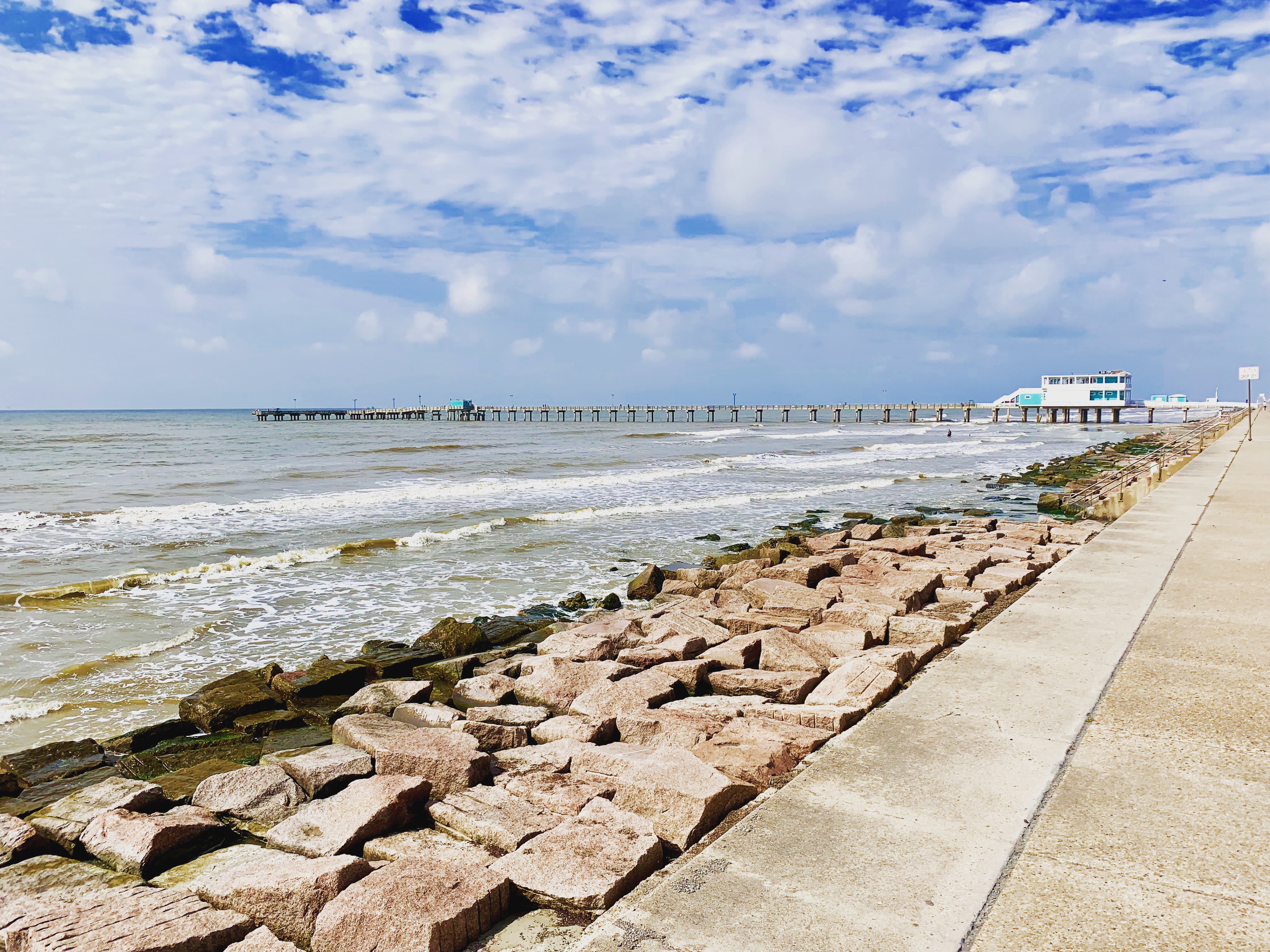
I wrote the first draft of this story while taking a writing class. The setting is based on some actual places in Galveston, Texas and all the photos in this post were taken by me during the trips I made to that island. Inspiration is the perfect reason for exploring.
The story sat in a file on my computer for a year or two, until I finally polished it enough to submit it to a writing contest. It didn’t place in that competition, so back in the file it went.
I went looking for something to post tonight, found it, and resurrected it here. There are ghosts of a sort in this one, but it isn’t particularly scary.
Speaking of scary stories, my book of short stories will be one of those listed in a “Stuff Your Kindle” event this Saturday, July 18. In case you want to pick up some free and .99 ebooks on that day (including my book, The Imposter and Other Stories), I’ll post the event graphic and link at the end of this post.
And now, here is my story. As always, thank you for reading!
GHOSTS IN GALVESTON
They rolled into Galveston after midnight, Dee and her boyfriend Emery. After they checked into the motel, Dee strode barefoot across the damp carpet in their room and wedged open the metal door to the balcony. Behind a curtain of gray mist, the sea lay hidden, revealed only by the sound of waves breaking against the seawall and the salt scent of the ocean. In the parking lot below, a solitary smoker lifted a cigarette, the lit end like an orange star that rose and fell.
Back inside, she joined Emery in unpacking their bags. Her case held, along with her clothing, a pocket-sized field guide to the island, the tattered paperback romance novel she never had time to read, and tucked at the bottom, a sturdy square cardboard box with eight pounds of bone-white ash. Until this trip, the ashes had rested on the shelf in her coat closet. The last reminder of her dead husband, Mack, she planned on spreading them here, in Galveston. If there had been anyone else to take on that chore, she would have gladly handed it off.
Emery dumped a handful of tourist brochures on the bed. A high school history teacher, he carried a list of landmarks he wanted to visit. “What should we do first?” He fanned a pair of folders. “The palace or the mansion?”
“It doesn’t matter. We’ll get to both of them, I expect.” She studied the pictures on the brochures—The Moody Mansion with its red-brick masonry and the white stone exterior of the Bishop’s Palace. Which had she toured with Mack? They went to Galveston every other summer until the year he died. Dee believed that by returning to all the places they had visited during her marriage, she might replace the terrible memories with good ones. It had taken her two years to get back to Galveston, the last spot her dead husband haunted. With luck, she’d leave him here.
Natural disaster and faulty recollection threatened her plan. The name of that restaurant, the one where she had dined on fried shrimp, the coating so crisp and flaky—floated out of reach. Dee wanted to test if the food tasted better when she sat across from someone who didn’t chastise her for every bite, who didn’t resent every small happiness she found.
Hurricane Ike wiped out the Balinese Room, the shady night club where Frank Sinatra sang to oil barons sipping margaritas. A gaudy amusement park sprang up on a new pier off the seawall, and Murdoch’s Gift Shop was destroyed and then rebuilt. Dee had purchased cheap trinkets there and hidden them from Mack to avoid the inevitable argument about how she squandered his money. She always had her own job, her own paycheck.
Dee encountered the ghost on their second day on the island, while she and Emery browsed antiques in a store in the Strand, the historical shopping district. They visited a bookstore, a candy shop, and a crystal store. Dee bought a necklace in the crystal shop, a silver chain with a heart-shaped azurite charm. She liked the blue color of the stone, and liked the charm even more when the black-garbed shopkeeper told her, “Good choice, azurite is for memory.”
“Help, please?” Dee handed the necklace to Emery. She lifted her hair from the nape of her neck and he fastened the clasp, his fingers brushing her skin. “Smile,” Dee said, as she took a selfie of them together.
In the bookstore, Dee got Emery to pose under the hurricane watermark etched into a post. The date, September 13, 2008, hovered five feet above his head. While he leaned against the post, Emery used his index finger to push up his glasses. By the end of the day, smudges would cover them so thickly that Dee wondered if he could see. She lifted her new phone, bought for this trip, and snapped his photo.

Their last stop downtown, the antique store, Dee wandered through the jumble of dusty furniture, rusted metal objects, and age-clouded glassware. A wall of broken wooden chairs covered one end of the space, as though stacked there to prevent an intruder from bursting through. Dee framed and focused the shot, then glanced back to where a short older woman, the cashier, spoke to Emery. He lifted his head and laughed, brushing back a lock of dark hair that fell across his forehead. A tiny, star-shaped scar was there, hidden by his hair. Dee liked to think she was the only one who could see it. When they lay in bed at night, she liked to trace its white outline with her finger. She asked him once, “How did you get this?”
“I don’t remember,” he had said. “It happened a long time ago, when I was a toddler.”
This answer amazed Dee. She knew the history of every mark on her body.
“We should go upstairs and look around,” Emery said, after he left the cashier. “This used to be a hotel, built in 1913. It closed and reopened in the 1940s as a bordello.”
“Mm hmm.” Dee nodded. In the space, filled with dividers and cabinets, it was easy to imagine an open lobby filled with travelers and, later, by customers of a different sort.

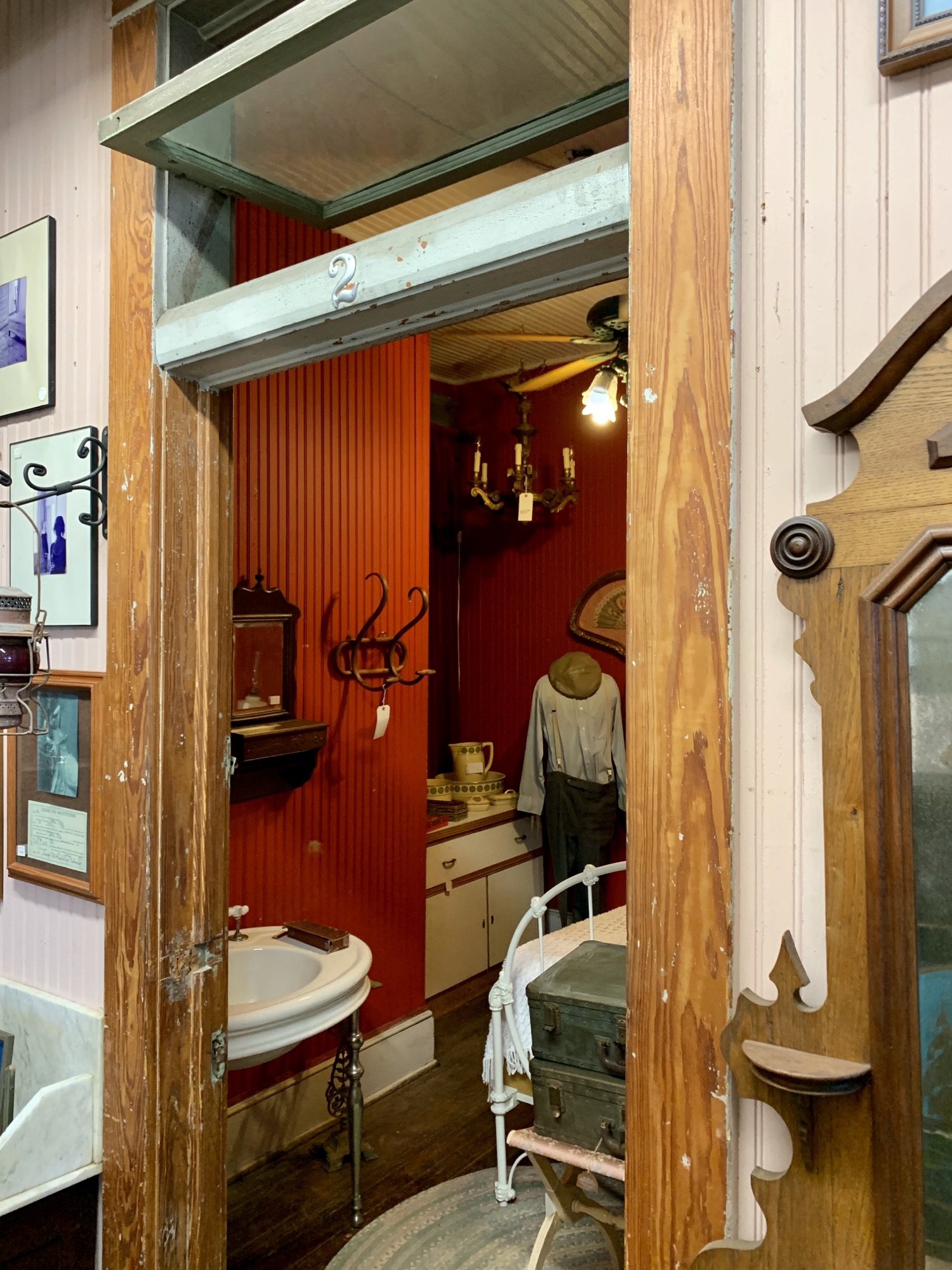
They climbed the creaking wooden steps to the second floor. The rooms were laid out along the outer walls and decorated with antique furniture. Metal room numbers, their paint scratched and faded, were hammered into the wood frames below transom windows at each door.
The first room they stopped in, Dee ran her hand across the velvet coverlet on the bed while Emery dug through a box of old phonograph records. The place smelled like damp cardboard and dust. Faded landscapes hung on the walls, and the nightstand beside the bed held a porcelain wash basin. A vintage tea towel, embroidered by someone’s great-grandmother, lay folded beside the bowl, as though the room’s occupants had stepped outside for a bit.
“This is so cool,” Emery held up a Cole Porter album. “It’s like a museum, but everything’s for sale.”
“I guess that was true back then, too,” Dee said. She smiled at his enthusiasm. Had she been here with Mack, he would have complained over the prices, the maze-like crush of the hallway crowded with furniture and knick-knacks. She held up her phone. “I’m going to look around.”
What would it have been like for the women living in these rooms? Like captive birds, held here at the whim of men. The place felt small, claustrophobic. Dee thought of the baseball bat Mack had kept by their front door, and the loaded gun in the hall closet. “Just in case,” he’d said, part of the paranoia that made him count the used batteries, scratched DVDs, and broken fishing lures scattered throughout their house. As though anyone would break in to steal their rubbish.
In the hallway, Dee dodged an older couple studying the price tag on an oak dresser. She passed rooms occupied with shoppers and left them alone. Through the phone’s camera app, Dee studied the composition of furniture crowding the hallway. A flutter of white at the far corner of the building drew her.

Voices faded as ambled past rooms barely more than closet-sized. The air grew colder the closer she got to the end of the hall. The hair on her arms stood up, the atmosphere charged with static. Dee halted at the threshold. A young woman stood at the window, staring through the glass. A tumble of auburn hair hung to her waist. She wore a linen nightdress, the loose cloth exposing one pale, bare shoulder as the ghost turned, looking past Dee at the hallway outside the room. The spirit’s eyes widened in terror and she backed against the wall.
“It’s okay.” Dee reached a hand out to the woman. Resisting the urge to glance behind her, Dee swallowed the words in her dry mouth, about to told the ghost, “Run.” Instead, she snapped a photo without taking time to focus. With the touch of the screen, the phantom woman disappeared. The picture illuminated in the preview showed only the white lace curtains.
“What did you find?” Emery appeared at Dee’s side.
“Did you see that?” she asked.
Emery shook his head. “See what?”
“Nothing. No, wait. I thought I saw a ghost.” She showed him the picture on her phone. “But there’s nothing there.”
Dee supposed that if any place were haunted, it would be Galveston. Over six thousand people died in the Great Storm of 1900. After the hurricane, they loaded the dead onto barges and dumped them at sea, only to have the corpses wash ashore days later. Workers buried many of the bodies where they lay, scattering ashes from funeral pyres along the beach. Anywhere you stepped, you could walk across a grave.
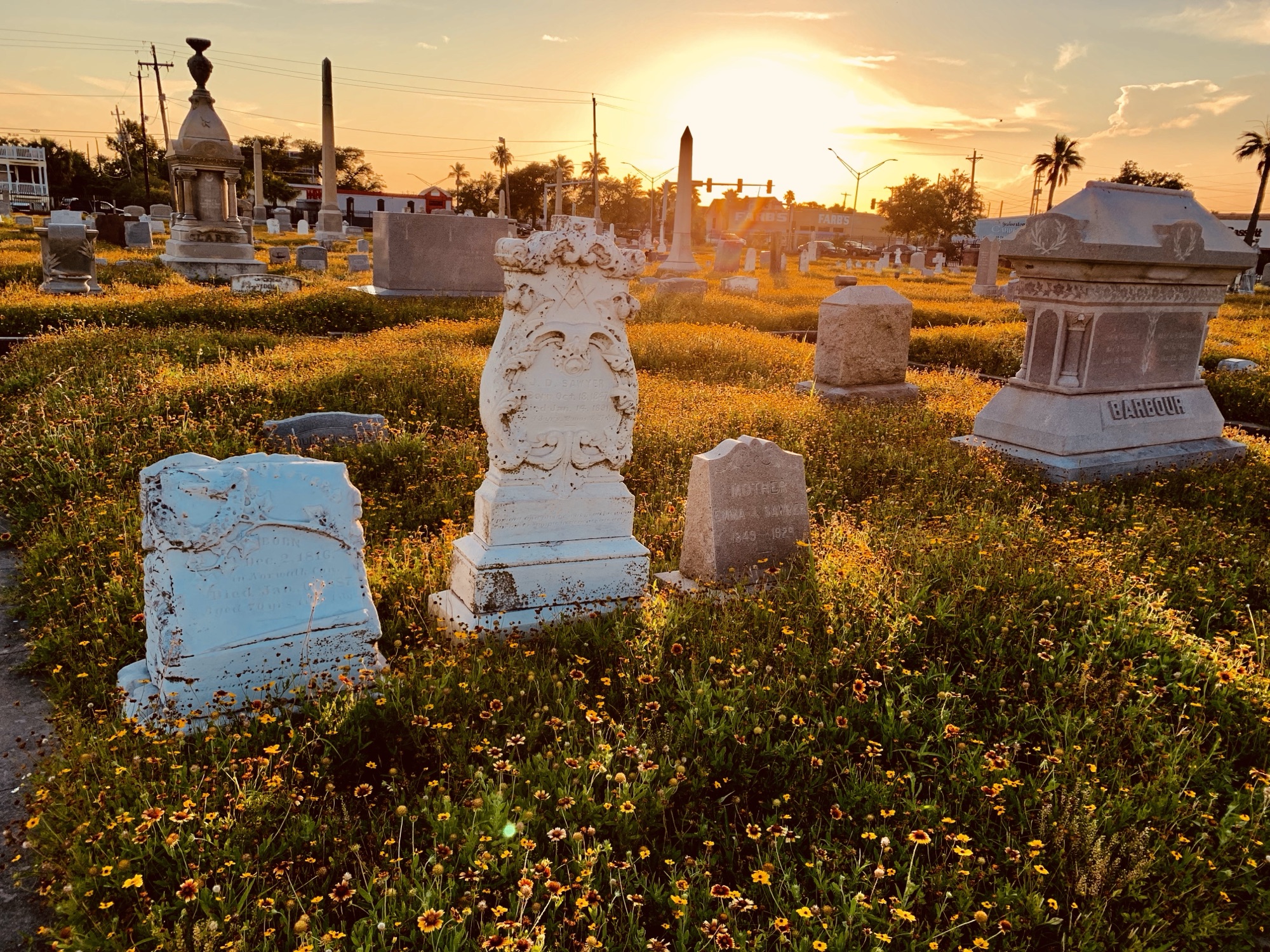
They left the Strand, and on the drive back to their motel they came upon the cemetery in the center of the city. Yellow sunflowers and golden evening primrose covered the graveyard. The sun hung low in the sky, casting the last of the light over the field. The blooms blazed as though the ground were on fire.
“Can we stop?” Dee asked. “I’d like to photograph the cemetery.”
While Emery read the inscriptions on the headstones, Dee strolled beside him. Tall monuments flung long shadows across the graves. Wear and fading had worn away many engravings, leaving only faint lines to mark those buried there.
“Sad, isn’t it?” Dee ran a finger through the green moss covering one tombstone. “How will they know who is buried here?”
“There’s a saying I’ve heard—that a person dies twice. The first time is their physical death and the second death is the final time someone says their name.”
As far as Dee knew, Mack had no family. An only child, his parents died before she met him. No friends, no far-flung cousins to carry his ghost. In the end, she would be the one to speak his name.
They had wandered toward the far end of the cemetery by the time the sun set. Her phone’s camera reduced the plots to quaint postcards, showing sleepy cherubs and palm trees dotting the grounds. Too dark now for a decent shot, Dee turned with Emery to head back to their car.
They hurried along the gravel path through the center of the graveyard, racing the sunset. Dee spotted a figure leaning against the gray marble of one of the larger mausoleums. She couldn’t see his features clearly, yet his posture seemed familiar. For six months after Mack’s death, Dee imagined him everywhere. Once, she’d abandoned a cart of groceries and left the store because she spotted a lanky man dressed in the same type of tan cotton duck jacket that Mack used to wear.
As though her memory had conjured her dead husband’s ghost, Dee shivered and grasped Emery’s hand. Reassured by the physical touch, she matched her steps to his until they reached the car. She refused to look back at the graveyard until she buckled her seat belt and Emery started the car. The figure, whatever it had been, was gone.
That night, back in their room, Dee lay sleepless. She waited until the quiet whistle of Emery’s breath slowed and she could be sure he slept, then she rose and pulled the box with Mack’s ashes from her suitcase.
At the beach, she kicked off her shoes and waded into the warm Gulf. The receding tide slapped against her thighs as she drew out the plastic bag that held the cremains. With only the moon to witness, she tossed a handful into the sea, then poured the rest after. She hoped the surf would carry him far from shore as she whispered, for the last time, “Mack.”
THE END
I hope you’ve enjoyed this story, and if you’re in the mood for more fiction with ghosts and ghouls, the link to the Midsummer Night’s Scream Stuff Your Kindle Event is below.