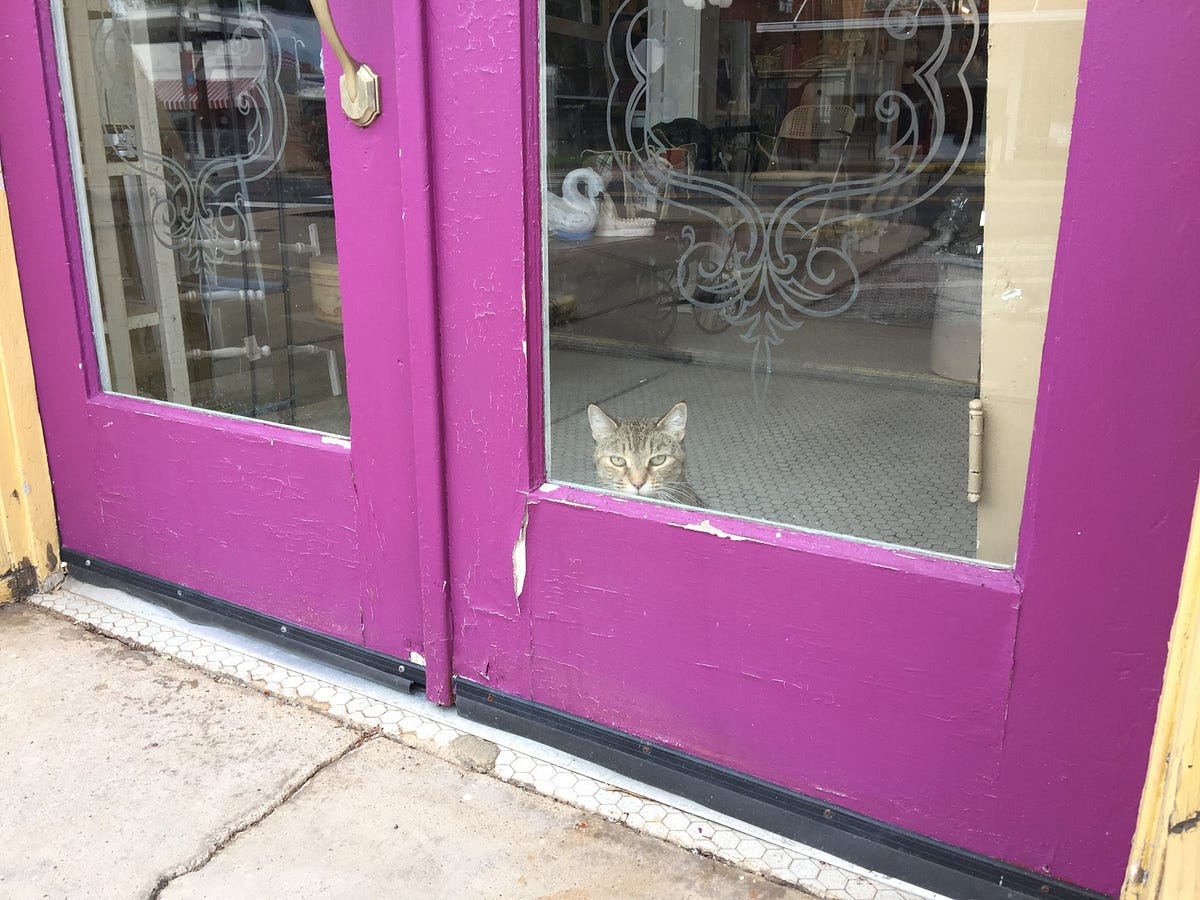
Distrustful Cat wonders who is at the door — Photo by Terrye Turpin
I’ve legally changed my name one time. When I married my first husband, I took his last name, and it has stuck through a divorce and a second marriage. Turpin is unusual enough, but my first name is the one that strikes fear in the heart of coffee shop baristas and medical office receptionists.
“Is that with an ‘I’ or a ‘Y’? they ask.
“Just spell it like a normal person would and then add a crazy ‘e’ on the end.”
I’ve heard them try to pronounce my name as two separate words — ’Ter’ and ‘Rye’, like the disembodied electronic voice that calls out directions on my phone. After I correct their spelling or pronunciation, the person asking will remark something like, “Oh! How did you come up with that?”
“You can blame my mother,” I’ll reply.
She’s the one who tagged me with that name, and it never occurred to me I could change it.
Besides confusing grocery store cashiers, fast food clerks, and telemarketers, my name kept me from purchasing a variety of mass-produced personalized mugs, pens, pencils, bracelets, and plastic souvenir license plates. They mocked me with every alternative spelling of my name — there were Terri’s and Terry’s galore, but not a single one ever spelled my name like my mother had. If every parent had been like her, a whole generation of Chinese factory workers would have been out of work, with no one to buy all the cheap plastic goods emblazoned with names that ended without unnecessary letters.
I was in junior high school when I asked my mom how she came up with the spelling. She got a smug look on her face as she explained.
“Back before you were born, I told your Aunt Judy I would name you Terrye, and she told me that was a boy’s name. But I spelled your name with an ‘e’ on the end, and that’s a girl’s name.”
I pointed out to my mother there were four others in my school, three girls and a boy, with my name. None of them ended with ‘e’, two of the girls ended their name with an ‘I’ and the boy and one girl were Terrys.
“Exactly,” my mother answered as though I’d proven her point. “Then when Judy had her youngest boy, she named your cousin Terry without the ‘e’!”
“Wait, who are you talking about?”
Until that moment I hadn’t known my cousin and I shared the same name. My cousin Bun had the misfortune to have two older sisters, who spoiled their baby brother and awarded him the nickname Honey Bun. They shortened that to Bun before his second birthday. No one in our family called him anything else. He even went through the Marine Corps as Bun.
Disappointed Self Portrait of the Author
The day I finalized my divorce I decided to pick up a copy of my birth certificate while I was at the courthouse. I wanted a passport, in case I might need to flee the country or take a cruise. I filled out the form to request the copy and handed it to the clerk behind the counter. She glanced at me over the top of her gold framed bifocals and asked if I had identification. I handed her my driver’s license, and she glanced up at me and said, “Oh, that’s an unusual spelling, how do you say your name?”
“It’s just Terrye,” I answered. She turned and tapped on her computer keyboard, then turned with a frown.
“I found a birth certificate with your parents’ names, and on your birth date, but the child’s name is different.”
Did I have a twin somewhere that I didn’t know about? Had they switched me at birth with some other child?
“Do you still want the birth certificate?” The clerk waited for my answer.
“What name is on it?” I found my voice to ask.
The clerk paused as she squinted at her computer screen. “The name is the same as yours, but there’s no ‘e’ on the end.”
I stood there dazed as I handed the clerk my payment and waited while she printed out an official copy of the birth certificate for this unknown person, this girl child who had not been burdened with an extra ‘e’. Visions of long lines of personalized gadgets and doodads marched through my vision when she placed the document in my hands. There, on the first line — my name, Terry, with no ‘e’. Where had it gone? Had some misguided or careless clerk dropped it? I looked further on the form, and there was the missing ‘e’, stuck on the end of my middle name! Renee with two ‘e’s!
I haven’t finished the passport application. I’m afraid to show up with a birth certificate with my name misspelled. They’ll shuffle me off to some bare room to be questioned by a branch of the secret service dedicated to grilling people who misuse the alphabet. I picture men in suits with square, solid names like Mark and Fred who would glare down at me and ask how I wound up with someone else’s birth certificate.
“Blame my mother!” I will cry out in vain while I hope they don’t notice the extra ‘e’ on the end of my middle name.
I’d been thinking about adopting a cat. I wanted a soft, purring companion, one that wouldn’t demand I hand over the remote as they snuggled up next to me on the couch. My vision didn’t include dumping out the litter box. Despite numerous calculations, my bank accounts refused to yield the proper amounts for the large pet deposit required. Was I even ready to share my 650 square feet of space with another living being, one that wouldn’t get its own dinner or tend to its own toilet needs?
I mentioned to my boyfriend, Andrew, “Maybe we should get a fish.”
“Oh! Let’s pick up some pill bugs,” he said, “they can live up to three years in captivity!”
I doubted this, as I used to collect them as a child. I called them “Roly Polys”. They tended to last about two weeks, or until my mother spotted the jar I kept them in and made me dump them out.
At least the pill bugs would not require a big investment in dollars. I knew they wouldn’t be cuddly, but I expected them at least to be entertaining.
“What do you feed them?” I wondered.
“They eat their own poop,” Andrew informed me. “And fish flakes,” he added.
We set off to Petco to get a suitable habitat and other supplies. When we got there, I stopped to admire the cats and kittens up for adoption at the front of the store. I sighed over a particularly sweet gray tabby as a store employee came up to me.
“Are you thinking of adopting a cat?” she asked.
“Oh no, I’m just looking at them,” I quickly replied, before I could include “Cat” on my list of impulse purchases.
“What kind of pet do you have?” she continued, a pleasant smile on her face. I froze, looking at this nice gray-haired lady in a Petco t-shirt. I realized if I answered “pill bugs” this might result in a longer conversation than I wanted to have at that moment.
“We have a fish,” I blurted out and then rushed over to join Andrew by the aquarium supplies.
“You denied the pill bugs!” he accused.
“Well, yes, but technically I wasn’t too far off, you remember you told me they were crustaceans.”
Supplies in hand, we managed to check out. Once we got back to the apartment, we assembled our purchases — a medium sized glass terrarium, sand, a small water dish, and a container of fish food. I insisted on putting two plastic plants in the habitat. Andrew tried to talk me out of the tan resin statue of Mount Rushmore, but I wanted to watch a pill bug climbing up the sides like a tiny Cary Grant.
Later that night we went for a walk in the park next to our apartment complex, and gathered up a nice variety of pill bugs. They looked like little armored tanks with antennae. When we set them loose in the terrarium, they scurried around for a few minutes on the plants, but none of them were inclined to scale Mount Rushmore. When we touched them, they rolled up into little balls. They seemed to enjoy the fish flakes and after they ate, they burrowed under the sand and disappeared.
Over the next few days we looked for the pill bugs, but they remained stubbornly out of sight. Apparently pill bugs do not live exciting lives. They are perfectly happy to stay covered in dirt all day and night, venturing out briefly to nibble some fish flakes and possibly some of their own poop before returning to the soil.
Eventually we noticed that the only thing moving in the terrarium was a large colony of gnats. Every time I spritzed some water in for the hibernating pill bugs the gnats rose up in a small dark cloud and zipped toward my nose and ears like kamikaze pilots. Andrew tried vacuuming them up, and he did manage to eliminate some of them, along with one of the plastic plants. He insisted this was not intentional, and swore that he saw pill bugs scrambling for safety after the poor plant was dislodged. By the time I came over to look they were out of sight again.
We had company over, and my friend Susan swatted at the gnats circling her head and suggested we set up a trap for them.
“Use a plastic bottle and some apple cider vinegar as bait,” she said.
Andrew rigged up a device, and before I could protest, he poured in some of my gourmet pomegranate vinegar. They deserved, I allowed, to drown in the best.
I monitored the vinegar trap, but the gnats preferred the warm, moist terrarium and the fish flakes. The pill bugs continued to hide, offering neither amusement nor companionship. Those little crustaceans were poor pets after all.
The gnats ventured out whenever I sat down in front of the television or my computer, drawn by the warm glow of the electronic light. I heard them buzzing around my ears, as though they were whispering secrets. Maybe they wanted to tell me what those pill bugs were up to all night. When I finally gave up swatting away the gnats, several of them settled on my arms and nuzzled against my neck. We sat there in the dark together, their wings light as whiskers and their feet soft as kitten paws.
I moved into my first apartment in 1979. The place came with shag carpet striped in an acid trip rainbow of purple, green, and brown. By the time my roommate Ann and I lived there the rug had collected a gummy overlay of tobacco and pot smoke, beer, and other substances we ignored. Our floral print couch had broken springs that sagged our butts toward the ground when we stretched out to catch up on Love Boat and Fantasy Island. The world’s biggest fan of the rock band Queen lived next door. He serenaded us every night with “Another One Bites the Dust” and if we pushed the couch close to the wall, it would rock us to sleep with the vibrating bass line. That apartment was the first place we had ever chosen all on our own, without help from parents or school administration.
Ann and I discovered our home in August, about three weeks before the fall semester would start at Texas Woman’s University. We drove over to Denton, Texas in her 1967 Dodge Dart. The car did not have air conditioning. We rolled down the windows and hung our heads out like dogs to catch the hot air blowing off the highway. By the time we made the hour-long trip from our hometown the backs of my legs stuck to the vinyl car seat with a tacky layer of sweat glue. We pulled into the parking lot of the first complex on our list and slumped out of the car, careful not to brand ourselves with the hot metal on the outside the Dart. In the full sun we stood there pondering the faded pink brick buildings. I imagined the rubber soles of my sandals melting into the black tar pit of the asphalt parking lot and I wondered if some later civilization would find my bones, preserved and still wearing flip flops.
“There’s a pool,” Ann said, pointing toward a shimmering patch of blue in the center of the courtyard. The sharp summer scent of chlorine hung in the air and we heard laughter and soft splashing coming from the lucky residents enjoying the water. We wiped the sweat out of our eyes, abandoned the car, and raced to the manager’s office to sign a lease for our new apartment.
We moved in over the next weekend, figuring to get settled in before classes started. We unpacked in air-conditioned comfort, without realizing we enjoyed the last bit of the previous tenant’s billing cycle. On Monday we woke to the end of that free ride. No electricity meant no radio, no television, and no air conditioning. Our friendly neighbor set down his bong and turned down the bass on his stereo long enough to explain how to go about getting our own account set up. A phone call to the utility company later, we had an appointment for them to come out the next day, Tuesday.
We opened the windows and the front door and spent the day at the pool. By early evening we were both the color of the Boone’s Farm Strawberry Hill wine we had been drinking all day.
“Is there any more ice?” Ann asked from the couch where she stirred the hot air with the magazine she had been reading.
“No, maybe we should go to the store.” My voice was muffled because I had my head in the open freezer, waving the last of the cool air onto my face.
“We’re also out of wine,” I added.
Ann and I moaned about the lack of air conditioning, ice, and alcohol and decided, since we were heading to the store to get ice and wine, we would stop at K-Mart to pick up a fan–yes, an electric fan, a fan that would need electricity to run.
Most people would notice the glaring gap in logic this purchase presented. However, Ann and I, stunned from the heat like lizards, and brain damaged from inhaling chlorine fumes and cheap wine all day, loaded into the Dart and headed to K-Mart.
Once we arrived at the store, we discovered the fans displayed right at the front entrance. We walked through a wind tunnel of spinning blades and overlooked the cords dangling from the back and running to the hidden power supply. We pictured our fan set up in the living room, spinning cool air out of nothing. Fan chosen and placed in the shopping cart, we picked up cleaning supplies and added a bottle of lemon scented ammonia to our cart as we headed to the cashier.
While we stood in line, Ann picked up the cleaner. “I wonder if this really smells like lemons. You know, like real lemons or just some sweet stuff.” I took the bottle from her and read the label.
“It says ammonia,” I said.
I unscrewed the cap, held the container close to my nose, and inhaled a strong breath. A line of lemon scented fire raced up my nose and entered my brain.
“Well, does it smell like lemons?” Ann asked.
I couldn’t answer as my lungs seemed to have collapsed from the ammonia. Instead I waved frantically, hoping it would be interpreted as “Yes, but help!”
I held out the bottle toward Ann and before I could warn her, watched as she took the bottle from me and inhaled. There we were, in the line at K-Mart, gasping for breath and crying, passing that bottle of ammonia back and forth between us like two drunks sharing a can of Sterno.
We recovered enough to put the cap back on the bottle, then looked at the fan sitting there in the cart. The ammonia must have loosened something in our brain because we realized then you can’t run an electric fan without electricity. We traded the fan for a pair of flashlights and left the ammonia at K-Mart. We stopped for ice and headed back to our apartment, our home where the moonlight beckoned off the dark, still surface of the swimming pool and the night air smelled of chlorine and not lemons.
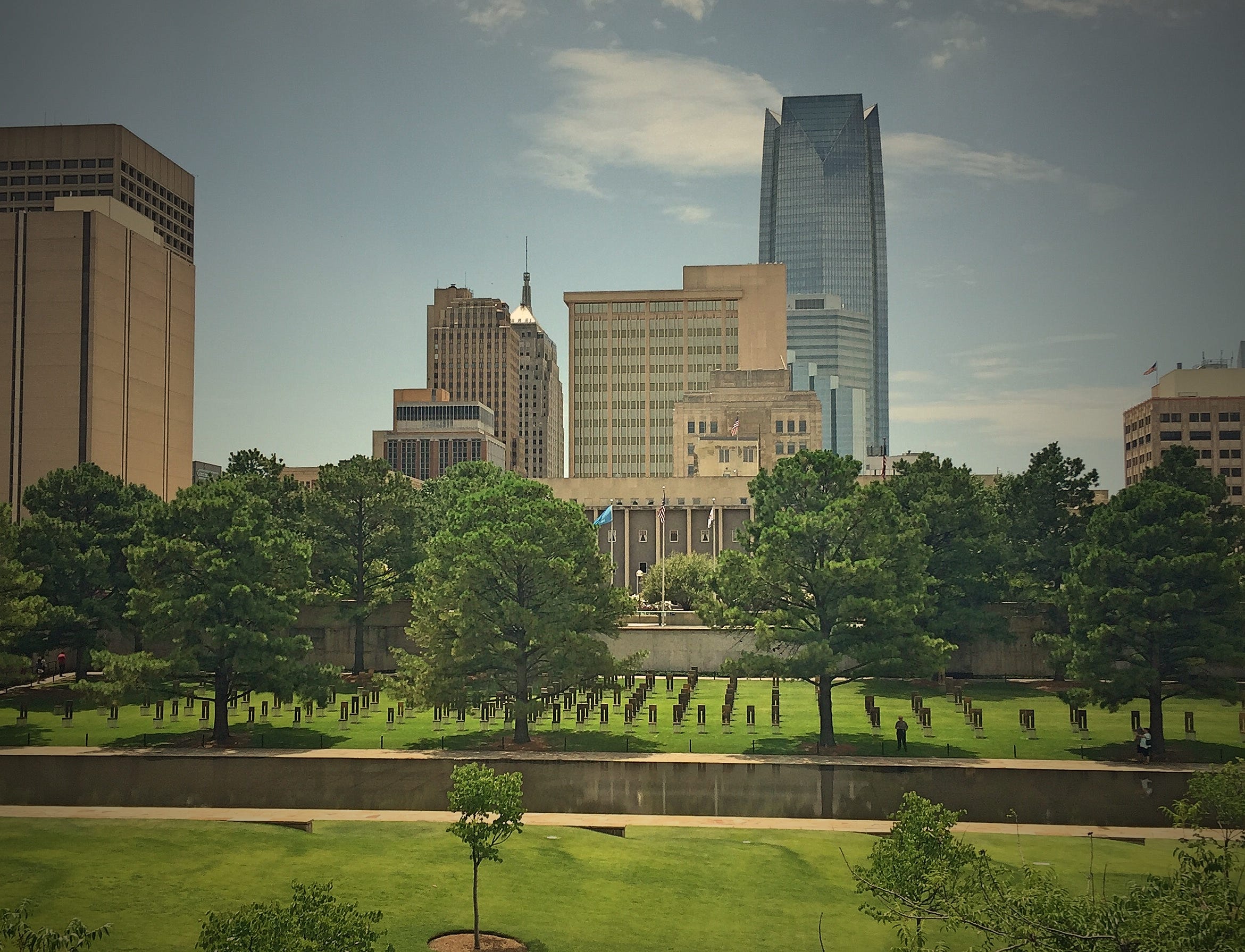
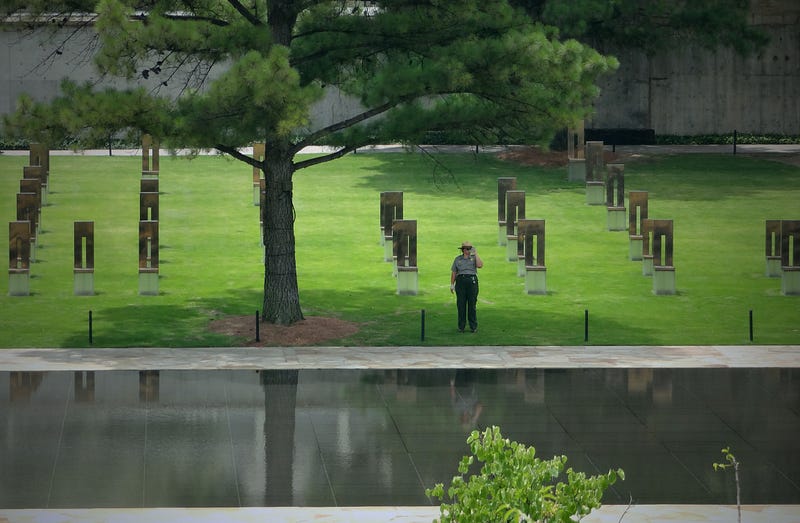
Oklahoma City National Memorial Photo by Terrye Turpin
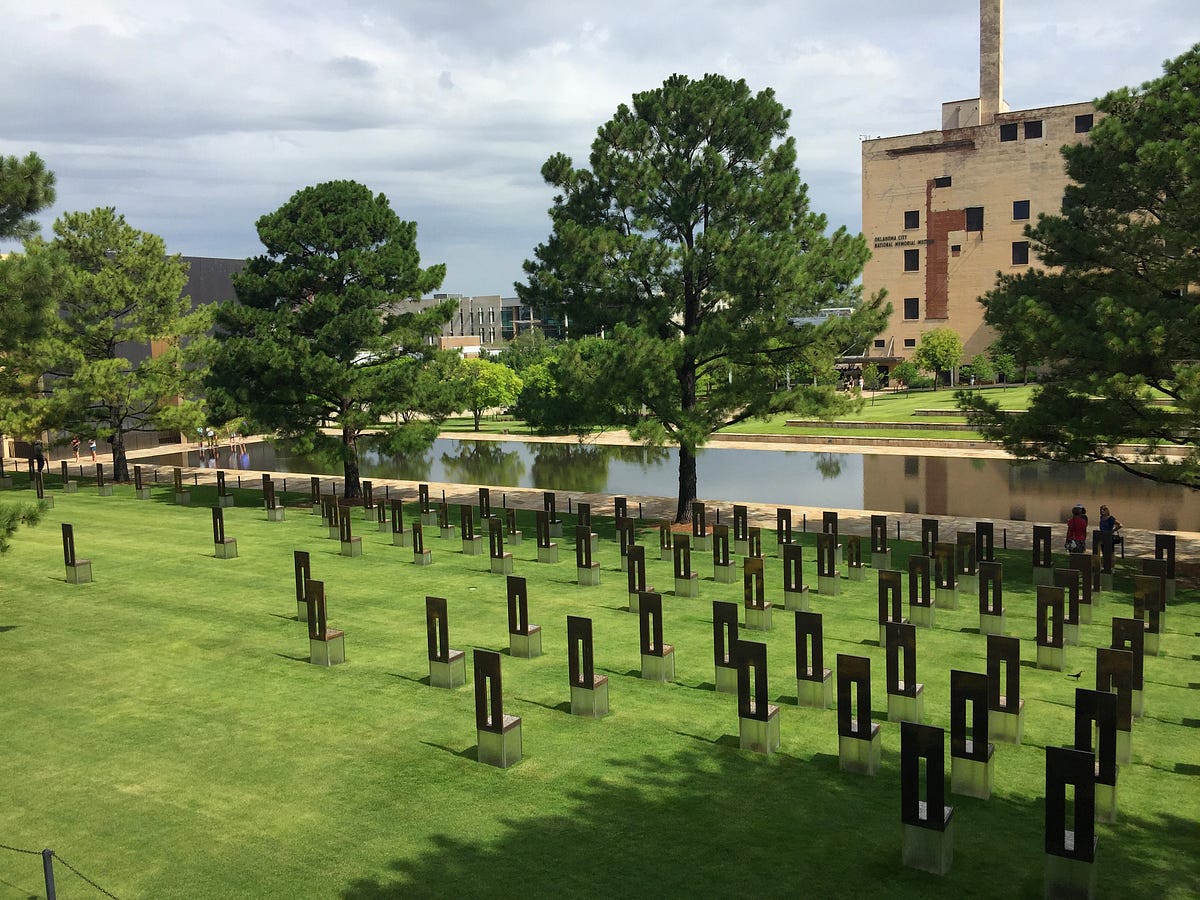
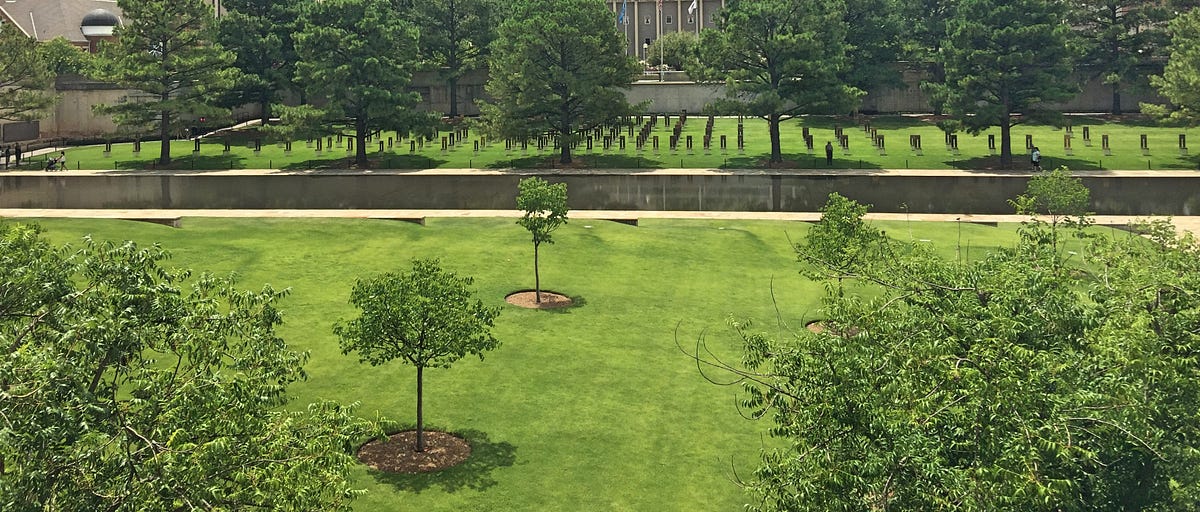
168 bronze and glass chairs, arranged in 9 rows, stretched across the green field.
My fiance Andrew and I drove up to Oklahoma City the day before, a Friday, and spent an endless, tiring day at the car dealership where Andrew negotiated the purchase of used BMW. I fidgeted in the vinyl covered chairs in the customer lounge, read books and checked my email.
The dealership offered free sodas and I spent the afternoon wandering between the bathroom and the soda machine. Engrossed in the book I was reading, I knocked a full cup of ice and cola onto the floor then sat there as the puddle crept toward my feet. Andrew found paper towels in the men’s room and mopped up the mess while I glanced to see if anyone else in the sparkling showroom had noticed.
We went for a test drive in the car, a 2009 BMW 128i series in Montego Blue, a color so electric brilliant I felt a small static shock walking up to it. I settled in the passenger seat and watched the highway exit signs flash past, too quick to read. After the purchase I followed in my SUV as Andrew drove back to our hotel. The bright blue sedan weaved through stodgy trucks and cars like a songbird.
The next day we visited the Oklahoma City National Memorial.
Field of Chairs Photo by Terrye Turpin
The chairs represent the empty places at dinner tables for each of the 168 people who died in the bombing of the Alfred P. Murrah Federal Building in downtown Oklahoma City on April 19, 1995. There are nine rows, corresponding to the nine floors of the building. Each chair is positioned according to the floor where each of the lost perished. There are five chairs in a separate row, symbolizing the five victims killed outside the building.
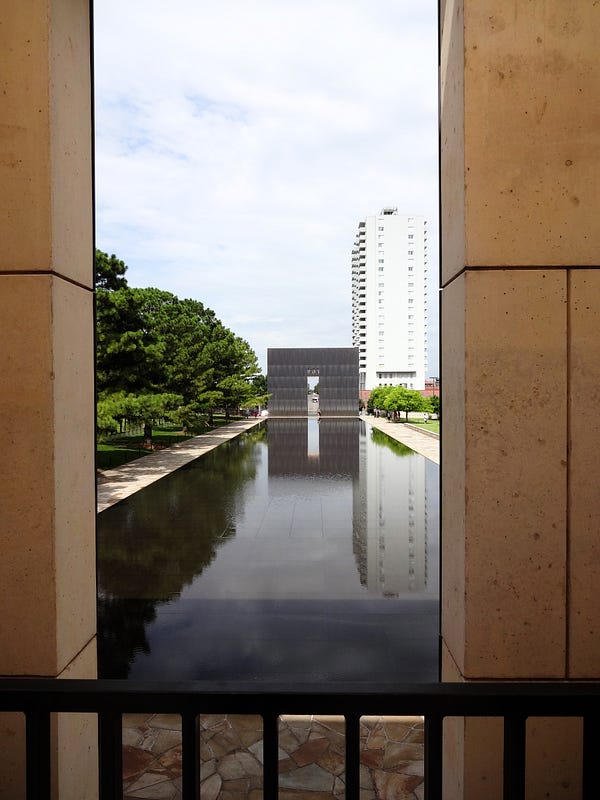
The West Gate and the Reflecting Pool Photo by Terrye Turpin
Looking out from the East Gate Photo by Terrye Turpin
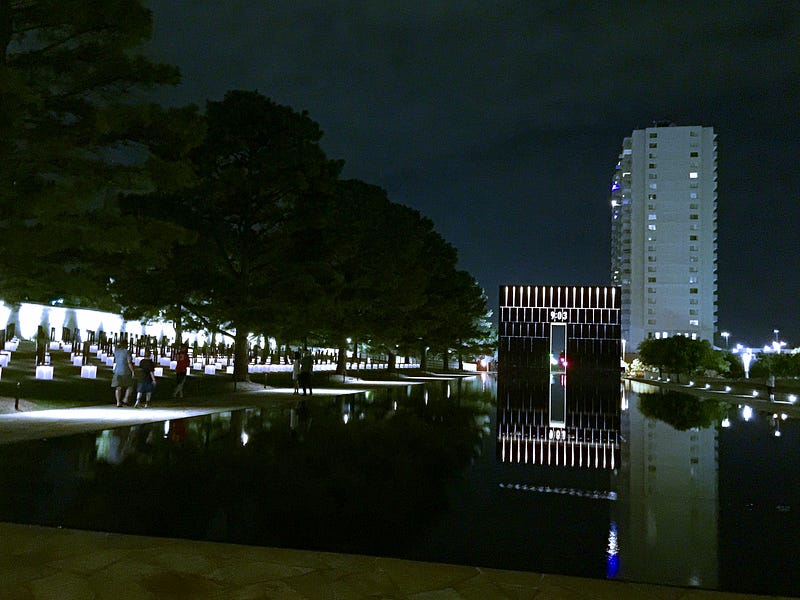
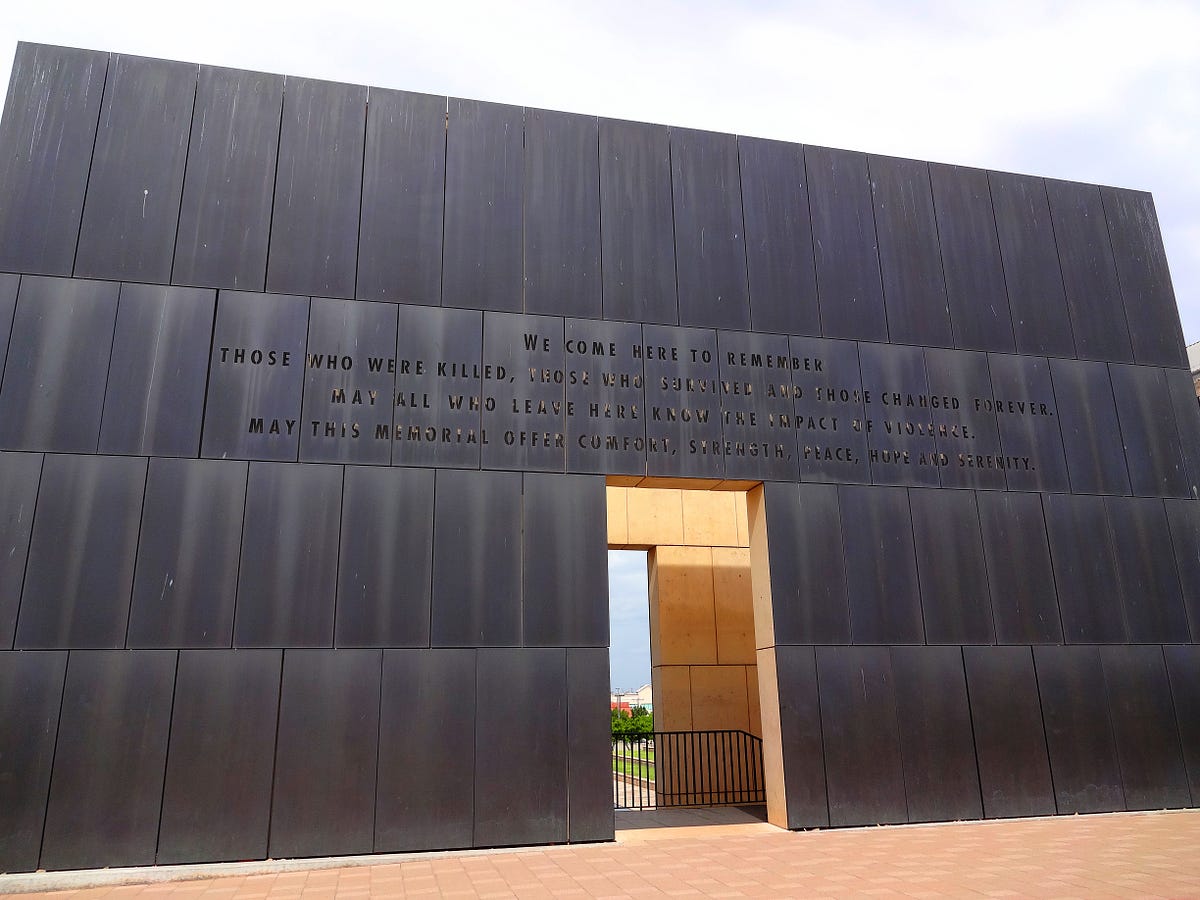
Two gates flank the memorial grounds. The East Gate displays the time 9:01, just before the bomb went off at 9:02 am that day. The West Gate displays 9:03, the time immediately after, when healing and rebuilding began.
A reflecting pool covers the area that once was the street in front of the building. The bomber drove a rented truck down NW 5th street, past the tall apartment building, and parked in front of the doors on the north side of the building.
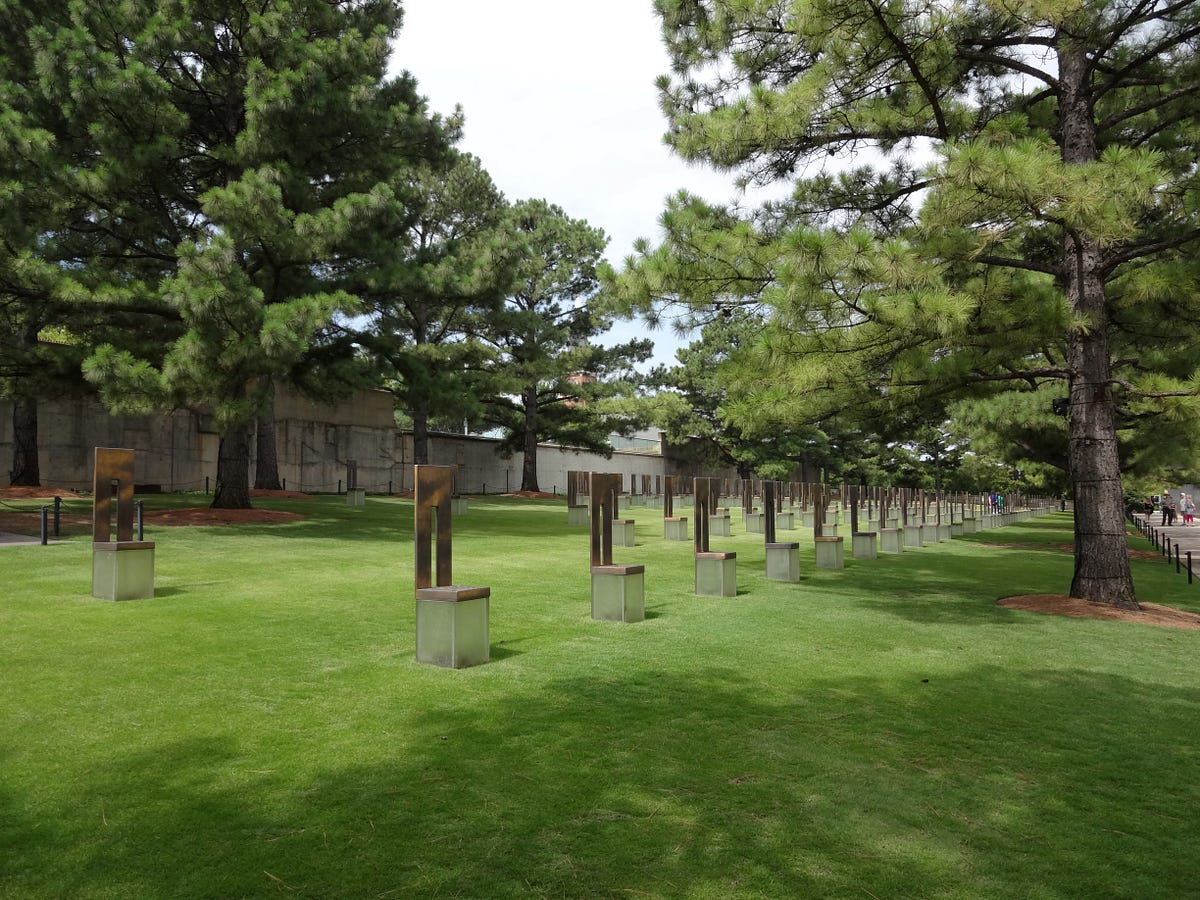
The granite walkway surrounding the field is constructed in part from rubble salvaged from the site.
Field of Chairs Photo by Terrye Turpin
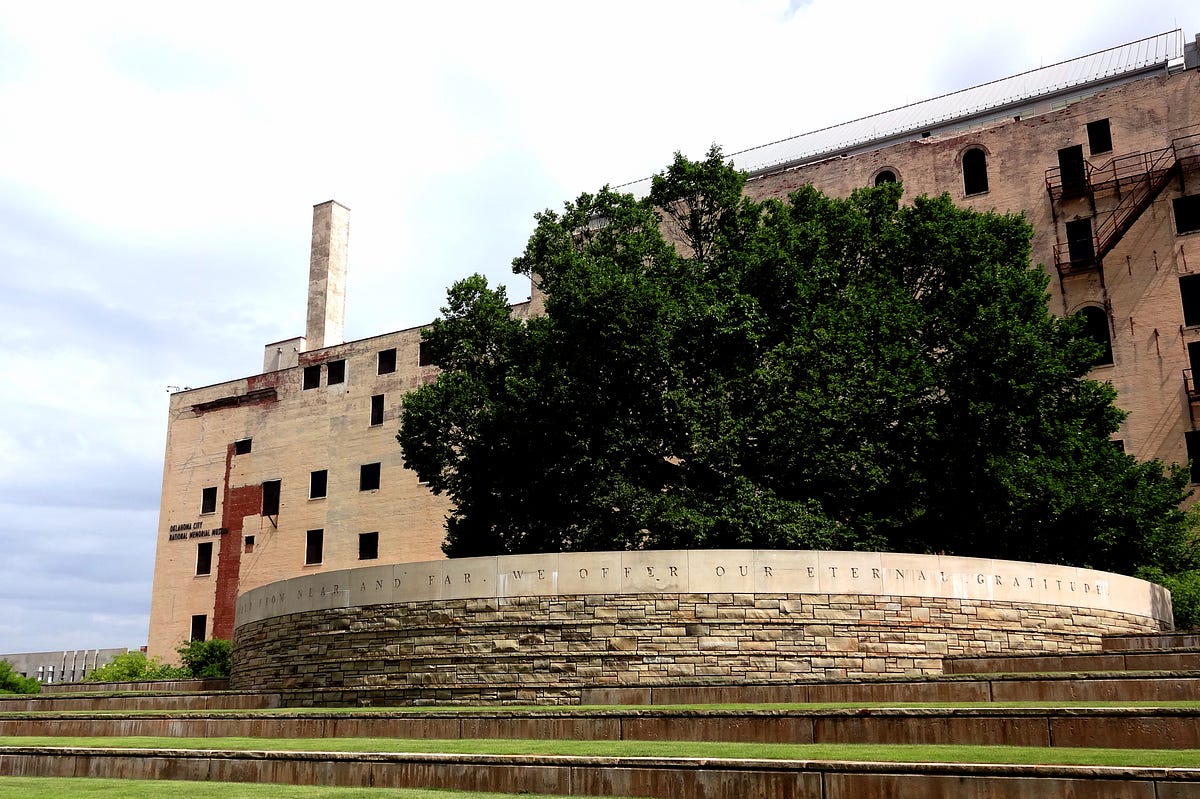
The field outlines the footprint of the Alfred P. Murrah building. The jagged outcroppings in the south wall are parts of the original building. The only walls remaining are on the east end of the memorial, where slabs of granite bear the names of the more than 1,000 who survived that day.
A portion of the Rescuer Orchard Photo by Terrye Turpin
The Rescuer’s Orchard represents the more than 12,000 people who responded that day, many within minutes of the explosion. One nurse, Rebecca Anderson, lost her life in the aftermath as she collapsed while rescuing survivors. The bronze and glass chair etched with her name stands with the five others in the row at the end of the field.
The Survivor Oak Photo by Terrye Turpin
At the east end of the Rescuer’s Orchard stands the 100 year old American Elm known as the Survivor Tree. It stood in the gravel parking lot directly in front of the Murrah building. Damaged in the blast and surrounded by burning cars, the tree was expected to die, but it recovered.
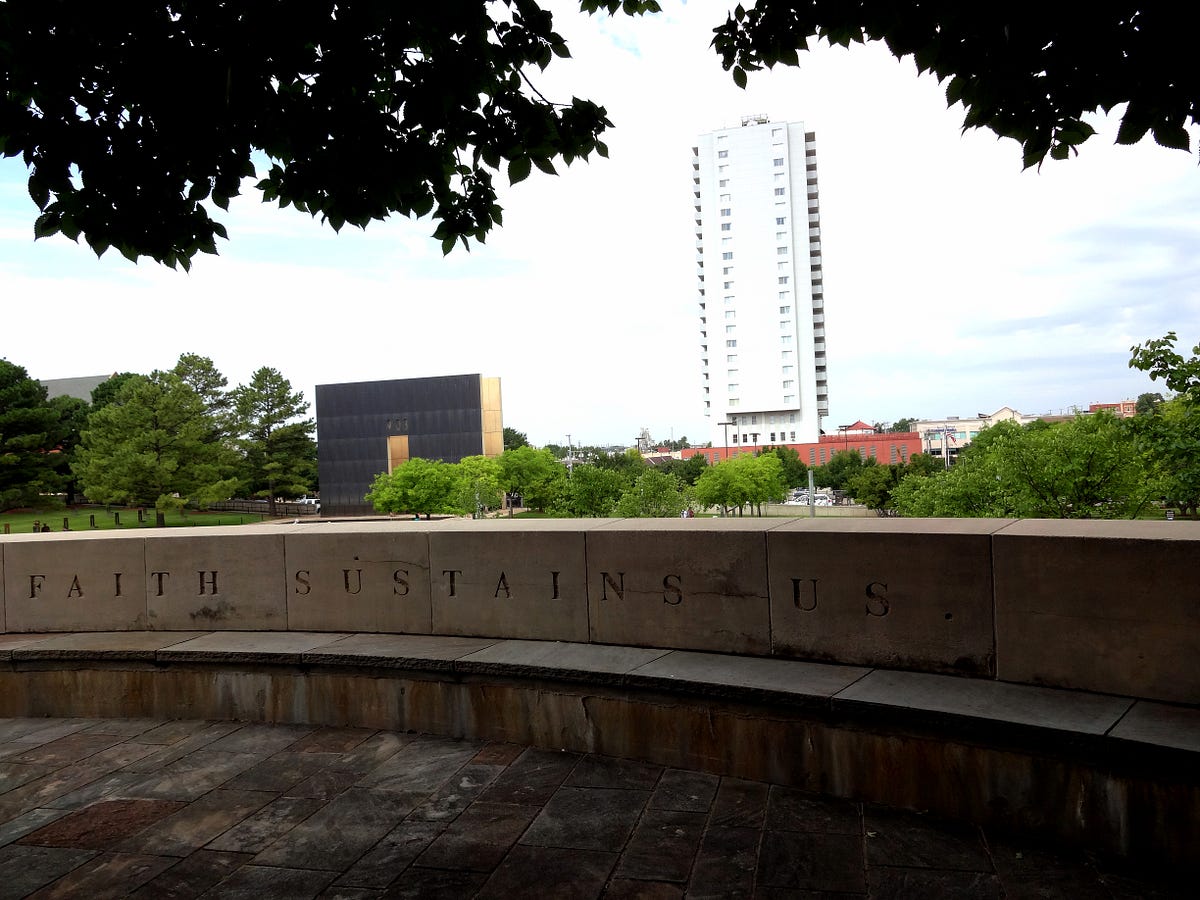
Inscription at the Survivor Tree Photo by Terrye Turpin
“The spirit of this city and this nation will not be defeated; our deeply rooted faith sustains us.” Inscription surrounding the Survivor Tree.
We walked around the grounds outside until the hot afternoon summer sun urged us into the air conditioned museum.
Photo by Terrye Turpin
Inside the museum we watched video interviews with survivors, investigators, and rescuers. Glass display cases held items gathered from the site — eyeglasses, car keys, shoes, toys, and pens. One case held a dress worn by one of the survivors, a small tear the only damage to the fabric. The same case also held a plastic baggy bulging with bits of cloth pulled from the body of another survivor. Their location when the bomb went off determined the extent of their injuries. A trip down the hall to the restroom or a chore at the copy machine literally meant the difference between life and death for some.
We, the visitors, gathered in a small room and sat on a padded bench pushed against the wall. Across from us a tape recorder enclosed in a clear case sat on a wooden table. It was easy to imagine the people gathered there that day, shuffling papers and scooting closer in the government issued straight back chairs that front the table. We listened to a taped recording from the Water Board Hearing held that day. The Oklahoma Water Resources Board building, located directly across from the Alfred P. Murrah Federal Building, was damaged in the blast and demolished. The taped meeting, a record of the events from that morning, was preserved.
A female voice on the tape announces the time and date for the record, 9:00 AM on April 19, 1995, and calls the hearing to order. The plaintiff, a man seeking a permit to sell water from his land, speaks up to confirm his presence. Fluorescent lights buzz above us as the voices on the tape drone on with the minutia of a government proceeding. We, the audience, know what is coming. I hold my breath and count off the seconds, my heart rate accelerating as I think surely it is past the time. I anticipate the blast, but when it comes I jump. The roar of sound and the frightened cries of the people on the tape do not resemble any special effects I have ever heard. The screen behind the table holding the tape recorder lights up with the images of the 168 lives lost that day.
Photo by Terrye Turpin
Photo by Terrye Turpin
We left the memorial and walked four hot concrete blocks to the Oklahoma City Museum of Art.
“Art washes from the soul the dust of everyday life.” ~ Pablo Picasso
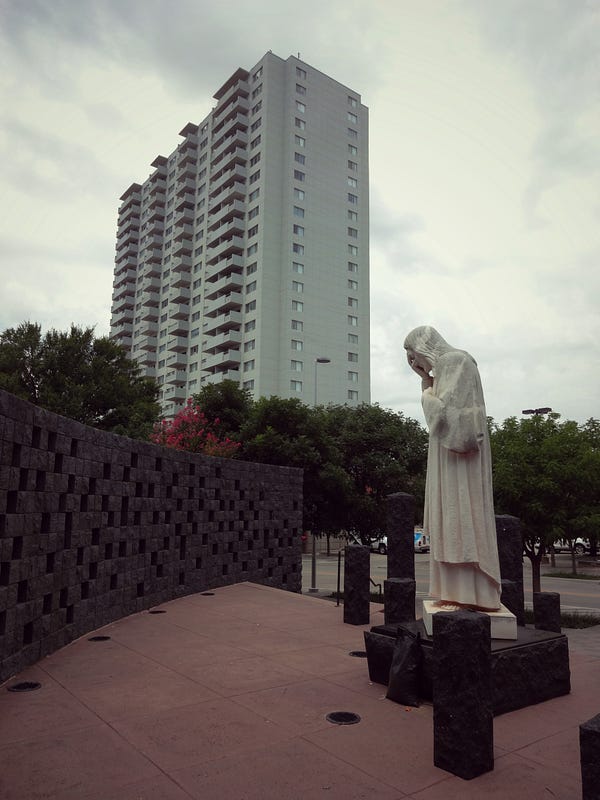
Jesus wept. John 11:35
We napped in the air conditioning of our hotel then returned to the memorial that evening.
The East Gate 9:01 Photo by Terrye Turpin
The memorial grounds are open 24 hours and are lighted at night.
The West Gate 9:03 Photo by Terrye Turpin
We strolled through the rows of chairs in their ghostly light. A group of people, a mother with short dark hair and her two teenage sons, stopped us to ask about the chairs.
“There are nine rows. They stand for the nine floors of the building and the chairs are placed according to where each victim was that day,” I explain. My voice carries over the still night air, rising as I grow absorbed in my description of the field and what we learned that morning at the museum. I wave my arms at the gates and tell about the reflecting pool that covers the street where he parked that day. I do not mention that the last three bodies were not recovered until May 27, 1995, 38 days after the bombing. We are standing on sacred ground.
“The smaller chairs are for the children who died in the blast.” My voice drops with this last.
“Children?” the woman asks.
“There were two daycare centers in the building,” I answer. The woman nods. The teenage boys stand silent and still. I do not tell her that several of the children had to be identified from latent prints lifted from their homes.
“You should come back tomorrow to the museum,” I add and she agrees.
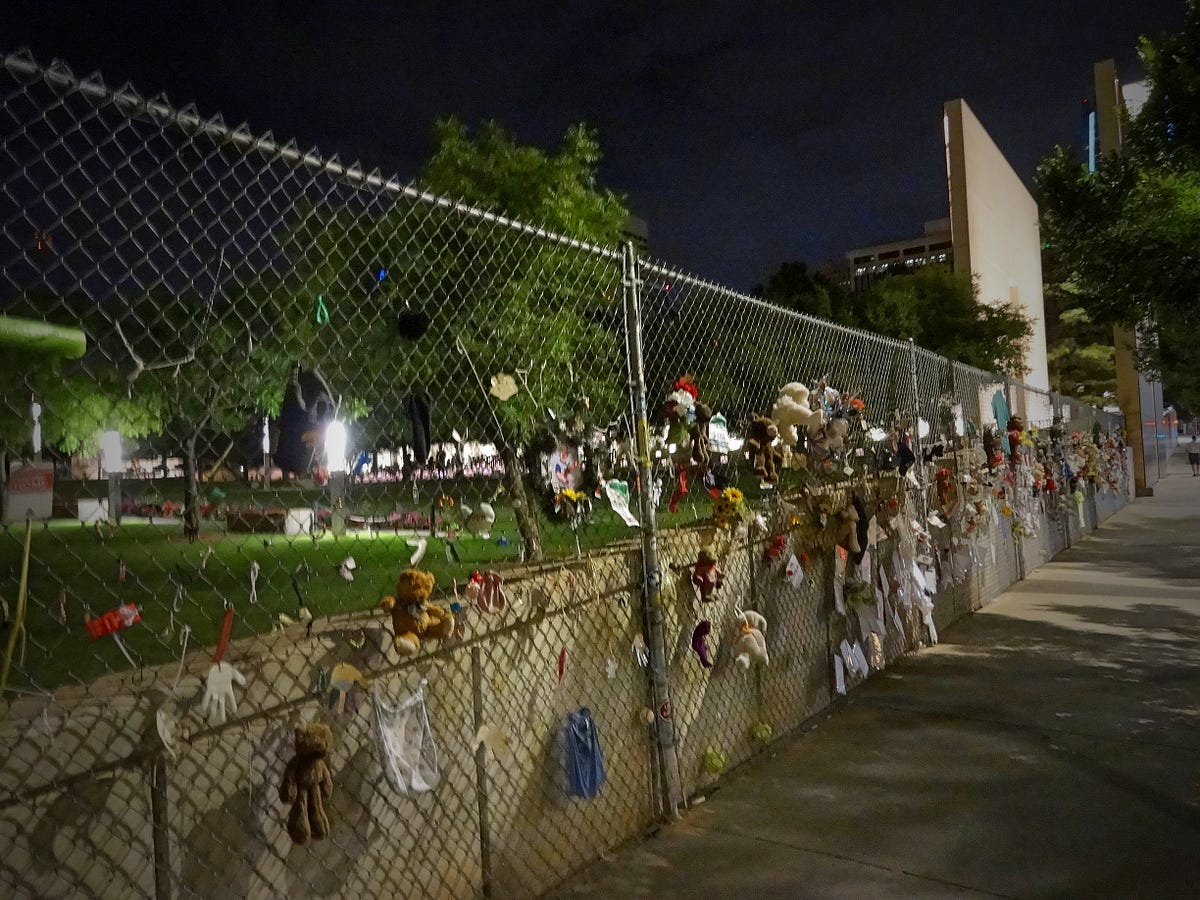
Fence at the Oklahoma City National Memorial Photo by Terrye Turpin
At the West Gate there is 200 feet of the original chain link fence that enclosed the bomb site. The fence is preserved so that visitors can leave items for remembrance. Periodically the tokens are removed and stored at the museum, which now holds more than 60,000 of these items.
Inscription on the West Gate Photo by Terrye Turpin
Park Ranger Photo by Terrye Turpin
We left Oklahoma City on Sunday and I followed the blue BMW until I lost sight of the car amid the flow of traffic headed south. Monday morning I returned to work, drank my coffee, chatted with coworkers, sent emails, made copies and visited the ladies room. A day like any other day.
I packed up my apartment in one afternoon, amazed at the amount and the variety of useless stuff I collected in fourteen months. Some of it I had when I moved in, but not the one hundred plus ketchup packets or the fifty little plastic sleeves of soy sauce. I certainly didn’t remember owning hundreds of clothes hangers. It’s funny the items you consider worthwhile when you are choosing which to leave and which to take. Two of my possessions I consider valuable enough to be the first on the “keep” list — a small statuette of a sad dog in a Boy Scout uniform, and my 1958 Barbie doll.
Photo by Terrye Turpin
The ceramic dog was a present from my father. By the time I came along he no longer led a scout troop, but I liked the little statue and asked him for it. The Barbie doll might be worth some money if her feet weren’t marked with the imprint of my childish teeth. Barbie and the little dog were among the first things I took out of the home I left to my ex-husband.
The more stuff you own the more dusting you need to do. If I could, I would reduce all my possessions down to what would fit into a backpack. I could make do with a travois I guess and drag the lot along behind me. I fled a twenty-five-year marriage with just what fit into my car, plus a futon. A small price to pay for a quick retreat.
Three months after I appeared alone in court to finalize the divorce, my ex-husband’s sister asked if I wanted anything from the house. They were selling it in a last gasp effort to avoid foreclosure. I brought friends, boxes, and a pickup and arrived to find the front door of the house covered in plywood. Law enforcement had kicked in the door, looking for a man my ex had let stay at the house. We loaded up photo albums, dishes, books, odds and ends I thought I might want.
I wound up with a collection of novelty coffee mugs, a flock of ceramic roosters and chickens, battered pots and pans with loose handles, puzzles, games, blankets, paperback books and bookcases–it grew exhausting dragging it all along behind me. I decided to hold a garage sale. I convinced my son, Andy, that he should let me hold the sale at his house by offering to split the proceeds with him.
I’ve lived long enough to have suffered through several garage sales, they seem to come in ten-year cycles, like a plague of locusts. The day of the big event I set up in Andy’s driveway with a cup of coffee and watched the sun rise while our first customer arrived. The woman struggled out of the passenger seat of an older model pickup truck with a bed piled high with used furniture. She ambled toward me and asked “Is your lawnmower for sale?”
I explained that we didn’t own a lawnmower, let alone have one for sale, and she huffed, turned around, and walked swaying back to the truck. The treasure hunters appeared. They rummaged through the mismatched coffee mugs, torn sheets and worn out bath towels, boxes of puzzles with just one piece missing, and clocks that no longer worked. They turned to ask, “You got any gold or silver jewelry?”
I had my wedding ring, but I didn’t sell it. Not then. I kept it stashed in a wooden jewelry box for a year after the divorce. I sold it at a store front with a large black and yellow banner proclaiming “We Buy Gold! Silver! Top Dollar!”
Each item that sold meant one less thing to pack up and move. I felt lighter as the boxes of knick-knacks, throw rugs, and collections of paperback books left with each buyer. I had been carrying the weight of these things for years. By ten o’clock on the second day of the sale I was down to several dozen coffee mugs, some pots and pans, a used television antennae, and a warped dresser with loose knobs and sticky drawers.
Andy joined me on the driveway as we watched people cruise by, checking out the remnants from the safety and air conditioning of their cars. Our last customers were a pair of older Hispanic men who paid two dollars for a dozen coffee mugs. Before they left, they asked if we would like to buy some tamales. The men led us to their car, parked at the curb in front of the house. They popped the trunk and lifted a foil wrapped bundle from a red plastic cooler. The tamales were warm, fragrant with chili and garlic. My son and I closed our enterprise. We packed up the left-over goods to donate to charity and placed the bulkier stuff out by the curb with a sign that read “Free.”
I still have the Barbie doll and the ceramic dog. The other things I own do not all fit in a backpack and I doubt I could get it all into my SUV. The possessions we own and the memories they contain can weight us down and bind us in one place like anchors, keeping us from moving on toward a better destination. And sometimes our things act as ballast, giving our life balance, reminding us of where we came from and holding us steady on our course.
I hesitated in the candlelight in front of the locked metal gate seven hundred and fifty feet underground. The cave was slightly warmer than the inside of a refrigerator and smelled of mildew and the earthy scent of bat guano. As I inhaled the cool, moist air I glanced around me at the dark rock walls. My fiancé Andrew waited beside me, listening to the gray-haired park ranger give our small group last minute safety instructions. At the end of his speech, the ranger mentioned a story about a kidnapping in the cavern. Four armed men held several people captive for hours near the spot where we stood. Had I paid better attention, I would have heard him say this crime occurred in 1979. I was, however, busy calculating how long the candle in my lantern would burn before it left me in the dark.
I glanced at my fellow tourists and tried to imagine one of them pulling out a gun. The flannel clad young couple in running shoes had two small children with them, so I expected they would behave. The retirees from Florida, dressed in matching Hawaiian shirts, did not look menacing. I decided at the least I could outrun them if they turned out to be dangerous.
Andrew and I chose this tour from the comfort of our home, weeks before our trip to New Mexico, and we bought the tickets online. I don’t mind spontaneity, but my first love is a well-planned itinerary. I browsed the options listed on the Carlsbad Caverns website and rejected the “Spider Cave Tour” based on the name alone. Andrew lobbied for the “Lower Cave Tour”, but after spotting the words “crawling” and “rope ladders” in the description, I knew this would not work for me. When I was a child I broke my arm, swinging from a plastic jump rope tied to a tree. I didn’t think the experience would improve if I recreated it underground fifty years later.
“I wonder if they have a senior discount,” I asked, as I clicked through the Park Service website.
“Oh no, don’t fool with that, just pay full price,” Andrew insisted.
I am happy to accept any age related savings given, while Andrew searches for and plucks out his gray hairs each evening. I once offered to sign him up under my AARP membership, and you would think I had volunteered to donate one of his kidneys.
After some discussion, we agreed on the Left Hand Tunnel tour. It promised to recreate the caving experience of early explorers. The only warning listed described walking on uneven surfaces in dim lighting. I can find my way to our bathroom in the middle of the night, so I thought I would be okay.
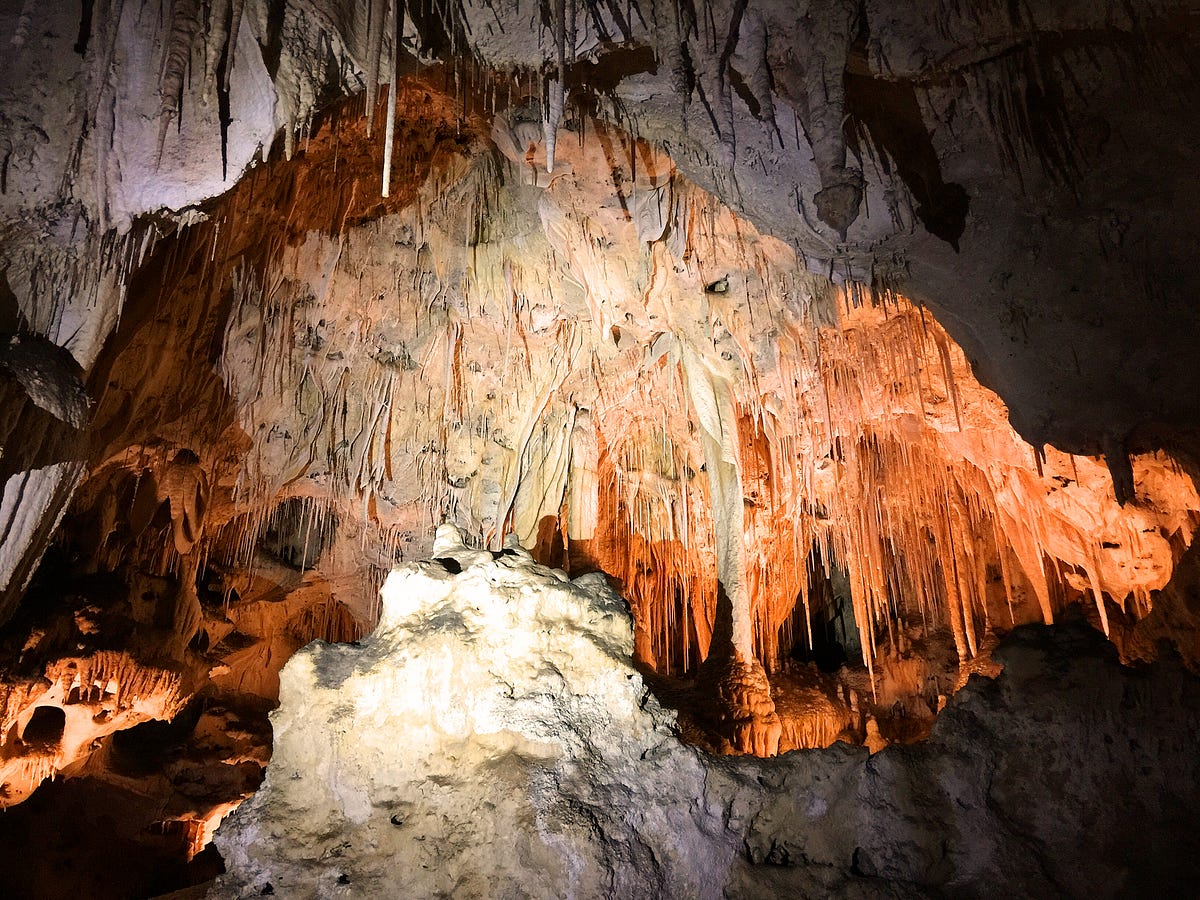
Photo by Terrye Turpin
When we arrived at Carlsbad, Andrew tried again to convince me I had the skill and flexibility to navigate the Lower Cave Tour. As we strolled along the paved path through the main cavern, the Big Room, we stopped to peer over the railing, down into the deeper portion of the cave. A narrow dirt path wound through stalagmites and disappeared through a dark opening in the cave wall below. Lovely formations like lacy curtains flowed from the ceiling, but I wondered how securely they were attached. “Crushed by beauty” might be a nice epitaph, but would be small consolation once I was buried.
“I don’t think I can climb down a rope ladder, and there are no lights down there.” I pointed over the side. In contrast, spotlights in the Big Room illuminated both the cave formations, and the paved trail with gentle lighting. There were no rope ladders in sight. Instead, people traveled up and down in elevators, dined at a snack bar, and relieved themselves in restrooms with running water and flush toilets. Still, it touched me that Andrew had this faith in me; that I could scamper down a rope ladder and crawl through bat infested tunnels in the dark. We pledged to grow old together even though I have a head start.
When Andrew and I first met our age difference didn’t matter. We seemed to be in that sweet spot of time between middle age and infirmity. However, I remember that I will retire eleven years before he does. I agonize over broken hips, and Andrew scoffs I am too young to worry about falling.
While we waited for the tour orientation to start, I looked at a photo display of early explorers to the caverns. The women wore their finest silk dresses and caps with feathers. I wondered how they managed the cave while wearing high heels. The men wore sensible loafers and looked dashing in wool overcoats and fedoras. All of them looked out of place as they dropped into the cavern in the large bat guano mining buckets used by visitors before the cavern upgraded to wooden stairs.
“How historically accurate is this tour? Will they lower us down in a bucket?” Andrew asked.
“No, I believe they phased that out,” I replied.
As we assembled in a small classroom, the park ranger who would lead the tour checked off our names. He asked us to affirm our ability to walk across a dim, rough dirt path. I felt confident about my “Yes!” until he opened a metal cabinet filled with hard hats, elbow pads, and head lamps, things a coal miner would use. When he took out a box of candles and left the crawling equipment in the cabinet, I sighed and sat back in my chair. We all lined up to select a candle, and I picked one with a fresh wick that looked like it would last until the end of the tour.
After the orientation, we rode the elevator down, and walked over to the Left Hand Tunnel entrance. We picked up our lanterns, and the ranger lit the candles placed inside. He warned us of the danger of spilling hot wax on our neighbors or the fragile cave formations and off we went.
As we entered the tunnel, my eyes adjusted to the dim light. I managed to spot my feet, fearful that I might wipe out a small, irreplaceable artifact with my sturdy hiking boots. We came to a slight incline in the path, a slick little hill about four feet tall, and the ranger offered a hand up and over to anyone who needed it. I hadn’t met my insurance deductible for the year, so I accepted. Everyone else–except the elderly couple from Florida — scrambled up and over the top as though they were stepping up onto a curb outside Starbucks.
The lantern did a fair job of lighting up a one foot perimeter of the cave around my feet, so I had a great view of the crushed rock on the dirt path. I kept my eyes trained on that path as the ranger mentioned the deep pools of water and the steep drop offs that we passed. I listened as he described other points of interest, the sparkling pyrites and ghostly pale calcium carbonate formations. When I felt steady enough, I lifted my gaze from my feet and focused on the backs of Andrew’s legs as he strode along. At one point we stopped and the ranger pointed out an area where an early visitor used a flare to burn their initials into the cave wall, proving that even decades ago people were assholes.
About halfway through the tour we came to a spot leveled out by thousands of tromping tourist feet, and we set down our lanterns. The ranger continued the kidnapping story he mentioned at the start of the tour. It turns out there was alcohol involved, which explains why the would-be terrorists thought it was a good idea to isolate themselves 750 feet underground and demand a million dollars, an airplane to Brazil, and an interview with a reporter. They got the interview, but not the money or airplane, and everyone came out of the cave without injury.
“With your permission, I’d like to do something exciting now,” The ranger said. I worried that here at last we would be asked to rappel down an underground crevice or scale a rock outcropping. I prepared to protest that the tour description failed to cover this.
“I’d like us to blow out our candles and experience the cave in total darkness.” When no one objected, he continued. “We will stand here in silence and then I will come around and light your candles.”
I breathed a sigh, standing still I could do, even in the dark. The cave dimmed as each person blew out their candle, and one by one I watched my fellow tourists disappear. The darkness enveloped me like a soft, thick blanket, and there were no sounds of trouble, no heavy breathing or whispers from a drawn pistol.
When the ranger suggested that we each hold up a hand in front of our face, I kept mine at my side, fearful if I couldn’t see it, then my hand would cease to exist. I knew my hand was there, I felt it dangling at the end of my arm, but it was disconcerting to know something was there but not be able to see the physical proof of its existence. This was the price I paid for a lifetime of reading scary stories.
A slight breeze brushed my cheek, and I heard a rustling, flapping sound that was either a bat brushing by or Andrew waving his hand in front of my face. I bumped him with my shoulder and he reached down to clasp my hand. My fingers intertwined with his while the ranger came around to each of us and relit our candles. We made our way back along the path, through the metal gate at the entrance to the tunnel, and dropped off our lanterns at the end of the tour.
When we stepped off the elevator at the surface, I left to browse the overpriced souvenirs in the gift shop while Andrew stopped to look over a table top diorama of the caverns. I came out to see him studying a map of the Lower Cave.
When I turned fifty, I traded in the recklessness of my youth. I chose my clothes for comfort rather than sex appeal. Then I met Andrew, and I took a chance on dating a man eleven years younger than me. Chance implies a risk of loss, but as we grew closer, I realized there was no risk here. The loss was in the years before we met. Here was a man who would find my hand in the dark.
I pointed over to the information desk. “Why don’t we stop and see if there are tickets for the Lower Cave tour?”
When we asked, the ranger informed us that there wouldn’t be another tour until the following week. “It sells out quickly” he told us, “It’s our most popular tour.”
“I’m sorry.” I told Andrew and tried to hide my relief. There is nothing like reaping the benefit of sacrifice, without actually having to make it.
“That’s okay.” Andrew said, “We will come back sometime. We can practice climbing up a rope ladder.”
I calculated how many years we would have to wait before I qualified for the National Park Senior Pass. I pictured a much older me, leaning on a walker with one of those cloth bags on the front to hold snacks and a book I was reading. I told Andrew I would be game to try the rope ladder, and he took my hand as we walked across the parking lot to our car. If the rope ladder doesn’t work out I thought, maybe they could just lower me down in a bucket.
We arrived in San Saba, Texas, the Pecan Capital of the World, in the hot late afternoon, in time to check into our hotel and stash the packs filled with what we thought we’d need for the weekend. My fiancé, Andrew, and I wandered down the small town street while I sipped a cup of coffee from a waxed paper cup. Our reflections cast back in mirrored glass and revealed a late middle-aged couple dressed in comfortable, travel wrinkled clothes. We stretched our legs and popped joints stiff from the three hour drive. We did our best to outwit the Texas sunshine by dodging along the shade cast on the sidewalk from awnings over businesses closed for the holiday weekend. I set down the paperboard cup at last to step through the doorway and into Harry’s Boots.
Photo by Terrye Turpin
The store, established in 1939, seemed to fill half the city block. Shelves and racks lured shoppers with pearl snapped and buttoned western shirts in peacock colors or solemn, solid dyes. Sturdy denim jeans, in every size that man or woman might exist, lay neatly stacked and folded into cubbies along the walls. But the main attractions, and those which filled the space with the heady fragrance of leather and the clean, sharp scent of saddle soap and polish, were the boots.
Boots in sizes dainty through durable, made from every type of hide imaginable. Boots from alligator, ostrich, lizard, goat, buffalo, and rattlesnake. I would not miss this last, but I cringed to pick up a pair labeled “elephant.” We left after browsing through rooms crowned with hats, straw and Stetson, felt and ten gallon, fit for cowboys, cattle barons, and weekend tourists with money to spare.
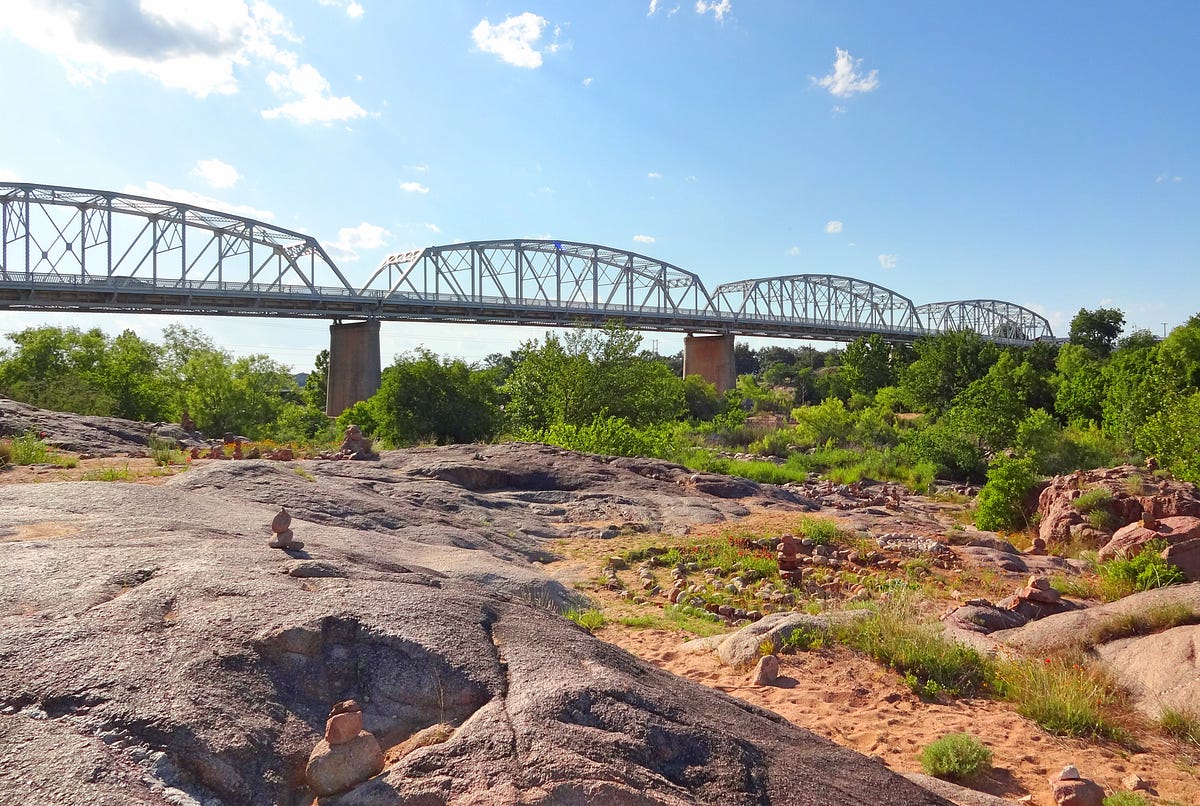
Bridge over the Llano River, photo by Terrye Turpin
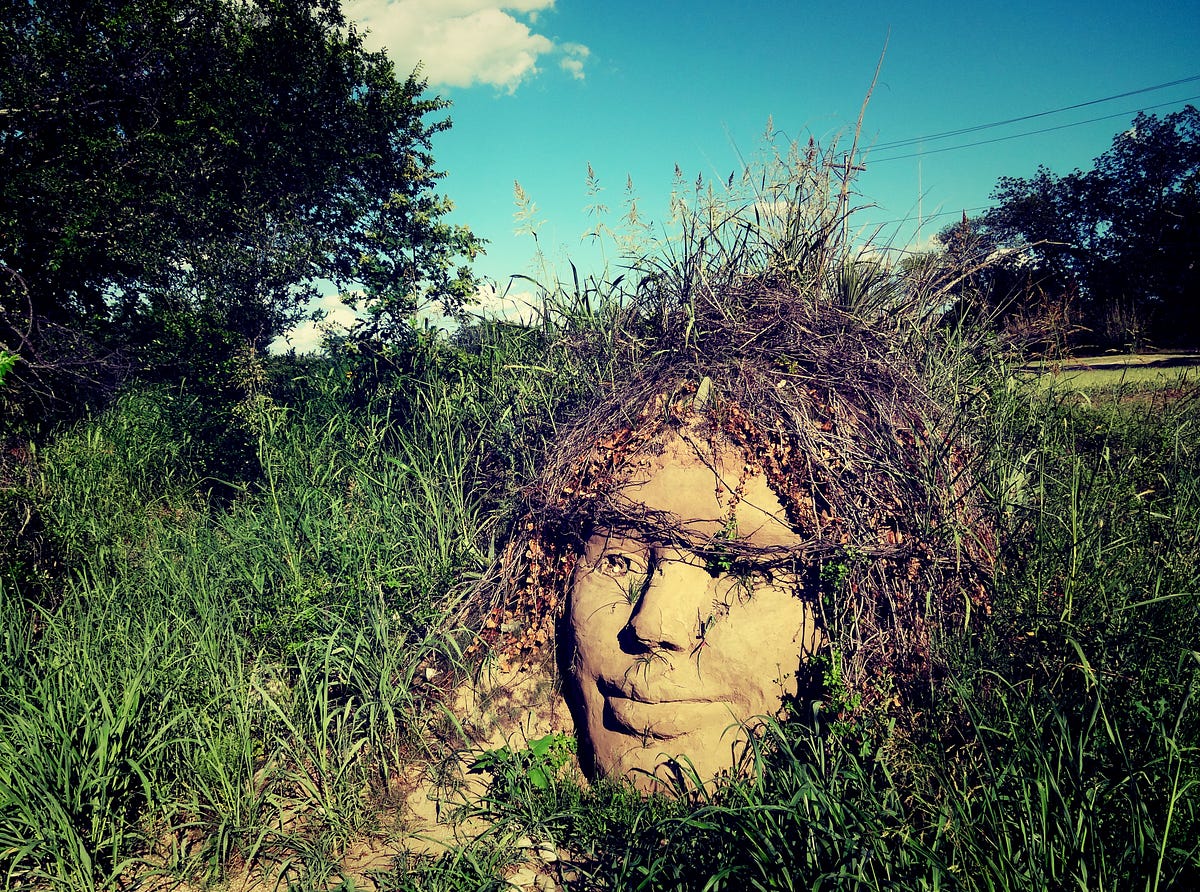
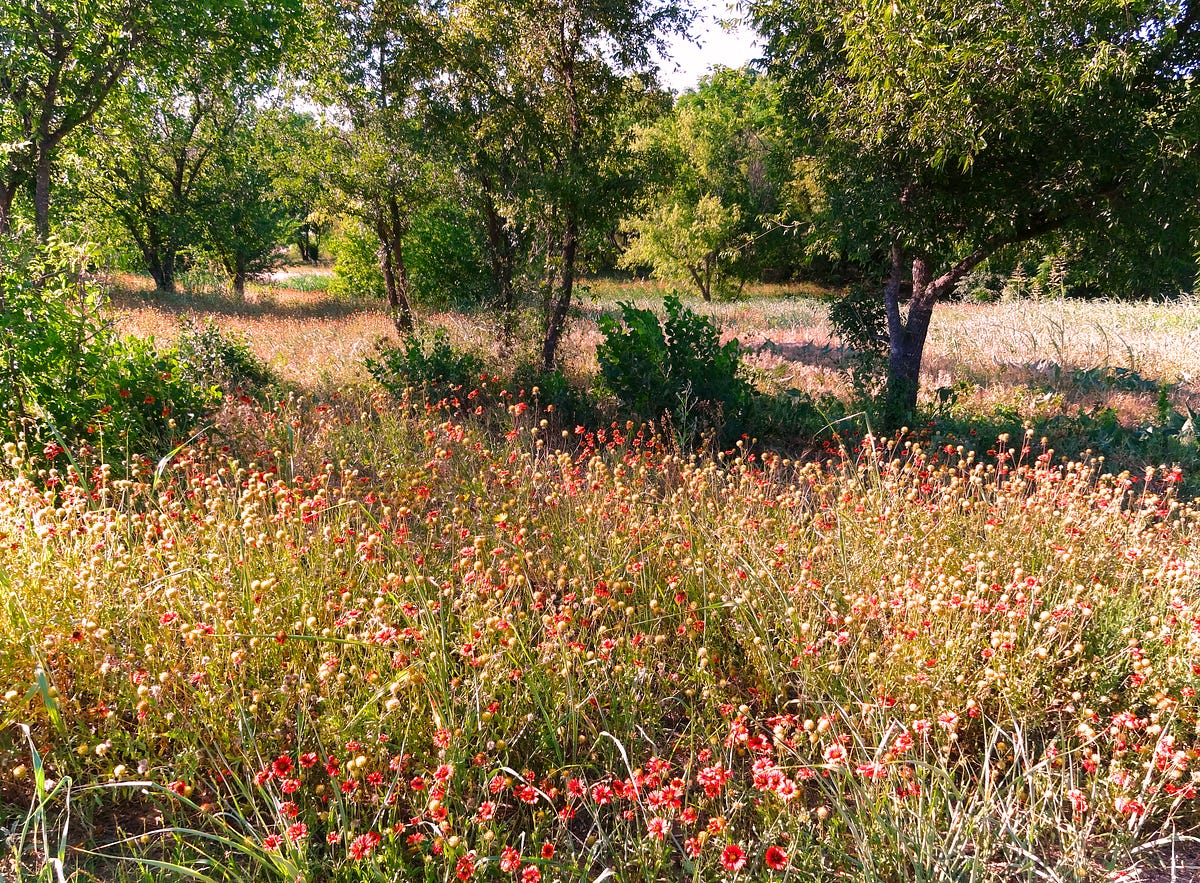
Too early for dinner, we cruised down the road to Llano, leaving the San Saba River behind and seeking the Llano in the city that bore its name. We hiked along the river bank and wondered at sculptures woven into the landscape, they seemed to have sprung up like the wildflowers, unassisted by human hands.
Photo by Terrye Turpin
Photo by Terrye Turpin
Back in San Saba we walked again, this time along a concrete trail through a park along a different river and through stands of pecan trees whose branches weaved overhead like lovers holding hands. Twilight came upon us while we bickered over which path led back to our car. Andrew held out his phone for a flashlight as we traced our steps back, past neon yellow bursts from fireflies waking to search for love. A family of deer lifted their ears and paused in their grazing to mutely ask what we thought we were up to, lingering so long near sundown.
Photo by Terrye Turpin
Photo by Terrye Turpin — Pecan trees in San Saba, Texas
Safely back in our room at the Dofflemyer Hotel, I pushed back the curtains to look down upon a street I imagined traveled by horses instead of Hondas. We turned in early after a snack of pecans roasted in butter and salt and left for us instead of mints on the pillow. I dreamed of Texas, a big land for sure, to hold those whose faith and fitness drew them here. Like the pecan I am native with roots that tap to green river water. If others wonder why I so long linger here, I’ll take a breath to remember the scent of leather boots, the charm of fireflies at dusk, and the graceful bend of prairie grass to wind.
The scar on my breast is a dark reddish brown, fading slowly at the edges. It is curved, like a parenthesis. There is a slight indentation, a flat spot under the blemish that shows when I stand in profile. The scar is hidden, even by my most revealing bathing suit. Most of the time I don’t even think about it, except when I’m undressed.
My usual routine when I can’t fall asleep consists of surfing the internet for cat memes and funny videos. The other night I sat up, bolstered on both sides by the collection of pillows my boyfriend and I have on our bed, and picked up my phone. The dark bedroom was lit by the tiny bluish glow from the screen, and I turned the volume down low so that Andrew wouldn’t hear and come in to remind me I had to get up early for work the next day.
I found a comedy sketch on YouTube that started with a woman entering a gym. Her dark hair piled on top of her head, she carries a gym bag over her arm as she walks up to the smiling young woman in a green polo shirt at the front desk. As she signs in an alarm sounds and the uniformed staffer stands up and congratulates the woman. The visitor has just turned forty, and the attendant leads her back to a special area that she is now entitled to enter. It is a changing room filled with naked women. They sprawl on benches and strut around the space without as much as a towel to hide behind. One of the women appears to be shaving her pubic hair. Another lifts her breasts and towels off underneath them. When the birthday girl protests that she’s not that comfortable with nudity, her clothes magically disappear and she’s left standing there, naked. She does, however, still have the gym bag over her arm. The other women gather around to welcome her to “not giving a shit at the gym.”
I have never been comfortable in locker rooms. I don’t like undressing in front of anyone unless they’re going to have sex with me or give me a medical exam. A changing room filled with other people has always necessitated contortions worthy of a gymnast or a Chinese acrobat. I can both remove and replace my bra without taking off my t-shirt. If I’m at the lake I can completely undress and put on a one piece bathing suit while wrapped in a beach towel. It’s not the scrutiny of strangers that bothers me, it’s being seen naked by someone I might encounter later at the grocery store.
Last year, I hesitated when one of my coworker friends invited me to come with her to a Korean spa. My friend is in her thirties, two decades younger than I am. She’s blonde, single, and a frequent shopper at Groupon, where she found a great deal on the spa visits.
“Isn’t there a lot of walking around naked at a Korean spa?” I asked her. It’s one thing to picture people without their clothes when you’re nervous about giving a presentation, but it’s another thing entirely to know exactly what they look like without their underwear. After my friend assured me that the mineral baths were the only area where nudity was required, I went with her, but I arrived later and undressed by myself in a different part of the locker room. I put on the baggy pink shirt and shorts assigned to me by the spa, and wore my bathing suit underneath.
When I told my son Robert about my visit, he encouraged me to go back and try out the mineral baths. “The nude part is no big deal, Mom” he said. Robert makes his living as a plumber, a job requiring both physical skill and tolerance for messy situations. My son is very comfortable with his body. One Christmas he arrived at a gathering of friends and family and announced “I have a new piercing!” I often wish I had his confidence, and that he had my tact.
I considered his suggestion, and I went back to the spa by myself. I decided I would take advantage of every area, including the mineral baths in the women’s locker area. I checked in with the twenty-something year old blonde girl at the counter, and paused before answering “No” when she asked if I would be consuming alcohol. She strapped the electronic device that looked like a watch on my wrist. It stored my credit card information, and I would use it to both open my assigned locker, and pay for any food or drink I might want purchase. It didn’t cover much of my body, but it did eliminate the need for pockets.
After I took off my shoes and socks, I stowed them away in the first locker area and then made my way barefoot down the white tiled hallway toward the changing room. I stopped to pick up the uniform I would wear after the bath. The friendly girl at the counter handed me a folded pair of pink shorts and a faded pink t-shirt and said “Have a good visit!” Because I was still fully dressed, except for my feet, I smiled back at her and said thanks.
After checking to make sure no one there was even remotely familiar, I undressed and stowed my belongings in my locker. Had I spotted my favorite barista from Starbucks the whole deal would have been off, but I bravely set off for the shower area. I discovered that walking naked through a crowded changing room required a degree of relaxed composure I didn’t possess. I couldn’t walk through the place with my eyes closed, but I didn’t want to be seen staring at someone’s nipples either. Direct eye contact is uncomfortable for me. Even if I am fully dressed I tend to look away nervously as if I’ve just stuffed a handful of collection plate money in my purse. I gave up staring at my feet after I almost walked into a column, and finally found that the area between the collarbone and the bottom of a person’s ear lobe is a nice, neutral area. I could avoid both running into obstacles and giving the impression that I wanted to have a conversation.
The glass walls around the mineral bath area were fogged with condensation and as I walked closer, I was greeted with warm, moist air that smelled like chlorine and salt. The first spa had just two women, an elderly Asian grandmother and a middle aged Asian woman who could have been her daughter. Their eyes were closed in blissful relaxation. I lowered myself into the hot whirlpool, and found that if scooted down on the seat around the edge of the bath, the churning water safely concealed most of my body. If I closed my eyes I could imagine myself alone, and not sharing a bath with naked strangers.
Photo by Terrye Turpin
I haven’t been back to the spa since my lumpectomy. The mass in my breast was familiar to me. It was there, in the upper right quadrant of my right breast, a small, hard lump that had been felt, scanned, and needle biopsied in the three years since I first discovered it. But when I went in for my annual well woman checkup, my gynecologist, a young woman with freckles and shiny black hair in a ponytail, paused during the breast exam.
“Was this lump there last year?” She gently tapped her fingers over my breast as I lay on the examining table. I raised my head a little bit to look at her instead of focusing on the many pictures of babies plastered on the walls. Her usual smile was replaced by a slight scowl. We had discussed this same lump last year. I even had a follow up ultrasound, but I felt as though I had conspired to hide this growth from her, maybe tucked away under my shoulder or behind my ear, one of the few places on my body not exposed during the annual exam.
“Yes.” I replied, “But maybe it’s bigger?” At this my doctor nodded her head and sent me off to a mammogram.
“You need an ultrasound.” The female technician, dressed in scrubs patterned with small hearts, frowned at me after the mammogram. Her eyes squinted at the images pinned up on the lightbox. She pushed her glasses up and pointed to the black and white pictures on the lightbox. “You have dense breasts” she said, shaking her head and blowing out a little puff of air. This was not news to me, although her tune was new, I’d heard the same refrain throughout my adult, yearly mammogram life.
I took my dense, uncooperative breasts for an ultrasound, which led to a referral to a specialist, a breast surgeon. My familiar lump had grown from the size of a small pea to slightly larger than a marble in the space of a year. The radiologist, a young man with dark hair and serious, black framed glasses, told me the growth did not look like cancer, but I would need a biopsy to be sure. The diagnosis read “Intermediate suspicion of malignancy”, which I took to mean I should make the appointment with the surgeon soon.
The next month I had the first surgery and a biopsy of the tumor. The week after that I met with my surgeon, a slim woman with a slight southern accent and soft, sure hands. Her walls were decorated with reassuring accolades and degrees. I sat on the examining table at her office and listened while she looked over the incision on my breast and discussed the lab results. The paper on the table crinkled as I shifted position.
“You have a phyllodes tumor” she explained. She went on to say that it wasn’t malignant, but that sometimes these tumors can come back, and develop into malignancies. “They are nasty” she said. I imagined a face on my tumor, like the Grinch from How the Grinch Stole Christmas. Nasty. I could choose to have her go back and remove the rest of the tumor, and the margins of tissue around it, or I could wait and monitor it with screenings. I imagined myself crossing off the days on the calendar until my insurance would cover the next ultrasound. I knew that I would feel the need to constantly check my breast, fingers measuring the skin over the lump, comparing and wondering if it had grown. If this urge overtook me in the grocery store check-out line it might be disturbing to the cashiers, so I chose the second surgery.
The scar, like the memory of the surgery that created it, fades more each day. Like the other bumps, stretch marks, and wrinkles, it is just a punctuation mark on my body, the grammar to my life story. If I were naked, the scar might require an explanation. I’m not embarrassed by it, but by the assumptions that might come from its presence. It is a purple heart from a battle that I did not have to fight.
I pull the covers up to my chin and slip down in my bed. The sheets smell pleasantly of floral fabric softener and they feel softly worn against my skin. I queue up the video again on my phone, and watch as the woman enters the gym. Once more the alarm sounds and the smiling attendant takes the lucky lady back to the changing room. The light from my phone screen lights up my face in the dark as I watch the naked women greet the newcomer. They all seem happy and relaxed, like friends I believe I would like to meet for coffee. I hear their laughter echo against the metal cabinets, as though from a distance. I think that maybe I am getting closer to where they are, in that kind and accepting place where everyone is welcome, as long as they are at least forty. As I turn off my phone for the night I take comfort in the thought that somewhere there is a room, a place for women, where no explanations or apologies are needed, and no one there gives a shit.
There were two groups of people in the small town I grew up in, those who went to church and those who didn’t. The church goers were overwhelmingly either Southern Baptist or Methodist. There were some Catholics over on the east side of town, but they mostly kept to themselves except for their annual Christmas tamale sale. I joined the Southern Baptist delegation at the Lake Lavon Baptist Encampment the summer after sixth grade. I remember gathering around a camp fire on one of the first evenings in camp, listening to a chorus of pre-teen girls singing hymns. I found myself walking forward when the counselor encouraged any who were lost to come and be found. After the twelfth or thirteenth verse of “Kumbya, My Lord”, I doubt if even Carl Sagan could have resisted the call of that sweet fellowship.
Every summer after that my best friend, Ann, and I traveled by church van the fifteen or twenty miles or so to the Lake Lavon camp, where, if we were lucky, we were assigned a dorm with air conditioning. By the end of the week the sleeping quarters would smell of a mixture of wet bathing suits, hair spray, and mildew, but we didn’t mind, as this was our week of freedom. We spent the days attending mission classes and crafts sessions, and each afternoon we were allowed one hour of swimming in the camp pool, where I was a weak swimmer but a champion dog paddler.
It was this lack of swimming skill, combined with an overwhelming fear of being singled out for attention that ultimately made me doubt my salvation. After my march down to the fireside that summer I thought my Christian duty was done, but one of the camp counselors informed me that, in order to seal the deal I would have to be baptized.
Oh, I thought regretfully, if only we were Methodists, those Christians who made their profession by merely becoming slightly dampened. But no, I had gone and hooked up with the Southern Baptists, those believers in full immersion. I might as well invest in a snorkel and wet suit, in order to establish my place in the Kingdom of Heaven.
“Do you think I could be saved without being baptized?” I asked Ann.
“I think so”, she replied, “but you should probably go ahead and do it just to be sure.”
“What if I choke on the water when the preacher dips me under?” I wasn’t so much afraid of drowning, but that I might start coughing and embarrass myself. I’d seen those awful white robes they made you wear, and I imagined water dripping down my face while the preacher called for others to come down and be saved. My luck no one else would be moved and we would have to float there through eight or nine choruses of “Just as I Am.”
Eventually I was able to forget about my lack of baptism, except once a quarter, when the Baptists would extend the Sunday morning worship to include communion. I would agonize on whether I should accept the tiny, flat cracker they passed around, but since it was so close to lunch time I would give in, washing down the inadequate snack with a swallow of unsweetened grape juice that represented the blood of Christ. Even though we were symbolically consuming his flesh, I felt that surely Jesus would have approved a larger portion.
To prove myself a loyal church member I devoted myself to bible study and Sunday School attendance. Our church hosted a twelve week session on the disciples, and each week they gave out a prize, a small charm with the image of each of the twelve apostles. I was home with strep throat the week they gave out James, and despite trying to convince my mother that a 102 degree fever was no big deal, I missed collecting the entire set.
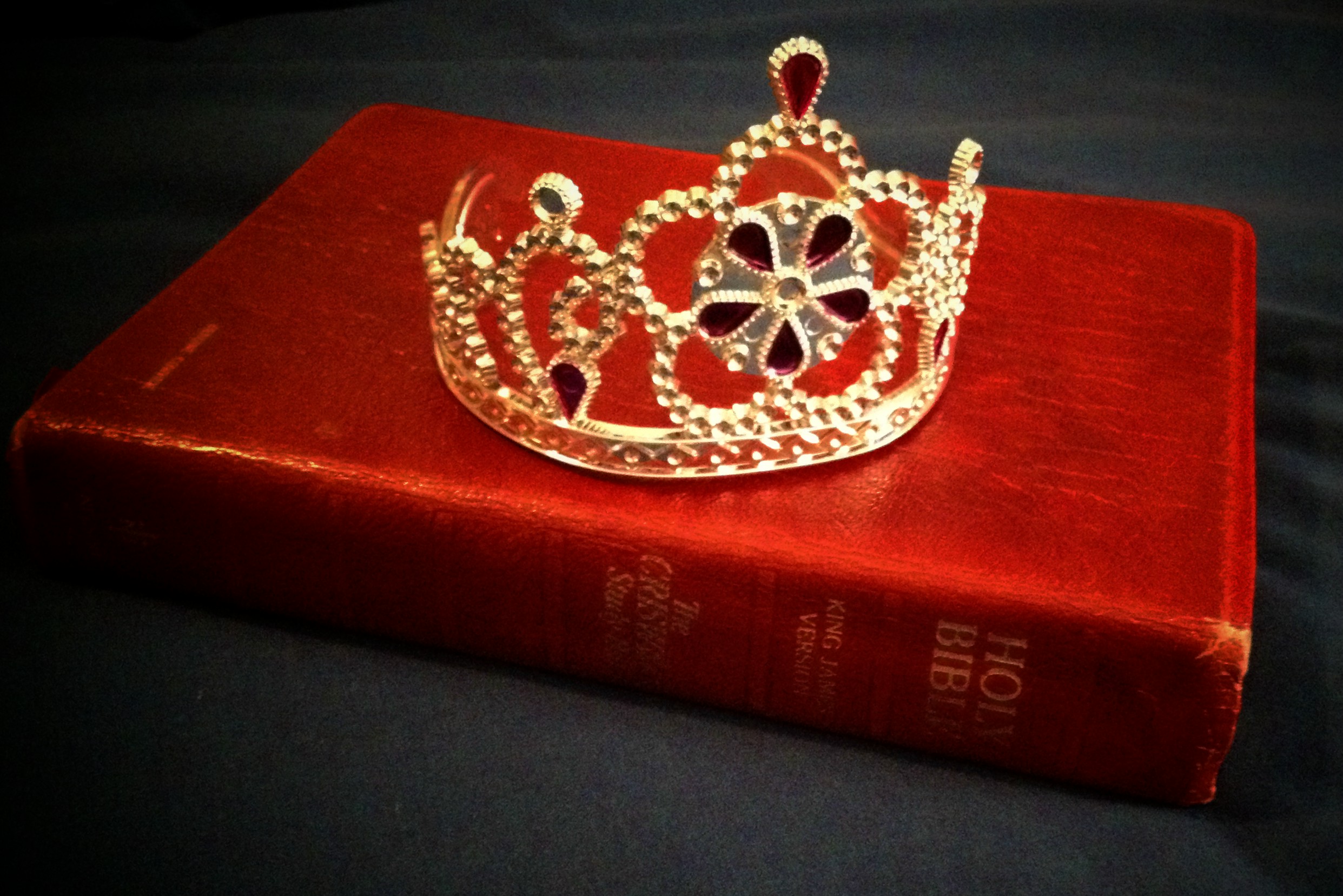
Along with Ann, I joined Acteens, the young girls’ mission study group. We met once a week to learn about missions, and this program included an opportunity to advance to “Queen of Mission Studies”, or some such other title that I can’t remember. Besides earning a nifty scepter and tiara; any young lady who reached the title of “Queen” would be invited to a special missionary tea at summer camp, and, most importantly, the Queens would be allowed an extra hour of swimming at midnight on the last day of camp.
Ann and I threw ourselves into this competition that was not meant to be a competition. We cooked special recipes from foreign lands and walked the three miles to church carrying a large cooler filled with curried rice the week we were studying India. We organized and put on a splendid Christmas pageant, refusing to allow the boy’s mission study group – the Royal Ambassadors, to participate. They spent too much time playing basketball, in our opinion, to be of any help. We progressed through the steps, I can’t remember now what they were, but something like maid, handmaiden, duchess, princess, and finally – Queen. There was a ceremony that surely was more embarrassing than any baptism would have been, except there was no water and I got to wear a long dress and makeup, and put my hair up under the crown.
We made it to Queen status just in time, as that summer would be our final trip to the Lake Lavon Baptist encampment. When our special day arrived at last, Ann and I dressed in our long gowns and put on our tiaras, and walked across the campgrounds to the place where the missionary tea was to be held. Unfortunately for us it was unusually hot that summer, and the meeting room was not air conditioned. I sat there and drank lukewarm Kool Aid while the sweat dripped off my face and the long dress stuck to the back of my legs. I don’t remember much more of the event, except feeling a great disappointment that the missionaries did not share stories of life threatening danger. They were stationed in Canada as school teachers, and the greatest threat they faced was a shortage of chalk.
When the midnight swimming hour arrived Ann and I dressed in our damp swim suits, gathered up our towels, and made our way with the other lucky girls to the swimming pool. We carried flashlights that looked like fireflies twinkling across grass. When we got there my summer friends jumped into the dark blue water, and I stood there on the edge, watching their heads bob up and down, drops sparkling on their brows like jewels.
“Come on in, jump!” Ann encouraged, and I curled my toes under the rough cement ledge and pushed off, jumping off into the deep end of the pool. Down, down I went until my toes barely scraped the slick tile on the bottom, and then I kicked my legs and shot up toward the surface, bursting up and spreading my hands out above into the cool night air. I looked up and saw the face of the Man in the Moon, soft and bright as God’s love, shining down on us, the Queens of Summer Camp.










 Let's Get Out of Here