You Can Lead a Pill Bug to Water…

But You Can’t Make Them Do Much Else.

Photo by Terrye Turpin

I’d been thinking about adopting a cat. I wanted a soft, purring companion, one that wouldn’t demand I hand over the remote as they snuggled up next to me on the couch. My vision didn’t include dumping out the litter box. Despite numerous calculations, my bank accounts refused to yield the proper amounts for the large pet deposit required. Was I even ready to share my 650 square feet of space with another living being, one that wouldn’t get its own dinner or tend to its own toilet needs?

I mentioned to my boyfriend, Andrew, “Maybe we should get a fish.”

“Oh! Let’s pick up some pill bugs,” he said, “they can live up to three years in captivity!”

I doubted this, as I used to collect them as a child. I called them “Roly Polys”. They tended to last about two weeks, or until my mother spotted the jar I kept them in and made me dump them out.

At least the pill bugs would not require a big investment in dollars. I knew they wouldn’t be cuddly, but I expected them at least to be entertaining.

“What do you feed them?” I wondered.

“They eat their own poop,” Andrew informed me. “And fish flakes,” he added.

We set off to Petco to get a suitable habitat and other supplies. When we got there, I stopped to admire the cats and kittens up for adoption at the front of the store. I sighed over a particularly sweet gray tabby as a store employee came up to me.

“Are you thinking of adopting a cat?” she asked.

“Oh no, I’m just looking at them,” I quickly replied, before I could include “Cat” on my list of impulse purchases.

“What kind of pet do you have?” she continued, a pleasant smile on her face. I froze, looking at this nice gray-haired lady in a Petco t-shirt. I realized if I answered “pill bugs” this might result in a longer conversation than I wanted to have at that moment.

“We have a fish,” I blurted out and then rushed over to join Andrew by the aquarium supplies.

“You denied the pill bugs!” he accused.

“Well, yes, but technically I wasn’t too far off, you remember you told me they were crustaceans.”

Supplies in hand, we managed to check out. Once we got back to the apartment, we assembled our purchases — a medium sized glass terrarium, sand, a small water dish, and a container of fish food. I insisted on putting two plastic plants in the habitat. Andrew tried to talk me out of the tan resin statue of Mount Rushmore, but I wanted to watch a pill bug climbing up the sides like a tiny Cary Grant.

Later that night we went for a walk in the park next to our apartment complex, and gathered up a nice variety of pill bugs. They looked like little armored tanks with antennae. When we set them loose in the terrarium, they scurried around for a few minutes on the plants, but none of them were inclined to scale Mount Rushmore. When we touched them, they rolled up into little balls. They seemed to enjoy the fish flakes and after they ate, they burrowed under the sand and disappeared.

Over the next few days we looked for the pill bugs, but they remained stubbornly out of sight. Apparently pill bugs do not live exciting lives. They are perfectly happy to stay covered in dirt all day and night, venturing out briefly to nibble some fish flakes and possibly some of their own poop before returning to the soil.

Eventually we noticed that the only thing moving in the terrarium was a large colony of gnats. Every time I spritzed some water in for the hibernating pill bugs the gnats rose up in a small dark cloud and zipped toward my nose and ears like kamikaze pilots. Andrew tried vacuuming them up, and he did manage to eliminate some of them, along with one of the plastic plants. He insisted this was not intentional, and swore that he saw pill bugs scrambling for safety after the poor plant was dislodged. By the time I came over to look they were out of sight again.

We had company over, and my friend Susan swatted at the gnats circling her head and suggested we set up a trap for them.

“Use a plastic bottle and some apple cider vinegar as bait,” she said.

Andrew rigged up a device, and before I could protest, he poured in some of my gourmet pomegranate vinegar. They deserved, I allowed, to drown in the best.

I monitored the vinegar trap, but the gnats preferred the warm, moist terrarium and the fish flakes. The pill bugs continued to hide, offering neither amusement nor companionship. Those little crustaceans were poor pets after all.

The gnats ventured out whenever I sat down in front of the television or my computer, drawn by the warm glow of the electronic light. I heard them buzzing around my ears, as though they were whispering secrets. Maybe they wanted to tell me what those pill bugs were up to all night. When I finally gave up swatting away the gnats, several of them settled on my arms and nuzzled against my neck. We sat there in the dark together, their wings light as whiskers and their feet soft as kitten paws.

The Wheels on the Bike Go ‘Round and ‘Round

Photo by Terrye Turpin

I flipped through the glossy pages of a fashion magazine and there, alongside an article on how to dress for a summer party, I spotted a glossy ad featuring a slim model posed gracefully alongside her Schwinn. I thought about the pants in my closet that no longer fit, and turned to my boyfriend, Andrew.

“I want a bicycle,” I said as I tossed the magazine back onto the growing stack on our coffee table.

This idea had been building, spurred by a desire to find an exercise that required more enthusiasm than ability. I’d gone through hiking, tennis, and yoga, trying to find something I could do and still get out of bed the next day.

Andrew agreed this was a fine idea, then asked me, “Do you remember your first bicycle?”

I have trouble remembering where I put down my coffee cup each morning, but I had an image in my mind of that first bicycle.

“It had a white vinyl banana-shaped seat with peace symbols, rainbow streamers on the handlebars, and one of those plastic wicker baskets with huge artificial sunflowers on the front.”

“Peace symbols? Sunflowers?” Andrew looked skeptical until I reminded him that my childhood took place in the 1960s. I assured him I would not add any flowered accessories to my new bicycle, and we went that next weekend to the Bike Mart.

In the bicycle shop, I sucked in my stomach as I wandered through crowds of whip-thin men dressed in spandex shorts. There were rows and rows of bikes in racks spaced around the store and organized into sections–mountain bikes, cruisers, hybrid bikes, tandem bikes, and even some that included an electric motor, handy I supposed for people who weren’t trying to fit into the pants in their closets.

I followed Andrew as he went over to look at the sturdy grey and black mountain bikes. I tried not to look at the price tags too closely. Surely they had the decimal in the wrong place. I rolled one of the mountain bikes off the rack and felt a sense of accomplishment when I sat on it without tipping over.

“Can I help you?” A young salesgirl, blond and tanned in her Bike Mart polo, walked up as I struggled to put the bike back on the rack.

“Yes,” I replied, “I’d like to buy a bicycle, and I guess I need a little help to pick one out.”

The salesgirl nodded, blond ponytail bobbing. With one hand she took the bike from me and slipped it back into the rack.

“Where will you be riding?” she asked.

I should answer, “Oh, just around my living room, and on soft, padded surfaces,” but I had an image in my mind of shaded forest paths. I told her, “Mostly paved roads, but I’d like to go off-road now and then.” This caused the salesgirl to pause for a moment, her forehead wrinkled as though she were working out a calculus equation. I wondered if she would recommend one of those adult tricycles, or maybe psychiatric counseling.

We looked through the inventory and settled on a turquoise and white mountain bike with an aluminum frame. Lighter than the other bikes, it would be less likely to damage me when it fell over, and the color matched my shoes.

I imagined myself cycling through the neighborhood on my new bike, maybe ringing a little bell attached to the handlebars. I purchased a gel padded seat, a bag for the handlebars in a somber shade of black with no flowers, and a helmet.

The helmet made my head look gigantic as though my brain had expanded. It did not, however, make me appear more intelligent. After our first outing, I added a pair of bike shorts with a soft insert supposed to help ease any soreness from riding. They seemed to hold up well, and I considered wearing them at work, where I have to sit typing at a computer for long periods.

After a leisurely five-mile ride on our local bike path, Andrew and I discussed where we should go next. He suggested the White Rock Lake Bike Trail, and I looked forward to the adventure as I packed snacks and extra water for the eighteen-mile trek.

For most of the ride, I kept Andrew in sight as he pedaled in front of me. We passed small children and grandmothers pushing strollers and I gave them all a cheery wave as we rolled down the first nine miles, but on the return loop, my strength failed. Somewhere around mile sixteen, I realized that the difference between an eighteen-mile bike ride and a five-mile bike ride was not thirteen miles. It was, instead, the distance from here to hell and back.

The bike shorts, while appreciated, had limits. When we stopped at a shady underpass, I plopped down in the dirt and tried to catch my breath while Andrew poured lukewarm water over my head and neck.
 “Can you go on? Do I need to get the car?” Andrew asked. “I’ve broken my sweetie!” he said.

I shook my head as I lay there in the dirt while scores of curious onlookers passed by, among them the small children and grandmothers I had floated past earlier.

“I’m sorry,” I replied, “I thought we were getting close to the end.”
 “We are, just another mile. Remember, we have Gatorade in the cooler back at the car.”

“Gatorade!” No drink had sounded so intoxicating since my college days.
 My heart rate slowed to a normal pace as a family with two toddlers pedaled past us. When an elderly man cycled by on a recumbent bike, I decided I would not be shown up by an octogenarian, and we got back up to continue the ride.

For the rest of that mile, I tried to ignore the white-hot rock that my nice cushioned bicycle seat had transformed into. I stood up to pedal to give my sitting parts relief, but my legs protested the extra work. My ass, not to be outdone, reminded me that, bicycle shorts or not, I would probably sleep facing down for the next few nights.

We got to the last one hundred yards of the route and the trail turned downhill toward the park where our car was waiting. I leaned forward into the warm wind and let the bike gather speed as I coasted. The spokes lulled me with a pleasant hum, and the sharp tar smell of hot summer roads rose from the path below. I drifted along to the sounds of children playing near the soccer fields and the tinkle of a bell from the ice cream vendor.

As the wheels on my bike spun around, I imagined rainbow streamers flying out from the handlebars, and a white plastic wicker basket with large, bright sunflowers on the front. Andrew waited at the car with an ice cold Gatorade as I rolled up, and I gratefully accepted his offering, ready for the ride to be over, ready for it to last forever.

©2018 Terrye Turpin

Ghosts in Mineral Wells


When the opportunity arose to plan a place to visit for my boyfriend Andrew’s birthday I chose the town of Mineral Wells. I am fortunate to have a boyfriend who shares my interest in obscure and cheap destinations. Mineral Wells seemed like the perfect place to spend a relaxed weekend: it boasted a haunted hotel, a historic mineral water well, and a Fossil Park where you could actually take home anything you found. Andrew was very excited about the Fossil Park, while I was happy to see that they did not have an admission charge.

The night before we left Andrew looked through the brochure from the Fossil Park while I studied one on the Baker Hotel.

“Look here,” I pointed out to Andrew, “It says that the hotel is haunted!”

“Oh! Do you think we’ll see the ghost?” Andrew replied. “Is it someone famous?”

I explained that, although famous people had stayed at The Baker during its heyday in the 1920’s, I seriously doubted that Will Rogers and Judy Garland were still hanging around the pool.

“And besides, the whole building is condemned; we won’t be able to go inside.” Andrew wondered if we might be able to sneak in under the fence, but I decided we would stand at a safe distance and snap photos, as I did not want the opportunity to see if the Palo Pinto County jail was also haunted.

As soon as we arrived and stashed our belongings in the hotel room, we left to explore the downtown sights. The Baker hotel was an impressive sight, even with yellow caution tape draped across her front, and a plain metal chain link fence surrounding the grounds.

“Look!” Andrew motioned toward an overgrown hedge. “There’s the pool that Clark Gable could have peed in.”

We left the Baker and made our way to the outskirts of town, to the abandoned landfill borrow pit that was now the Fossil Park. We stopped in the gravel parking area, and I pointed out a sign that said the place closed at dusk. There was also a warning to beware of dangerous animals and insects. Andrew unloaded our gear while I dowsed the both of us with mosquito repellant and wondered out loud if there were bears in West Texas.

“No, just snakes I imagine,” Andrew answered, as though this would console me. We made our way into the sandy gully where we could dig for fossils.

Andrew arranged his tools — a small shovel, a brush, and a colander for sifting, and sat down in the dirt while I cautiously walked around, kicking at the dirt and looking for anything that might resemble either a fossil or a snake. We found several pieces of ancient sea lilies — little wheels of rock with perfect lines radiating out like spokes. I imagined them waving underwater in an ocean 300 million years ago. As it grew dark I began to worry about mosquitoes and then about marauding coyotes, so I suggested that we start packing up.

“Oh no! I’d like to stay just a little longer. I might find a trilobite, or maybe a shark tooth,” Andrew protested.

I reluctantly agreed to linger a bit, and as a cloud of hungry insects began to settle on my arms and legs I decided that I would wait in the car. I settled in and kept an eye on the glow from the light that Andrew had strapped to his hat. As long as the glow stayed in one place I could be assured that Andrew had not been carried off by coyotes or bears. The longer I sat there, and the darker it grew, the more I became convinced that the faint howls and yips I heard were not from stray dogs or coyotes, but from some other worldly creatures, perhaps werewolves. Just when I wondered if we had reached the point in our relationship where I might be willing to face off a herd of starving zombies for my sweetie, I saw the little light rise up and start its way toward the car.

“At last!” I said when Andrew opened the door and climbed in. “I thought you were going to spend the night out there.”

“I just hate to leave,” he said. “I might get up very early tomorrow and come back out. You can stay asleep at the hotel,” he added when he saw my expression.

The next morning we woke to the sound of pouring rain and I tried to console Andrew over the lost opportunity.

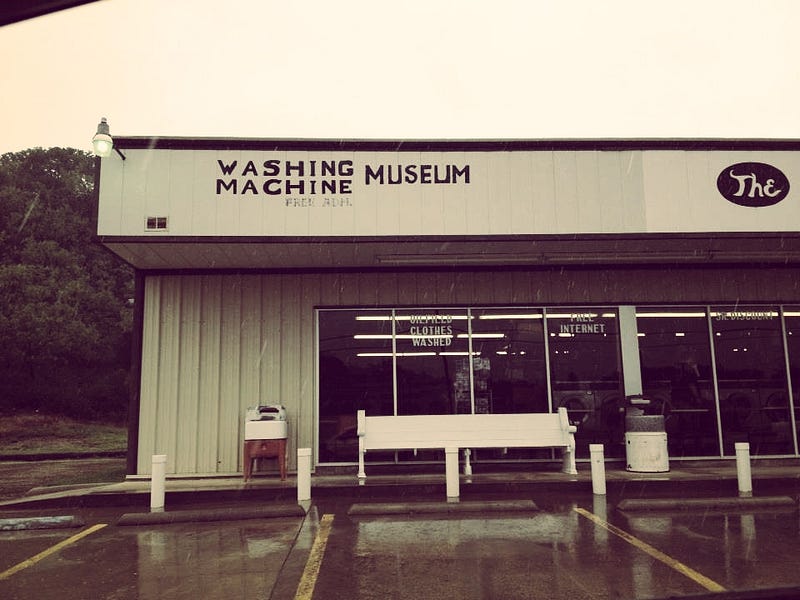
“I know it’s not as exciting as sitting in the hot sun all morning digging up little fossilized plant wheels,” I offered, “but we could stop by the Washing Machine Museum.”

I’d seen the sign for this improbable destination the previous day as we were heading downtown. The museum was located in an actual working Laundromat, “The Laumdronat”, and the words “Free Admission” were included on the front of the building.

We got there just as a light drizzle started, and I got ready to dash inside, but Andrew stopped me as I reached for the door handle.
 “Look at that man there,” he said. “He’s looking at us.” I glanced over to the front window of the Laumdronat, where a rather large fellow was standing, staring morosely out into the rain.

“Oh it’s okay,” I said, “He’s just doing his laundry.”

“He looks angry, like he doesn’t want us to come inside and bother him. He could be a serial killer!” Andrew replied. While I allowed that even serial killers must wash their undies, I didn’t think that the man posed any threat to us, and eventually Andrew agreed that we would risk venturing into the Washing Machine Museum. I wondered if they had a gift store, postcards for sale, or a place to pose for a photograph.

The place was indeed a working Laundromat, and the antique machines included manual scrub boards, and some of the very first electric and gasoline powered machines with wringers. I asked the laundry room attendant, a busy middle aged woman dressed in blue jeans and an apron, if it was okay to take photographs.

“Oh sure,” she said, “Just help yourself.”


There were some machines lined up against the back wall of the place, but most of them hung, securely I hoped, from the ceiling. They hovered over the actual, working machines and as the sounds of swishing washers and tumbling dryers filled the room, I could imagine the machines above us thrumming and bumping through the wash cycles.

“My grandmother had a machine like this one.” I pointed to a model with a hand wringer on the side. “She made her own lye soap to wash with,” I said. “It smelled like ashes and animal fat.” I pictured my grandmother wringing out the week’s wash, her long gray hair in a bun and her hands red and chapped from the fierce work of laundry.

“I don’t think that would be a popular combination now,” Andrew said, and I agreed as I inhaled the warm, flowery scent of modern detergent.

We finished our tour of the museum and held the door for the large man who had been watching us when we walked in. He did not look nearly as threatening while carrying a pink plastic basket filled with freshly folded clothes.

We drove past the Baker hotel on our way out of town, and I glanced up to see a sheet of plastic waving, like an ethereal hand, from the broken casement of a window on one of the upper floors.

“It’s too bad we didn’t see any ghosts.” Andrew said.

“Yes.” I replied, as I thought to myself that ghosts are often found in the most unlikely places, and we are often haunted, not by the unknown, but by things that are instead very familiar.

The Baker Hotel in Mineral Wells, Texas