A trail suitable for walking — Photo by Terrye Turpin
Until I met Andrew, the man who would eventually become my husband, I was blissfully unaware that there were socks designed for specific activities. I purchased my socks in bulk and in solid colors that eliminated the need to make sure I had on a matching pair.
When I started dating Andrew, we spent weekends hiking along the shady trails near our home. I used to call this activity ‘taking a walk’ and it didn’t require specialized equipment. Andrew suggested that my feet would feel better if I were wearing a pair of socks with extra cushioning, and I agreed while we were limping to the car after a five-mile hike over terrain so scattered with sharp rocks and tree roots it resembled a trek through Mordor.
I didn’t realize that there were special socks for hiking, but a trip to REI (Recreational Equipment Insanity) set me straight on that right away. While I puzzled over the price tag on a pair woven from tan and green striped wool, Andrew handed me a flimsy bit of white cloth I held up and realized was actually a pair of socks.
“You should get liners. They’ll help to prevent blisters,” he said.
“You’re telling me my socks need socks?”
I left the store without purchasing anything when Andrew mentioned that REI had an outlet and if I weren’t picky on style, I could find suitable socks at a discount online. I ordered one set in a lovely shade of hot pink, just shy of rose and a little darker than blush, and I figured the color must be what landed them on the clearance section. Surely hiking socks would tend toward more solid, understated colors, like beige or olive green. I imagined that in a pinch I could take them off and use them as an emergency signal since the color could be seen by passing planes.
When the socks arrived, I opened the package to discover they came with instructions in five different languages and a 30 day no risk trial. They were made from a material called Thorlon, which sounded like a character from a fantasy novel.
“By the shield of Thorlon I command you!” I told Andrew.
The packaging described how this material magically prevented blisters. No liners required. A disclaimer on the tag mentioned the socks should not be ironed or dry-cleaned. While I pondered the type of person who would iron their socks and wondered just how this could be accomplished, I was relieved to notice the instructions included illustrations, captioned in English, of how the socks were fitted and cushioned. I worried I would have to learn German to get dressed for hiking.
The colorful tag also mentioned the socks protected against shock, impact, and shear. For a moment I thought I had mistakenly ordered a parachute. I reassured myself by trying them on and walking around my apartment. Although they seemed to have a nice amount of cushioning I didn’t think I would jump out of an airplane wearing them.
I wore the socks the next evening to walk down to the local library with Andrew to return some books. It was a chilly evening, so I put on the bright pink socks with a pair of matronly sandals that had elastic bands at the back, to hold them on my feet.
“My feet are cold,” I explained as I put on the socks and slipped into my sandals.
“Those socks should help.”
“If we get separated, just look for the pink glow,” I told him.
We made our way to and from the library, and Andrew not only walked beside me he carried my books and held my hand for most of the trip. It was dark out, which made it difficult for anyone to spot us I suppose, but the Thorlon material seemed to reflect the streetlights in a rosy glow around my feet. It occurred to me the packaging for these socks ought to include the disclaimer you shouldn’t judge someone until you had walked a mile in their socks. And while they are often found together, a warm heart doesn’t have to be accompanied by cold feet.
The Dublin Bottling Works — Home of the original Dr. Pepper and definitely not a clear liquid. (Photo by Terrye Turpin)
At my last physical my doctor mentioned it had been five years since I had a colonoscopy.
“That long, huh? Gee doc, the whole experience was so pleasant it seems like only yesterday.”
Every time I light a candle in my bathroom, I feel like I’m setting up an altar to the god of poop.
I successfully delayed the colon conversation by mentioning my cholesterol. I’ve found as I grow older I can deflect almost any uncomfortable medical inquiry by bringing up another body part.
The first time I had a screening colonoscopy it took my doctor three years to convince me. She seemed puzzled that I continued to dodge major illnesses, so I felt I owed it to her to try one more test to see if we couldn’t find something. I called to make the appointment, and they told me I would need a designated driver to chauffeur me home after the procedure. Because I had spent 30 hours in labor with him, I nominated my oldest son, Robert. A few days before the big event he accompanied me to pick up the aptly named Super Bowel Prep Kit at the pharmacy.
“That will be $73,” the cheerful cashier said as she rang up my purchase.
“Holy crap!” I said. Robert laughed behind me.
I felt that for $73 the stuff should come with a sommelier, someone to uncork the bottle, swirl the liquid around in a glass, and remark on the bouquet. Reluctantly I paid for the purchase with my rapidly depleting medical flex spending card and we left with the kit — two 8 ounce bottles of clear liquid that each had to be mixed with another 8 ounces of water and then chased with yet another 16 ounces of water within an hour.
On the way back to my apartment I held up a bottle. “I wonder what it tastes like?”
“I bet it tastes like ass,” said my twenty-eight-year-old son with all the smug self-assurance of someone at least two decades away from having to drink 32 ounces of ass flavored liquid himself. We tried out different names for the drink — “Turd Tonic”, “Poopy Potion”, and finally decided the winner was “Caca Cola.”
The instructions for my prep assured me I could have all the clear liquids I wanted during the process. I enthusiastically mixed up a dozen servings of lemon and pineapple Jello. Red gelatin was discouraged in horrific detail. I discovered all the clear liquids I wanted were considerably less than the amount of clear liquids taking up room in my refrigerator.
The actual prep went as expected. I took the advice found on several internet sites and bought adult diapers to wear during the experience. They worked so well I wondered why I didn’t wear them all the time. Robert stayed with me in the beginning but when the real fun began, he left for his apartment.
“I’ll see you tomorrow!” I called out from behind the bathroom door.
The pharmacist had warned me that the prep was “very effective” and by the end of the second dose I had to agree. My colon was so clear the doctor could probably see all the way to Cleveland.
I couldn’t have anything to eat or drink the day of the colonoscopy and this worried me before I understood that by the end of the first day I wouldn’t want anything to eat or drink on the second day.
The morning of the procedure Robert strolled into my apartment. He wore an Iron Maiden t-shirt featuring a rotting corpse on the front.
“I’ll drive on the way there,” I told him.
When we arrived at the clinic I checked in while Robert discovered they didn’t have Wi-Fi in the waiting room. A smiling nurse escorted us back to a little room and I met with the doctor who would perform the colonoscopy. He looked slightly older than my son and had very nice hair.
“Awesome t-shirt dude!” he said to Robert as he flashed the metal sign and they slapped hands.
The doctor briefly explained the procedure and then a nurse brought over a hospital gown and a brown paper bag. She told me to take off all my clothes and put them in the bag.
“They’ll call when I’m ready to leave,” I tossed Robert my purse and phone as he bolted out the door.
After I stuffed my clothes into the paper bag, the nurse took a black marker and wrote my name on the outside, just in case they needed to use it as evidence. I hopped onto the narrow hospital bed as the anesthesiologist came in to meet with me. He also had nice hair and a lovely smile. He looked and sounded like the actor Antonio Banderas.
“How are you feeling?” he asked as he placed his hand on my arm. He had very warm hands.
“I’m okay,” I responded, with as much confidence as I could while my bare ass stuck to the sheet covering the bed.
“Don’t be nervous, I promise you won’t remember anything about the procedure. You will just have a little nap now.”
I smiled up at him from the bed and tried not to look nervous, despite his being one of the most handsome men to see me half naked. He kept his warm hand on my arm as he helped me turn over on my side. Then he bent down to gaze into my eyes and ask, “Do you have any loose teeth or dentures?”
My doctor came in and fussed around with something behind my back as he hummed what sounded suspiciously like “Run to the Hills”, complete with shredding guitar solo. I no longer felt nervous, I felt old and tired as I fell into the promised nap.
I had read all about the unpleasantness of the prep but what no one mentioned was how wonderful were the after-affects of the sedative they give you. I woke up to the sound of “Slow Ride” by Fog Hat playing on the room’s sound system, which was appropriate since I hadn’t felt that stoned since 1975.
“How are you doing?” asked the nurse as she took my arm and helped me to sit up.
“Wow,” I replied.
“Would you like a drink? We have Coke, Dr. Pepper, and Sprite.”
I chose a Dr. Pepper, and when the nurse asked if I wanted a regular or a diet drink, I replied, “Oh, I want a REAL Dr. Pepper!”
When Robert arrived to pick me up, I was still enjoying my not-clear drink. The nurse warned us “Go straight home. No shopping and don’t make any legal decisions or sign any documents today.”
“Can I take my Dr. Pepper with me?” I asked.
On the way home I buckled into the passenger seat of the car, propped up against the door, and enjoyed the rest of my soda while Robert drove with his usual reckless abandon. The drugs were still kicking in, so I didn’t mind when we charged through yellow lights and swerved around corners.
I wanted to make some profound comment on how wonderful it is to have a family, and how much I loved and appreciated him. Tears welled up in my eyes and I spoke in a hoarse voice.
“This is the best Dr. Pepper in the entire world.” I reached over to pat my son’s arm.
“Those must be some fantastic drugs, Mom.”
We continued on towards home, where we would listen to Iron Maiden on the stereo, watch television together, and have anything we wanted for dinner, including six or seven servings of pineapple Jello.
I flipped through the glossy pages of a fashion magazine and there, alongside an article on how to dress for a summer party, I spotted a glossy ad featuring a slim model posed gracefully alongside her Schwinn. I thought about the pants in my closet that no longer fit, and turned to my boyfriend, Andrew.
“I want a bicycle,” I said as I tossed the magazine back onto the growing stack on our coffee table.
This idea had been building, spurred by a desire to find an exercise that required more enthusiasm than ability. I’d gone through hiking, tennis, and yoga, trying to find something I could do and still get out of bed the next day.
Andrew agreed this was a fine idea, then asked me, “Do you remember your first bicycle?”
I have trouble remembering where I put down my coffee cup each morning, but I had an image in my mind of that first bicycle.
“It had a white vinyl banana-shaped seat with peace symbols, rainbow streamers on the handlebars, and one of those plastic wicker baskets with huge artificial sunflowers on the front.”
“Peace symbols? Sunflowers?” Andrew looked skeptical until I reminded him that my childhood took place in the 1960s. I assured him I would not add any flowered accessories to my new bicycle, and we went that next weekend to the Bike Mart.
In the bicycle shop, I sucked in my stomach as I wandered through crowds of whip-thin men dressed in spandex shorts. There were rows and rows of bikes in racks spaced around the store and organized into sections–mountain bikes, cruisers, hybrid bikes, tandem bikes, and even some that included an electric motor, handy I supposed for people who weren’t trying to fit into the pants in their closets.
I followed Andrew as he went over to look at the sturdy grey and black mountain bikes. I tried not to look at the price tags too closely. Surely they had the decimal in the wrong place. I rolled one of the mountain bikes off the rack and felt a sense of accomplishment when I sat on it without tipping over.
“Can I help you?” A young salesgirl, blond and tanned in her Bike Mart polo, walked up as I struggled to put the bike back on the rack.
“Yes,” I replied, “I’d like to buy a bicycle, and I guess I need a little help to pick one out.”
The salesgirl nodded, blond ponytail bobbing. With one hand she took the bike from me and slipped it back into the rack.
“Where will you be riding?” she asked.
I should answer, “Oh, just around my living room, and on soft, padded surfaces,” but I had an image in my mind of shaded forest paths. I told her, “Mostly paved roads, but I’d like to go off-road now and then.” This caused the salesgirl to pause for a moment, her forehead wrinkled as though she were working out a calculus equation. I wondered if she would recommend one of those adult tricycles, or maybe psychiatric counseling.
We looked through the inventory and settled on a turquoise and white mountain bike with an aluminum frame. Lighter than the other bikes, it would be less likely to damage me when it fell over, and the color matched my shoes.
I imagined myself cycling through the neighborhood on my new bike, maybe ringing a little bell attached to the handlebars. I purchased a gel padded seat, a bag for the handlebars in a somber shade of black with no flowers, and a helmet.
The helmet made my head look gigantic as though my brain had expanded. It did not, however, make me appear more intelligent. After our first outing, I added a pair of bike shorts with a soft insert supposed to help ease any soreness from riding. They seemed to hold up well, and I considered wearing them at work, where I have to sit typing at a computer for long periods.
After a leisurely five-mile ride on our local bike path, Andrew and I discussed where we should go next. He suggested the White Rock Lake Bike Trail, and I looked forward to the adventure as I packed snacks and extra water for the eighteen-mile trek.
For most of the ride, I kept Andrew in sight as he pedaled in front of me. We passed small children and grandmothers pushing strollers and I gave them all a cheery wave as we rolled down the first nine miles, but on the return loop, my strength failed. Somewhere around mile sixteen, I realized that the difference between an eighteen-mile bike ride and a five-mile bike ride was not thirteen miles. It was, instead, the distance from here to hell and back.
The bike shorts, while appreciated, had limits. When we stopped at a shady underpass, I plopped down in the dirt and tried to catch my breath while Andrew poured lukewarm water over my head and neck. “Can you go on? Do I need to get the car?” Andrew asked. “I’ve broken my sweetie!” he said.
I shook my head as I lay there in the dirt while scores of curious onlookers passed by, among them the small children and grandmothers I had floated past earlier.
“I’m sorry,” I replied, “I thought we were getting close to the end.” “We are, just another mile. Remember, we have Gatorade in the cooler back at the car.”
“Gatorade!” No drink had sounded so intoxicating since my college days. My heart rate slowed to a normal pace as a family with two toddlers pedaled past us. When an elderly man cycled by on a recumbent bike, I decided I would not be shown up by an octogenarian, and we got back up to continue the ride.
For the rest of that mile, I tried to ignore the white-hot rock that my nice cushioned bicycle seat had transformed into. I stood up to pedal to give my sitting parts relief, but my legs protested the extra work. My ass, not to be outdone, reminded me that, bicycle shorts or not, I would probably sleep facing down for the next few nights.
We got to the last one hundred yards of the route and the trail turned downhill toward the park where our car was waiting. I leaned forward into the warm wind and let the bike gather speed as I coasted. The spokes lulled me with a pleasant hum, and the sharp tar smell of hot summer roads rose from the path below. I drifted along to the sounds of children playing near the soccer fields and the tinkle of a bell from the ice cream vendor.
As the wheels on my bike spun around, I imagined rainbow streamers flying out from the handlebars, and a white plastic wicker basket with large, bright sunflowers on the front. Andrew waited at the car with an ice cold Gatorade as I rolled up, and I gratefully accepted his offering, ready for the ride to be over, ready for it to last forever.
I’m from Friday night football games Third Quarter sitting with the band kids. Fourth Quarter standing in the end zone Rooting for the visiting team.
I’m from Saturday night drive-in backseat sin And Sunday morning sermons served with dinner on the ground, Communion with fried chicken.
Photo by Terrye Turpin
I’m from a land where Pump jacks bob against the horizon Like the dinosaurs whose bones They pull from the earth.
Where I’m from we played half court basketball Because girls could not be trusted To run the full length, goal to goal Until Title IX gave us our breath.
Photo by Terrye Turpin
My great-grandmother treasured her Confederate flag And courthouses commemorated with statues That losing side.
Where I’m from defines my past but does not determine my future.
I was tagged in this craze by the very talented Kay Bolden, so I’m assuming there’s at least one person out there interested in learning a little more about me. So here are ten things that will tell you a bit. Most of the photographs, for better or worse, were taken by me.
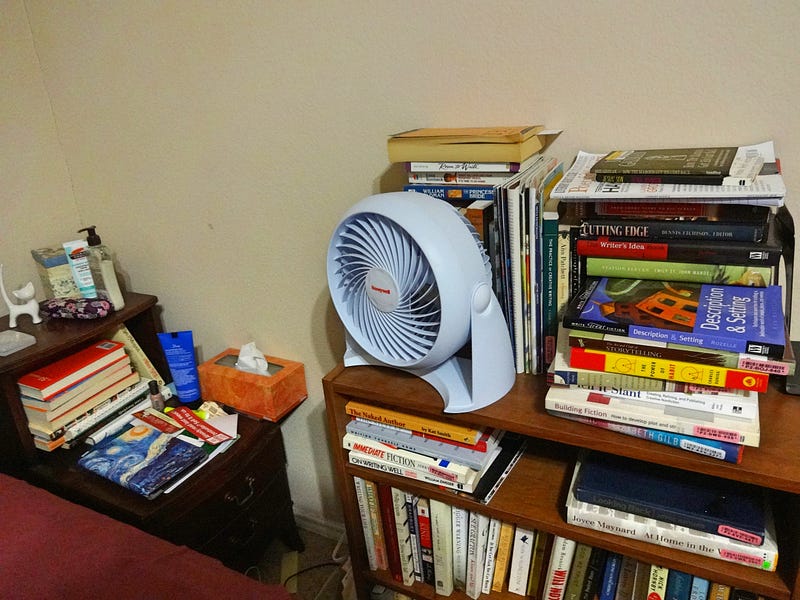
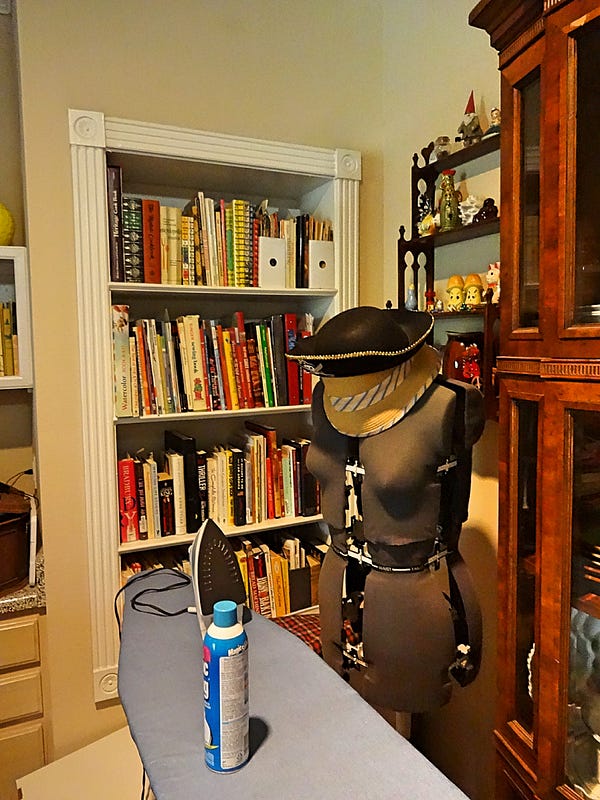
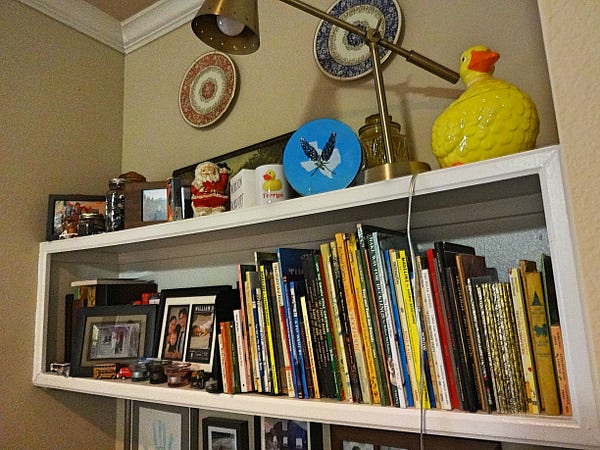
There are books in almost every room of my home.
Bedside table and bookcase filled with books on writing.
Well, Hello Dolly!
The dining room is also my crafting room. The bookcase here is filled with cookbooks and craft books. That’s Dolly lurking beside the ironing board.
Archer guards the nonfiction books and my Hot Wheels collection.
More books in the dining room.
I keep the children’s books in the dining room for when my grandson visits. I wrote a story about that duck.
More books
2. I am the youngest of seven children, but because they were all much older than me, I grew up like an only child. My mother was 42 when I was born on her birthday. Three of my sisters and one brother have passed away, as have my mother and father.
My mother Christine Hamilton
My Dad Lloyd Hamilton and my older brother Ronnie
3. I’ve never lived further than 40 miles from McKinney, Texas — the place I was born.
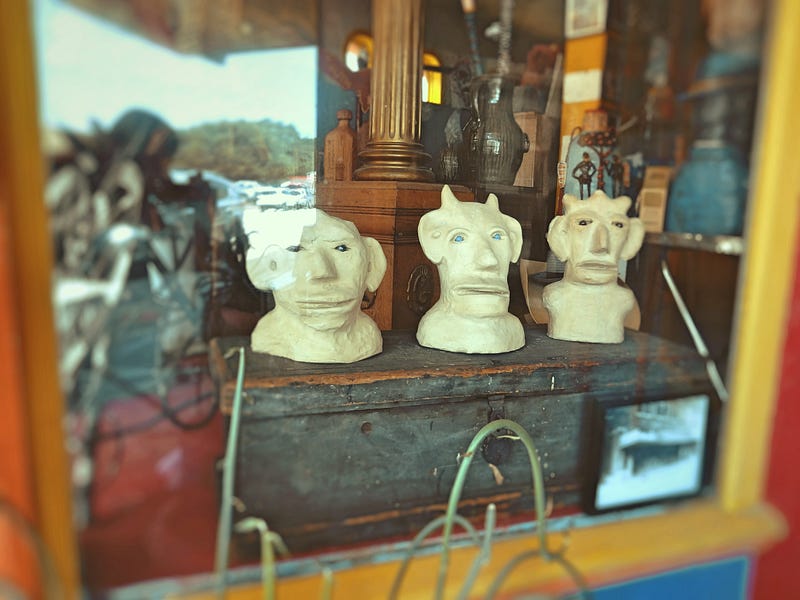
4. I love shopping at antique, junk, and thrift stores.
Window Shopping in Waxahachie, Texas
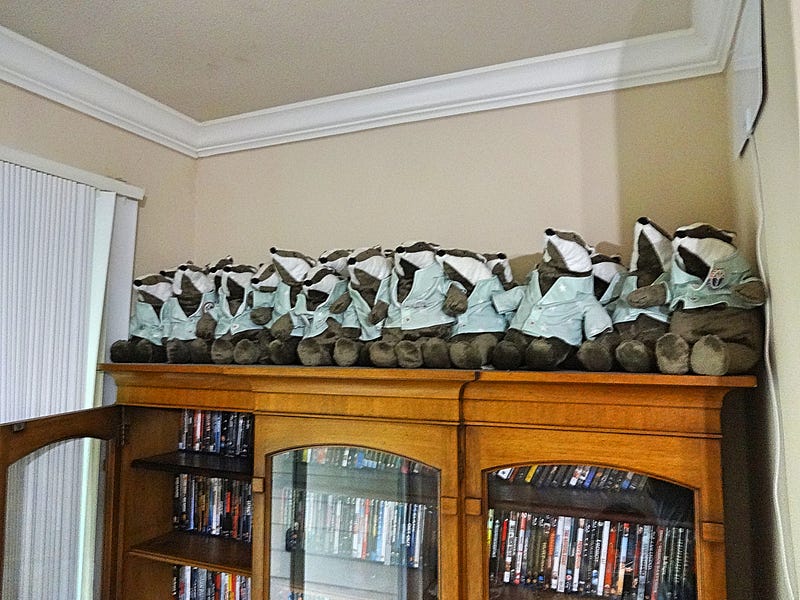
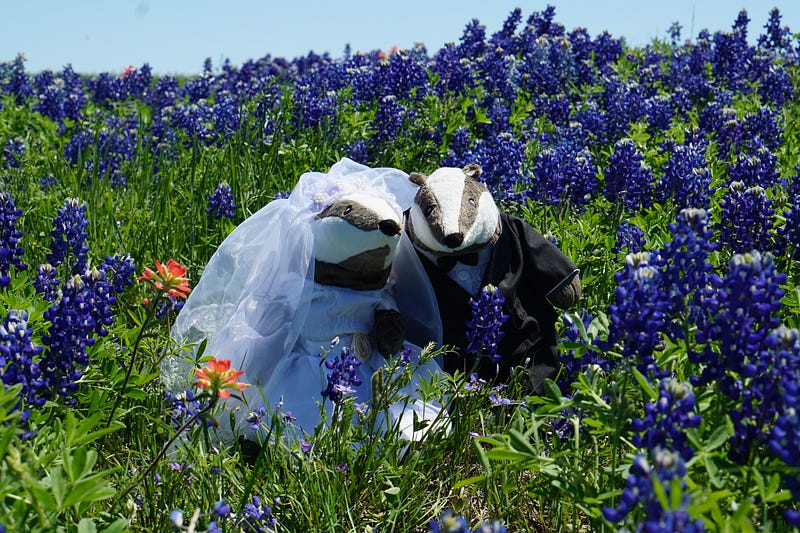
5. My fiance and I own more than 30 IKEA badgers. (We love IKEA)
Badgers, Badgers, Badgers
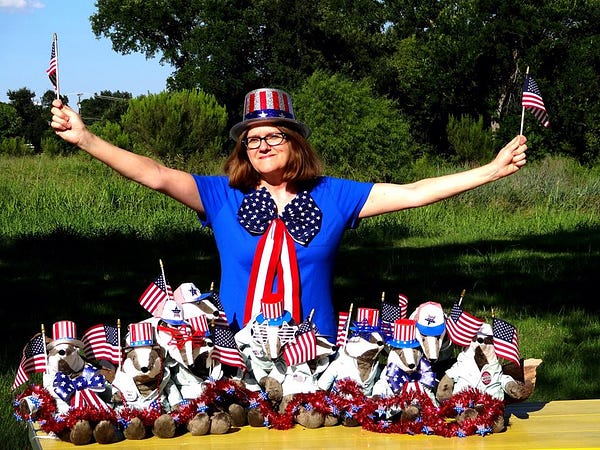
Happy Fourth of July!
Sometimes we dress the badgers in holiday apparel.
6. My favorite authors are Stephen King, Neil Gaiman, Robert McCammon, and David Sedaris.
If I’m in a dark mood my writing takes a twisted turn to horror.
I love David Sedaris, and you can probably see his influence in my humorous essays. I go to hear him perform his work every time he’s in the Dallas/Fort Worth area and I have all his books, four of them are signed by him.
7. I have a Bachelor of Science degree in Chemistry (I thought I wanted to go to medical school). When I was 45 I went back to school to earn a graduate degree. It took me five years working full time and going to classes part time to earn my Masters degree in Taxation. I worked my way through graduate school delivering pizzas part time in addition to my 40 hour a week full time job.
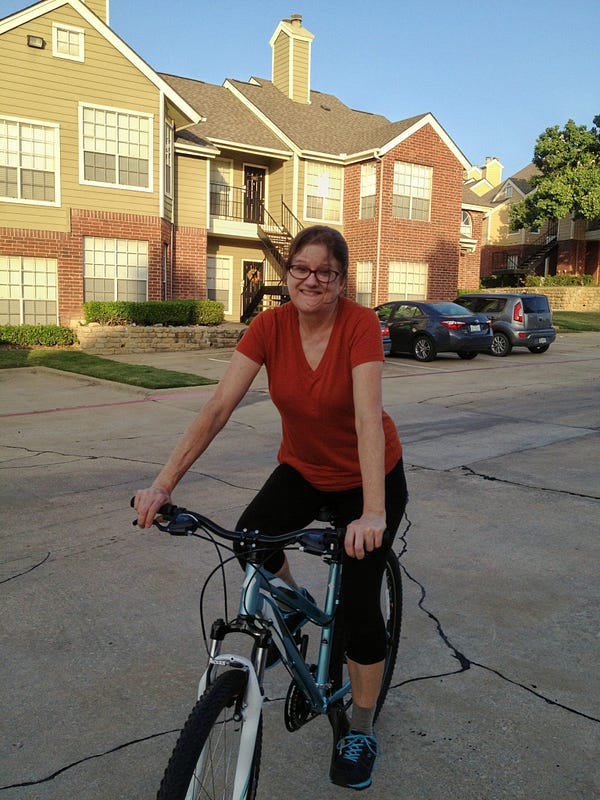
8. I bought a bicycle when I was 52, and started riding again after almost 30 years.
I’m just posing here, I do ride with a helmet.
9. I got divorced after 25 years of marriage. When I started dating again I signed up for OK Cupid and gave online dating a try.
I only met one person and had one date through OK Cupid.
Me and Andrew hiking in Glen Rose, Texas at Dinosaur Valley State Park
10. I’m getting married in October to that one date I met six years ago on OK Cupid.
Badgers in Bluebonnets in Ennis, Texas — This photo by Andrew Shaw
I’ll keep the thread going by tagging a few folks here, if you’ve already been tagged you can blissfully ignore this one, but I hope you’ll play. And if I haven’t tagged you please join in with your list of ten things and tag me, I’d love to read them.
I moved into my first apartment in 1979. The place came with shag carpet striped in an acid trip rainbow of purple, green, and brown. By the time my roommate Ann and I lived there the rug had collected a gummy overlay of tobacco and pot smoke, beer, and other substances we ignored. Our floral print couch had broken springs that sagged our butts toward the ground when we stretched out to catch up on Love Boat and Fantasy Island. The world’s biggest fan of the rock band Queen lived next door. He serenaded us every night with “Another One Bites the Dust” and if we pushed the couch close to the wall, it would rock us to sleep with the vibrating bass line. That apartment was the first place we had ever chosen all on our own, without help from parents or school administration.
Ann and I discovered our home in August, about three weeks before the fall semester would start at Texas Woman’s University. We drove over to Denton, Texas in her 1967 Dodge Dart. The car did not have air conditioning. We rolled down the windows and hung our heads out like dogs to catch the hot air blowing off the highway. By the time we made the hour-long trip from our hometown the backs of my legs stuck to the vinyl car seat with a tacky layer of sweat glue. We pulled into the parking lot of the first complex on our list and slumped out of the car, careful not to brand ourselves with the hot metal on the outside the Dart. In the full sun we stood there pondering the faded pink brick buildings. I imagined the rubber soles of my sandals melting into the black tar pit of the asphalt parking lot and I wondered if some later civilization would find my bones, preserved and still wearing flip flops.
“There’s a pool,” Ann said, pointing toward a shimmering patch of blue in the center of the courtyard. The sharp summer scent of chlorine hung in the air and we heard laughter and soft splashing coming from the lucky residents enjoying the water. We wiped the sweat out of our eyes, abandoned the car, and raced to the manager’s office to sign a lease for our new apartment.
We moved in over the next weekend, figuring to get settled in before classes started. We unpacked in air-conditioned comfort, without realizing we enjoyed the last bit of the previous tenant’s billing cycle. On Monday we woke to the end of that free ride. No electricity meant no radio, no television, and no air conditioning. Our friendly neighbor set down his bong and turned down the bass on his stereo long enough to explain how to go about getting our own account set up. A phone call to the utility company later, we had an appointment for them to come out the next day, Tuesday.
We opened the windows and the front door and spent the day at the pool. By early evening we were both the color of the Boone’s Farm Strawberry Hill wine we had been drinking all day.
“Is there any more ice?” Ann asked from the couch where she stirred the hot air with the magazine she had been reading.
“No, maybe we should go to the store.” My voice was muffled because I had my head in the open freezer, waving the last of the cool air onto my face.
“We’re also out of wine,” I added.
Ann and I moaned about the lack of air conditioning, ice, and alcohol and decided, since we were heading to the store to get ice and wine, we would stop at K-Mart to pick up a fan–yes, an electric fan, a fan that would need electricity to run.
Most people would notice the glaring gap in logic this purchase presented. However, Ann and I, stunned from the heat like lizards, and brain damaged from inhaling chlorine fumes and cheap wine all day, loaded into the Dart and headed to K-Mart.
Once we arrived at the store, we discovered the fans displayed right at the front entrance. We walked through a wind tunnel of spinning blades and overlooked the cords dangling from the back and running to the hidden power supply. We pictured our fan set up in the living room, spinning cool air out of nothing. Fan chosen and placed in the shopping cart, we picked up cleaning supplies and added a bottle of lemon scented ammonia to our cart as we headed to the cashier.
While we stood in line, Ann picked up the cleaner. “I wonder if this really smells like lemons. You know, like real lemons or just some sweet stuff.” I took the bottle from her and read the label.
“It says ammonia,” I said.
I unscrewed the cap, held the container close to my nose, and inhaled a strong breath. A line of lemon scented fire raced up my nose and entered my brain.
“Well, does it smell like lemons?” Ann asked.
I couldn’t answer as my lungs seemed to have collapsed from the ammonia. Instead I waved frantically, hoping it would be interpreted as “Yes, but help!”
I held out the bottle toward Ann and before I could warn her, watched as she took the bottle from me and inhaled. There we were, in the line at K-Mart, gasping for breath and crying, passing that bottle of ammonia back and forth between us like two drunks sharing a can of Sterno.
We recovered enough to put the cap back on the bottle, then looked at the fan sitting there in the cart. The ammonia must have loosened something in our brain because we realized then you can’t run an electric fan without electricity. We traded the fan for a pair of flashlights and left the ammonia at K-Mart. We stopped for ice and headed back to our apartment, our home where the moonlight beckoned off the dark, still surface of the swimming pool and the night air smelled of chlorine and not lemons.
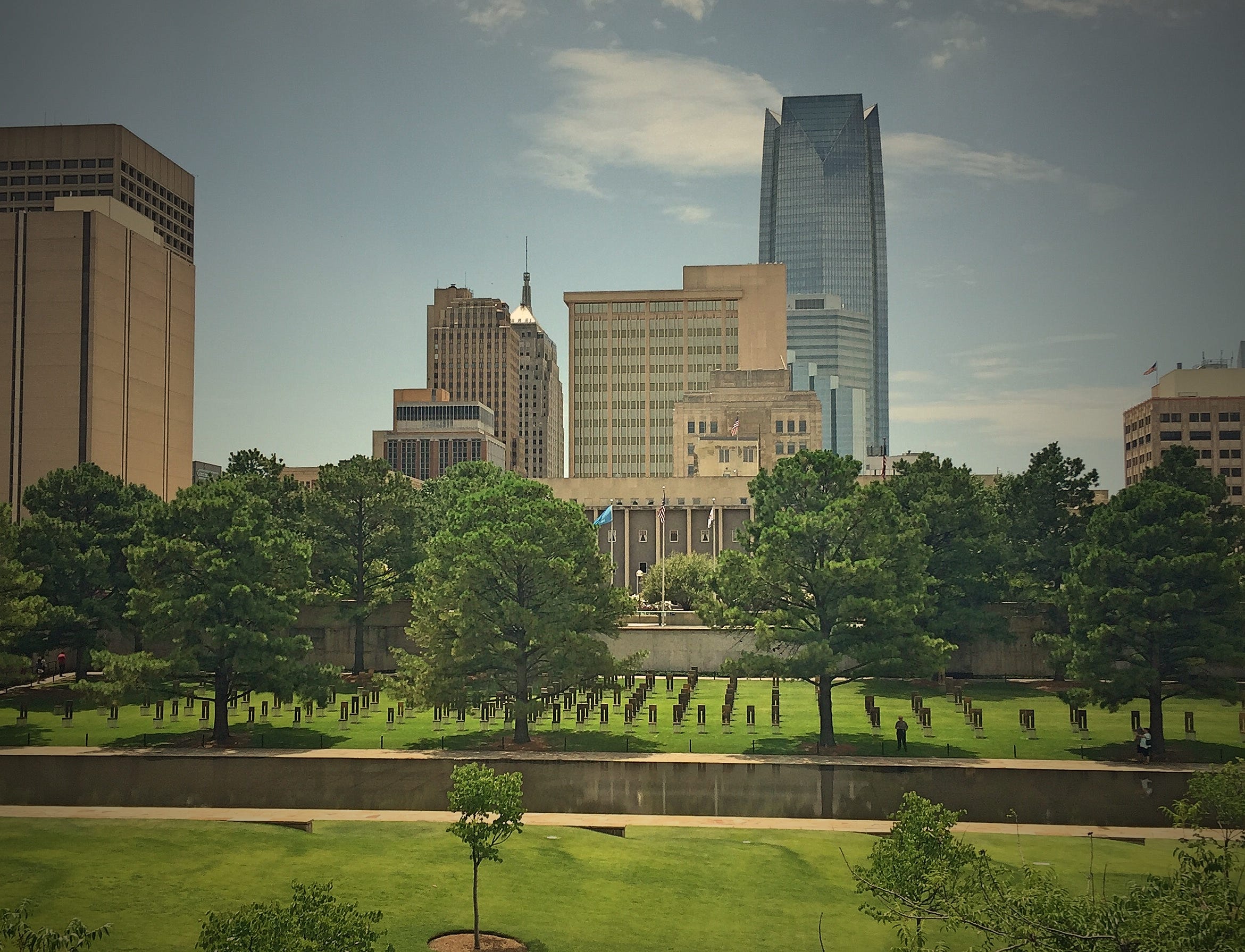
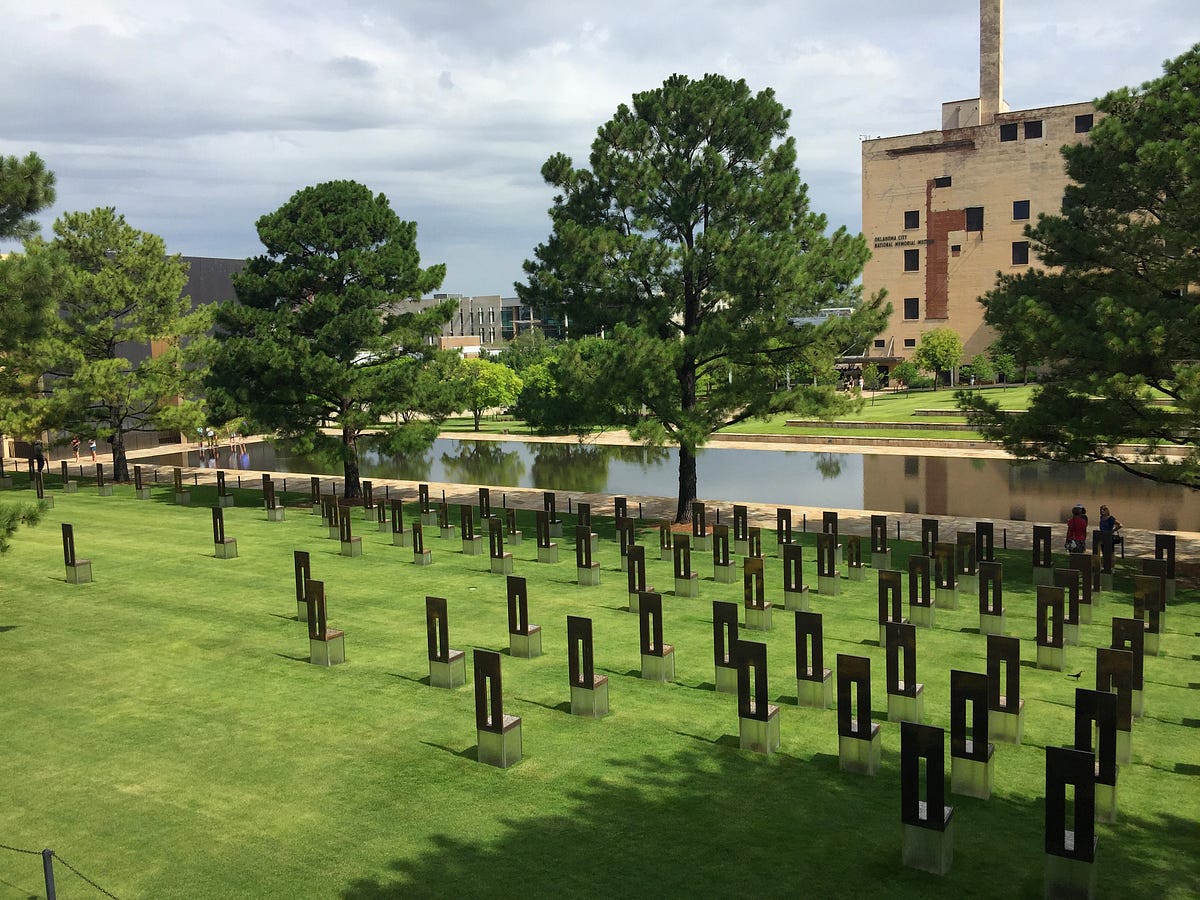
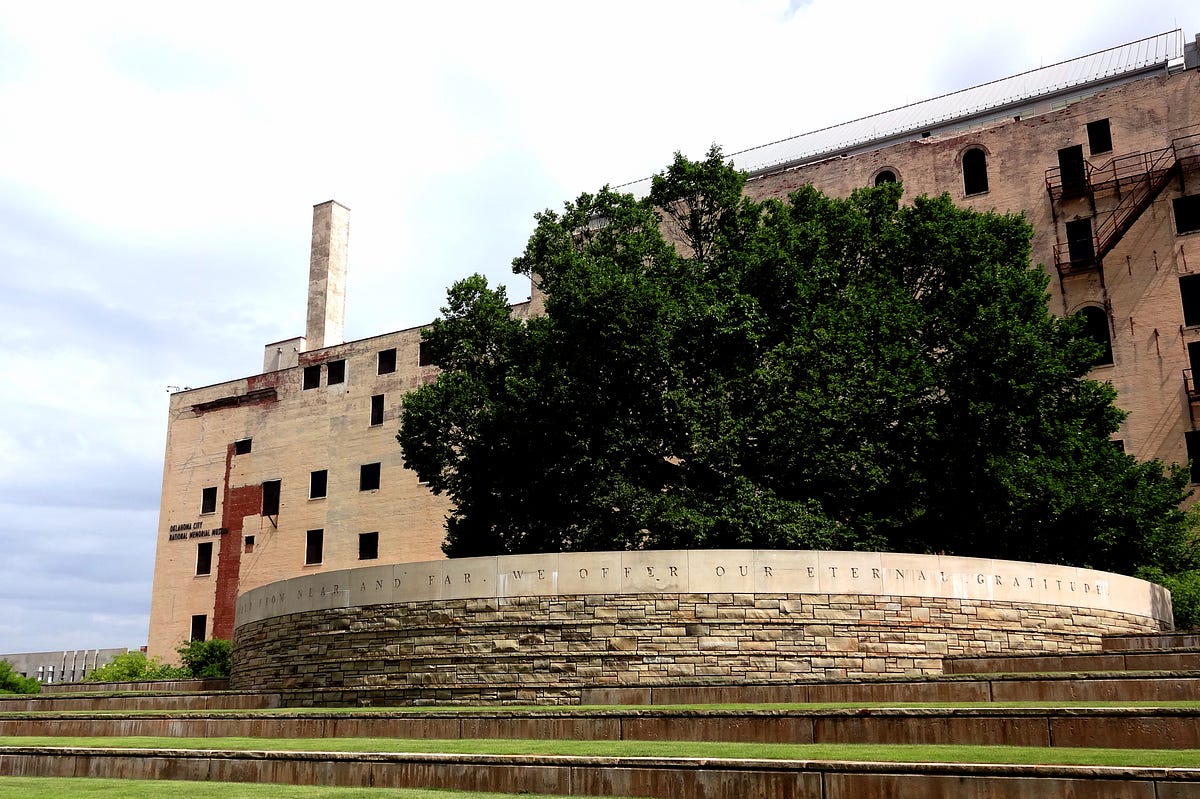
Oklahoma City National Memorial Photo by Terrye Turpin
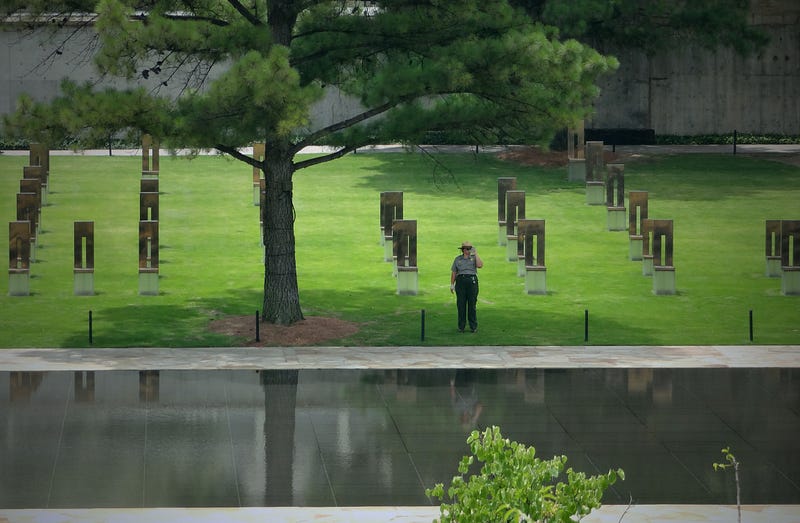
168 bronze and glass chairs, arranged in 9 rows, stretched across the green field.
My fiance Andrew and I drove up to Oklahoma City the day before, a Friday, and spent an endless, tiring day at the car dealership where Andrew negotiated the purchase of used BMW. I fidgeted in the vinyl covered chairs in the customer lounge, read books and checked my email.
The dealership offered free sodas and I spent the afternoon wandering between the bathroom and the soda machine. Engrossed in the book I was reading, I knocked a full cup of ice and cola onto the floor then sat there as the puddle crept toward my feet. Andrew found paper towels in the men’s room and mopped up the mess while I glanced to see if anyone else in the sparkling showroom had noticed.
We went for a test drive in the car, a 2009 BMW 128i series in Montego Blue, a color so electric brilliant I felt a small static shock walking up to it. I settled in the passenger seat and watched the highway exit signs flash past, too quick to read. After the purchase I followed in my SUV as Andrew drove back to our hotel. The bright blue sedan weaved through stodgy trucks and cars like a songbird.
The next day we visited the Oklahoma City National Memorial.
Field of Chairs Photo by Terrye Turpin
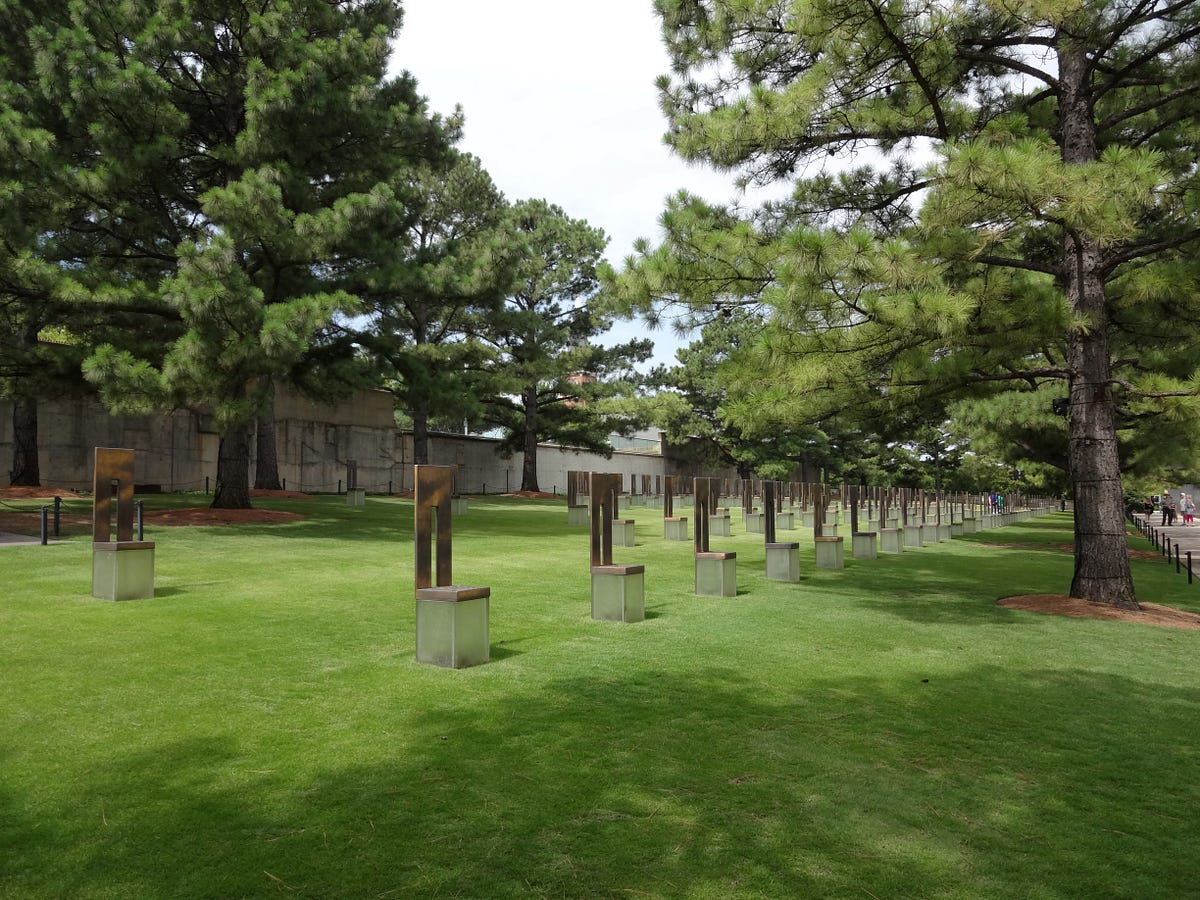
The chairs represent the empty places at dinner tables for each of the 168 people who died in the bombing of the Alfred P. Murrah Federal Building in downtown Oklahoma City on April 19, 1995. There are nine rows, corresponding to the nine floors of the building. Each chair is positioned according to the floor where each of the lost perished. There are five chairs in a separate row, symbolizing the five victims killed outside the building.
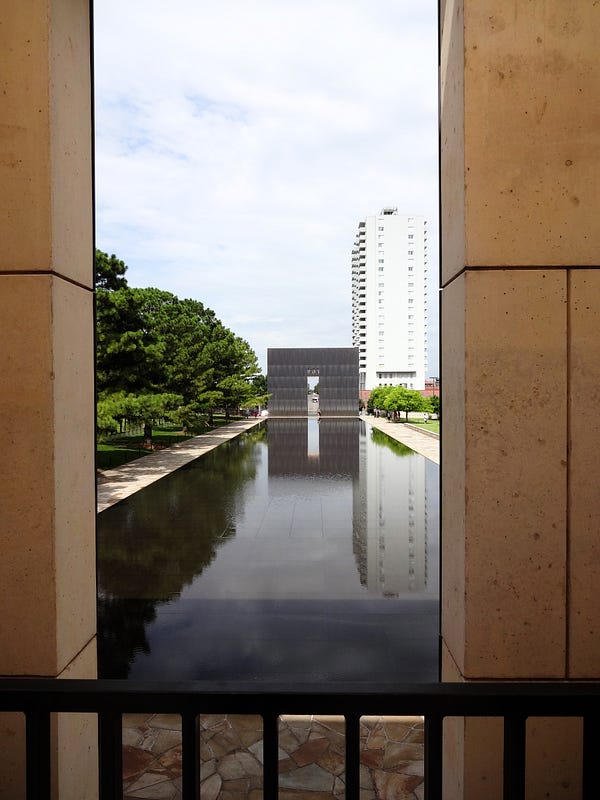
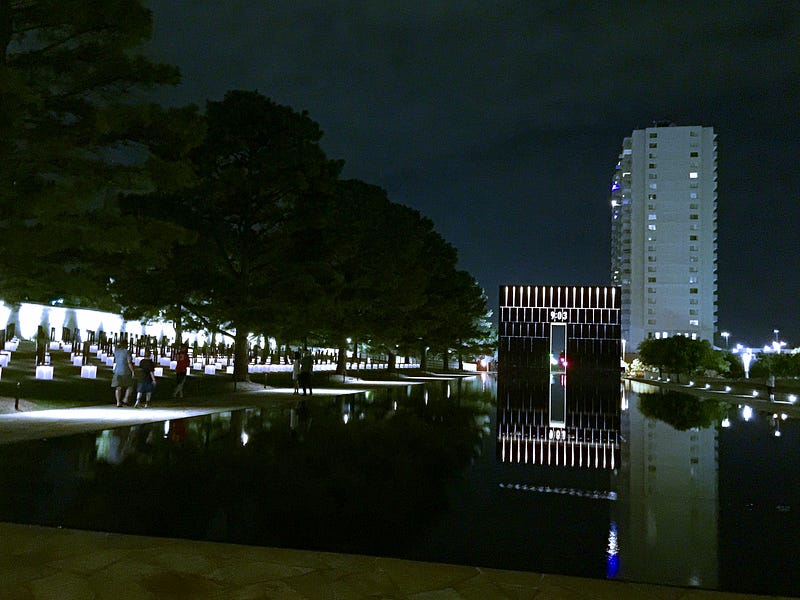
The West Gate and the Reflecting Pool Photo by Terrye Turpin
Looking out from the East Gate Photo by Terrye Turpin
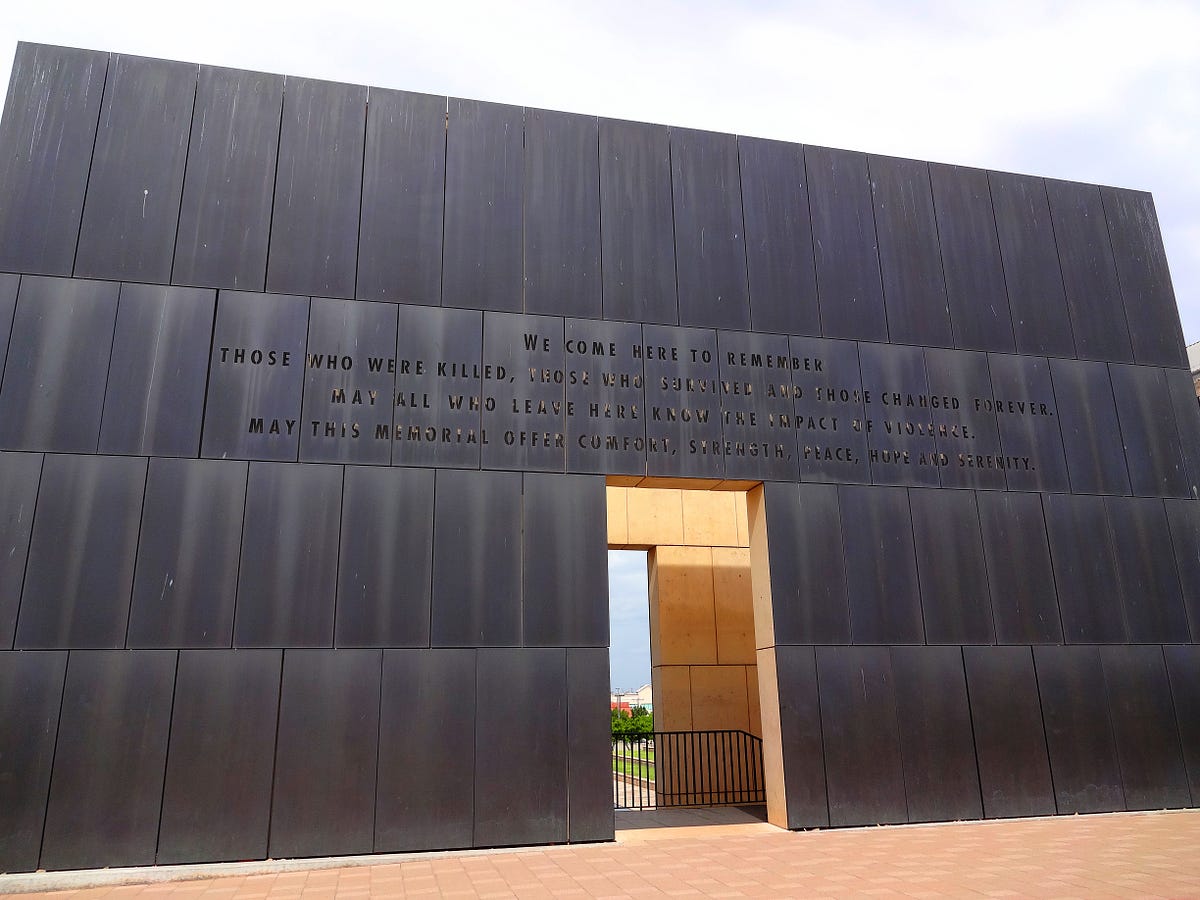
Two gates flank the memorial grounds. The East Gate displays the time 9:01, just before the bomb went off at 9:02 am that day. The West Gate displays 9:03, the time immediately after, when healing and rebuilding began.
A reflecting pool covers the area that once was the street in front of the building. The bomber drove a rented truck down NW 5th street, past the tall apartment building, and parked in front of the doors on the north side of the building.
The granite walkway surrounding the field is constructed in part from rubble salvaged from the site.
Field of Chairs Photo by Terrye Turpin
The field outlines the footprint of the Alfred P. Murrah building. The jagged outcroppings in the south wall are parts of the original building. The only walls remaining are on the east end of the memorial, where slabs of granite bear the names of the more than 1,000 who survived that day.
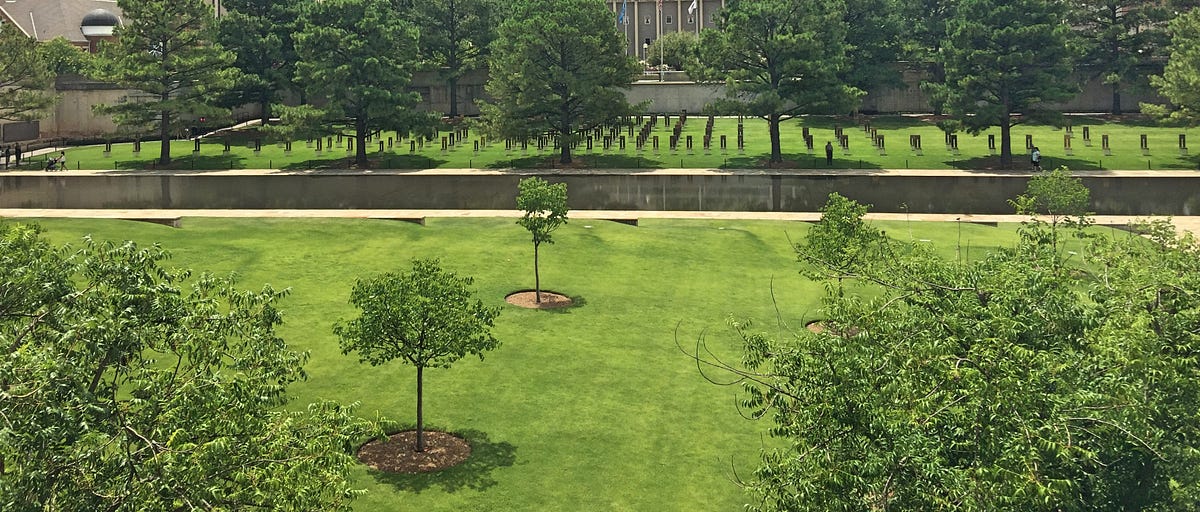
A portion of the Rescuer Orchard Photo by Terrye Turpin
The Rescuer’s Orchard represents the more than 12,000 people who responded that day, many within minutes of the explosion. One nurse, Rebecca Anderson, lost her life in the aftermath as she collapsed while rescuing survivors. The bronze and glass chair etched with her name stands with the five others in the row at the end of the field.
The Survivor Oak Photo by Terrye Turpin
At the east end of the Rescuer’s Orchard stands the 100 year old American Elm known as the Survivor Tree. It stood in the gravel parking lot directly in front of the Murrah building. Damaged in the blast and surrounded by burning cars, the tree was expected to die, but it recovered.
Inscription at the Survivor Tree Photo by Terrye Turpin
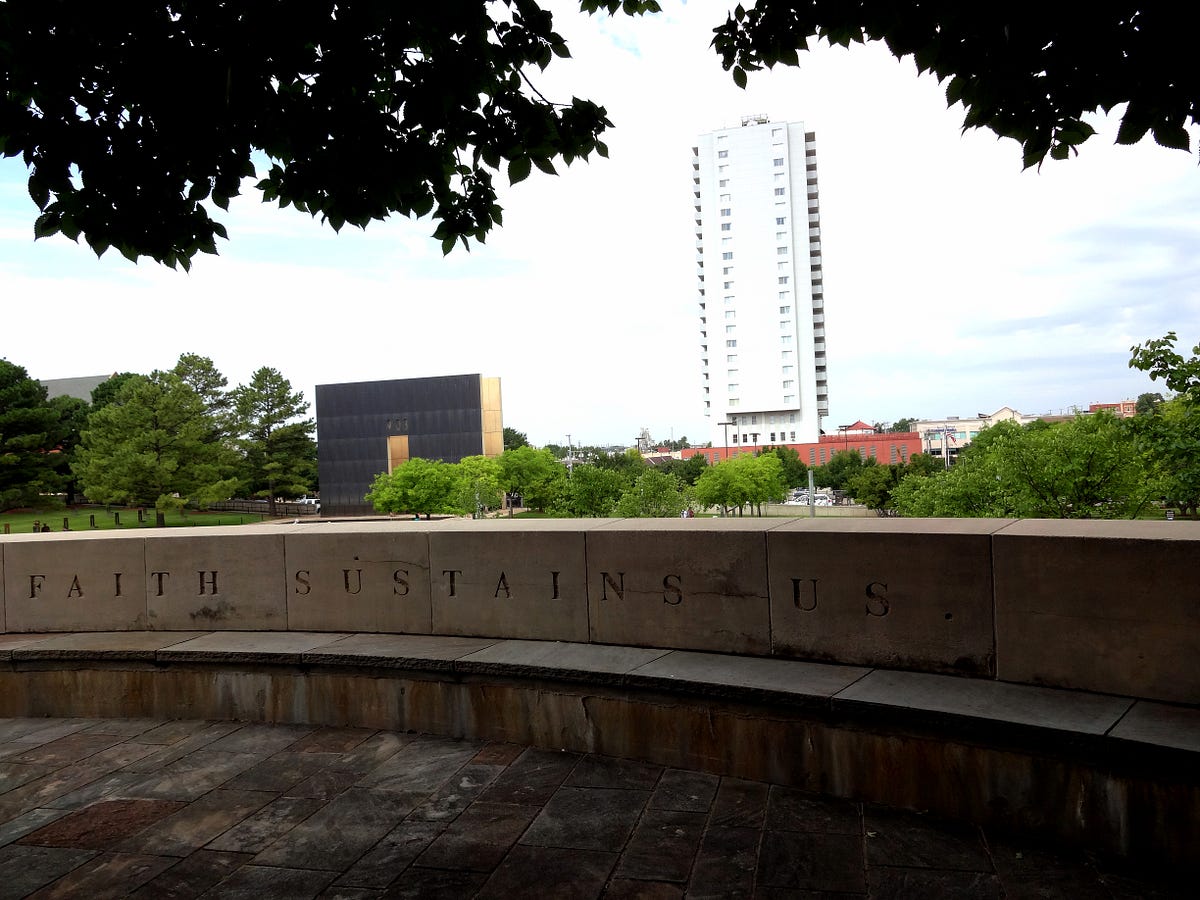
“The spirit of this city and this nation will not be defeated; our deeply rooted faith sustains us.” Inscription surrounding the Survivor Tree.
We walked around the grounds outside until the hot afternoon summer sun urged us into the air conditioned museum.
Photo by Terrye Turpin
Inside the museum we watched video interviews with survivors, investigators, and rescuers. Glass display cases held items gathered from the site — eyeglasses, car keys, shoes, toys, and pens. One case held a dress worn by one of the survivors, a small tear the only damage to the fabric. The same case also held a plastic baggy bulging with bits of cloth pulled from the body of another survivor. Their location when the bomb went off determined the extent of their injuries. A trip down the hall to the restroom or a chore at the copy machine literally meant the difference between life and death for some.
We, the visitors, gathered in a small room and sat on a padded bench pushed against the wall. Across from us a tape recorder enclosed in a clear case sat on a wooden table. It was easy to imagine the people gathered there that day, shuffling papers and scooting closer in the government issued straight back chairs that front the table. We listened to a taped recording from the Water Board Hearing held that day. The Oklahoma Water Resources Board building, located directly across from the Alfred P. Murrah Federal Building, was damaged in the blast and demolished. The taped meeting, a record of the events from that morning, was preserved.
A female voice on the tape announces the time and date for the record, 9:00 AM on April 19, 1995, and calls the hearing to order. The plaintiff, a man seeking a permit to sell water from his land, speaks up to confirm his presence. Fluorescent lights buzz above us as the voices on the tape drone on with the minutia of a government proceeding. We, the audience, know what is coming. I hold my breath and count off the seconds, my heart rate accelerating as I think surely it is past the time. I anticipate the blast, but when it comes I jump. The roar of sound and the frightened cries of the people on the tape do not resemble any special effects I have ever heard. The screen behind the table holding the tape recorder lights up with the images of the 168 lives lost that day.
Photo by Terrye Turpin
Photo by Terrye Turpin
We left the memorial and walked four hot concrete blocks to the Oklahoma City Museum of Art.
“Art washes from the soul the dust of everyday life.” ~ Pablo Picasso
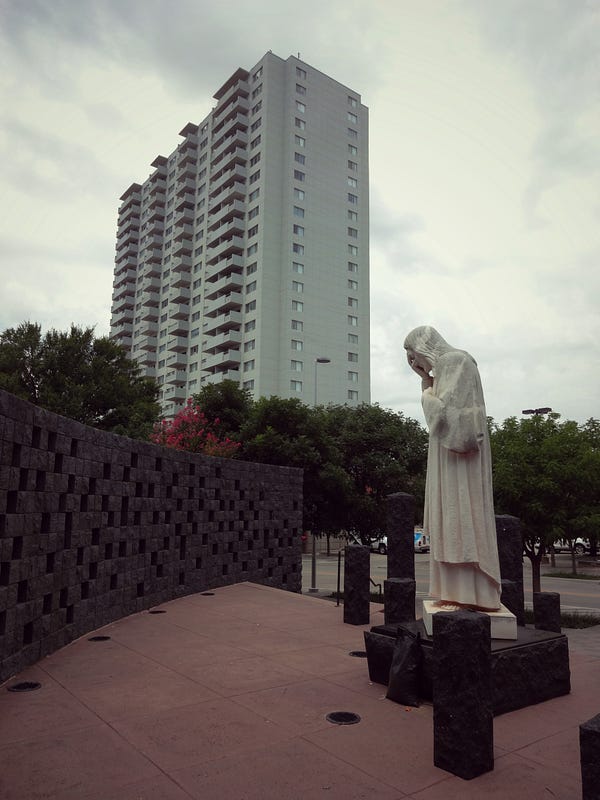
Jesus wept. John 11:35
We napped in the air conditioning of our hotel then returned to the memorial that evening.
The East Gate 9:01 Photo by Terrye Turpin
The memorial grounds are open 24 hours and are lighted at night.
The West Gate 9:03 Photo by Terrye Turpin
We strolled through the rows of chairs in their ghostly light. A group of people, a mother with short dark hair and her two teenage sons, stopped us to ask about the chairs.
“There are nine rows. They stand for the nine floors of the building and the chairs are placed according to where each victim was that day,” I explain. My voice carries over the still night air, rising as I grow absorbed in my description of the field and what we learned that morning at the museum. I wave my arms at the gates and tell about the reflecting pool that covers the street where he parked that day. I do not mention that the last three bodies were not recovered until May 27, 1995, 38 days after the bombing. We are standing on sacred ground.
“The smaller chairs are for the children who died in the blast.” My voice drops with this last.
“Children?” the woman asks.
“There were two daycare centers in the building,” I answer. The woman nods. The teenage boys stand silent and still. I do not tell her that several of the children had to be identified from latent prints lifted from their homes.
“You should come back tomorrow to the museum,” I add and she agrees.
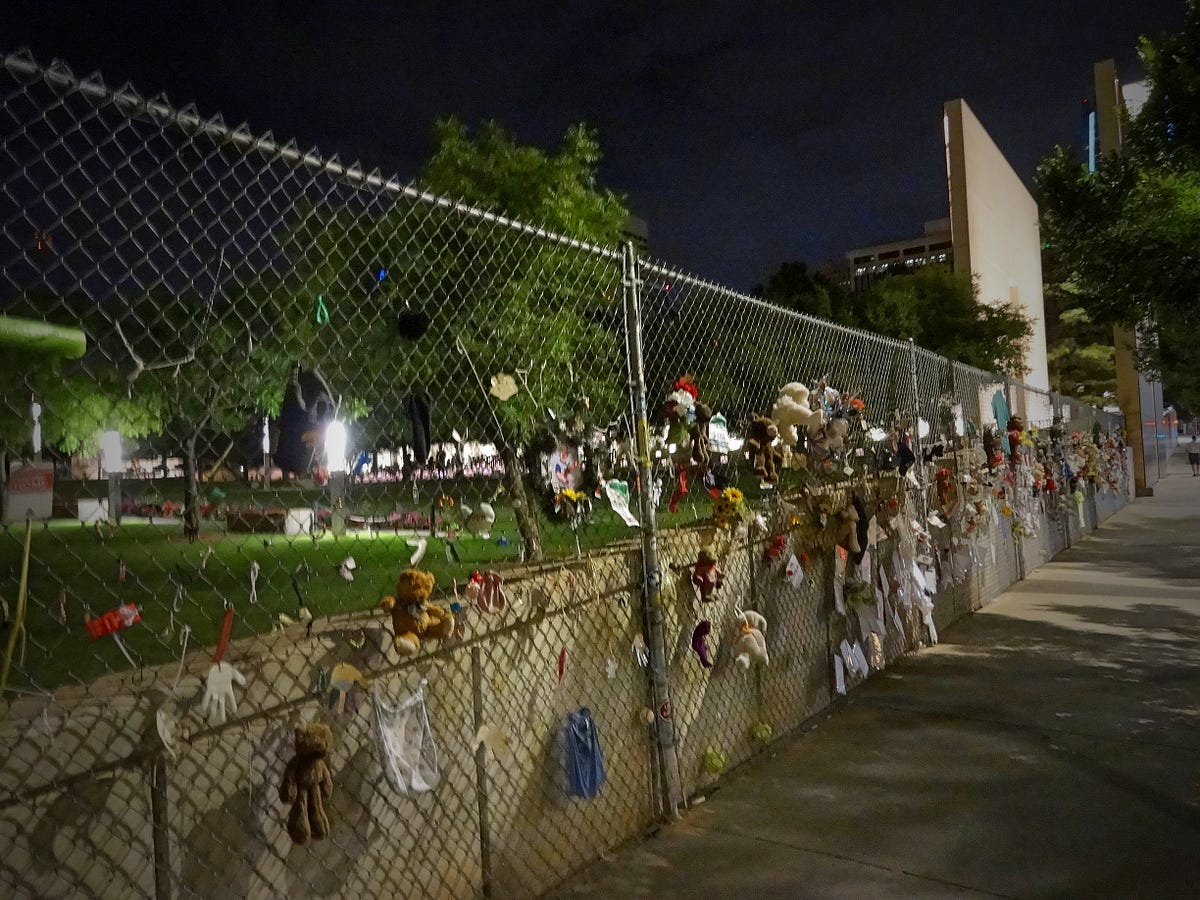
Fence at the Oklahoma City National Memorial Photo by Terrye Turpin
At the West Gate there is 200 feet of the original chain link fence that enclosed the bomb site. The fence is preserved so that visitors can leave items for remembrance. Periodically the tokens are removed and stored at the museum, which now holds more than 60,000 of these items.
Inscription on the West Gate Photo by Terrye Turpin
Park Ranger Photo by Terrye Turpin
We left Oklahoma City on Sunday and I followed the blue BMW until I lost sight of the car amid the flow of traffic headed south. Monday morning I returned to work, drank my coffee, chatted with coworkers, sent emails, made copies and visited the ladies room. A day like any other day.
My son, Andy, told me about the stray cat when I stopped over at his house for a visit. The cat, a scrawny orange and white tabby, wandered over to him at the park near his home.
“I shared my snack with it,” he said.
The cat, hungry enough to eat a granola bar, held still and purred while he petted her. She either had a taste for sweetened oats or she hadn’t eaten real cat food in a while. He told me he would have taken her home if he could have figured out a way to get her into his car.
We always had pets. A hamster, cats, dogs, a gecko, fish — every branch of the animal kingdom was represented. The last of them, our cat Miss Tiggy and the dog Greta, died not too long before my marriage came to its own timely end. When I moved out Andy came with me to share an apartment. Now he lived in a house with his fiancé. I stayed in the apartment, alone for the first time in twenty-five years.
When Andy mentioned going back to the park to look for the cat, the appropriate response at this point from me would have been “What about your allergies?” or “Are you sure you’re ready to own a pet?”
But Andy had a house in need of a pet, and there was a cat in need of a home.
“I wonder if she’s still there?” I asked as I gathered up my car keys.
We piled into my Honda SUV and drove the four blocks to Finch Park. The pecan and oak trees in the park loomed tall and shady over the playground when I played there as a child, and years later they stood over my own boys. The donated land was a gift from Fannie and Henry A. Finch and the park carries their name. Fannie was one of the first women in Texas to be elected to a school board, not an easy feat in 1917. In fact, since women weren’t allowed to vote until 1920, she wouldn’t have been able to cast a ballet for herself.
We found the kitty hiding out in the bushes that ringed one side of the grounds. She strolled out to greet us as we stepped out of the car, waving her tail like a flag signaling surrender. We hadn’t given much thought to the logistics of moving the cat from the park, into my car, and down the street to Andy’s house. We surveyed the supplies on hand.
“I have a recyclable grocery sack, a zippered cooler, and a laundry basket.” I said.
The cat did not particularly like being stuffed in the back of an SUV and having a laundry basket turned over on top of her. We made the drive back to the house listening to the cat wailing harmony to Lucinda Williams on the CD player.
I stopped in the driveway and Andy hopped out to open the front door. Once the way inside was clear we cautiously lifted the hatch on my SUV. The term “catapult” does not adequately describe the velocity that an angry cat can achieve when she launches herself from the driver’s seat of a car and out the back, past the astonished humans who stood in her way.
We lured her within grabbing distance with a can of tuna and I scooped her up to carry her into the house. At this point the cat noticed that we were approaching an open door into who knows what, and she decided to attach herself to me like a large, furry cockle burr. I don’t know who was howling louder, me or the cat, but we made it safely inside.
I searched the bathroom medicine cabinet for first aid supplies while Andy treated the cat to the rest of the tuna.
“What will you name the cat?” I called as I poured antiseptic down my arm.
“How about Killer?” Andy replied.
I was in favor of Lucy, short for Lucifer. I contemplated the angry red scratches on my arm and considered the possibility that I might perish from some cat borne illness.
Andy replied, “Don’t worry Mom, if you die we’ll name the cat after you.”
I thought about Miss Fannie Finch and the park named for her, and decided that if worse came to worse I could accept a scrawny cat as a namesake. After all, it’s nice to be remembered.













 Let's Get Out of Here