I’m from Friday night football games Third Quarter sitting with the band kids. Fourth Quarter standing in the end zone Rooting for the visiting team.
I’m from Saturday night drive-in backseat sin And Sunday morning sermons served with dinner on the ground, Communion with fried chicken.
Photo by Terrye Turpin
I’m from a land where Pump jacks bob against the horizon Like the dinosaurs whose bones They pull from the earth.
Where I’m from we played half court basketball Because girls could not be trusted To run the full length, goal to goal Until Title IX gave us our breath.
Photo by Terrye Turpin
My great-grandmother treasured her Confederate flag And courthouses commemorated with statues That losing side.
Where I’m from defines my past but does not determine my future.
I was tagged in this craze by the very talented Kay Bolden, so I’m assuming there’s at least one person out there interested in learning a little more about me. So here are ten things that will tell you a bit. Most of the photographs, for better or worse, were taken by me.
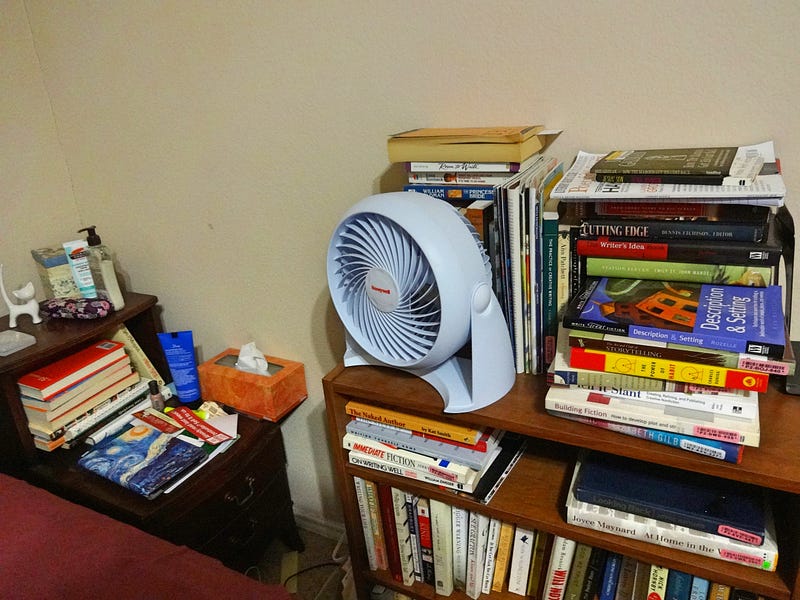
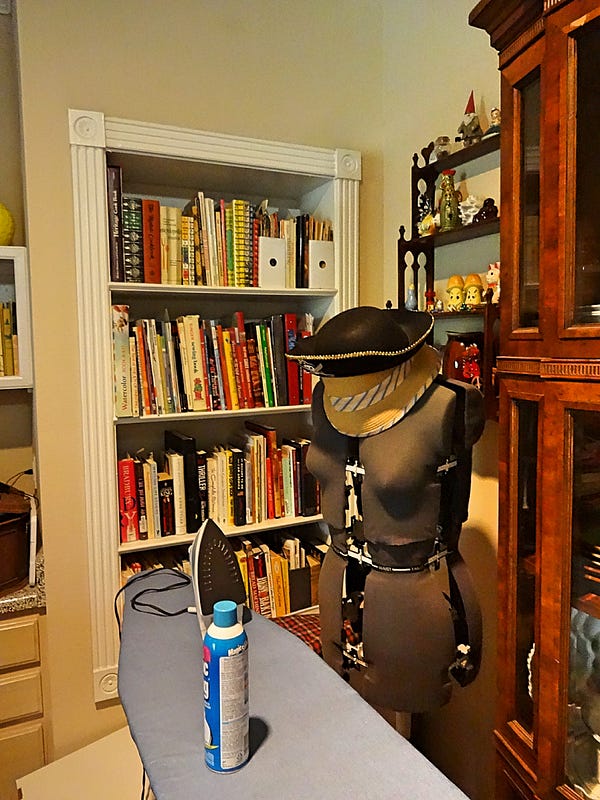
There are books in almost every room of my home.
Bedside table and bookcase filled with books on writing.
Well, Hello Dolly!
The dining room is also my crafting room. The bookcase here is filled with cookbooks and craft books. That’s Dolly lurking beside the ironing board.
Archer guards the nonfiction books and my Hot Wheels collection.
More books in the dining room.
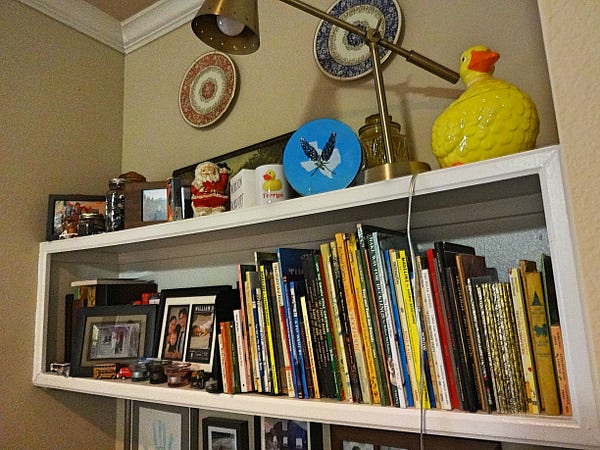
I keep the children’s books in the dining room for when my grandson visits. I wrote a story about that duck.
More books
2. I am the youngest of seven children, but because they were all much older than me, I grew up like an only child. My mother was 42 when I was born on her birthday. Three of my sisters and one brother have passed away, as have my mother and father.
My mother Christine Hamilton
My Dad Lloyd Hamilton and my older brother Ronnie
3. I’ve never lived further than 40 miles from McKinney, Texas — the place I was born.
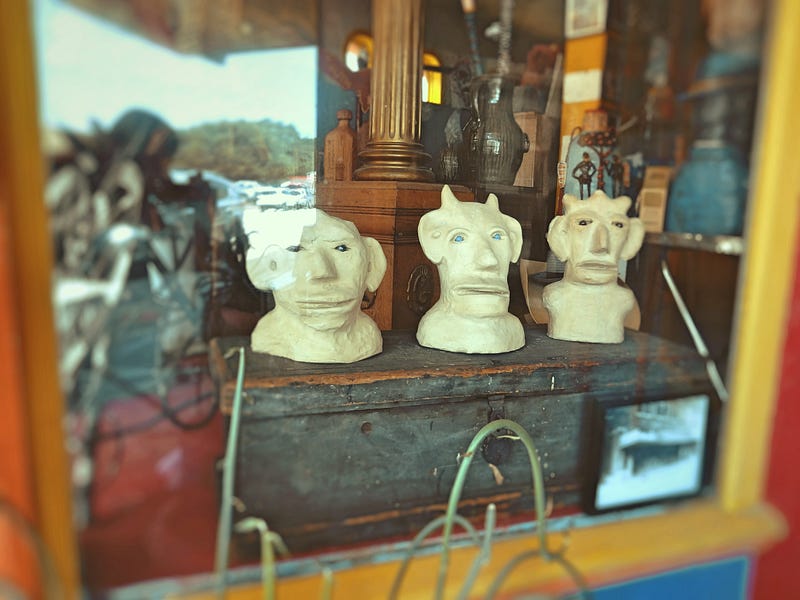
4. I love shopping at antique, junk, and thrift stores.
Window Shopping in Waxahachie, Texas
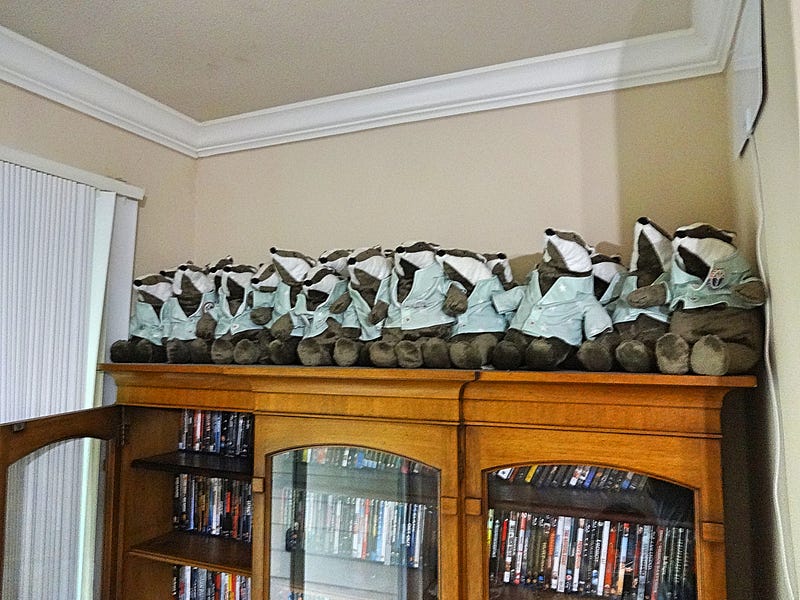
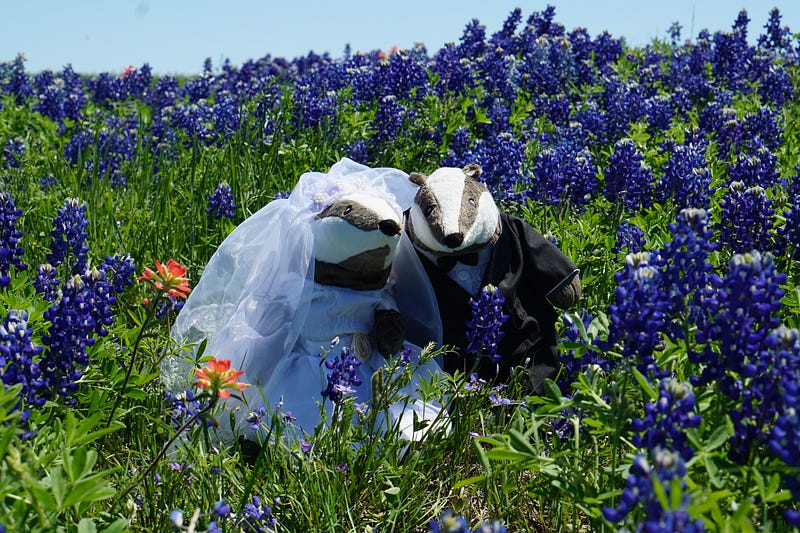
5. My fiance and I own more than 30 IKEA badgers. (We love IKEA)
Badgers, Badgers, Badgers
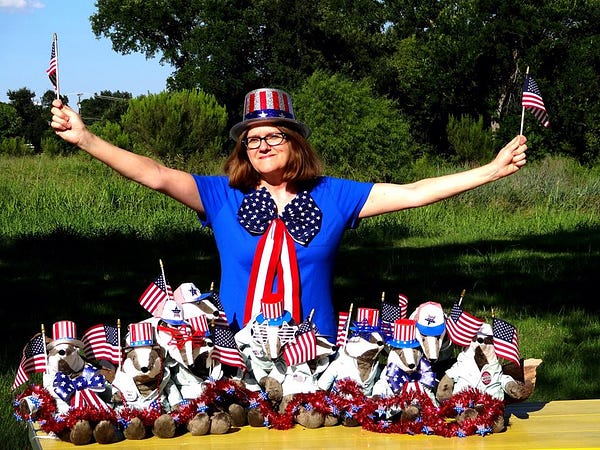
Happy Fourth of July!
Sometimes we dress the badgers in holiday apparel.
6. My favorite authors are Stephen King, Neil Gaiman, Robert McCammon, and David Sedaris.
If I’m in a dark mood my writing takes a twisted turn to horror.
I love David Sedaris, and you can probably see his influence in my humorous essays. I go to hear him perform his work every time he’s in the Dallas/Fort Worth area and I have all his books, four of them are signed by him.
7. I have a Bachelor of Science degree in Chemistry (I thought I wanted to go to medical school). When I was 45 I went back to school to earn a graduate degree. It took me five years working full time and going to classes part time to earn my Masters degree in Taxation. I worked my way through graduate school delivering pizzas part time in addition to my 40 hour a week full time job.
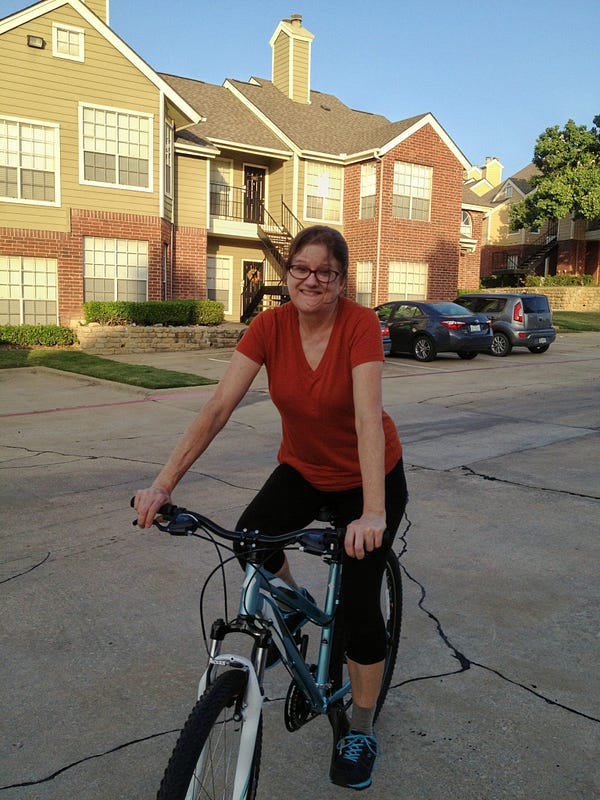
8. I bought a bicycle when I was 52, and started riding again after almost 30 years.
I’m just posing here, I do ride with a helmet.
9. I got divorced after 25 years of marriage. When I started dating again I signed up for OK Cupid and gave online dating a try.
I only met one person and had one date through OK Cupid.
Me and Andrew hiking in Glen Rose, Texas at Dinosaur Valley State Park
10. I’m getting married in October to that one date I met six years ago on OK Cupid.
Badgers in Bluebonnets in Ennis, Texas — This photo by Andrew Shaw
I’ll keep the thread going by tagging a few folks here, if you’ve already been tagged you can blissfully ignore this one, but I hope you’ll play. And if I haven’t tagged you please join in with your list of ten things and tag me, I’d love to read them.
I moved into my first apartment in 1979. The place came with shag carpet striped in an acid trip rainbow of purple, green, and brown. By the time my roommate Ann and I lived there the rug had collected a gummy overlay of tobacco and pot smoke, beer, and other substances we ignored. Our floral print couch had broken springs that sagged our butts toward the ground when we stretched out to catch up on Love Boat and Fantasy Island. The world’s biggest fan of the rock band Queen lived next door. He serenaded us every night with “Another One Bites the Dust” and if we pushed the couch close to the wall, it would rock us to sleep with the vibrating bass line. That apartment was the first place we had ever chosen all on our own, without help from parents or school administration.
Ann and I discovered our home in August, about three weeks before the fall semester would start at Texas Woman’s University. We drove over to Denton, Texas in her 1967 Dodge Dart. The car did not have air conditioning. We rolled down the windows and hung our heads out like dogs to catch the hot air blowing off the highway. By the time we made the hour-long trip from our hometown the backs of my legs stuck to the vinyl car seat with a tacky layer of sweat glue. We pulled into the parking lot of the first complex on our list and slumped out of the car, careful not to brand ourselves with the hot metal on the outside the Dart. In the full sun we stood there pondering the faded pink brick buildings. I imagined the rubber soles of my sandals melting into the black tar pit of the asphalt parking lot and I wondered if some later civilization would find my bones, preserved and still wearing flip flops.
“There’s a pool,” Ann said, pointing toward a shimmering patch of blue in the center of the courtyard. The sharp summer scent of chlorine hung in the air and we heard laughter and soft splashing coming from the lucky residents enjoying the water. We wiped the sweat out of our eyes, abandoned the car, and raced to the manager’s office to sign a lease for our new apartment.
We moved in over the next weekend, figuring to get settled in before classes started. We unpacked in air-conditioned comfort, without realizing we enjoyed the last bit of the previous tenant’s billing cycle. On Monday we woke to the end of that free ride. No electricity meant no radio, no television, and no air conditioning. Our friendly neighbor set down his bong and turned down the bass on his stereo long enough to explain how to go about getting our own account set up. A phone call to the utility company later, we had an appointment for them to come out the next day, Tuesday.
We opened the windows and the front door and spent the day at the pool. By early evening we were both the color of the Boone’s Farm Strawberry Hill wine we had been drinking all day.
“Is there any more ice?” Ann asked from the couch where she stirred the hot air with the magazine she had been reading.
“No, maybe we should go to the store.” My voice was muffled because I had my head in the open freezer, waving the last of the cool air onto my face.
“We’re also out of wine,” I added.
Ann and I moaned about the lack of air conditioning, ice, and alcohol and decided, since we were heading to the store to get ice and wine, we would stop at K-Mart to pick up a fan–yes, an electric fan, a fan that would need electricity to run.
Most people would notice the glaring gap in logic this purchase presented. However, Ann and I, stunned from the heat like lizards, and brain damaged from inhaling chlorine fumes and cheap wine all day, loaded into the Dart and headed to K-Mart.
Once we arrived at the store, we discovered the fans displayed right at the front entrance. We walked through a wind tunnel of spinning blades and overlooked the cords dangling from the back and running to the hidden power supply. We pictured our fan set up in the living room, spinning cool air out of nothing. Fan chosen and placed in the shopping cart, we picked up cleaning supplies and added a bottle of lemon scented ammonia to our cart as we headed to the cashier.
While we stood in line, Ann picked up the cleaner. “I wonder if this really smells like lemons. You know, like real lemons or just some sweet stuff.” I took the bottle from her and read the label.
“It says ammonia,” I said.
I unscrewed the cap, held the container close to my nose, and inhaled a strong breath. A line of lemon scented fire raced up my nose and entered my brain.
“Well, does it smell like lemons?” Ann asked.
I couldn’t answer as my lungs seemed to have collapsed from the ammonia. Instead I waved frantically, hoping it would be interpreted as “Yes, but help!”
I held out the bottle toward Ann and before I could warn her, watched as she took the bottle from me and inhaled. There we were, in the line at K-Mart, gasping for breath and crying, passing that bottle of ammonia back and forth between us like two drunks sharing a can of Sterno.
We recovered enough to put the cap back on the bottle, then looked at the fan sitting there in the cart. The ammonia must have loosened something in our brain because we realized then you can’t run an electric fan without electricity. We traded the fan for a pair of flashlights and left the ammonia at K-Mart. We stopped for ice and headed back to our apartment, our home where the moonlight beckoned off the dark, still surface of the swimming pool and the night air smelled of chlorine and not lemons.
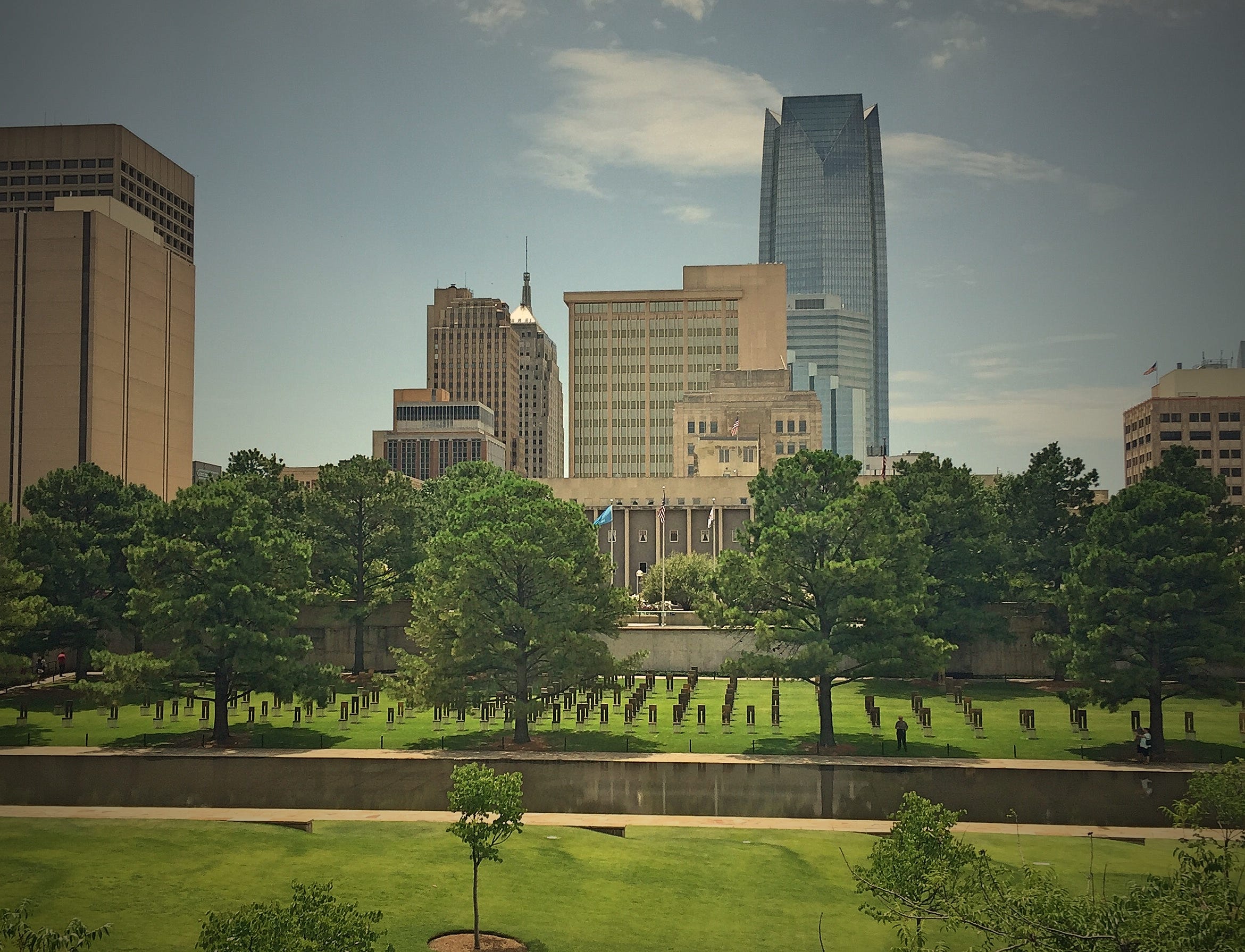
Oklahoma City National Memorial Photo by Terrye Turpin
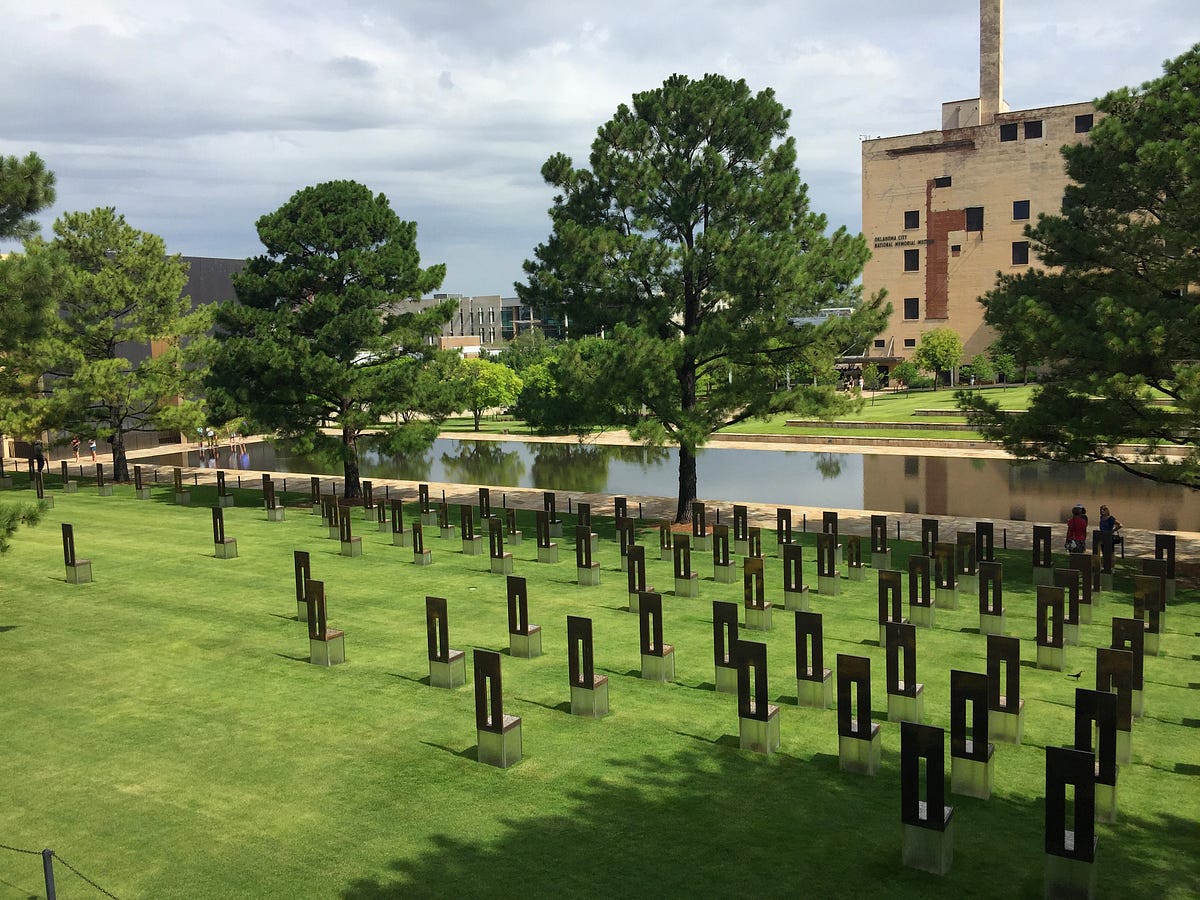
168 bronze and glass chairs, arranged in 9 rows, stretched across the green field.
My fiance Andrew and I drove up to Oklahoma City the day before, a Friday, and spent an endless, tiring day at the car dealership where Andrew negotiated the purchase of used BMW. I fidgeted in the vinyl covered chairs in the customer lounge, read books and checked my email.
The dealership offered free sodas and I spent the afternoon wandering between the bathroom and the soda machine. Engrossed in the book I was reading, I knocked a full cup of ice and cola onto the floor then sat there as the puddle crept toward my feet. Andrew found paper towels in the men’s room and mopped up the mess while I glanced to see if anyone else in the sparkling showroom had noticed.
We went for a test drive in the car, a 2009 BMW 128i series in Montego Blue, a color so electric brilliant I felt a small static shock walking up to it. I settled in the passenger seat and watched the highway exit signs flash past, too quick to read. After the purchase I followed in my SUV as Andrew drove back to our hotel. The bright blue sedan weaved through stodgy trucks and cars like a songbird.
The next day we visited the Oklahoma City National Memorial.
Field of Chairs Photo by Terrye Turpin
The chairs represent the empty places at dinner tables for each of the 168 people who died in the bombing of the Alfred P. Murrah Federal Building in downtown Oklahoma City on April 19, 1995. There are nine rows, corresponding to the nine floors of the building. Each chair is positioned according to the floor where each of the lost perished. There are five chairs in a separate row, symbolizing the five victims killed outside the building.
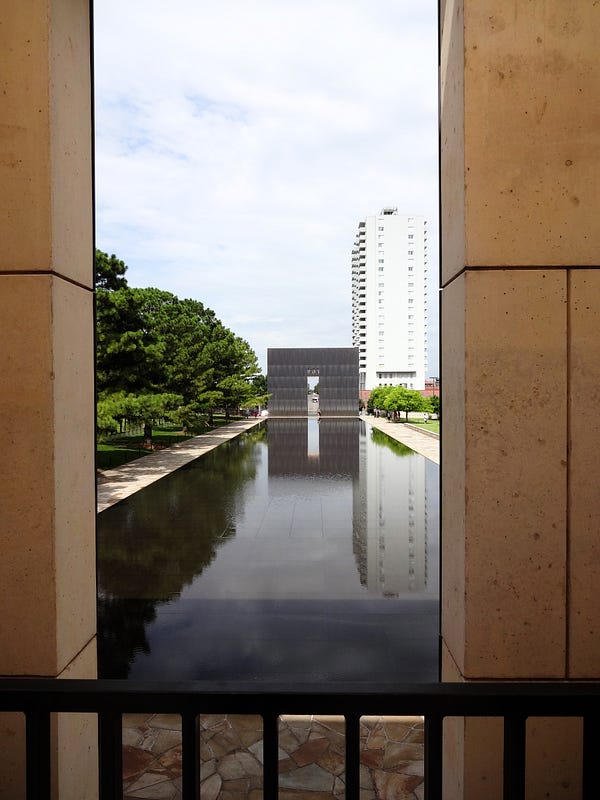
The West Gate and the Reflecting Pool Photo by Terrye Turpin
Looking out from the East Gate Photo by Terrye Turpin
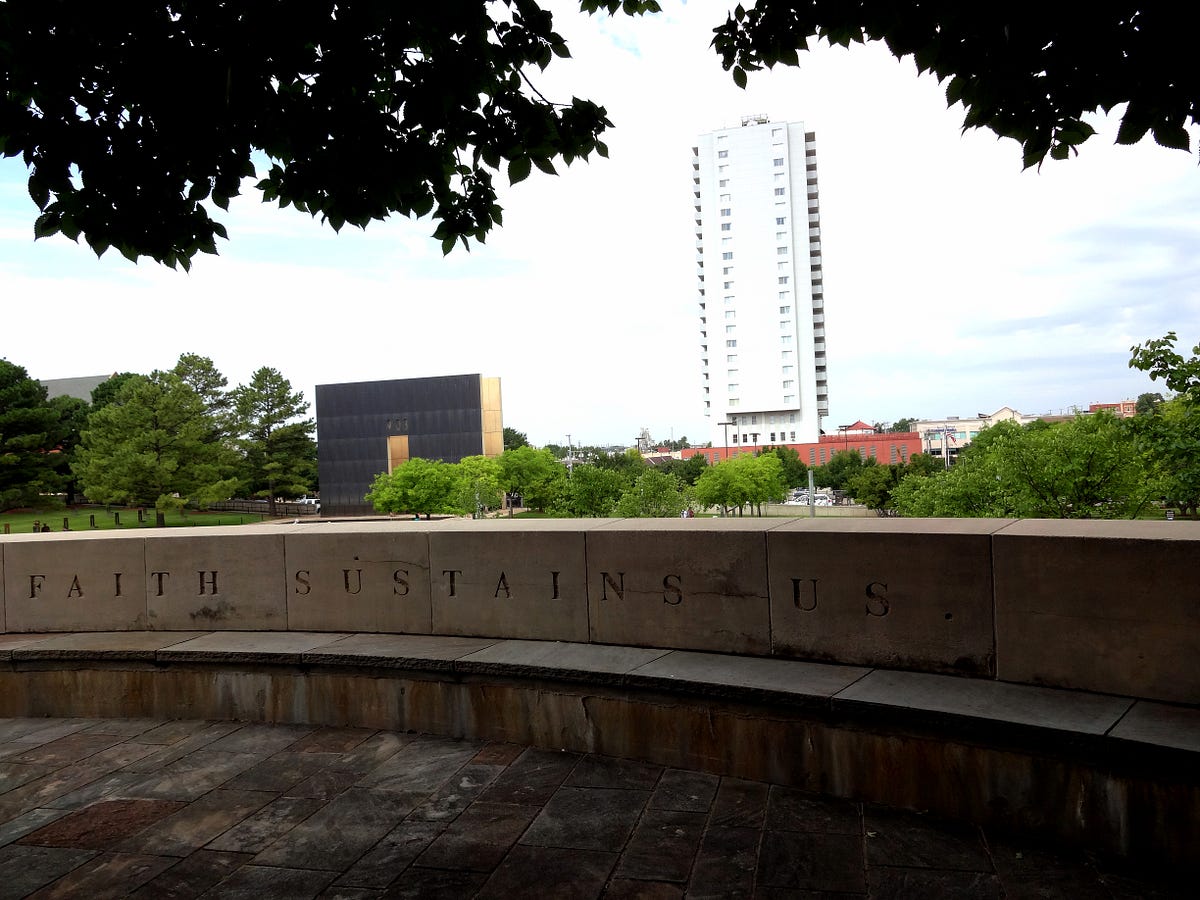
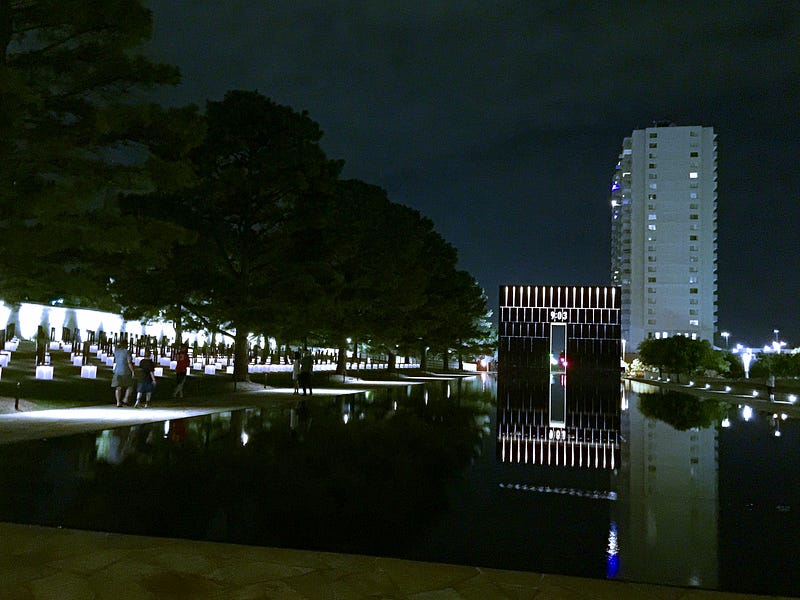
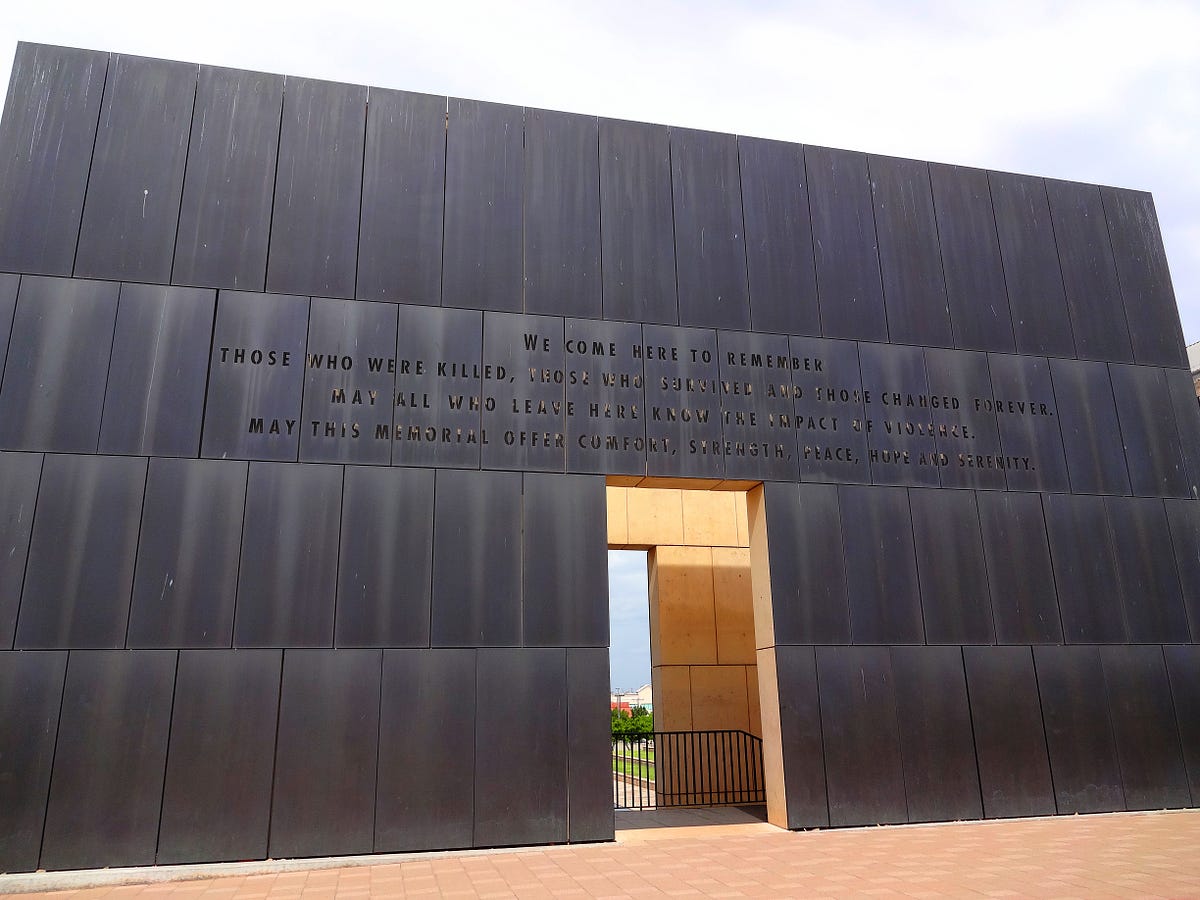
Two gates flank the memorial grounds. The East Gate displays the time 9:01, just before the bomb went off at 9:02 am that day. The West Gate displays 9:03, the time immediately after, when healing and rebuilding began.
A reflecting pool covers the area that once was the street in front of the building. The bomber drove a rented truck down NW 5th street, past the tall apartment building, and parked in front of the doors on the north side of the building.
The granite walkway surrounding the field is constructed in part from rubble salvaged from the site.
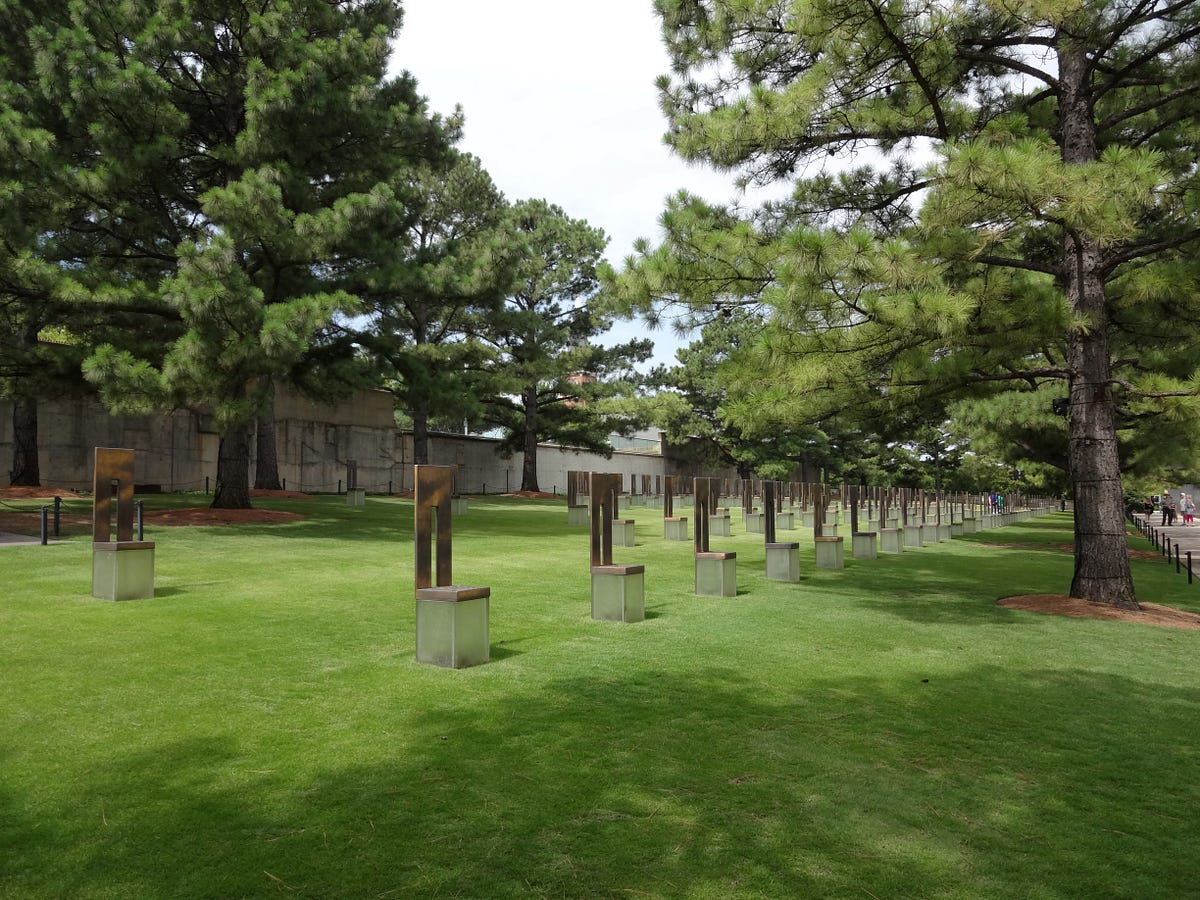
Field of Chairs Photo by Terrye Turpin
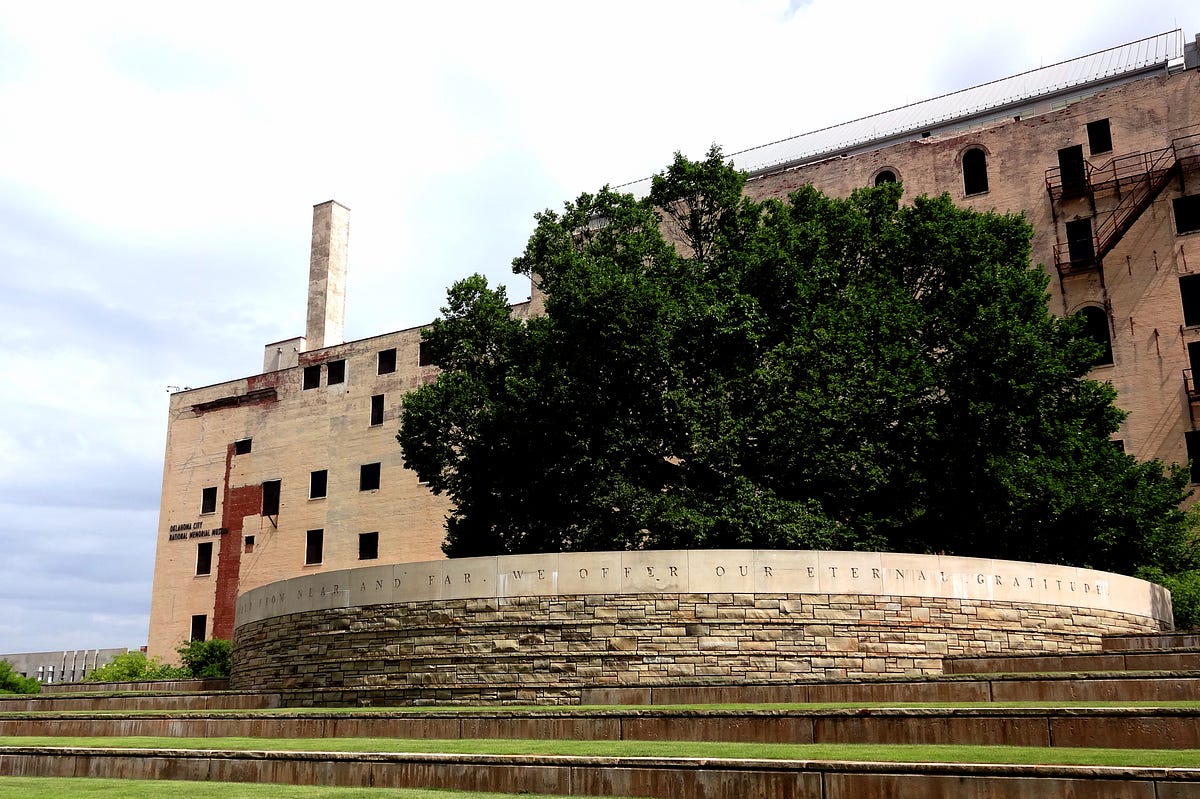
The field outlines the footprint of the Alfred P. Murrah building. The jagged outcroppings in the south wall are parts of the original building. The only walls remaining are on the east end of the memorial, where slabs of granite bear the names of the more than 1,000 who survived that day.
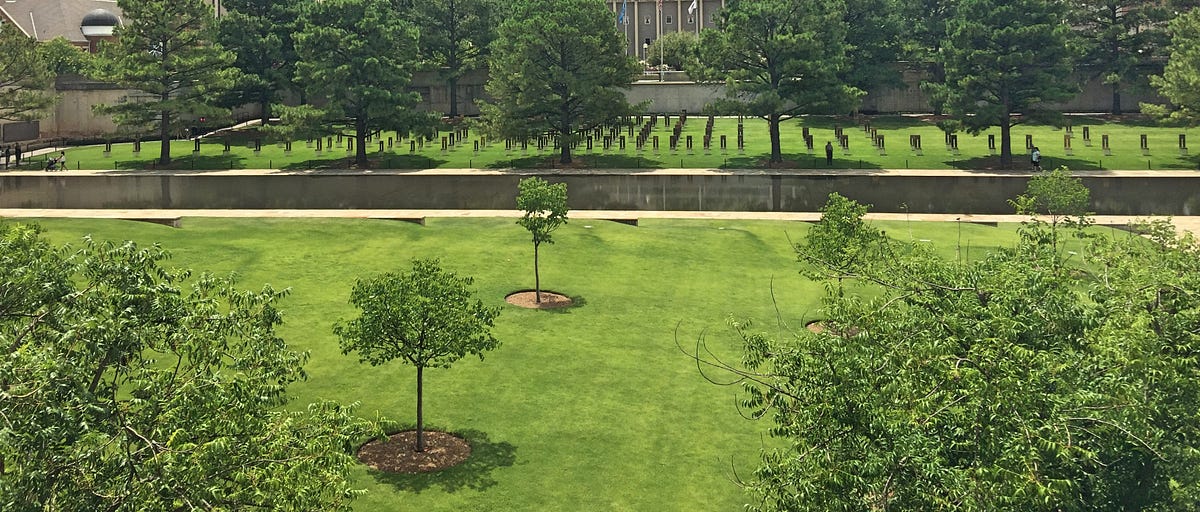
A portion of the Rescuer Orchard Photo by Terrye Turpin
The Rescuer’s Orchard represents the more than 12,000 people who responded that day, many within minutes of the explosion. One nurse, Rebecca Anderson, lost her life in the aftermath as she collapsed while rescuing survivors. The bronze and glass chair etched with her name stands with the five others in the row at the end of the field.
The Survivor Oak Photo by Terrye Turpin
At the east end of the Rescuer’s Orchard stands the 100 year old American Elm known as the Survivor Tree. It stood in the gravel parking lot directly in front of the Murrah building. Damaged in the blast and surrounded by burning cars, the tree was expected to die, but it recovered.
Inscription at the Survivor Tree Photo by Terrye Turpin
“The spirit of this city and this nation will not be defeated; our deeply rooted faith sustains us.” Inscription surrounding the Survivor Tree.
We walked around the grounds outside until the hot afternoon summer sun urged us into the air conditioned museum.
Photo by Terrye Turpin
Inside the museum we watched video interviews with survivors, investigators, and rescuers. Glass display cases held items gathered from the site — eyeglasses, car keys, shoes, toys, and pens. One case held a dress worn by one of the survivors, a small tear the only damage to the fabric. The same case also held a plastic baggy bulging with bits of cloth pulled from the body of another survivor. Their location when the bomb went off determined the extent of their injuries. A trip down the hall to the restroom or a chore at the copy machine literally meant the difference between life and death for some.
We, the visitors, gathered in a small room and sat on a padded bench pushed against the wall. Across from us a tape recorder enclosed in a clear case sat on a wooden table. It was easy to imagine the people gathered there that day, shuffling papers and scooting closer in the government issued straight back chairs that front the table. We listened to a taped recording from the Water Board Hearing held that day. The Oklahoma Water Resources Board building, located directly across from the Alfred P. Murrah Federal Building, was damaged in the blast and demolished. The taped meeting, a record of the events from that morning, was preserved.
A female voice on the tape announces the time and date for the record, 9:00 AM on April 19, 1995, and calls the hearing to order. The plaintiff, a man seeking a permit to sell water from his land, speaks up to confirm his presence. Fluorescent lights buzz above us as the voices on the tape drone on with the minutia of a government proceeding. We, the audience, know what is coming. I hold my breath and count off the seconds, my heart rate accelerating as I think surely it is past the time. I anticipate the blast, but when it comes I jump. The roar of sound and the frightened cries of the people on the tape do not resemble any special effects I have ever heard. The screen behind the table holding the tape recorder lights up with the images of the 168 lives lost that day.
Photo by Terrye Turpin
Photo by Terrye Turpin
We left the memorial and walked four hot concrete blocks to the Oklahoma City Museum of Art.
“Art washes from the soul the dust of everyday life.” ~ Pablo Picasso
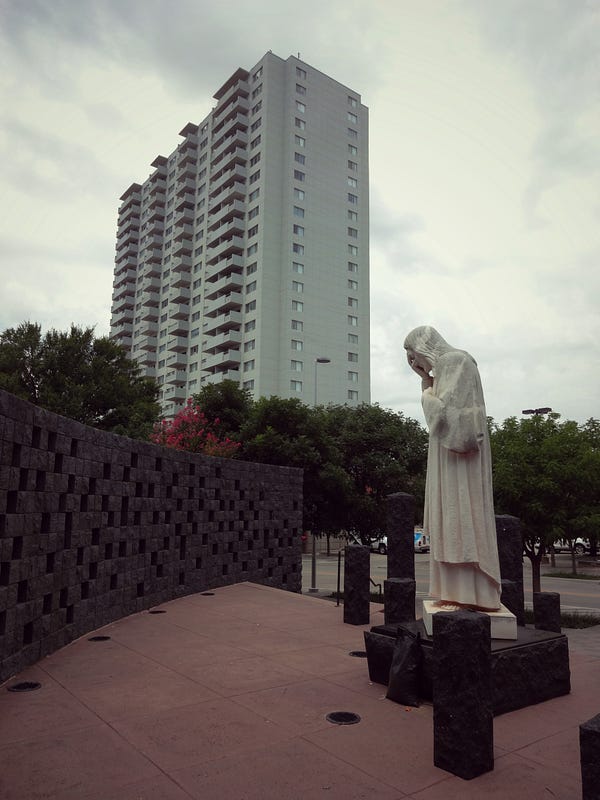
Jesus wept. John 11:35
We napped in the air conditioning of our hotel then returned to the memorial that evening.
The East Gate 9:01 Photo by Terrye Turpin
The memorial grounds are open 24 hours and are lighted at night.
The West Gate 9:03 Photo by Terrye Turpin
We strolled through the rows of chairs in their ghostly light. A group of people, a mother with short dark hair and her two teenage sons, stopped us to ask about the chairs.
“There are nine rows. They stand for the nine floors of the building and the chairs are placed according to where each victim was that day,” I explain. My voice carries over the still night air, rising as I grow absorbed in my description of the field and what we learned that morning at the museum. I wave my arms at the gates and tell about the reflecting pool that covers the street where he parked that day. I do not mention that the last three bodies were not recovered until May 27, 1995, 38 days after the bombing. We are standing on sacred ground.
“The smaller chairs are for the children who died in the blast.” My voice drops with this last.
“Children?” the woman asks.
“There were two daycare centers in the building,” I answer. The woman nods. The teenage boys stand silent and still. I do not tell her that several of the children had to be identified from latent prints lifted from their homes.
“You should come back tomorrow to the museum,” I add and she agrees.
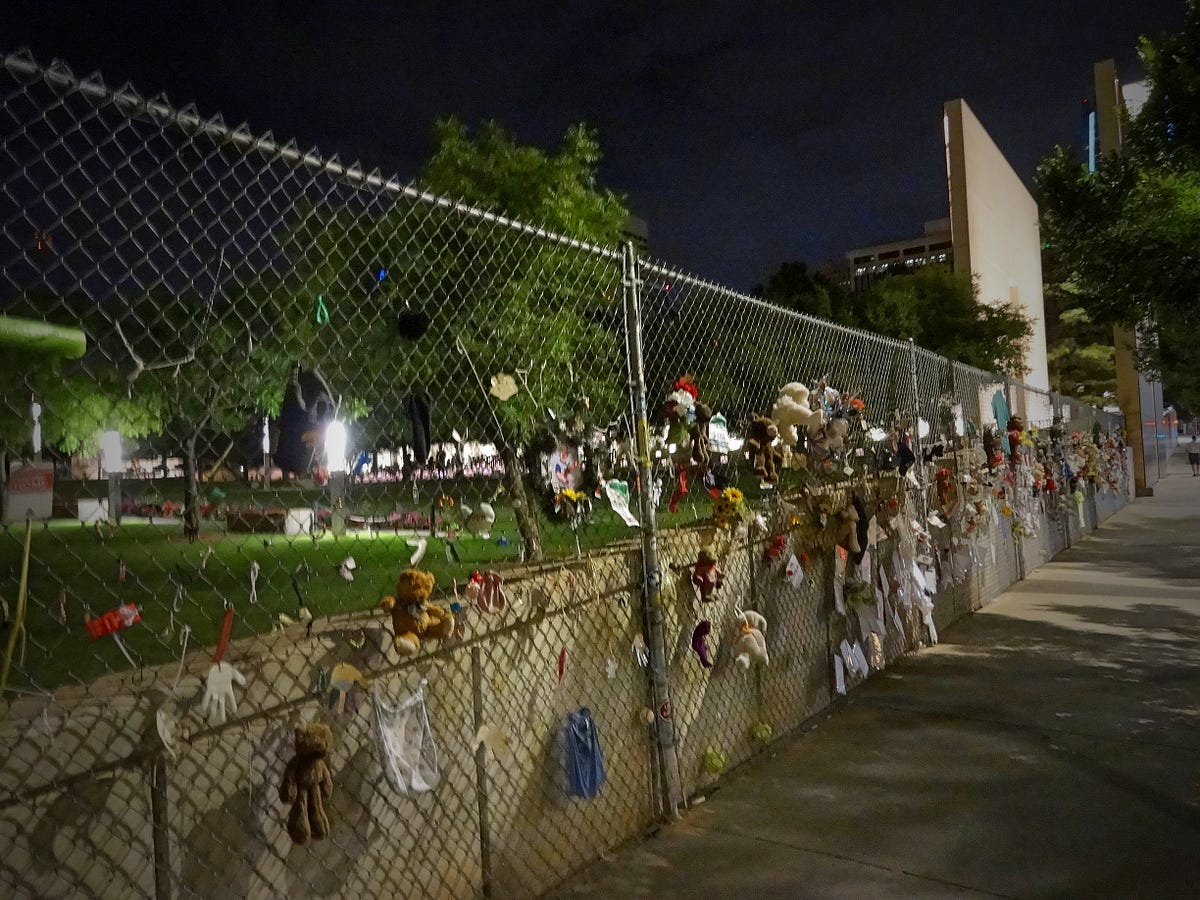
Fence at the Oklahoma City National Memorial Photo by Terrye Turpin
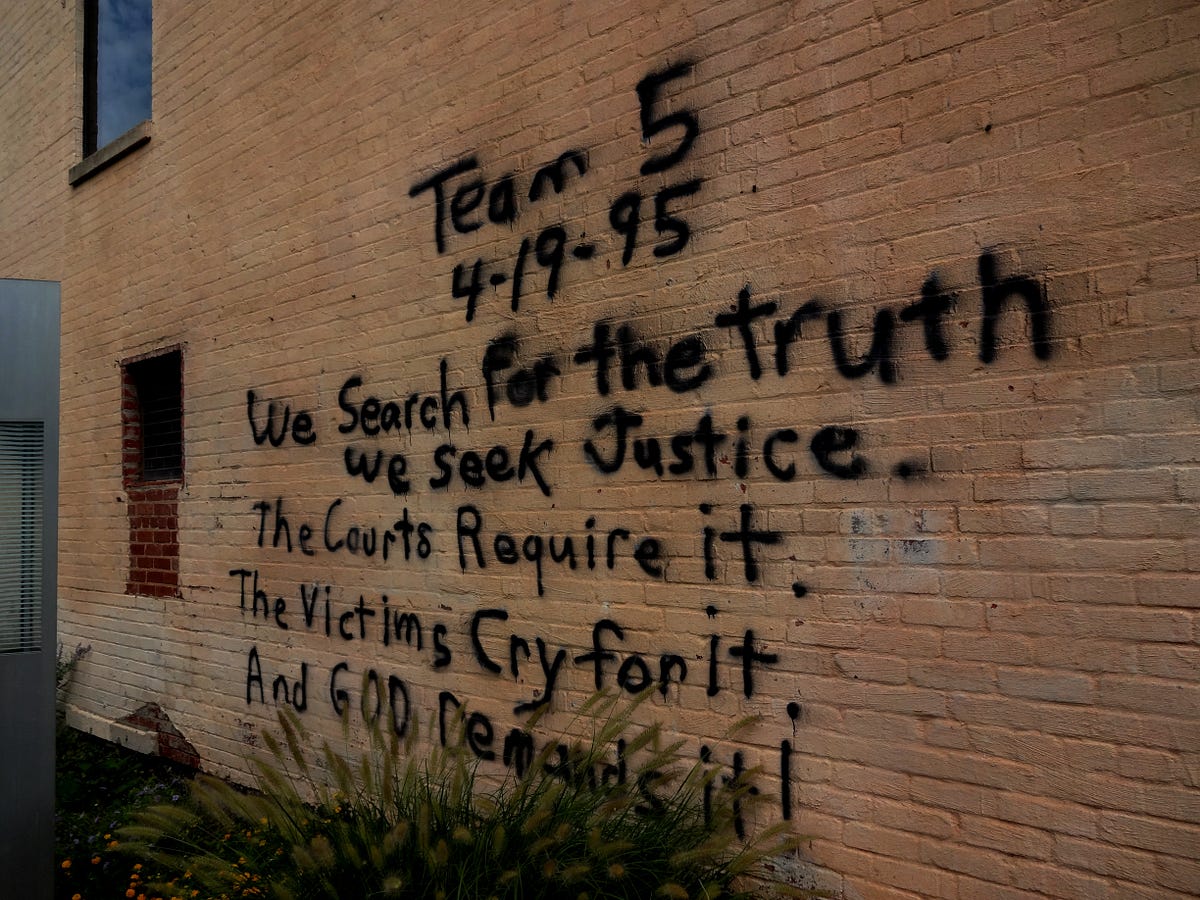
At the West Gate there is 200 feet of the original chain link fence that enclosed the bomb site. The fence is preserved so that visitors can leave items for remembrance. Periodically the tokens are removed and stored at the museum, which now holds more than 60,000 of these items.
Inscription on the West Gate Photo by Terrye Turpin
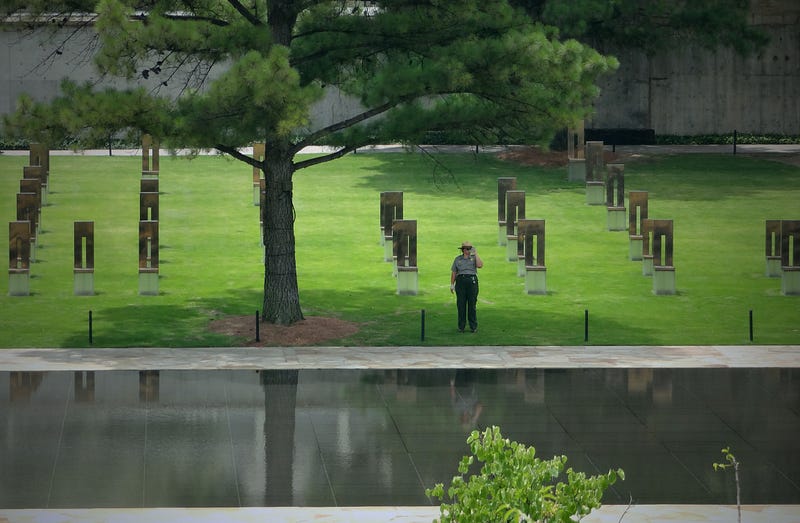
Park Ranger Photo by Terrye Turpin
We left Oklahoma City on Sunday and I followed the blue BMW until I lost sight of the car amid the flow of traffic headed south. Monday morning I returned to work, drank my coffee, chatted with coworkers, sent emails, made copies and visited the ladies room. A day like any other day.
My son, Andy, told me about the stray cat when I stopped over at his house for a visit. The cat, a scrawny orange and white tabby, wandered over to him at the park near his home.
“I shared my snack with it,” he said.
The cat, hungry enough to eat a granola bar, held still and purred while he petted her. She either had a taste for sweetened oats or she hadn’t eaten real cat food in a while. He told me he would have taken her home if he could have figured out a way to get her into his car.
We always had pets. A hamster, cats, dogs, a gecko, fish — every branch of the animal kingdom was represented. The last of them, our cat Miss Tiggy and the dog Greta, died not too long before my marriage came to its own timely end. When I moved out Andy came with me to share an apartment. Now he lived in a house with his fiancé. I stayed in the apartment, alone for the first time in twenty-five years.
When Andy mentioned going back to the park to look for the cat, the appropriate response at this point from me would have been “What about your allergies?” or “Are you sure you’re ready to own a pet?”
But Andy had a house in need of a pet, and there was a cat in need of a home.
“I wonder if she’s still there?” I asked as I gathered up my car keys.
We piled into my Honda SUV and drove the four blocks to Finch Park. The pecan and oak trees in the park loomed tall and shady over the playground when I played there as a child, and years later they stood over my own boys. The donated land was a gift from Fannie and Henry A. Finch and the park carries their name. Fannie was one of the first women in Texas to be elected to a school board, not an easy feat in 1917. In fact, since women weren’t allowed to vote until 1920, she wouldn’t have been able to cast a ballet for herself.
We found the kitty hiding out in the bushes that ringed one side of the grounds. She strolled out to greet us as we stepped out of the car, waving her tail like a flag signaling surrender. We hadn’t given much thought to the logistics of moving the cat from the park, into my car, and down the street to Andy’s house. We surveyed the supplies on hand.
“I have a recyclable grocery sack, a zippered cooler, and a laundry basket.” I said.
The cat did not particularly like being stuffed in the back of an SUV and having a laundry basket turned over on top of her. We made the drive back to the house listening to the cat wailing harmony to Lucinda Williams on the CD player.
I stopped in the driveway and Andy hopped out to open the front door. Once the way inside was clear we cautiously lifted the hatch on my SUV. The term “catapult” does not adequately describe the velocity that an angry cat can achieve when she launches herself from the driver’s seat of a car and out the back, past the astonished humans who stood in her way.
We lured her within grabbing distance with a can of tuna and I scooped her up to carry her into the house. At this point the cat noticed that we were approaching an open door into who knows what, and she decided to attach herself to me like a large, furry cockle burr. I don’t know who was howling louder, me or the cat, but we made it safely inside.
I searched the bathroom medicine cabinet for first aid supplies while Andy treated the cat to the rest of the tuna.
“What will you name the cat?” I called as I poured antiseptic down my arm.
“How about Killer?” Andy replied.
I was in favor of Lucy, short for Lucifer. I contemplated the angry red scratches on my arm and considered the possibility that I might perish from some cat borne illness.
Andy replied, “Don’t worry Mom, if you die we’ll name the cat after you.”
I thought about Miss Fannie Finch and the park named for her, and decided that if worse came to worse I could accept a scrawny cat as a namesake. After all, it’s nice to be remembered.
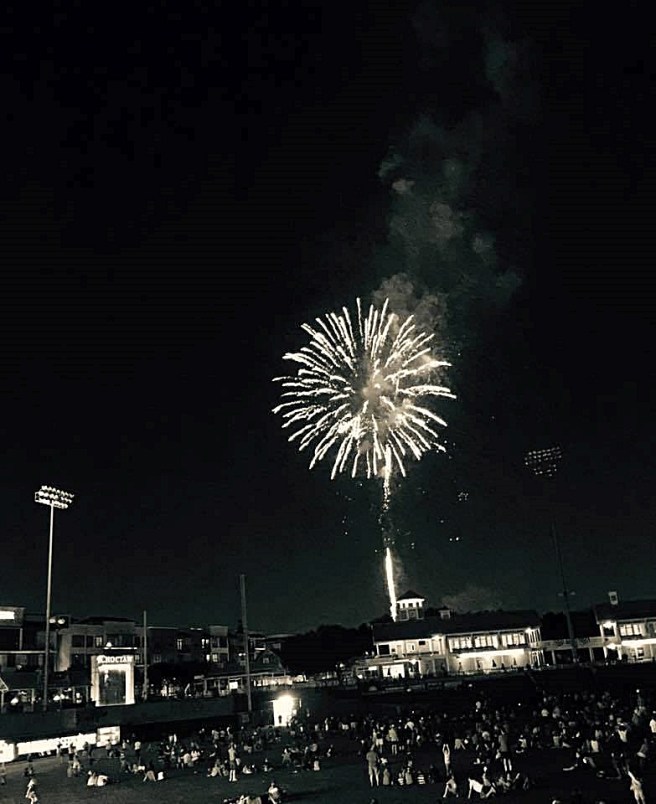
The view from 2016 when we were on the other side of the stadium.
I am not especially patriotic, but I love a good fireworks display. I’m not sure how I came to this attraction to all things bright and sparkly. It isn’t nostalgia. The only fireworks I remember in my childhood involved a car trip with my parents down a deserted country road. We stopped outside the city limits and my dad unloaded a paper sack of bottle rockets that we carried past a herd of curious cattle to the edge of a pond on some stranger’s land. It wasn’t exactly the type of memory I’m anxious to recreate.
The other day was July 4th, the day we Americans celebrate our independence by setting off grass fires and frightening the neighborhood dogs. My fiancé Andrew and I set aside this date every year for our annual disagreement about fireworks. He prefers to ignore them and hide inside in the air conditioning (I think he must have been a Labrador retriever in a past life) while I insist that the holiday won’t be complete unless I watch something explode.
“I could always stick a sparkler up my butt and run around,” Andrew said.
“Not spectacular enough,” I said, after considering his offer.
This year we compromised with an outing on July 3rd to the ballpark near our home to watch the Frisco RoughRiders play baseball. The schedule stated there would be fireworks following the game. We arrived at the stadium after the first inning and settled into our seats behind first base. I counted off the innings and willed the sun to set while we ducked at the occasional foul ball flying overhead. The ice in my soda melted and my thighs stuck to the plastic seat. The air filled with what was either the aroma of grilled hot dogs or my fellow spectators roasting in the summer heat. Around the 7th inning we rallied enough to stand and sing along with “God Bless America.”
As soon as the game ended I noticed a stream of people heading down from the stands.
“Should we follow them?” I asked.
The loudspeaker cut in, announcing that the fireworks would soon start. “They’ll be visible behind the first base section of the stands, fans will have a good view from the field,” the announcer said.
“That’s right over us,” Andrew pointed out. “I don’t think we’ll be able to see from here.” We leaned back in our seats, trying to judge the line of sight.
“We should move,” I agreed.
We hopped over rows of plastic folding seats and fought like salmon headed upstream against the crowd tromping down the aisles. The announcer warned “The fireworks will start in one minute” just as we reached the top of the stadium. I hummed the theme from Mission Impossible as we dodged a stadium attendant.
“Go! Go!” I urged Andrew as we weaved past shuttered food stands and splashed through puddles alongside the Lazy River pool. The first boom sounded as we fled through a gate and into the street beside the ballpark. I stood on the curb and leaned out into traffic so I could watch the pyrotechnics bursting in flashes of brilliant red, white, and blue. Their splendor was slightly blocked by the leaves on the tree I stood under. The display ended while I was still deciding on the best place to stand. It was like someone offered me a cookie and then broke it in half and gave me the smaller bit.
The following evening, the proper Independence Day, we celebrated with an after dark bike ride through our neighborhood. We ride at night because I will only put on bicycle shorts when there is no danger of anyone seeing me. The subdivision across from our home features roads with challenging hills. I usually complain and grumble as I downshift and pedal along. This night, as I struggled up the fourth or fifth incline, I heard the distinctive boom that meant somewhere people were celebrating.
“Can you see any fireworks at the top?” I called as Andrew cycled past me.
When we got to the peak we could hear a barrage of blasts from every direction. But we couldn’t see any fireworks. It was as though we had arrived at a free fire zone in the midst of an invisible military occupation.
We biked on through the subdivision. I struggled along hopefully at every rise in elevation while Andrew shot past me. At last we arrived at the outside edge of the subdivision, and Andrew coasted up to the stop sign at the intersection with the main road. An older man and his barefoot son stood in their front yard, watching the horizon.
“Look there.” Andrew pointed toward the east. A sound like far off thunder rolled toward us and I saw a burst of red and gold light up the sky miles away.
“I think that’s Arlington, it’s been going on almost an hour,” our neighbor told us.
We had a good view, although from our remote vantage point the fireworks resembled glittery dandelions gone to seed. As the booms faded Andrew turned to me. “If we listen carefully we might hear the people cheering.”
“Maybe,” I replied. I envied that distant crowd. I imagined the fireworks bursting in the air and showering their magic light on those below. I hoped they clapped. I hoped they cheered. I hoped they sang.
God bless America, land that I love
Stand beside her and guide her
Through the night with a light from above
From the mountains to the prairies
To the oceans white with foam
God bless America, my home sweet home
God bless America, my home sweet home
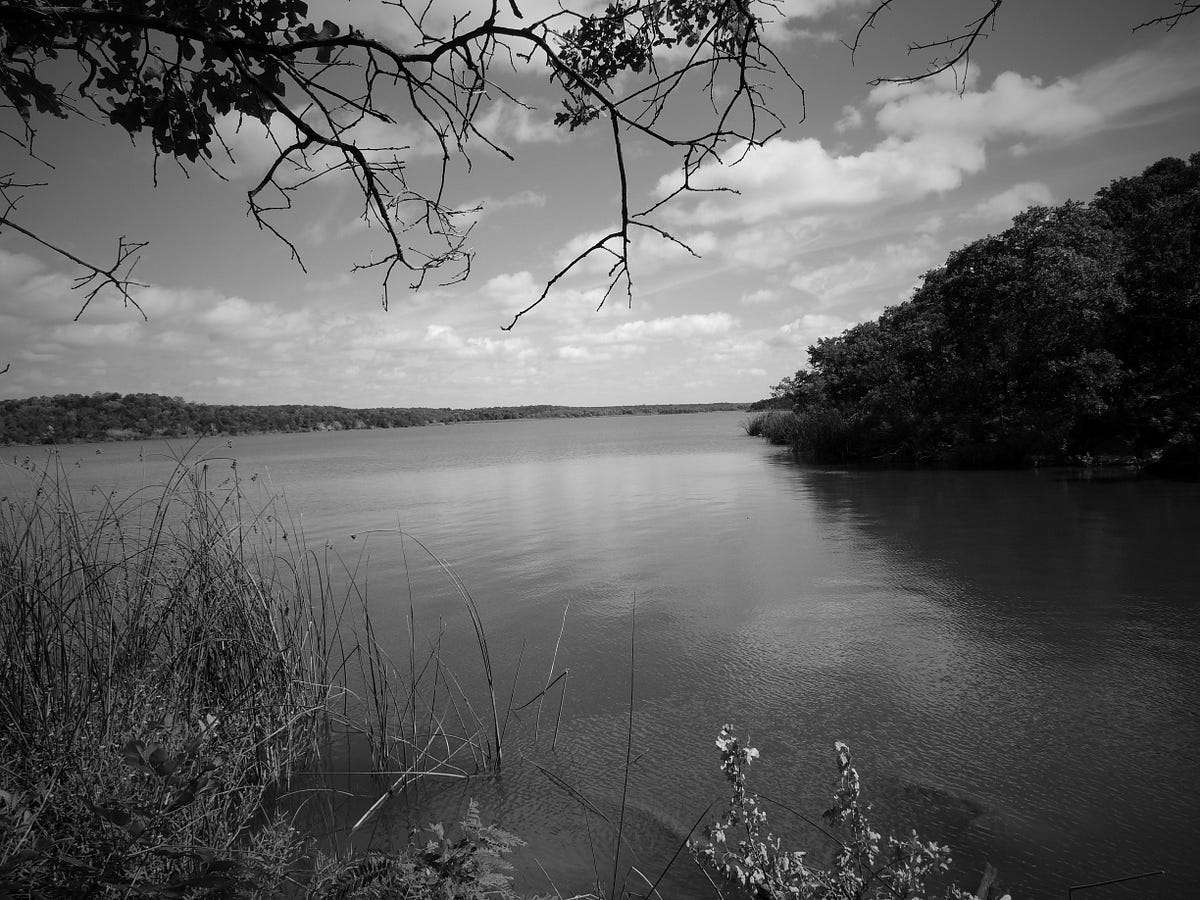
I was excited when Sherry Kappel announced this challenge. I love black and white photographs, the texture of the subject comes through so well. It was perfect timing too, we traveled to Lake Mineral Wells State Park and Trailway in Mineral Wells, Texas last weekend for a night of camping and I still had these pictures on my camera. The challenge gave me the incentive I needed to get them on my computer and edit them.
Hiking trail at Lake Mineral Wells State Park
Our first night at the state park we hiked along a trail in the dark. The photo above was taken during the following day, but the black and white print gives you an idea of what the trail might look like at night when colors are less visible. We had flashlights, and since the trail ended in a loop there was little chance of getting lost. Still, it had a bit too much “Blair Witch” feel for me, and we ended the hike early.
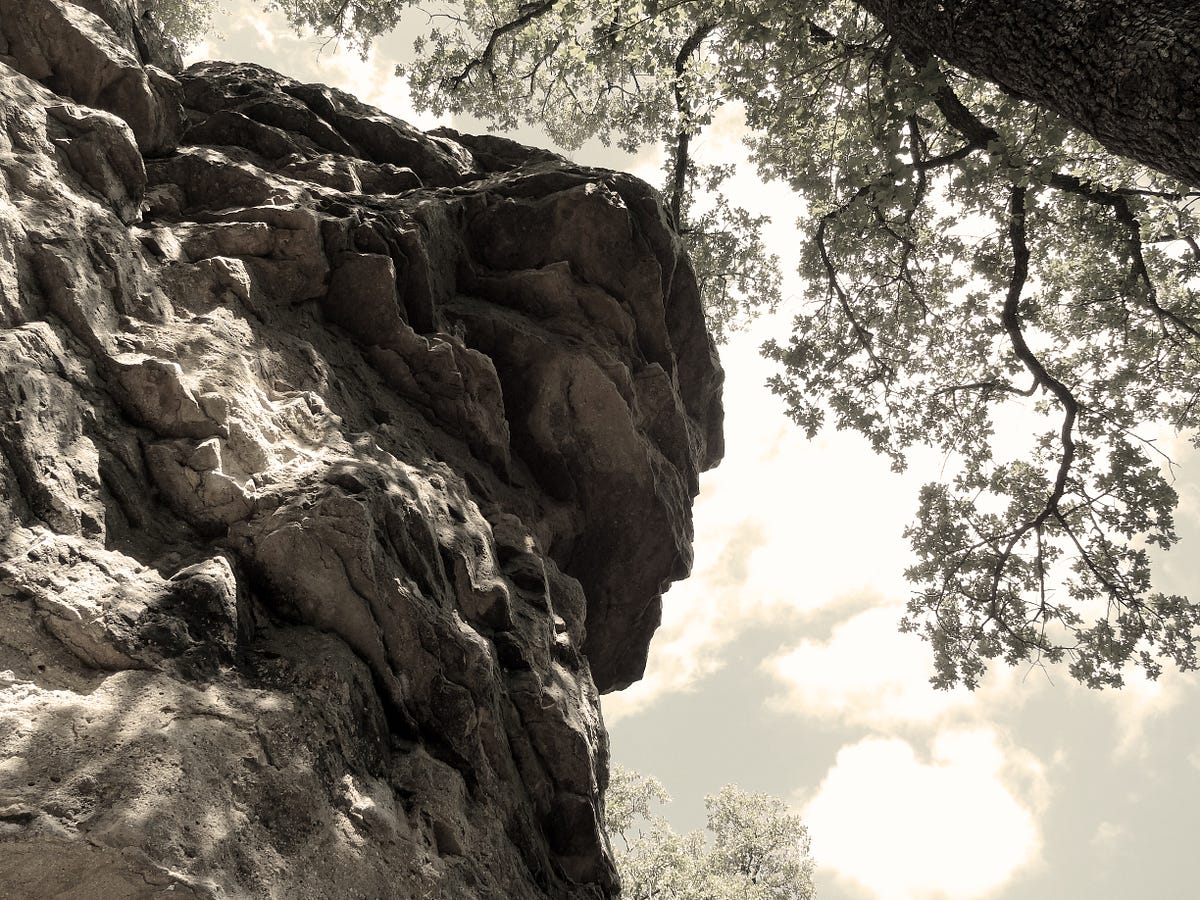
Rock Face at Penitentiary Hollow in Mineral Wells
Penitentiary Hollow at the state park is the rock climbing area. I didn’t try it, preferring to stumble along the ground instead.
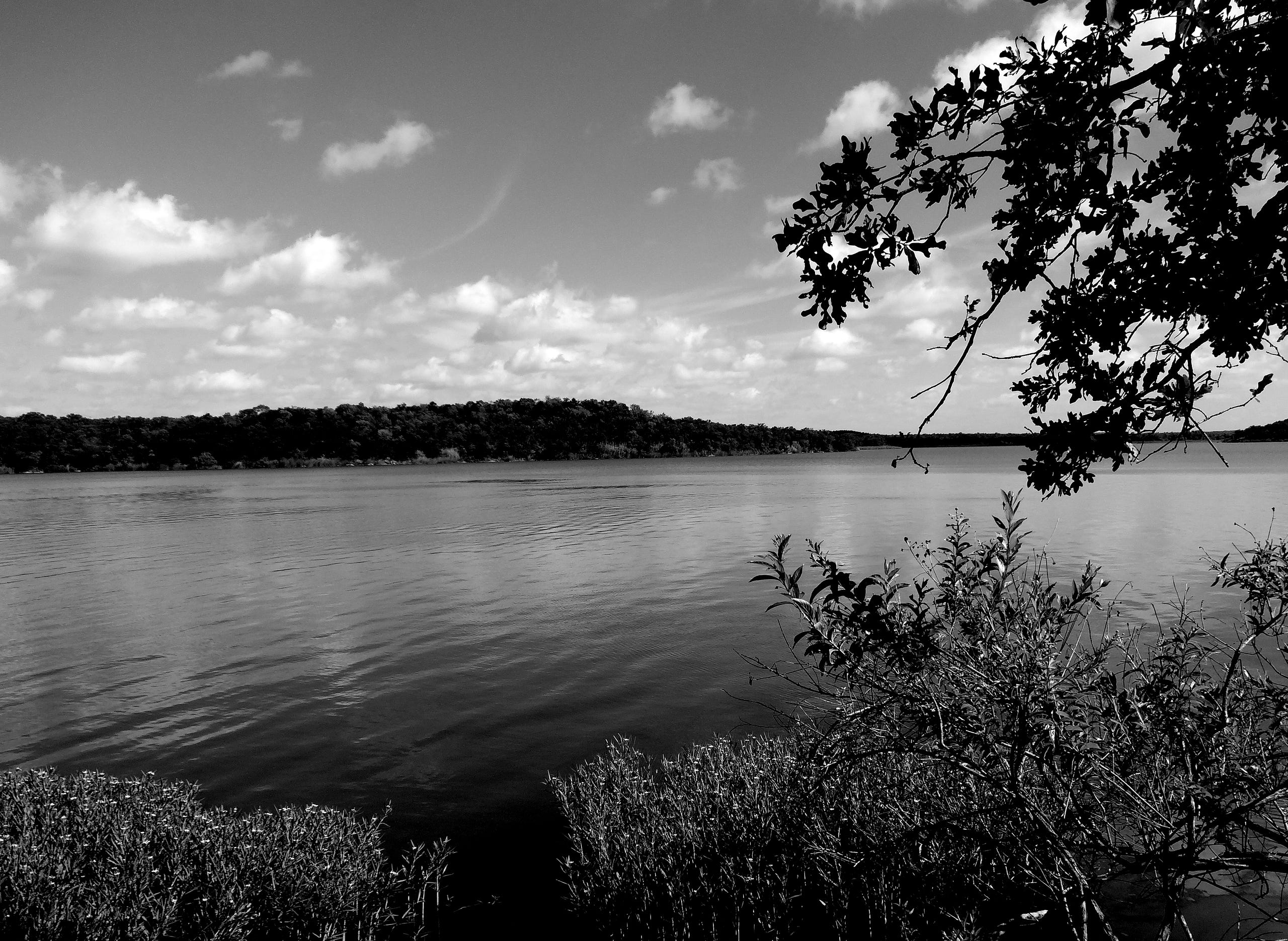
A little cove, perfect for launching a canoe or kayak
The lake is perfect for fishing, canoeing, or kayaking. There’s no skiing, tubing, or jet skis allowed so the place is calm and quiet.
Thanks again for this challenge, it’s always a pleasure to share and see what everyone posts!
I’ve never liked escalators. I look at an escalator and I see big metal teeth waiting to grind up my feet. I have a problem with the last section, the one that goes under the metal strip at the end. I imagine myself being sucked down under like a cartoon character, getting smaller and flatter until I disappear under the edge with a quiet pop.
Elevators aren’t much better. Nothing good ever happens in an elevator in the movies. If the cable doesn’t break and all the characters plummet to their death, they’ll get stuck inside the car with the bad guy. Or, just when you think everyone is going to escape, the doors will make that little “ping” noise and open up to the serial killer standing there with an ax.
I used to think I was safe on a treadmill. It doesn’t go anywhere, and I always manage to hit the “Stop” button, mostly when I don’t intend to. Recently I discovered how accurate the phrase “ass over elbows” can be, and I can now answer “Yes!” to the question “Have you ever fallen off a treadmill?” Nothing broken, except my dignity, but how much of that can you really have while you’re wearing sweat pants?
I was moving along at a brisk pace when I decided to take off my jacket. I could have easily turned off the treadmill, but I was in the middle of a nice series of laps and didn’t want to lose my place. I like to imagine myself huffing along in the lead in a 5k run while being chased by bears. In that situation I would hardly stop to take off a jacket, unless I planned on using it to distract the bears. So, without looking I tossed my top behind me, toward my gear stacked on the floor.
My friend, trudging along on the next treadmill, cried out, “Oh! You knocked over your tea!”
Born and raised a Southerner, I take my iced tea seriously, even if it is in a flimsy foam cup sitting on the floor of a gym. So I immediately turned around on the treadmill to see the damage, and the machine rewarded me by trying to shoot me off the end like I was the target in a skeet shooting competition.
I fell back onto the treadmill. Luckily I landed on the part of my body that was the object of the treadmill exercise in the first place. The treadmill was still running, any other time I would have hit the safety switch by accident and had to start my program all over. The treadmill seemed thrilled to have me back. I swear the belt sped up, and this time I shot off and performed a half somersault, something I haven’t done voluntarily since third grade.
I landed in a cold puddle of foam bits, tea, and ice, not quite so refreshing when applied to the bottom half of my body. I finished my work out on the stationary bicycle, figuring that if I fell off I would at least be closer to the floor.
I’ve heard people say, “It’s not the destination that matters, it’s the journey”, and I’m okay with that, as long as I don’t have to get there by escalator, elevator, or treadmill.












 Let's Get Out of Here