I belong to a Facebook group called We Pretend it’s Still the 1970s. The rules are simple – post personal photos from that decade and comment on them as though whatever is pictured has just happened. No past tense, no mentioning the future. It’s an exercise in time travel that is both humorous and poignant.
I have yet to post anything on the page, but I’m a loyal lurker. The images remind me that I lived through that era. Scrolling through Olan Mills family portraits, prom snapshots, and polaroid pics of smiling girls with that Farrah Fawcett shag haircut – I can indulge in happy memories uncluttered by the anxious reality of my teenage years.
The past seems so far away, as though the events of the 1970s happened to a different person, not me. In a way, that’s true. I’m far from that teenager now, but sometimes I come across things that bring the memories back so vividly that I can touch them and feel their weight.
We’ve been organizing our household, trying to clear some of the clutter and decide which items are worth keeping, donating, or selling. As I sorted through decades of sewing supplies, I set aside anything I wanted to keep. I’ll hang onto the thread – wooden spools either inherited or bought at antique stores and plastic spools sporting the small green Walmart price stickers from before the age of UPC tags. There are at least two dozen spools of turquoise blue thread that Mom bought on clearance. It was a really good deal.
Me and my mom circa 1970s – I’m wearing a dress I made
My mother taught me to sew. First by hand with needle and thread, and then on her classic black Singer sewing machine. A junior high school home economics class rounded out my seamstress education. Throughout the 1970s I sewed dresses, skirts, peasant tops and anything else that could be whipped up over a weekend.
I don’t sew much now, although I do still own a sewing machine. Recently I took up quilting and I’ll hand stitch together the pieces while I’m watching television. It’s a relaxing hobby and it gives me an excuse to hold onto the boxes of thread. Eventually I might even use the turquoise color that my mother found so lovely. I think she would have liked that I found some use for it.
I come from generations of gardeners. When we moved into our house last year, it was too late in the summer for planting. I vowed an early start in the next season. This year, however, brought mostly failed experiments with container gardening. My tomatoes grew weary in the dry heat, dropping leaves and blossoming worth with small, wrinkled fruit. I tried summer squash – remembering the butter yellow vegetables my mother grew. My plants protested confinement in pots, however large. But one hardy vegetable flourished in the ten square feet I allotted it. Okra, that heat-loving Southern staple.
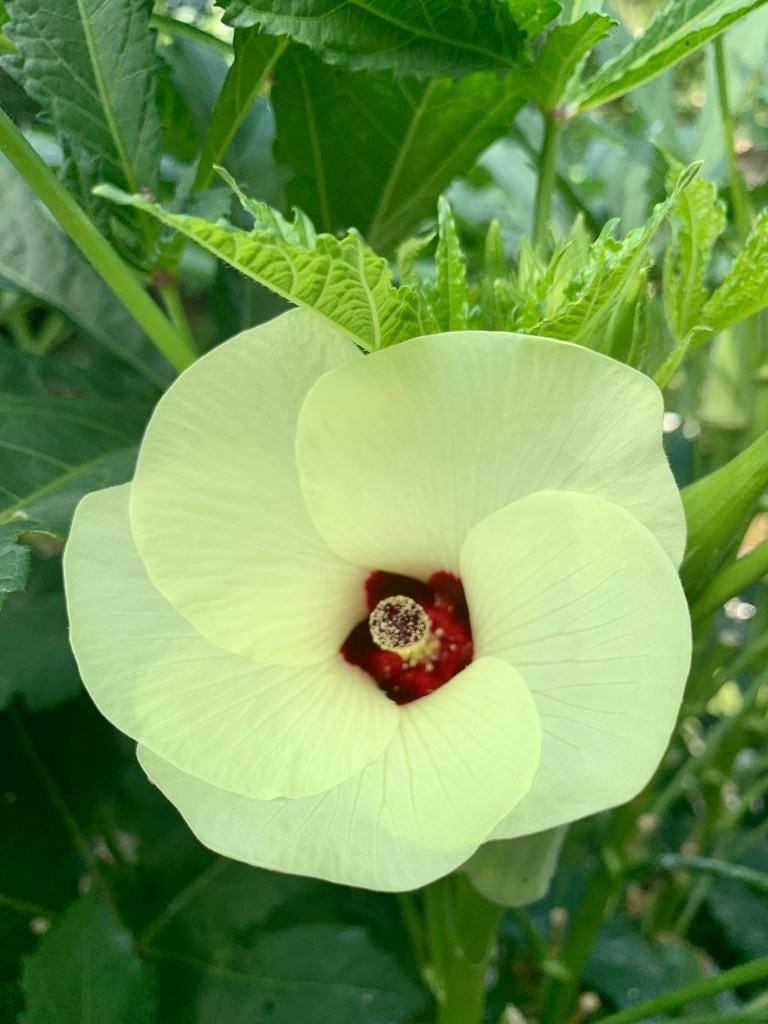
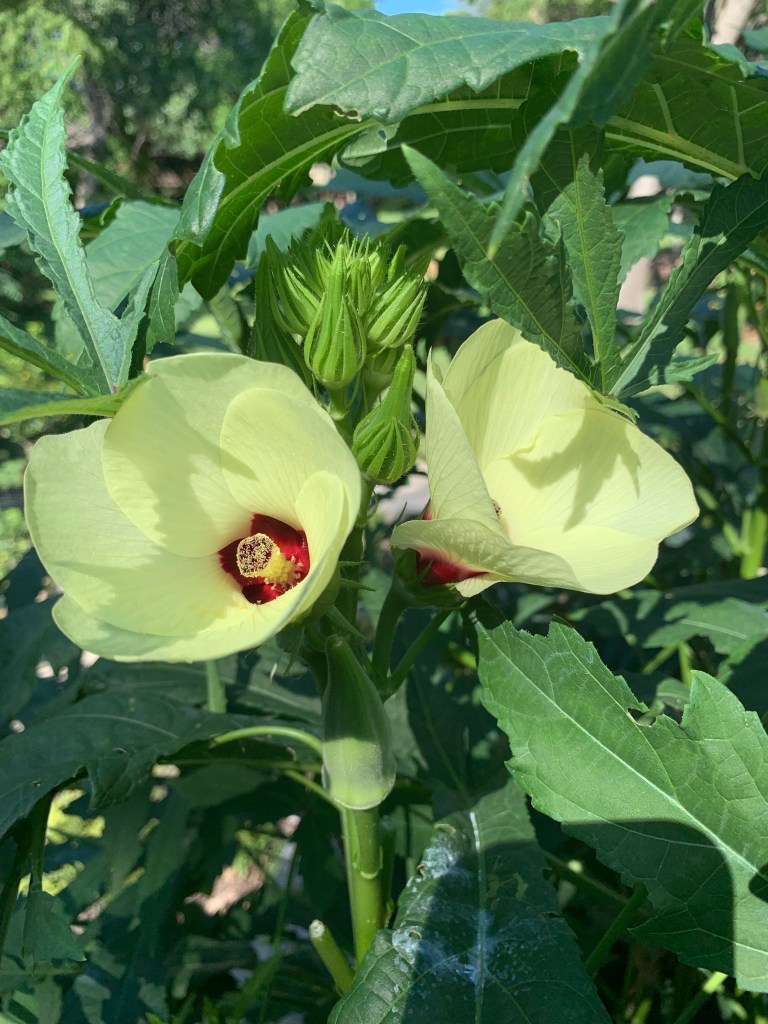
It’s one of the easiest plants to grow, and it makes an interesting addition to your garden. The yellow blossoms with their deep red centers reveal the plant’s place in the mallow family, a relative of the hibiscus. A little water, lots of sun, and you’re rewarded with hardy, heat-loving stalks and enough okra pods to share with your friends and family. Okra is best right after it is picked. The stuff you see in a grocery store most likely will be soft and wilted. If you don’t have a spot to grow it yourself, pick it up at a Farmers Market. Okra is delicious roasted. Boiled it makes a tasty thickener for stews and gumbo. My favorite way to cook it is to bread it in either corn meal or flour and fry it.
Okra
The blooms open in the early morning sun, around the time I set aside for harvesting the pods. Bees circle the plants, landing and picking up their fill of pollen while I brush aside the broad leaves and search for the tasty green okra. I’m growing Clemson Spineless – a kinder variety from the one I picked as a child in my mother’s garden. Those plants and their pods were covered in prickly spines that raised red welts on the tender flesh of my arms. The rash, however, was payment for the reward – plates of crunchy, cornmeal breaded and fried okra.
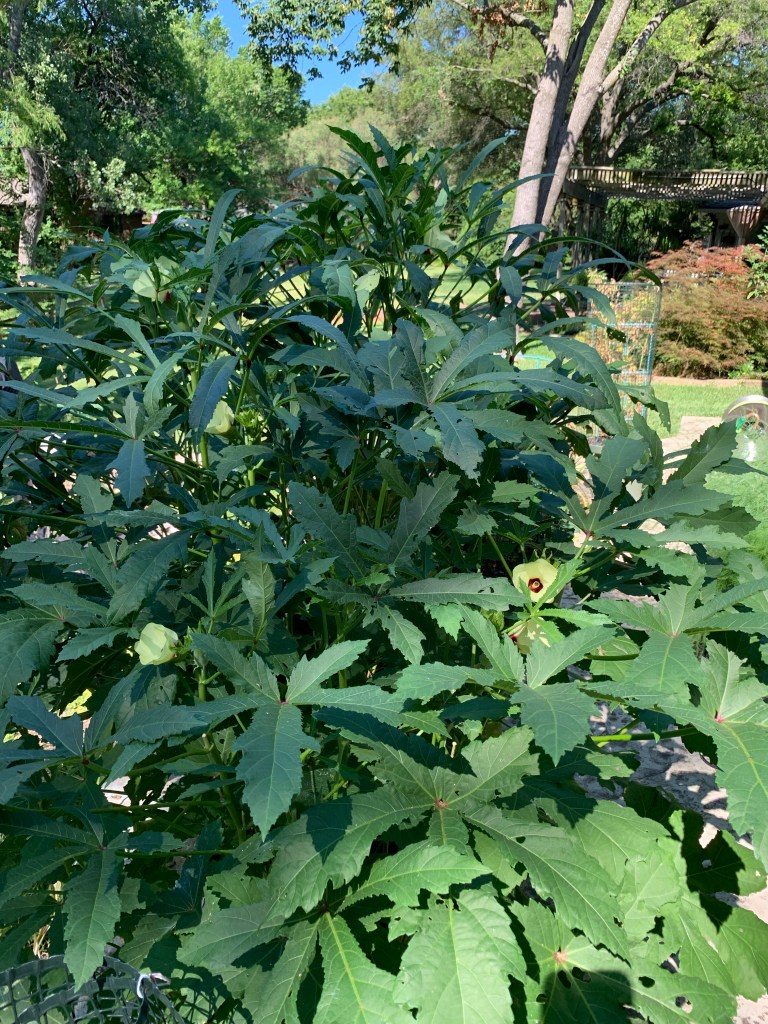
Okra plants in my garden
As I pick the pods, I can imagine the taste of the crispy chunks. Okra has a flavor that reminds me of cool green grass. It tastes like summer. I remember my mother, setting the table with fried okra and red slices of tomato. She pan-fried her okra in shortening with a little bacon grease mixed in for flavor. I cook mine in canola oil and skip the bacon grease. Like my mom, I use a cast iron skillet. Each bite I take I taste the past.
When I was seven years old, my parents lost me at the State Fair of Texas. Their last sight of me, I’d slipped into a crowd of folks shuffling into a garish tent on the midway. I imagine them watching as I stood in line, my hair done up in twin pony-tails in the style we called “dog ears” and my sweaty little fist clutching the ticket to the freak show.
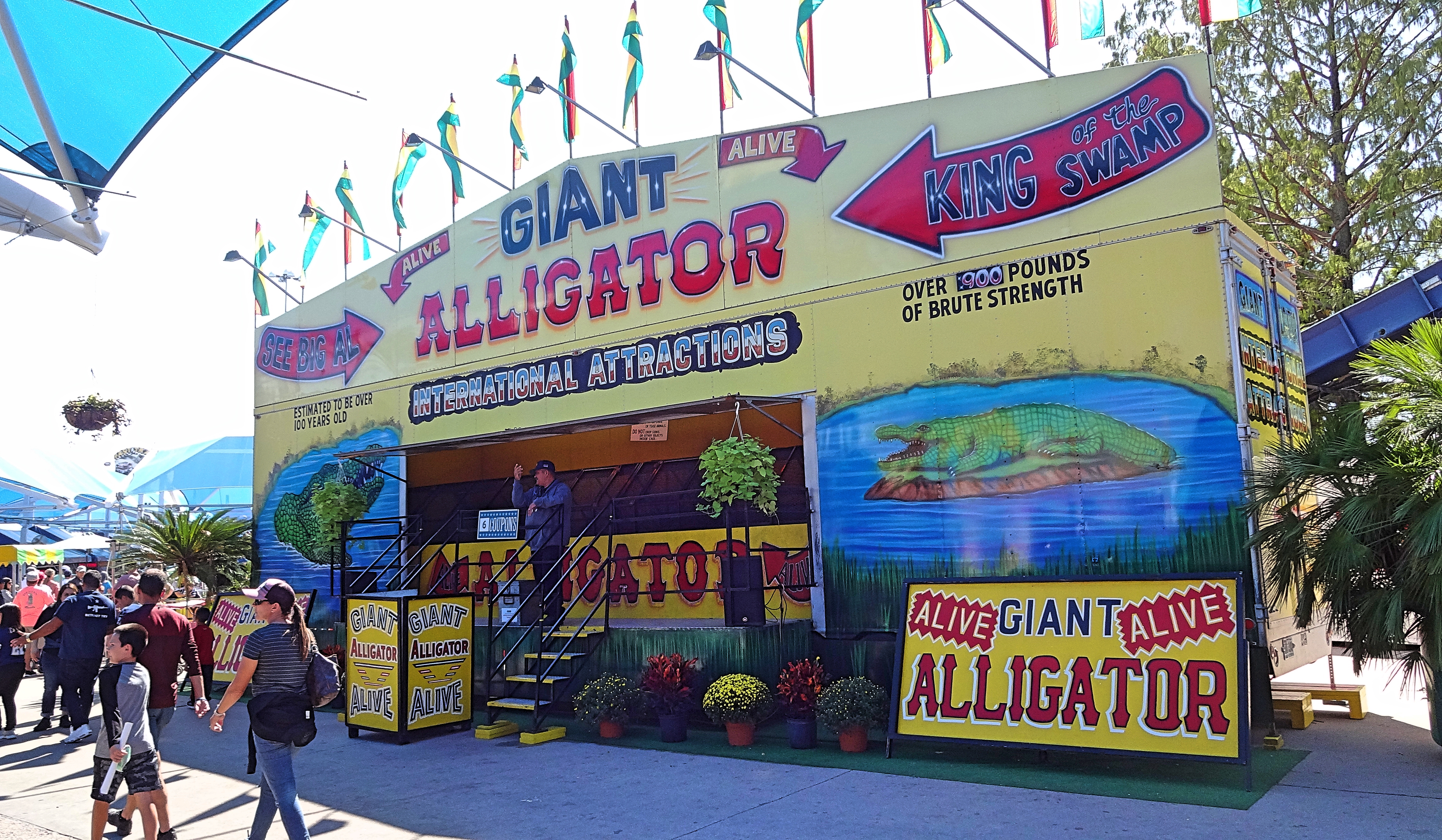
You’d be hard pressed to find a decent freak show now. This was 1967, when no one thought it unusual or awkward to put people on display. We have the internet for that now, but in the 60s you had to show up in person. I didn’t know what to expect from the sideshow. A bright splash of colored posters flapped against the outside of the tent and promised many miracles. An alligator boy, a sword swallower, the pincushion man, the world’s ugliest woman—they all waited inside.
The last one on this list drew me in. I’d started wearing glasses, a homely set in thick tan plastic that magnified my eyes to the size of saucers. Coupled with the elastic waisted pants and polyester tops mom dressed me in, from a distance I resembled a short, middle-aged housewife. Add in my under-bite, square jaw, and the nose I grew into, and you’ll get the picture. I couldn’t wait to spot the world’s ugliest woman.
Once inside the tent I fidgeted through the first part of the show. The only audience member shorter than five feet, I faced a solid fence of adult backsides. I hopped up and down, afraid I’d miss the one act I’d wanted to see. I caught the flash of metal as the sword swallower flourished his props, and from the collective sighs and gasps as the other performers took the stage, I understood they had displayed wonderful things.
At last the slick sideshow barker announced we could all move into a curtained off area to the side of the stage. “Only one additional dollar, folks,” he said, “and you will witness a site certain to frighten children!” The barkers gaze skimmed the crowd, measuring the size of our wallets. “Any patrons with weak hearts might want to skip the act.” I dug the last of my allowance from my pocket.
Half the crowd jostled through the curtains to arrive in a roped off space the size of my living room at home. I pushed my way to the front, determined not to miss a bit of the show. We faced a wooden platform, taller than I was, and barely large enough to support the plain kitchen chair placed in the center. Another set of curtains covered the back of this makeshift stage.
“Presenting the world famous…”
I don’t remember the woman’s name, the color or length of her hair, I couldn’t guess her age. The curtains at the back of the platform parted to allow her passage onto the platform where she settled on the little chair and dropped the robe that covered her body.
There must be some mistake, I remember thinking. This was not the World’s Ugliest Woman. Extraordinary designs—red dragons, blue and yellow birds, circles and flowers and bright flourishes covered every inch of her. I supposed the parts hidden behind her bikini top and shorts were also inked. When she smiled the tattoos moved along her face, as though they held a separate life from hers. She perched on the chair, smiling down at us, her supplicants. I wondered what she thought of me, so plain, so ordinary, without a single story drawn upon my skin.
I didn’t notice the others slipping out from the tent as I stood there, entranced until the sideshow barker, with a gentle nudge, told us, “Thanks for visiting folks.”
Released onto the fairgrounds, I wandered out into the sunlight to find my mother and father standing on either side of a uniformed policeman.
“Where were you?” My mother snatched my arm, dragging me away from the dark shadow of the sideshow tent as though it might suck me back in.
For answer I waved behind us, as a new stream of fair goers exited from the front of the tent. This was where most of the group I’d been a part of had left the show, strolling out past my waiting parents. I’d appeared almost twenty minutes later, from the back of the tent.
“Never again!” My mother vowed.
That was my first, last, and only visit to the freak show. Years passed and they replaced the freak show with exhibits of bizarre animals. The two-headed turtle, the world’s largest snake, the sheep with six legs—none of them had the alluring charm of the World’s Ugliest Woman. There was a brief time when the midway claimed to have a girl without a body, but we all knew that floating head trick was done with mirrors.
I went to the fair this year with my husband, Andrew, on a Sunday, a day when the crowds shuffled shoulder to shoulder past booths selling sheets, candles, cookware, and beef jerky. The air smelled of cotton candy, stale beer, and manure from the livestock barn. We left the carnival music of the midway fading and ducked behind a row of food stalls. With Andrew’s help I perched atop a concrete retaining wall, above the crowd as they streamed past. I wore a t-shirt with the smiling face of Big-Tex, the 55-foot statue greeting the crowd at the fairgrounds. His cheeks stuffed with fair food matched mine as I enjoyed my meal. I nodded to those passersby who met my gaze, and waved to the onlookers, the audience at the show.
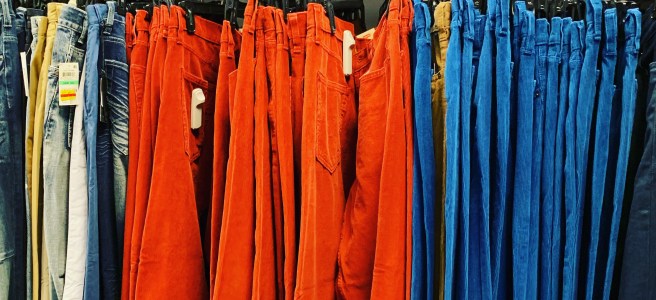
Andrew and I were wandering through the clearance section in men’s clothing at Macy’s when we spotted them. A row of corduroy pants in vivid orange and royal blue.
“No one wants the whistle britches,” Andrew commented.
“Do you think they have my size?” I asked. I love a bargain.
“Please, no.”
Andrew does not like to draw attention, and it’s hard to be discreet when you’re dressed in colors loud as caution flags. Plus, everyone would hear the swish-swish of your legs, making it impossible to sneak up on anyone.
I had an entire corduroy outfit in Ninth Grade. The brown pants and matching tunic were hand sewn by a seamstress my mother worked for, cleaning her house. They worked out an exchange, my mother scrubbed and in return the seamstress fashioned my freshman year wardrobe. I don’t remember the rest of the clothing from that year, but the brown corduroy set was extraordinary. I must have resembled a large teddy bear swooshing down the hallways of my high school. Either that, or a giant, rustling paper bag.
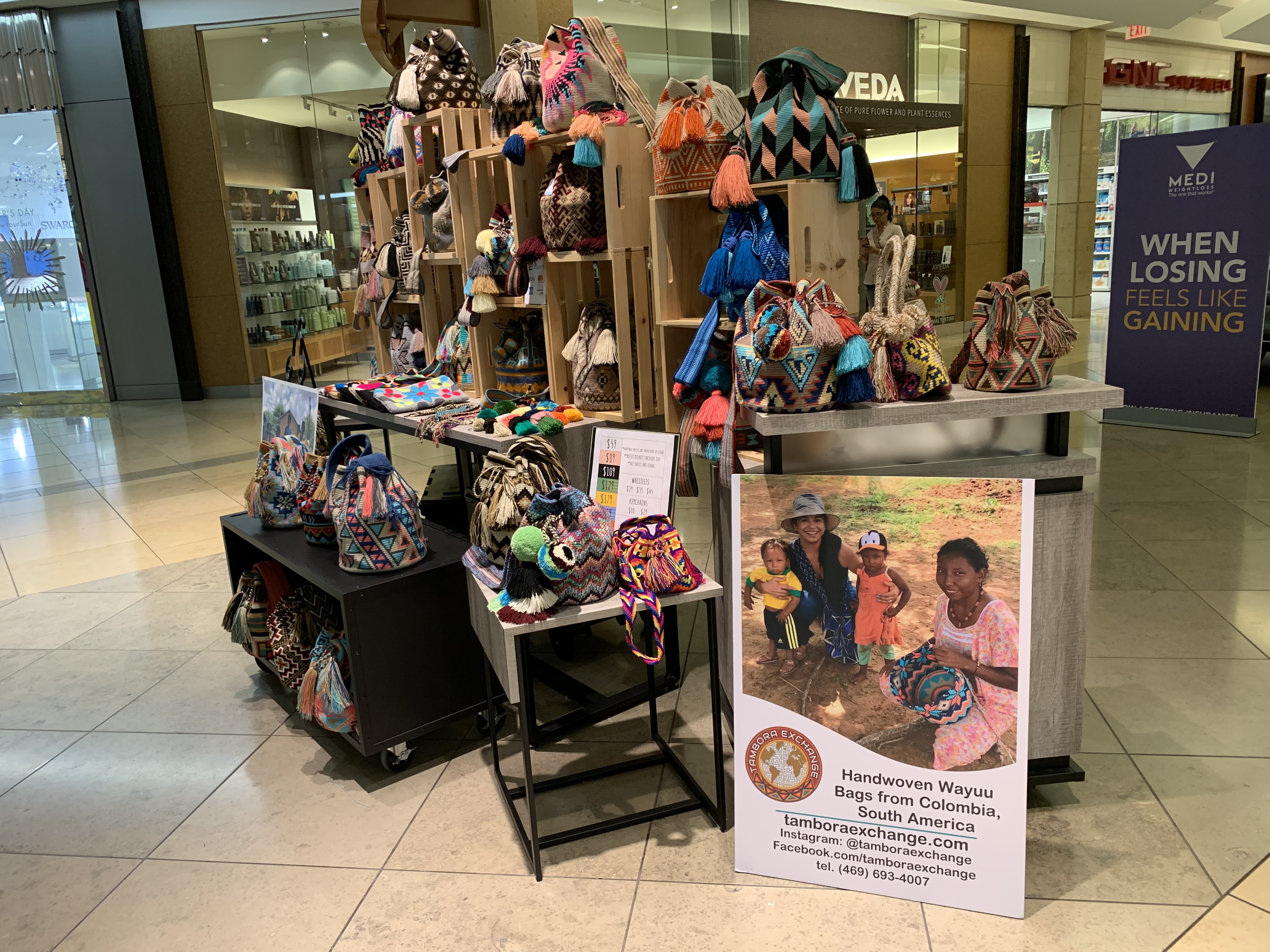
I bought a purse at the mall, from one of those pop-up kiosks. An unusual transaction for me, as I usually race-walk past those shops before I’m attacked with a salt scrub or an offer to clean my glasses.
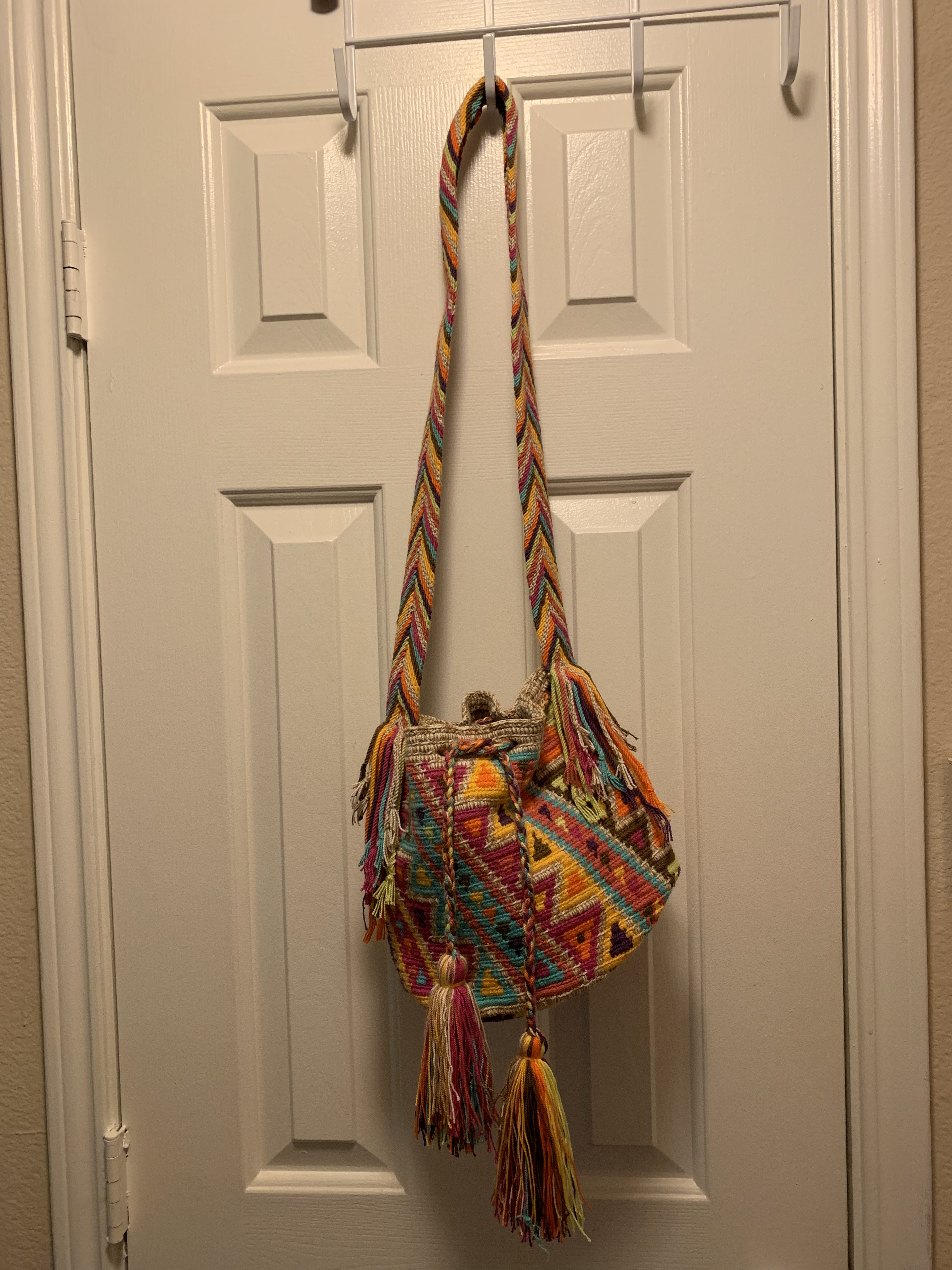
The purses, however, caught my eye with their loveliness. Handwoven by women of the Wayuu tribe in Columbia, each bag resembled more a work of art than a place to stash your lip balm and that paperback you’ve been carrying around for six months. Dazzled by the dozens of bags, I pulled out my credit card (not an easy task as it was buried in the IKEA backpack I tote when I visit the mall).
The saleswoman couldn’t get her payment processing software to work with the mall’s lousy internet service. She tried standing in the doorway of a nearby shop and leeching off their connection, while I wondered if dozens of strange purchases would pop up on my Capital One account. I offered to scoot down to the ATM and bring back cash. At the last minute I remembered the purse, wrapped and tucked in my IKEA backpack. I handed it back to the saleswoman with a teary-eyed promise to return, like Odysseus at the start of his journey to Troy.
You can find out more about the purses here, and even buy one if you have a good internet connection.
If you enjoy reading about my adventures click the Follow button at the top of the page on my website and I’ll send you my newsletter, with updates on what I’ve published and the collection of stories I’m working on.
You can unsubscribe at any time – but I hope you’ll stick around.
I’m from Friday night football games Third Quarter sitting with the band kids. Fourth Quarter standing in the end zone Rooting for the visiting team.
I’m from Saturday night drive-in backseat sin And Sunday morning sermons served with dinner on the ground, Communion with fried chicken.
Photo by Terrye Turpin
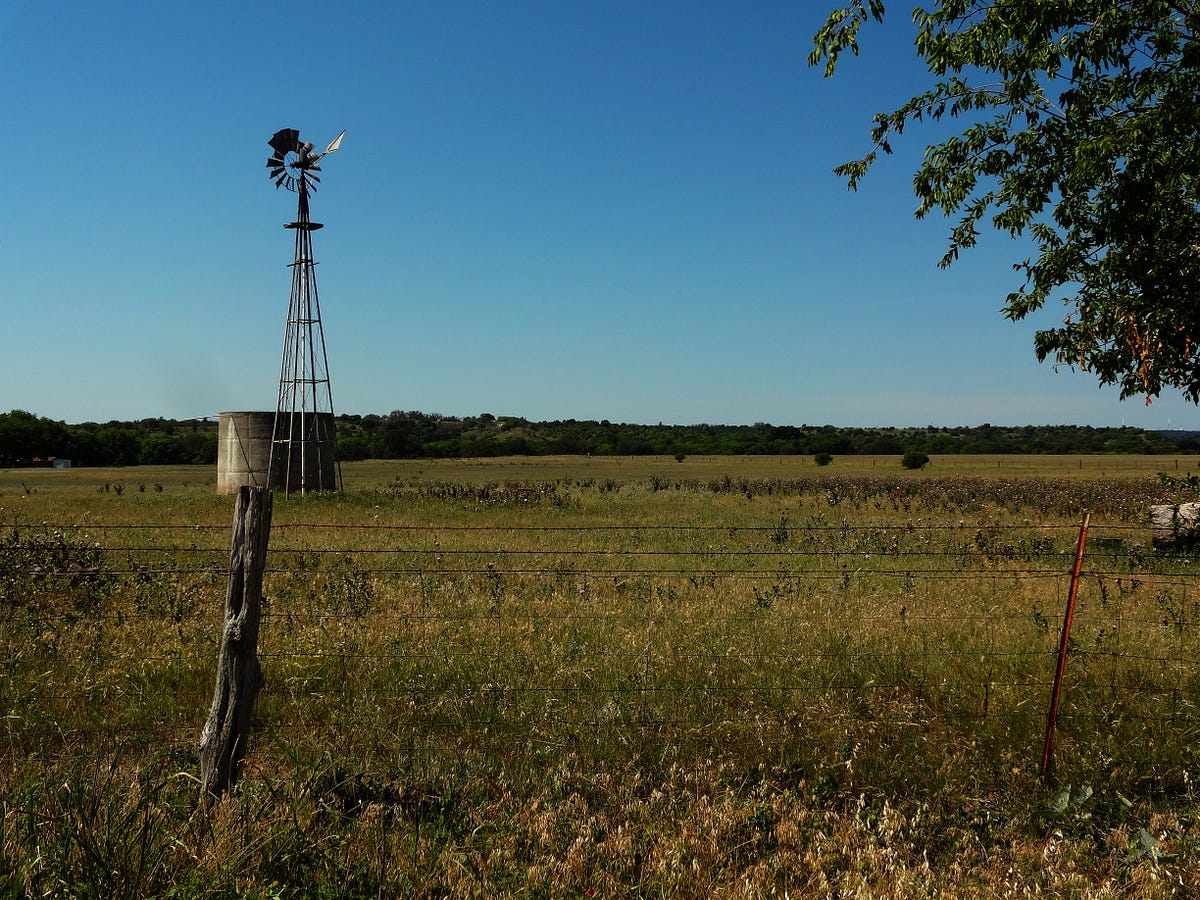
I’m from a land where Pump jacks bob against the horizon Like the dinosaurs whose bones They pull from the earth.
Where I’m from we played half court basketball Because girls could not be trusted To run the full length, goal to goal Until Title IX gave us our breath.
Photo by Terrye Turpin
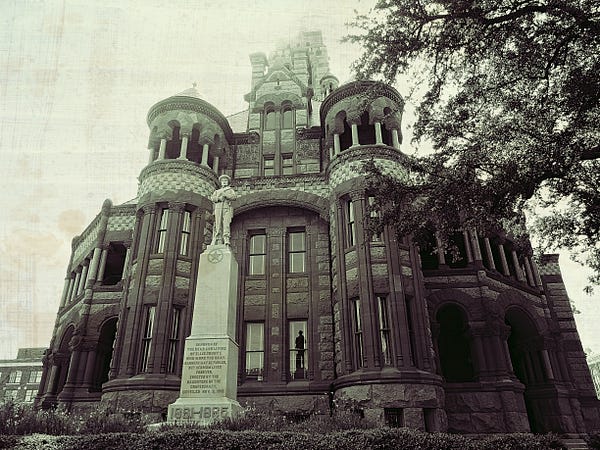
My great-grandmother treasured her Confederate flag And courthouses commemorated with statues That losing side.
Where I’m from defines my past but does not determine my future.
I was tagged in this craze by the very talented Kay Bolden, so I’m assuming there’s at least one person out there interested in learning a little more about me. So here are ten things that will tell you a bit. Most of the photographs, for better or worse, were taken by me.
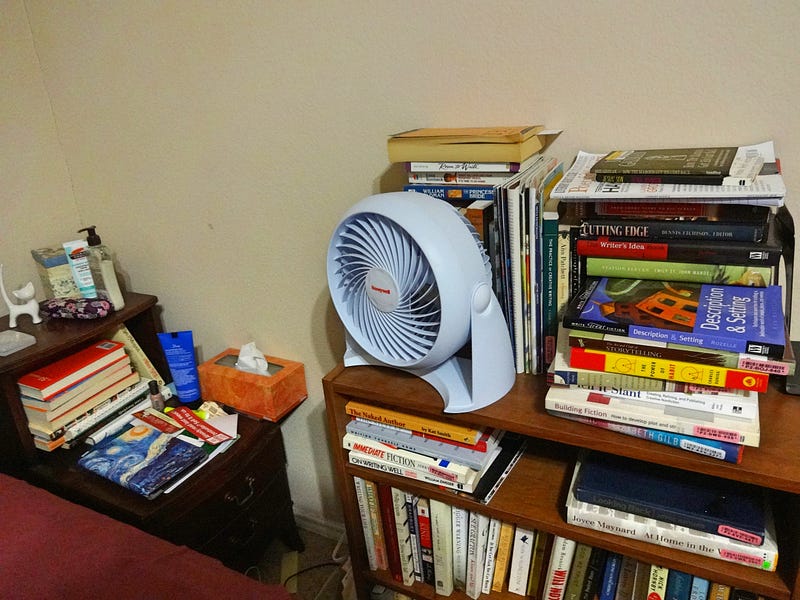
There are books in almost every room of my home.
Bedside table and bookcase filled with books on writing.
Well, Hello Dolly!
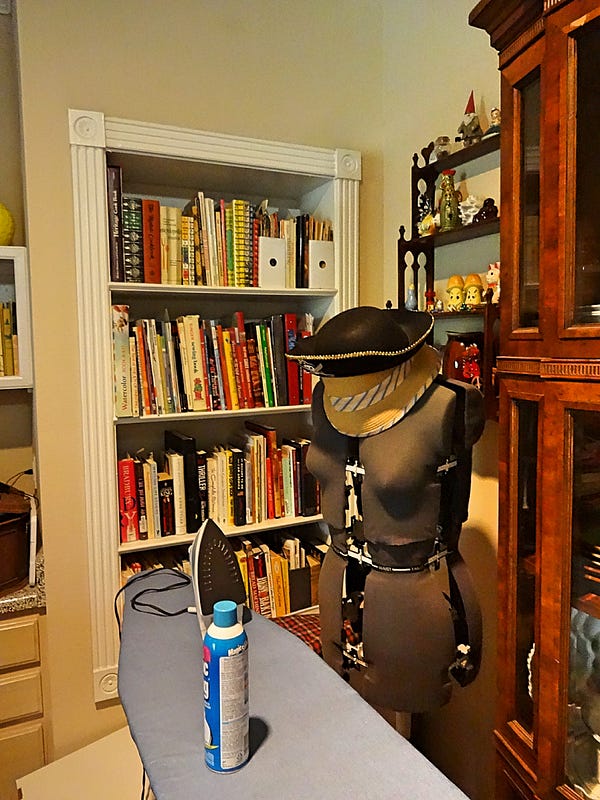
The dining room is also my crafting room. The bookcase here is filled with cookbooks and craft books. That’s Dolly lurking beside the ironing board.
Archer guards the nonfiction books and my Hot Wheels collection.
More books in the dining room.
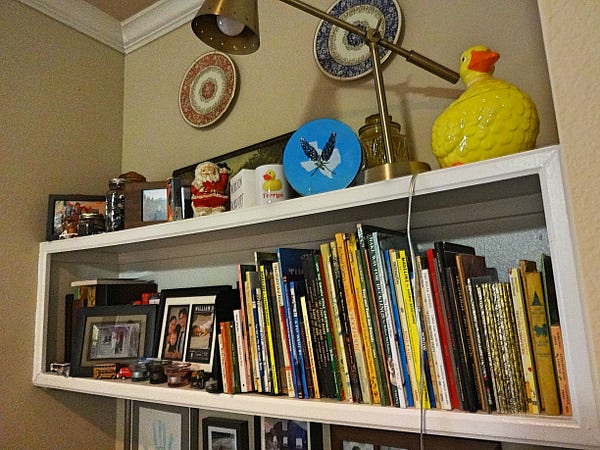
I keep the children’s books in the dining room for when my grandson visits. I wrote a story about that duck.
More books
2. I am the youngest of seven children, but because they were all much older than me, I grew up like an only child. My mother was 42 when I was born on her birthday. Three of my sisters and one brother have passed away, as have my mother and father.
My mother Christine Hamilton
My Dad Lloyd Hamilton and my older brother Ronnie
3. I’ve never lived further than 40 miles from McKinney, Texas — the place I was born.
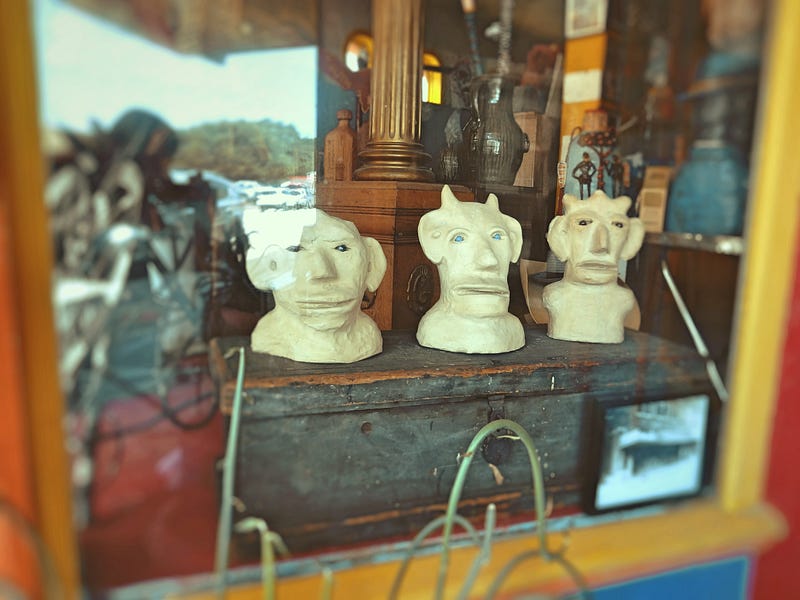
4. I love shopping at antique, junk, and thrift stores.
Window Shopping in Waxahachie, Texas
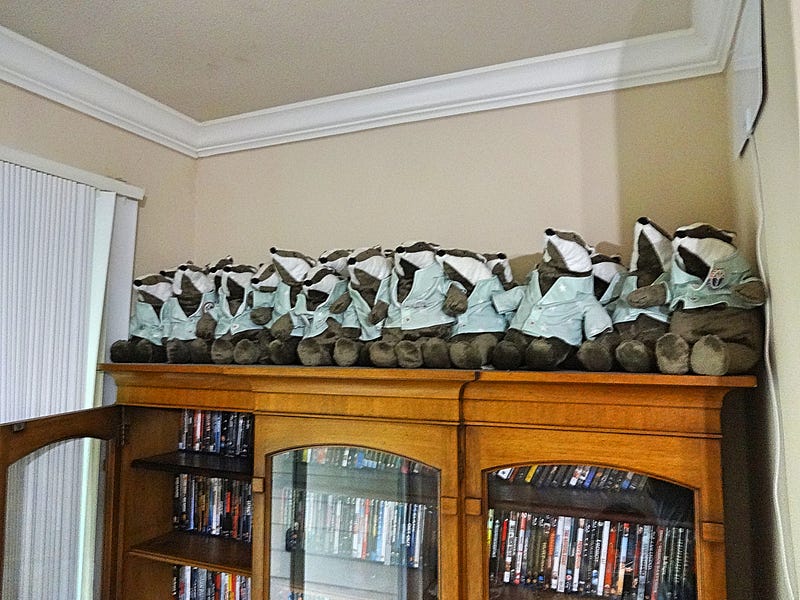
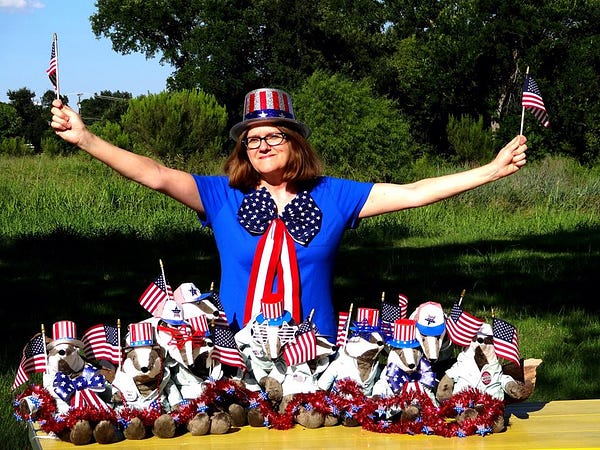
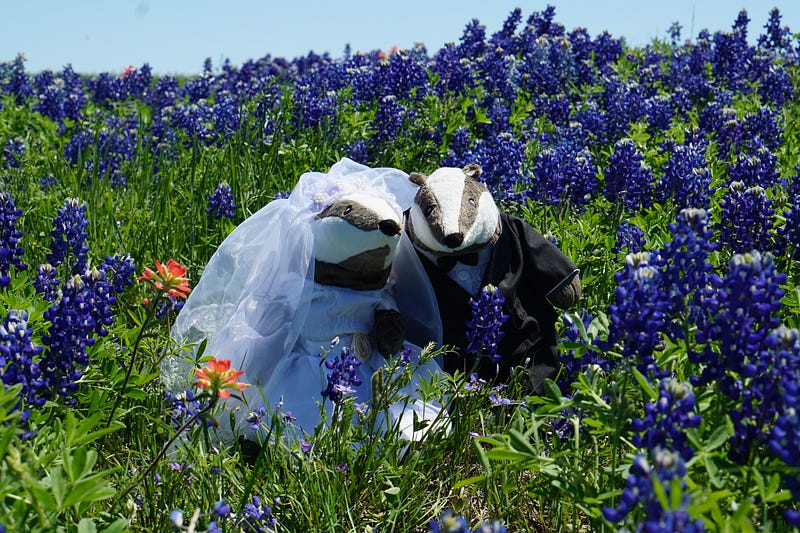
5. My fiance and I own more than 30 IKEA badgers. (We love IKEA)
Badgers, Badgers, Badgers
Happy Fourth of July!
Sometimes we dress the badgers in holiday apparel.
6. My favorite authors are Stephen King, Neil Gaiman, Robert McCammon, and David Sedaris.
If I’m in a dark mood my writing takes a twisted turn to horror.
I love David Sedaris, and you can probably see his influence in my humorous essays. I go to hear him perform his work every time he’s in the Dallas/Fort Worth area and I have all his books, four of them are signed by him.
7. I have a Bachelor of Science degree in Chemistry (I thought I wanted to go to medical school). When I was 45 I went back to school to earn a graduate degree. It took me five years working full time and going to classes part time to earn my Masters degree in Taxation. I worked my way through graduate school delivering pizzas part time in addition to my 40 hour a week full time job.
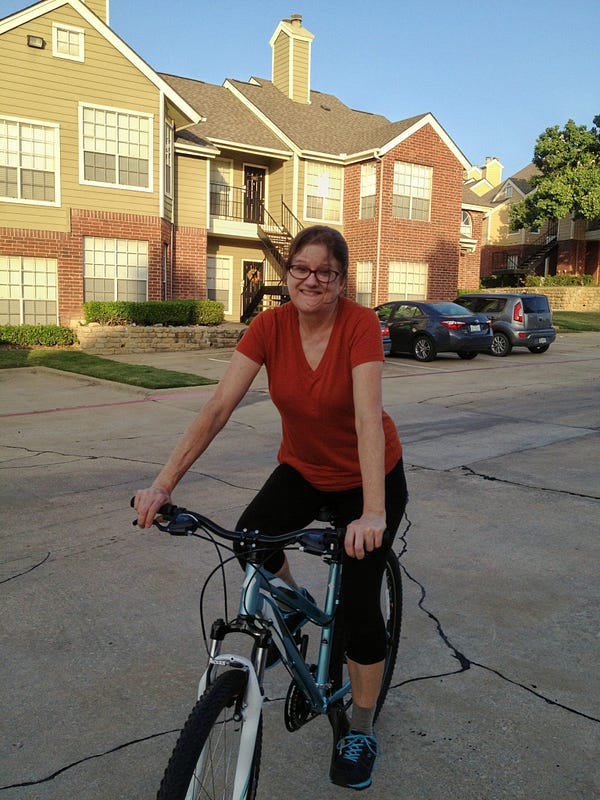
8. I bought a bicycle when I was 52, and started riding again after almost 30 years.
I’m just posing here, I do ride with a helmet.
9. I got divorced after 25 years of marriage. When I started dating again I signed up for OK Cupid and gave online dating a try.
I only met one person and had one date through OK Cupid.
Me and Andrew hiking in Glen Rose, Texas at Dinosaur Valley State Park
10. I’m getting married in October to that one date I met six years ago on OK Cupid.
Badgers in Bluebonnets in Ennis, Texas — This photo by Andrew Shaw
I’ll keep the thread going by tagging a few folks here, if you’ve already been tagged you can blissfully ignore this one, but I hope you’ll play. And if I haven’t tagged you please join in with your list of ten things and tag me, I’d love to read them.
I moved into my first apartment in 1979. The place came with shag carpet striped in an acid trip rainbow of purple, green, and brown. By the time my roommate Ann and I lived there the rug had collected a gummy overlay of tobacco and pot smoke, beer, and other substances we ignored. Our floral print couch had broken springs that sagged our butts toward the ground when we stretched out to catch up on Love Boat and Fantasy Island. The world’s biggest fan of the rock band Queen lived next door. He serenaded us every night with “Another One Bites the Dust” and if we pushed the couch close to the wall, it would rock us to sleep with the vibrating bass line. That apartment was the first place we had ever chosen all on our own, without help from parents or school administration.
Ann and I discovered our home in August, about three weeks before the fall semester would start at Texas Woman’s University. We drove over to Denton, Texas in her 1967 Dodge Dart. The car did not have air conditioning. We rolled down the windows and hung our heads out like dogs to catch the hot air blowing off the highway. By the time we made the hour-long trip from our hometown the backs of my legs stuck to the vinyl car seat with a tacky layer of sweat glue. We pulled into the parking lot of the first complex on our list and slumped out of the car, careful not to brand ourselves with the hot metal on the outside the Dart. In the full sun we stood there pondering the faded pink brick buildings. I imagined the rubber soles of my sandals melting into the black tar pit of the asphalt parking lot and I wondered if some later civilization would find my bones, preserved and still wearing flip flops.
“There’s a pool,” Ann said, pointing toward a shimmering patch of blue in the center of the courtyard. The sharp summer scent of chlorine hung in the air and we heard laughter and soft splashing coming from the lucky residents enjoying the water. We wiped the sweat out of our eyes, abandoned the car, and raced to the manager’s office to sign a lease for our new apartment.
We moved in over the next weekend, figuring to get settled in before classes started. We unpacked in air-conditioned comfort, without realizing we enjoyed the last bit of the previous tenant’s billing cycle. On Monday we woke to the end of that free ride. No electricity meant no radio, no television, and no air conditioning. Our friendly neighbor set down his bong and turned down the bass on his stereo long enough to explain how to go about getting our own account set up. A phone call to the utility company later, we had an appointment for them to come out the next day, Tuesday.
We opened the windows and the front door and spent the day at the pool. By early evening we were both the color of the Boone’s Farm Strawberry Hill wine we had been drinking all day.
“Is there any more ice?” Ann asked from the couch where she stirred the hot air with the magazine she had been reading.
“No, maybe we should go to the store.” My voice was muffled because I had my head in the open freezer, waving the last of the cool air onto my face.
“We’re also out of wine,” I added.
Ann and I moaned about the lack of air conditioning, ice, and alcohol and decided, since we were heading to the store to get ice and wine, we would stop at K-Mart to pick up a fan–yes, an electric fan, a fan that would need electricity to run.
Most people would notice the glaring gap in logic this purchase presented. However, Ann and I, stunned from the heat like lizards, and brain damaged from inhaling chlorine fumes and cheap wine all day, loaded into the Dart and headed to K-Mart.
Once we arrived at the store, we discovered the fans displayed right at the front entrance. We walked through a wind tunnel of spinning blades and overlooked the cords dangling from the back and running to the hidden power supply. We pictured our fan set up in the living room, spinning cool air out of nothing. Fan chosen and placed in the shopping cart, we picked up cleaning supplies and added a bottle of lemon scented ammonia to our cart as we headed to the cashier.
While we stood in line, Ann picked up the cleaner. “I wonder if this really smells like lemons. You know, like real lemons or just some sweet stuff.” I took the bottle from her and read the label.
“It says ammonia,” I said.
I unscrewed the cap, held the container close to my nose, and inhaled a strong breath. A line of lemon scented fire raced up my nose and entered my brain.
“Well, does it smell like lemons?” Ann asked.
I couldn’t answer as my lungs seemed to have collapsed from the ammonia. Instead I waved frantically, hoping it would be interpreted as “Yes, but help!”
I held out the bottle toward Ann and before I could warn her, watched as she took the bottle from me and inhaled. There we were, in the line at K-Mart, gasping for breath and crying, passing that bottle of ammonia back and forth between us like two drunks sharing a can of Sterno.
We recovered enough to put the cap back on the bottle, then looked at the fan sitting there in the cart. The ammonia must have loosened something in our brain because we realized then you can’t run an electric fan without electricity. We traded the fan for a pair of flashlights and left the ammonia at K-Mart. We stopped for ice and headed back to our apartment, our home where the moonlight beckoned off the dark, still surface of the swimming pool and the night air smelled of chlorine and not lemons.
Sometimes I’ll strike a match, and the sulfur scent brings back that sweet tobacco taste from the first draw on a fresh cigarette. I remember the blue-white smoke curling in tendrils and the hot orange glow of embers illuminating a dark room like secrets shared. Cigarettes were a secret I kept hidden from my mother.
I picked up smoking in college. Away from home on the first lap toward adulthood, I embraced every bad habit I had once railed against. My mother didn’t smoke, but my father did. He wasn’t allowed to smoke in the house, and during my childhood, before their divorce, he sat in a metal glider in the backyard while I lectured him on the evils of nicotine. I accepted, however, the little brown and cream colored coupons from the packs of his Raleigh smokes. You could exchange them for prizes in a catalog, and I was saving up for a transistor radio.
My cigarettes were Benson and Hedges Deluxe Ultra Lights — menthol. Inhaling one of those was like smoking a breath mint. My path through higher education started while the legal drinking age was eighteen. Cigarettes were cheaper than alcohol back then so I exchanged my bottle thick glasses for contact lens and imagined myself in an old black and white movie. I played at cool and sophisticated while I tried and failed to produce a perfect smoke ring.
I balanced painful shyness with a desire to separate from my mother and went away to school a mere 52 miles from what I left behind. When I gazed at the view from my dorm room balcony, I saw the highway that led back to my hometown, a straight asphalt line like an arrow over the horizon.
College was an escape from my mother’s obsessive compulsive disorder. In my mother’s house each daily routine magnified into a complex ritual. Simple tasks like dusting became chores that lasted half a day because every ceramic bird or glass vase had to be removed then placed back in the same position. If they were moved even one quarter of an inch I would have to start the whole task over again.
Home on weekends and holidays it was easy to hide the smoke odor on my clothes. Each time I entered the house I had to stop, strip naked in the laundry room, and drop my clothes in the washer. I walked naked to the bathroom where I showered and scrubbed off the outside world. The whole process would have come in handy at a nuclear power plant.
One weekend my mother announced that she would come visit me on campus. I broke the news the day before her arrival to Ann, my best friend since elementary school, and now, roommate. Ann glanced around our dorm and asked, “Does this mean we need to dust?”
“No,” I replied, then suggested we open the windows and turn off the lights. Books, papers, food wrappers, and discarded clothing covered the surfaces in our room. There was a noticeable coating of dust on our bookcase, which held not books but an assortment of empty liquor bottles.
My mother showed up wearing a light blue polyester pant suit she’d had at least six years. That pantsuit, with easy to wash material and elastic waist pants, was her uniform of choice whenever she left the house. She had other clothes, but she chose the comfort of the familiar over style. I led my mom on a speedy tour of the campus, avoiding any place where I might be recognized. We picked up a pizza to share with Ann back at the dorm.
After we ate we all leaned back, drowsy the way you are after a large meal. The room smelled of pepperoni and as I pushed aside the empty cardboard pizza box, I thought about how much I would like a cigarette. My mother opened her bag, the size and shape of a small black leather suitcase, and bent over to fish around inside it. She set things aside, not looking at them as she searched through her purse. Out came a lipstick, a coin purse, her wallet, and right before she found the tissue she was searching for, she pulled out and set down a pack of cigarettes.
“When did you start smoking?” I asked. I wondered how she got around washing the packs before she opened them.
“Oh, it’s a bad habit I used to have, I’ll quit again soon.”
I wouldn’t have been more surprised if she had confessed to being a serial killer. I laughed and brought out my own pack, then asked if she wanted to step out onto the balcony.
From left to right — my father, mother and my Uncle Buddy
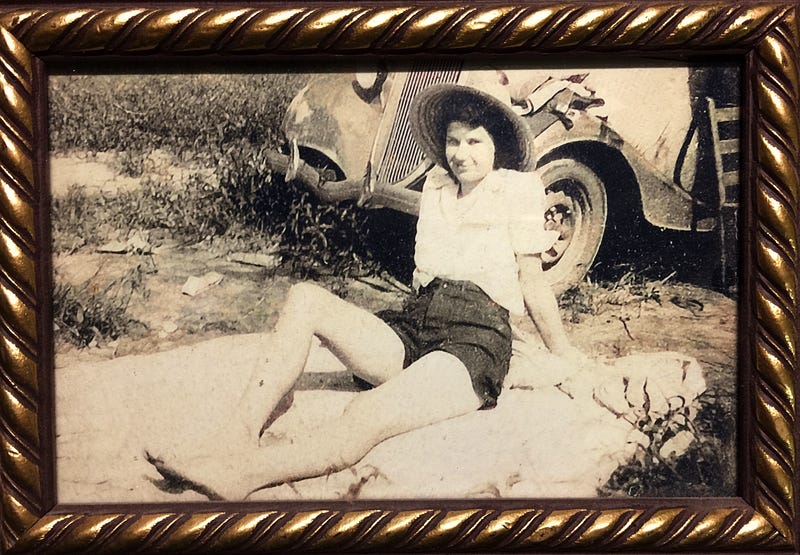
Years later I would discover old photographs, tucked away in albums and stashed hidden in a desk drawer, and in them my mother posed in high heels and dresses. It was hard for me to reconcile the woman she had become, the one who had to wash every grocery item before she stored it away in the pantry, with the smiling woman in the sepia tinted photos.
My mom eloped and got married at fifteen, worked as a cook on a farm cooperative, had seven children, and divorced my dad when I was thirteen. Back then I feared that I would become my mother. As though genetics would dictate I inherit not only her nose and her eyes, but her personality, her failings, her mental illness.
My mother
We drew on our cigarettes and stared out over the silent courtyard below. The lights from passing cars flashed along the stretch of dark highway that led back toward my hometown. I glanced over at my mother, dressed in her familiar pant suit as she stood beside me, the smoke from our cigarettes curling over our heads like wispy halos.
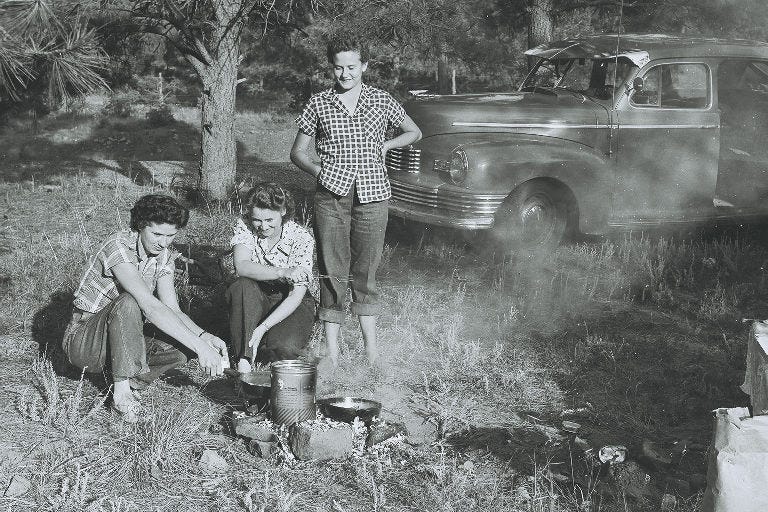
My mother on the far left, cooking over an open fire.
I cannot find my mother’s frying pan. The one she gave me before she moved into the nursing home, before she died, and after she stopped cooking for herself.
Her hands were rough, large and knotted with arthritis. They shook as she held out the frying pan. “You want this?” she asked as she picked up the heavy skillet from the inside of the oven where she stored her pots and pans. I took it because it was one of the few things in her apartment that didn’t smell like pine cleaner.
Other people hold on to things. They remember birthdays and anniversaries, and know exactly who inherited their grandmother’s silver. I misplace my scissors and the remote to the television but you would think something large and useful like a frying pan wouldn’t just float off out of sight.
My parents started their married life as farmworkers. My father drove a combine, and my mother cooked for the field hands in the 1930’s. She didn’t speak of it much. I am left to picture her aproned and bending to tend to a wood fired stove and stooping to wipe the sweat from her forehead with the back of her hand. After the farm job she cooked for her husband and children and then just for herself and me, the last in the line of seven offspring.
Her cast iron skillet had a surface polished mirror smooth and jet black from years of fried potatoes, scrambled eggs, pork chops, and scratch made pancakes with golden brown circles dotted with pale spots where the butter melted. I was in high school when my parents divorced and our meals changed to things barely recognizable as food.
My mom, with her eighth grade education, found work as a housekeeper. She spent long days cleaning and cooking for other people, so at home we had frozen pizzas, chili and soup from a can. Evenings we settled in front of the television and suffered through boil-in-bag meals, little plastic packets pulled from the freezer and dunked into boiling water to cook. We dumped the contents out and spooned up Chicken a la King or Salisbury steak over instant potatoes. The boil-in-bag meals had an unpleasant aftertaste, like you had licked a plastic bucket and decided to melt it and serve it for dinner.
Married with two children, I had a frying pan when my mother gave me hers. My cast iron skillet was new and not well seasoned, the surface still pitted with small imperfections.
I didn’t notice when my mother stopped eating. She didn’t trust food prepared by others. She quit attending holiday meals, refusing even the plates brought to her by family. She liked hamburgers from Wendy’s so I often picked up a burger and fries to drop off on my way home. I have worked in fast food restaurants, but I never mentioned that her meal had most likely been prepared by someone with tattoos and a nose ring.
The microwave confused her, and she never learned how to use the one in her apartment. On our weekly trips to the grocery store she bought whatever frozen meal she could cook in her toaster oven. I carried her groceries in and stood in the entryway while she took off her shoes. One by one she ferried the items to the kitchen counter where she washed each box and bottle in harsh cleaner before putting them away.
My mother’s mental illness went untreated for most of her life. The obsessive compulsive disorder that locked her into rituals of cleaning didn’t appear until most of my brothers and sisters had grown up and left her house. I guess it might have been worse for me, growing up in a home with easy to mop vinyl floors in every room. At least she wasn’t a hoarder. I had to strip my clothes off and toss them into the washer before I walked through the living room but I didn’t have to wonder if there was a dead cat hidden under the couch.
She lived alone, in an apartment complex for senior citizens. They had a concierge to carry off the trash, so I didn’t notice the empty peanut butter jars that stuffed the bags of garbage while unused dinners filled the freezer. She began phoning 911, certain she was having a heart attack. I made the twenty minute drive from my house, arriving in time to find her sitting up and flirting with the young, attractive emergency medical technicians. When I mentioned the dizziness and confusion to her doctor, he suggested that it might be caused by malnutrition.
My mother’s frying pan stayed stashed in the cupboard. I don’t remember packing it up when I moved out of our house after my divorce, but I must have. There’s a vague memory of giving it to one of my grown children, but when I asked they both could not remember anything about it.
“I have a skillet, but it’s not that old,” said one.
“I think I got mine at Goodwill,” the other replied to my text.
To properly season a new cast iron skillet you must first scrub it with hot, soapy water to remove the grime from manufacturing. You dry the pan, rub the surface with oil and bake it for one hour at 375 degrees. I wish I remembered what I did with my mother’s frying pan. If I made a gift of it, I wish I had given it with the ceremony and pomp it deserved. Perhaps then one of us would recollect where they’d last seen it. A seasoned cast iron skillet will last a lifetime, and heat and use will wear the surface smooth and brilliant and precious.
My first steady boyfriend drove a 1978 Chevrolet Monte Carlo Sport Coupe. The official name for the car’s color was Camel Brown, an unfortunate tag that suggests a lumpish, disagreeable animal. The license plate number was UAB711. I remember the license plate number because I spent most of the next summer, after we broke up, stalking him.
I met Mark through his best friend Johnny, who was dating my best friend, Ann. When he dressed up for a date Mark wore a velour pullover top, corduroy pants, and a splash of Jovan Musk. We started dating during my freshman year at Texas Woman’s University, where I found a strong fellowship of sisterhood but also a shortage of eligible young men.
Most of our dates we cruised around our home town in the Monte Carlo. Sometimes we would drive to Finch Park and make out in the parking lot in front of the Collin McKinney Cabin, a historical structure famous for hosting tours for elementary school children.
After we broke up, I still spent Saturday nights cruising the streets of McKinney, Texas, but I rode around with my best friend. Ann had a 1976 Datsun. It didn’t have a moon roof or wire spoke wheels, but it did have an eight track player, and I had a subscription to the Columbia House Tape of the Month Club.
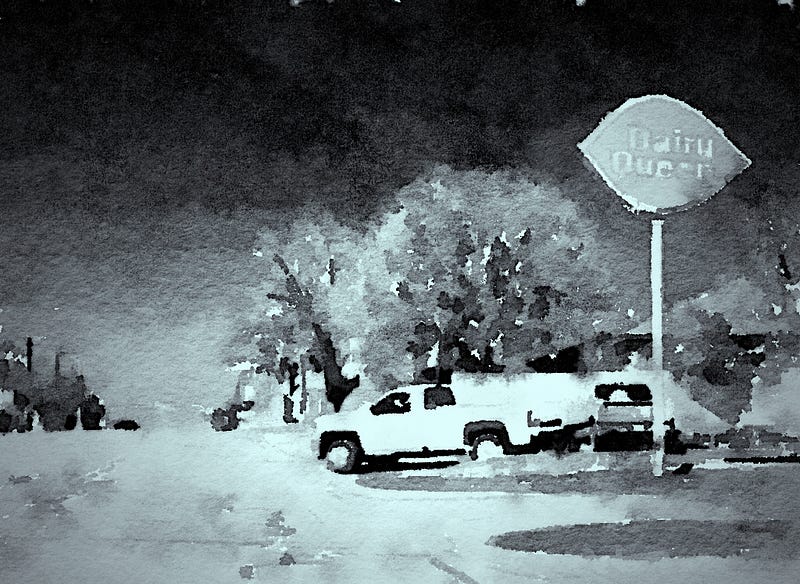
There was an energy crisis in 1979, but that didn’t stop us from filling up the tank in the Datsun and tossing a suitcase filled with eight tracks into the back seat. On a typical Saturday night we stopped at Dairy Queen for ice cream, popped some REO Speedwagon in the tape deck and drove around crying out loud to “Time for Me to Fly.” I would search the streets for Mark’s Monte Carlo. I could recognize those headlights in the dark, and I perfected the ability to look long enough to see if the plate number was his, but not so long that he could see I was looking at him.
One weekend, dizzy with unrequited love and reruns of Love Boat, I came up with an idea. “Hey”, I said to Ann, “What if we took the For Sale sign from the house next door and put it in front of a different house?” I went on to explain that this prank would be funny, easy to pull off, and most importantly, untraceable back to us, the perpetrators.
“Oh, wow! Sure! Let’s do it!” Ann was loyal and easily persuaded, which made her both the ideal best friend and perfect accomplice in petty crime.
We headed out in the Datsun, not the most inconspicuous car with its bright yellow paint job, but it had a hatch back, which made it easier to load up the signs. We circled the block, gathering up and replacing signs throughout the neighborhood. We placed the last one in front of the Collin McKinney Cabin.
The next several days I alternated between guilt and worry that our crime would be found out. I imagined a crowd of angry, bouffant haired real estate agents. But we remained undiscovered. The next weekend Ann called me. “Hey! Guess what! I talked to Johnny!” I considered this.
“Did he mention Mark?” I asked.
“Yeah, and guess what!” Ann paused to laugh into the phone. “He tried to buy the Collin McKinney Cabin! Isn’t that crazy?”
I realized that my former boyfriend would never forgive me for this practical joke, and the sign that our relationship was really over had come from Century 21.
The rest of that summer we spent as Ladies in Waiting as we leaned casually on the hoods of our cars and pretended that the heat from the car engine wasn’t searing the flesh from the back of our thighs. We drank Boones Farm Strawberry wine from plastic straws in Styrofoam cups and kept Visine and peppermint candies in the glove box. While the late summer sun set and the street lights flickered on, we kept watch from grocery store parking lots and drive in burger joints while Prince Charming rode by in pick up trucks or silver Mustangs, black Firebirds, and sometimes a Camel Brown Monte Carlo, license plate number UAB711.










 Let's Get Out of Here